Economy
Asian Stocks Fall on Disappointing Data from China, Japan
By Investors Hub
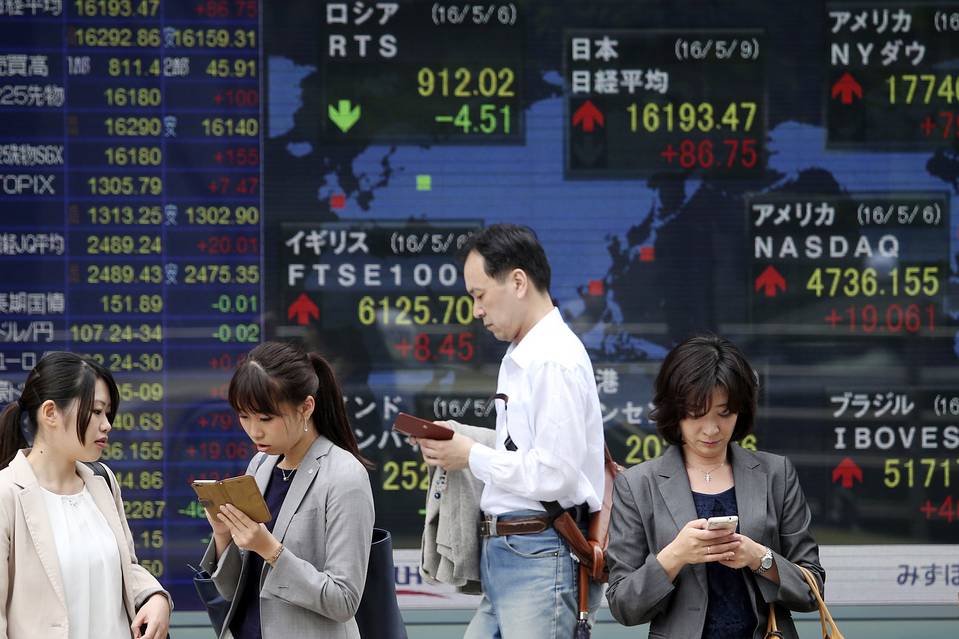
Asian stocks tumbled on Monday as weaker than expected U.S. jobs data for November as well as disappointing data from China and Japan raised fresh concerns over global growth.
Brexit-related uncertainty and rising tensions between the U.S. and China over the detention of tech company Huawei’s CFO Meng Wanzhou also dented investor sentiment.
Chinese shares fell as data on trade pointed to slower global demand. The benchmark Shanghai Composite Index dropped 21.31 points or 0.8 percent to 2,584.58, while Hong Kong’s Hang Seng Index ended down 311.38 points or 1.2 percent at 25,752.38.
China’s exports rose 5.4 percent in November from a year earlier, customs data showed on Saturday, marking the weakest performance since a 3 percent contraction in March. Import growth stood at 3 percent, the slowest since October 2016.
Separately, Chinese consumer inflation and producer price inflation eased in November, giving policymakers more room to loosen fiscal and monetary policies.
Japanese shares hit a six-week low on worries over fresh U.S.-China trade tensions after White House trade adviser Peter Navarro said the Trump administration would raise tariff rates on China if the two countries fail to resolve their issues during the 90-day truce period.
Data showing that the Japanese economy contracted the most in over four years in the third quarter also added to investor worries over slowing global growth. GDP shrank at an annualized rate of 2.5 percent in July-September, worse than an initial estimate of a 1.2 percent contraction, revised data showed.
The Nikkei 225 Index tumbled 459.18 points or 2.1 percent to close at 21,219.50, the lowest level since October 29th. The broader Topix index closed 1.9 percent lower at 1,589.81.
Machinery firms fell on concerns over Chinese demand. Fanuc dropped 1.9 percent, Hitachi Construction Machinery declined 4.1 percent and Komatsu slumped 5.2 percent.
Nissan Motor lost 2.9 percent after Tokyo prosecutors indicted the automaker along with its ousted Chairman Carlos Ghosn. Market heavyweight Fast Retailing shed 2.4 percent.
Japan Display plummeted 10.6 percent on a Nikkei report that it is cutting production of liquid crystal display panels for the iPhone XR.
Pioneer Corp plummeted 27.3 percent on news that private equity firm Baring Private Equity will buy the cash-strapped electronics firm for $900 million.
Australian markets hit two-year lows amid renewed worries about slowing global growth and U.S.-China trade tensions.
The benchmark S&P/ASX 200 Index plunged 129.00 points or 2.3 percent to 5,552.50, while the broader All Ordinaries Index slumped 130.40 points or 2.3 percent to 5,627.50.
The big four banks lost 3-4 percent, while mining heavyweights BHP and Rio Tinto ended mixed. Engineering service provider WorleyParsons plummeted 4.7 percent.
Meanwhile, Oil Search gained 0.6 percent and Santos advanced 1.4 percent as oil extended gains from Friday.
Gold miner Evolution rallied 2.5 percent and Newcrest Mining advanced 1.6 percent after gold prices rose to a nearly five-month high on Friday.
Economy
FrieslandCampina Wamco, Three Others Raise NASD OTC Exchange by 1.41%
By Adedapo Adesanya
The NASD Over-the-Counter (OTC) Securities Exchange closed higher by 1.41 per cent on Friday, May 15, supported by four securities on the platform.
During the session, FrieslandCampina Wamco Plc added N14.24 to its share price to sell for N159.00 per unit, in contrast to the previous day’s N144.76 per unit.
Further, Central Securities and Clearing System (CSCS) Plc appreciated by N1.34 to N72.34 per share from N71.00 per share, Geo-Fluids Plc improved its price by 4 Kobo to N2.94 per unit from N2.90 per unit, and Industrial and General Insurance (IGI) Plc gained 1 Kobo to trade at 61 Kobo per share compared with Thursday’s closing price of 60 Kobo per share.
As a result, the NASD Unlisted Security Index (NSI) rose by 58.20 points to 4,188.41 points from 4,130.21 points, and the market capitalisation soared by N34.82 billion to N2.506 trillion from N2.471 trillion on Thursday.
During the session, the volume of trades went up by 180.8 per cent to 1.2 million units from 417,349 units, and the value of transactions increased by 29.8 per cent to N29.8 million from N23.2 million, while the number of deals fell by 22.6 per cent to 24 deals from 31 deals.
Great Nigeria Insurance (GNI) Plc ended the day as the most traded stock by value on a year-to-date basis with 3.4 billion units sold for N8.4 billion, followed by CSCS Plc with 60.8 million units exchanged for N4.1 billion, and Okitipupa Plc with 27.9 million units valued at N1.9 billion.
GNI Plc also closed the session as the most traded stock by volume on a year-to-date basis with 3.4 billion units worth N8.4 billion, followed by Resourcery Plc with 1.1 billion units transacted for N415.7 million, and Infrastructure Guarantee Credit Plc with 400 million units traded for N1.2 billion.
Economy
Profit-taking Sinks Nigeria’s Equity Market by 0.76% as Bears Take Control
By Dipo Olowookere
The bears overpowered the Nigerian Exchange (NGX) Limited on Friday, sinking it further by 0.76 per cent when the closing gong was struck by 4 pm.
The nation’s flagship equity market was under selling pressure during the session, as investors booked profits after the shares witnessed price appreciation in the past trading sessions.
The energy sector was the most impacted, as it shed 4.43 per cent. The consumer goods index declined by 0.90 per cent, the banking counter decreased by 0.15 per cent, and the industrial goods sector lost 0.08 per cent, while the insurance counter gained 2.42 per cent, which was not enough to salvage the situation.
Consequently, the All-Share Index (ASI) contracted by 1,912.19 points to 250,330.92 points from 252,243.11 points, and the market capitalisation moderated by 1.225 trillion to N160.444 trillion from N161.669 trillion.
Zichis was the worst-performing stock for the session after it gave up 9.97 per cent to close at N29.43, FTN Cocoa slipped by 9.95 per cent to N8.96, The Initiates slumped by 9.90 per cent to N32.30, LivingTrust Mortgage Bank tumbled by 9.88 per cent to N3.83, and International Energy Insurance dropped 9.71 per cent to trade at N2.79.
The best-performing stock was ABC Transport, which grew by 10.00 per cent to N6.27. May and Baker also appreciated by 10.00 per cent to N47.30, SCOA Nigeria surged by 9.98 per cent to N33.05, Trans-Nationwide Express expanded by 9.97 per cent to N7.06, and DAAR Communications jumped 9.76 per cent to N2.25.
Yesterday, investors traded 1.1 billion shares worth N44.3 billion in 65,744 deals compared with the 1.0 billion shares valued at N41.6 billion transacted in 74,822 deals a day earlier. This indicated a dip in the number of deals by 12.13 per cent, and a rise in the trading volume and value by 10.00 per cent and 6.49 per cent, respectively.
Chams was the busiest equity for the day, with 328.5 million units sold for N1.1 billion. UBA traded 61.6 million units worth N2.7 billion, First Holdco transacted 58.7 million units valued at N4.2 billion, Secure Electronic Technology exchanged 51.9 million units worth N45.0 million, and Access Holdings traded 51.8 million units valued at N1.3 billion.
Economy
Naira Weakens to N1,371/$1 at Official Market
By Adedapo Adesanya
The last trading session of the week at the Nigerian Autonomous Foreign Exchange Market (NAFEX) ended on a negative note for the Naira on Friday, May 15, as it lost N15 Kobo or 0.1 per cent against the Dollar to trade at N1,371.04/$1 compared with the previous day’s N1,370.89/$1.
However, it further appreciated against the Pound Sterling in the same market segment yesterday by N20.77 to close at N1,830.61/£1 versus Thursday’s value of N1,851.38/£1, and gained N7.91 against the Euro to settle at N1,595.07/€1 versus N1,602.98/€1.
At the GTBank FX desk, the Naira lost N2 against the US Dollar during the session to sell at N1,383/$1 compared with the preceding session’s N1,381/$1, and at the black market, it remained unchanged at N1,385/$1.
The Naira is forecast to be broadly stable, supported by Dollar sales by the Central Bank of Nigeria (CBN) amid steady, higher oil receipts, with the market settling into a balance.
Policy direction is also expected to give the market some boost as the CBN said the new edition of the FX market guidelines will deepen liquidity, improve transparency and strengthen confidence in the country’s foreign exchange market.
According to the Governor of the CBN, Mr Yemi Cardoso, the update is due to changing global economic realities, domestic reforms and the need for a more coherent and forward-looking regulatory framework. According to him, the last edition of the FX manual was issued in 2018, making the latest review both timely and necessary.
Meanwhile, the cryptocurrency market plunged into the red zone as rising bond yields hit risk assets across markets, while traders are increasingly betting the Federal Reserve may need to raise rates again. Rising energy prices and resurging inflation could force central banks back into tightening mode.
Cardano (ADA) shrank by 4.4 per cent to $0.2557, Dogecoin (DOGE) slid by 3.7 per cent to $0.1104, Ripple (XRP) depreciated by 3.5 per cent to $1.41, Solana (SOL) crashed by 3.5 per cent to $87.81, and Binance Coin (BNB) slumped by 3.4 per cent to $659.64.
Further, Bitcoin (BTC) declined by 2.6 per cent to $78,547.49, Ethereum (ETH) lost 2.1 per cent to quote at $2,209.19, and TRON (TRX) tumbled by 0.7 per cent to $0.3509, while the US Dollar Tether (USDT) and the US Dollar Coin (USDC) traded flat at $1.00 each.
-
Feature/OPED6 years agoDavos was Different this year
-
Travel/Tourism10 years ago
Lagos Seals Western Lodge Hotel In Ikorodu
-
Showbiz3 years agoEstranged Lover Releases Videos of Empress Njamah Bathing
-
Banking8 years agoSort Codes of GTBank Branches in Nigeria
-
Economy3 years agoSubsidy Removal: CNG at N130 Per Litre Cheaper Than Petrol—IPMAN
-
Banking3 years agoSort Codes of UBA Branches in Nigeria
-
Banking3 years agoFirst Bank Announces Planned Downtime
-
Sports3 years agoHighest Paid Nigerian Footballer – How Much Do Nigerian Footballers Earn