Connect with us

Feature/OPED

Alhaji Ibrahim Chatta: Exit of a Monarch with a Sense of Obligation

Published

on

By Yusuf An-Nuphawi

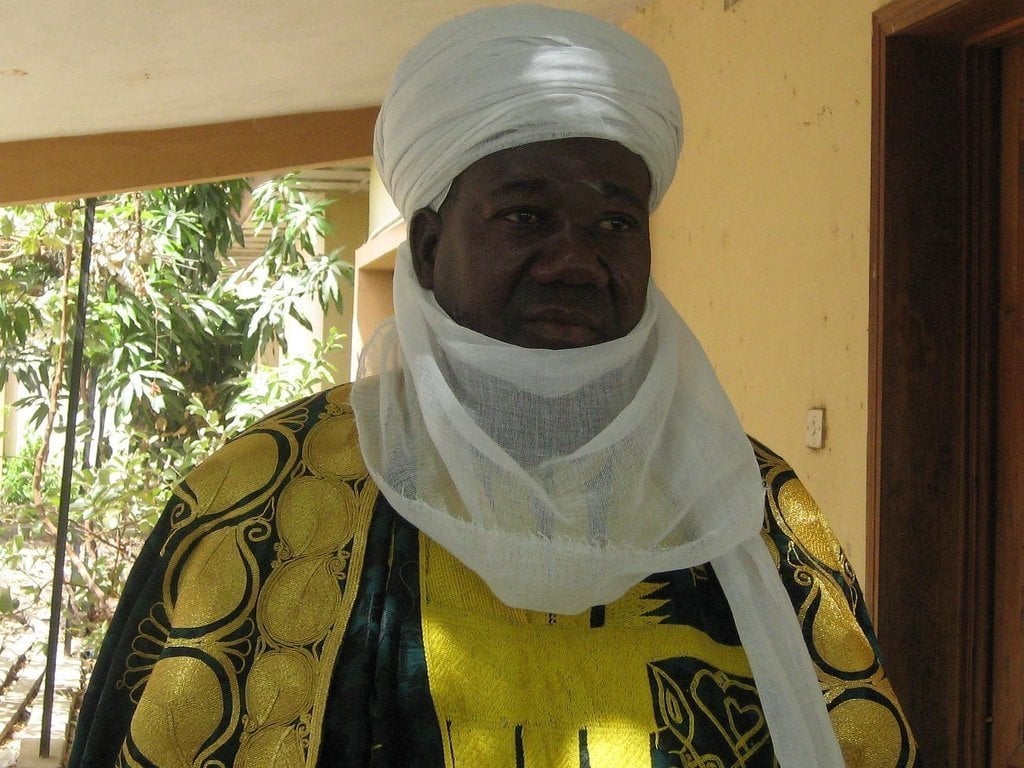
The legendary Patigi Emirate in Kwara State was shaken to its marrow on Tuesday 19th February, 2019, with the irreparable demise of Alhaji Ibrahim Chatta Umar, the Etsu Patigi and Vice Chairman of Kwara State Council of Traditional Rulers. The late Umar was a celebrated king in every sense of the word.

It is with indescribable joy, gratitude and feeling of fulfilment, I vividly recall my maiden encounter with the king. And indeed, his personality was endeared to me right from the get go. The late Umar, a consummate traditional leader, was the first person to compellingly educate me on the virtue of formal education and why I must go to school.

Another distinct personae of the departed Emir is selflessness. He was a king with a great sense of obligation to his immediate society, Patigi Emirate and Kwara State, by extension. This much, he has demonstrated, since he became Etsu in 1999.

It is an open secret that Patigi was still crawling, trying to catch up with civilization and modernization when he was appointed and subsequently coronated exactly two decades ago. Nonetheless, as a new Emir then, he used his powerful social networks to rescue his home land from the clutches of socioeconomic underdevelopment, occasioned by high level of illiteracy, dehumanizing poverty, hopelessness and lack of clear understanding of human capital development as a bedrock of development.

Perhaps due to his uncommon compassion for the poor and less privileged in the society, Etsu Umar, was a monarch with an extraordinary knack for philanthropy. Afraid of sounding hyperbolic, I dare say that even his cynics would have been confounded by the late revered Etsu’s spirit of generosity, which was obviously unparalleled.

Alhaji Umar, more than anything, abundantly provided opportunity for his teeming subjects to become successful in life. It is a naked reality that since he ascended the exalted throne of his illustrious predecessors, the narrative of Patigi changed. Under his reign as a purposeful Etsu Patigi, the emirate has tremendously experienced a drastic socioeconomic metamorphoses, with rising number of university graduates, increasing number of the citizens owning lucrative business ventures and other valuable assets, to mention a few. These, among others, are the vital metrics for evaluating the wellbeing of a people.

As a child, I was greatly fascinated by the captivating spectacle of royal procession, especially during festive celebrations, when the late Etsu and his entourage rode on gorgeously-decorated horses to salute his subjects. Two decades back, the imposing palace of the departed Etsu was still a Mecca I must visit every day. Except for school hours, if you cannot find me at home during my primary school years, I am at the stable (where horses are kept) in the palace.

An event that has permanently stuck in my mind occurred in one bright morning of late 90s. I went to the palace to catch a glimpse of newly-added stock of horses. It was at a time my school had declared a mid-term break. Fortunately, Alhaji Umar was at the stable to inspect the new arrivals. There, I had a one-on-one encounter with him for the first time. Initially, I was quite timid meeting the highest traditional authority of Patigi land, whom our parents somewhat deify and subconsciously consider as next-to-God. Upon sighting me, he frowned, asking in a husky voice, “Young man, what are you doing in the palace during school hours?” I was terrified. But I eventually mustered courage, and told him that my school was on break.

My experience exemplifies the late Etsu’s unadulterated passion to see every child in the land educated. A friend of mine, who the departed Patigi Emir sponsored his education, had told me in a recent informal discussion that Baba’s financial responsibilities were growing exponentially. He said many students in various tertiary institutions across the country are presently beneficiaries of scholarship awards from Baba. Among several other things, the sterling moral and exemplary leadership traits possessed by the Alhaji Umar stood him out among his contemporaries. In him, everybody who crossed his path saw a foremost traditional leader per excellence. A leader whose accomplishments are indelible, remarkable and groundbreaking. The entire people of Patigi, Kwara State and Nigeria, will for a long time mourn his painful exit. But striving to lead a selfless, devoted and humble life, while upholding some of the lofty ideals he stood and fought for during his lifetime, are the most precious gifts we can offer the immortal memory of the iconic Alhaji Ibrahim Chatta Umar.

May his virtues challenge us all to leave the world better than we found it.

Yusuf An-Nuphawi is a Corporate Communication Executive at Jaiz Takaful Insurance Plc. He is an indigene of Patigi, Patigi Local Government Area of Kwara State and can be reached via [email protected]

Modupe Gbadeyanka is a fast-rising journalist with Business Post Nigeria. Her passion for journalism is amazing. She is willing to learn more with a view to becoming one of the best pen-pushers in Nigeria. Her role models are the duo of CNN's Richard Quest and Christiane Amanpour.

Advertisement
Click to comment

Leave a Reply

Your email address will not be published. Required fields are marked *

Feature/OPED

Energy Transition: Will Nigeria Go Green Only To Go Broke?

Published

on

energy transition plan

By Isah Kamisu Madachi

Nigeria has been preparing for a sustainable future beyond oil for years. At COP26 in the UK, the country announced its commitment to carbon neutrality by 2060. Shortly after the event, the Energy Transition Plan (ETP) was unveiled, the Climate Change Act 2021 was passed and signed into law, and an Energy Transition Office was created for the implementations. These were impressive efforts, and they truly speak highly of the seriousness of the federal government. However, beyond climate change stress, there’s an angle to look at this issue, because in practice, an important question in this conversation that needs to be answered is: how exactly will Nigeria’s economy be when oil finally stops paying the bills?

For decades, oil has been the backbone of public finance in Nigeria. It funds budgets, stabilises foreign exchange, supports states through monthly FAAC allocations, and quietly props up the naira. Even when production falls or prices fluctuate, the optimism has always been that oil will somehow carry Nigeria through the storms. It is even boldly acknowledged in the available policy document of the energy transition plan that global fossil fuel demand will decline. But it does not fully confront what that decline means for a country of roughly 230 million people whose economy is still largely structured around oil dollars.

Energy transition is often discussed from the angle of the emissions issue alone. However, for Nigeria, it is first an economic survival issue. Evidence already confirms that oil now contributes less to GDP than it used to, but it remains central to government revenue and foreign exchange earnings. When oil revenues drop, the effects are felt in budget shortfalls, rising debt, currency pressure, and inflation. Nigerians experienced this reality during periods of oil price crashes, from 2014 to the pandemic shock.

The Energy Transition Plan promises to lift 100 million Nigerians out of poverty, expand energy access, preserve jobs, and lead a fair transition in Africa. These are necessary goals for a future beyond fossil fuels. But this bold ambition alone does not replace revenue. If oil earnings shrink faster than alternative sources grow, the transition risks deepening fiscal stress rather than easing it. Without a clear post-oil revenue strategy tied directly to the transition, Nigeria may end up cleaner with the net-zero goals achieved, but poorer.

Jobs need to be considered, too. The plan recognises that employment in the oil sector will decline over time. What should be taken into consideration is where large-scale employment will come from. Renewable energy, of course, creates jobs, but not automatically, and not at the scale oil-related value chains once supported, unless deliberately designed to do so. Solar panels assembled abroad and imported into Nigeria will hardly replace lost oil jobs. Local manufacturing, large-scale skills development, and industrial policy are what make the difference, yet these remain weak links in Nigeria’s transition conversation.

The same problem is glaringly present in public finance. States that depend heavily on oil-derived allocations are already struggling to pay salaries, though with improvement after fuel subsidy removal. A future with less oil revenue will only worsen this unless states are supported to proactively build formidably productive local economies. Energy transition, if disconnected from economic diversification, could unintentionally widen inequality between regions and states and also exacerbate dependence on internal and external borrowing.

There is also the foreign exchange question. Oil export is still Nigeria’s main source of dollars. As global demand shifts and revenues decline, pressure on the naira will likely intensify unless non-oil exports rise in a dramatically meaningful way. However, Nigeria’s non-oil export base remains very narrow. Agriculture, solid minerals, manufacturing, and services are often mentioned, but rarely aligned with the Energy Transition Plan in a concrete and measurable way.

The core issue here is not about Nigeria wanting to transition, but that it wants to transition without rethinking how the economy earns, spends, and survives. Clean energy will not automatically fix public finance, stabilise the currency, or replace lost oil income and jobs. Those outcomes require deliberate and strategic economic choices that go beyond power generation and meeting emissions targets. Otherwise, the country will be walking into a future where oil is no longer dependable, yet nothing else has been built strongly enough to pay the bills as oil did.

Isah Kamisu Madachi is a policy analyst and development practitioner. He writes from Abuja and can be reached via [email protected]

Continue Reading

Feature/OPED

Why Access Champions Africa’s Biggest Race

Published

on

roosevelt ogbonna access bank

On a particular Saturday each February, before dawn breaks over Lagos and thousands of participants prepare for the event, the city is filled with an unmistakable sense of anticipation. Roads typically bustling with traffic become thoroughfares devoted to new possibilities. Whether it is first-time runners adjusting their bibs or elite athletes focusing on the challenge ahead, a recurring question arises in both public discourse and executive meetings: What motivates Access to consistently support Africa’s largest road race year after year?

The response does not lie merely within sponsorship objectives or marketing strategies. Rather, it emanates from a philosophy of leadership, one that recognises institutions as interconnected with society, measuring true success by purpose, people, and enduring social impact, not solely by financial outcomes.

For Access, the Lagos City Marathon is a statement of belief in Africa’s potential, a commitment to collective progress, and a powerful reflection of the values that guide how we build businesses and engage with communities across the continent.

Marathon as Metaphor for Africa’s Journey

A marathon is not won in the first kilometre. It demands patience, resilience, discipline, and an unshakable belief in the finish line, even when it feels impossibly far away. These qualities mirror Africa’s own development journey and the realities of building enduring institutions on the continent.

Access sees the marathon as a living metaphor for what it takes to create sustainable impact. Growth is rarely linear. Progress often comes with setbacks. But those who stay the course, who invest consistently, and who keep moving forward ultimately create lasting change. This philosophy shapes how we approach banking, partnerships, innovation, and leadership.

Supporting Africa’s biggest road race is therefore not incidental. It reinforces the idea that success, whether personal, corporate, or national, is built through long-term commitment rather than short-term wins.

People at the Centre of Progress

What makes the Lagos City Marathon truly special is its inclusivity. On race day, the streets belong to everyone: professionals running for personal bests, young people discovering the joy of movement, families cheering from the sidelines, and communities coming together in shared celebration.

This diversity reflects Access’s people-first philosophy, believing that progress is most powerful when it is inclusive, when platforms are designed to welcome participation rather than privilege exclusivity. By championing the marathon, we invest in a space where people from all walks of life are united by a common goal: to push beyond perceived limits.

Leadership Beyond Profit

Today’s business environment demands more from corporate leaders. Stakeholders increasingly expect institutions to contribute meaningfully to society, not as an afterthought, but as an integral part of strategy. Access embraces this responsibility.

Championing the Lagos City Marathon is one of the ways leadership is projected from Access. It is an opportunity to demonstrate what values-driven leadership looks like in action. The race promotes physical and mental wellness, encourages healthy lifestyles, and reinforces the importance of balance,lessons that are as relevant in the workplace as they are on the road.

More importantly, it shows that leadership is not about standing apart from society, but about standing with it. Running alongside communities. Investing in shared experiences. Creating platforms that inspire confidence and ambition, especially for young Africans who are redefining what is possible.

Economic and Social Impact That Lasts

The impact of the marathon extends far beyond race day. Each edition generates economic activity across multiple sectors, hospitality, transportation, logistics, retail, media, and tourism. Small businesses thrive, jobs are created, and local vendors benefit from increased footfall.

By attracting international runners and visitors, the marathon positions Lagos as a global destination capable of hosting world-class events. It challenges outdated narratives and showcases Nigeria’s ability to deliver excellence at scale. This visibility matters, not just for the city, but for the continent.

Building a Legacy of Inspiration

Perhaps the most enduring value of the marathon lies in inspiration. For many runners, crossing the finish line is a personal victory, proof that they can commit, endure, and succeed. For spectators, it is a powerful reminder of human potential and collective spirit.

These moments matter. They shape mindsets. They encourage people to set bigger goals, whether in health, career, or community. They reinforce the belief that with the right support and determination, progress is possible.

Access champions this race because of the belief that Africa deserves platforms that inspire millions to move, dream, and achieve more.

Leading the Long Race Together

Leadership, like a marathon, is not a sprint. It requires vision, endurance, and the willingness to keep going even when results are not immediate. Access is committed to running this long race with Africa, investing in people, institutions, and platforms that drive sustainable growth.

As runners take their marks every February, we are reminded that progress is built one step at a time. By championing Africa’s biggest road race, Access shows its belief in collective effort, long-term impact, and the power of leadership that moves with society, not ahead of it, and never apart from it.Because when Africa runs, we all move forward.

Continue Reading

Feature/OPED

Why Nigeria’s Banks Still on Shaky Ground with Big Profits, Weak Capital

Published

on

Nigeria’s Banks Still on Shaky Ground

By Blaise Udunze

Despite the fragile 2024 economy grappling with inflation, currency volatility, and weak growth, Nigeria’s banking industry was widely portrayed as successful and strong amid triumphal headlines. The figures appeared to signal strength, resilience, and superior management as the Tier-1 banks such as Access Bank, Zenith Bank, GTBank, UBA, and First Bank of Nigeria, collectively reported profits approaching, and in some cases exceeding, N1 trillion. Surprisingly, a year later, these same banks touted as sound and solid are locked in a frenetic race to the capital markets, issuing rights offers and public placements back-to-back to meet the Central Bank of Nigeria’s N500 billion recapitalisation thresholds.

The contradiction is glaring. If Nigeria’s biggest banks are so profitable, why are they unable to internally fund their new capital requirements? Why have no fewer than 27 banks tapped the capital market in quick succession despite repeated assurances of balance-sheet robustness? And more fundamentally, what do these record profits actually say about the real health of the banking system?

The recapitalisation directive announced by the CBN in 2024 was ambitious by design. Banks with international licences were required to raise minimum capital to N500 billion by March 2026, while national and regional banks faced lower but still substantial thresholds ranging from N200 billion to N50 billion, respectively. Looking at the policy, it was sold as a modern reform meant to make banks stronger, more resilient in tough times, and better able to support major long-term economic development.  In theory, strong banks should welcome such reforms. In practice, the scramble that followed has exposed uncomfortable truths about the structure of bank profitability in Nigeria.

At the heart of the inconsistency is a fundamental misunderstanding often encouraged by the banks themselves between profits and capital. Unknown to many, profitability, no matter how impressive, does not automatically translate into regulatory capital. Primarily, the CBN’s recapitalisation framework actually focuses on money paid in by shareholders when buying shares, fresh equity injected by investors over retained earnings or profits that exist mainly on paper.

This distinction matters because much of the profit surge recorded in 2024 and early 2025 was neither cash-generative nor sustainably repeatable. A significant portion of those headline banks’ profits reported actually came from foreign exchange revaluation gains following the sharp fall of the naira after exchange-rate unification. The industry witnessed that banks’ holding dollar-denominated assets their books showed bigger numbers as their balance sheets swell in naira terms, creating enormous paper profits without a corresponding improvement in underlying operational strength. These gains inflated income statements but did little to strengthen core capital, especially after the CBN barred banks from using FX revaluation gains for dividends or routine operations. In effect, banks looked richer without becoming stronger.

Beyond FX effects, Nigerian banks have increasingly relied on non-interest income fees, charges, and transaction levies to drive profitability. While this model is lucrative, it does not necessarily deepen financial intermediation or expand productive lending. High profits built on customer charges rather than loan growth offer limited support for long-term balance-sheet expansion. They also leave banks vulnerable when macroeconomic conditions shift, as is now happening.

Indeed, the recapitalisation exercise coincides with a turning point in the monetary cycle. The extraordinary conditions that supported bank earnings in 2024 and 2025 are beginning to unwind. Analysts now warn that Nigerian banks are approaching earnings reset, as net interest margins the backbone of traditional banking profitability, come under sustained pressure.

Renaissance Capital, in a January note, projects that major banks including Zenith, GTCO, Access Holdings, and UBA will struggle to deliver earnings growth in 2026 comparable to recent performance.

In a real sense, the CBN is expected to lower interest rates by 400 to 500 basis points because inflation is slowing down, and this means that banks will earn less on loans and government bonds, but they may not be able to quickly lower the interest they pay on deposits or other debts. The cash reserve requirements are still elevated, which does not earn interest; banks can’t easily increase or expand lending investments to make up for lower returns. The implications are significant. Net interest margin, the difference between what banks earn on loans and investments and what they pay on deposits, is poised to contract. Deposit competition is intensifying as lenders fight to shore up liquidity ahead of recapitalisation deadlines, pushing up funding costs. At the same time, yields on treasury bills and bonds, long a safe and lucrative haven for banks are expected to soften in a lower-rate environment. The result is a narrowing profit cushion just as banks are being asked to carry far larger equity bases.

Compounding this challenge is the fading of FX revaluation windfalls. With the naira relatively more stable in early 2026, the non-cash gains that once flattered bank earnings have largely evaporated. What remains is the less glamorous reality of core banking operations: credit risk management, cost efficiency, and genuine loan growth in a sluggish economy. In this new environment, maintaining headline profits will be far harder, even before accounting for the dilutive impact of recapitalisation.

That dilution is another underappreciated consequence of the capital rush. Massive share issuances mean that even if banks manage to sustain absolute profit levels, earnings per share and return on equity are likely to decline. Zenith, Access, UBA, and others are dramatically increasing their share counts. The same earnings pie is now being divided among many more shareholders, making individual returns leaner than during the pre-recapitalisation boom. For investors, the optics of strong profits may soon give way to the reality of weaker per-share performance.

Yet banks have pressed ahead, not only out of regulatory necessity but also strategic calculation.

During this period of recapitalization, investors are interested in the stock market with optimism, especially about bank shares, as banks are raising fresh capital, and this makes it easier to attract investments. This has become a season for the management teams to seize the moment to raise funds at relatively attractive valuations, strengthen ownership positions, and position themselves for post-recapitalisation dominance. In several cases, major shareholders and insiders have increased their stakes, as projected in the media, signalling confidence in long-term prospects even as near-term returns face pressure.

There is also a broader structural ambition at play. Well-capitalised banks can take on larger single obligor exposures, finance infrastructure projects, expand regionally, and compete more credibly with pan-African and global peers. From this perspective, recapitalisation is not merely about compliance but about reshaping the competitive hierarchy of Nigerian banking. What will be witnessed in the industry is that those who succeed will emerge larger, fewer, and more powerful. Those that fail will be forced into consolidation, retreat, or irrelevance.

For the wider economy, the outcome is ambiguous. Stronger banks with deeper capital buffers could improve systemic stability and enhance Nigeria’s ability to fund long-term development. The point is that while merging or consolidating banks may make them safer, it can also harm the market and the economy because it will reduce competition, let a few banks dominate, and encourage them to earn easy money from bonds and fees instead of funding real businesses. The truth be told, injecting more capital into the banks without complementary reforms in credit infrastructure, risk-sharing mechanisms, and fiscal discipline, isn’t enough as the aforementioned reforms are also needed.

The rush as exposed in this period, is that the moment Nigerian banks started raising new capital, the glaring reality behind their reported profits became clearer, that profits weren’t purely from good management, while the financial industry is not as sound and strong as its headline figures. The fact that trillion-naira profit banks must return repeatedly to shareholders for fresh capital is not a sign of excess strength, but of structural imbalance.

With the deadline for banks to raise new capital coming soon, by 31 March 2026, the focus has shifted from just raising N500 billion. N200 billion or N50 billion to think about the future shape and quality of Nigeria’s financial industry, or what it will actually look like afterward. Will recapitalisation mark a turning point toward deeper intermediation, lower dependence on speculative gains, and stronger support for economic growth? Or will it simply reset the numbers while leaving underlying incentives unchanged?

The answer will define the next chapter of Nigerian banking long after the capital market roadshows have ended and the profit headlines have faded.

Blaise, a journalist and PR professional, writes from Lagos and can be reached via: [email protected]

Continue Reading

Trending