Connect with us

General

Kwara Govt Explains Truck Deliveries to Government House

Published

on

By Modupe Gbadeyanka

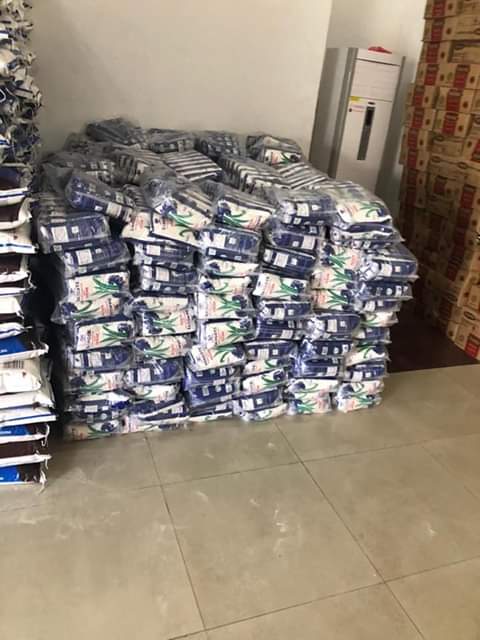
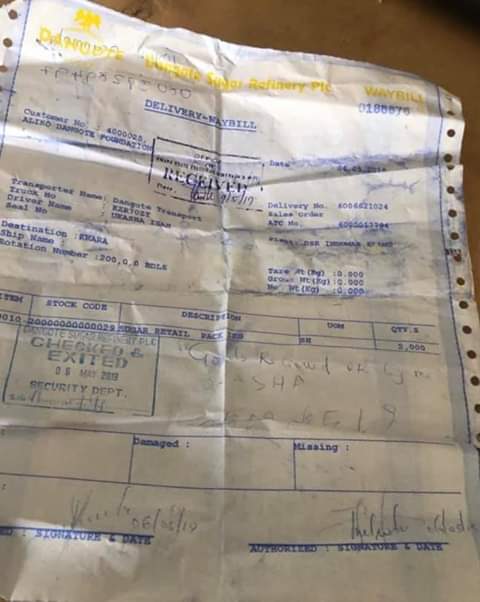
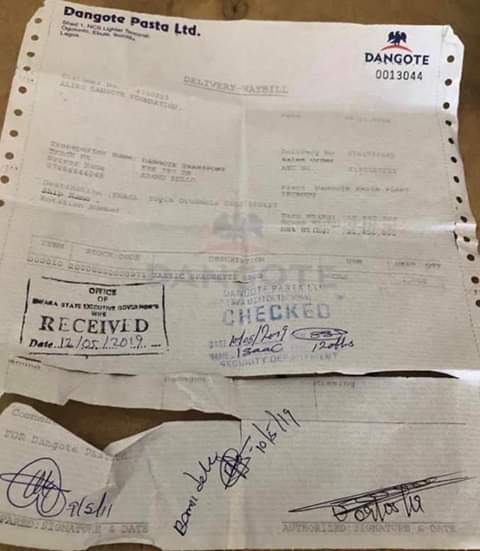
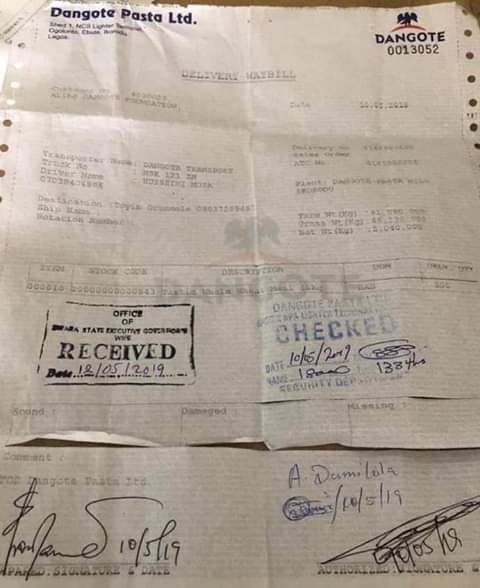
Additional facts have emerged on how Dangote Industries trucks delivered food items to the Kwara State Government House on May 9th, 10th, 12th and 18th, 2019 as part of annual support by Dangote Foundation for state government efforts to provide food for the needy during the Holy Month of Ramadan.

Details of the deliveries including correspondence between the Dangote Foundation and Kwara State Governor, Alhaji Abdulfatah Ahmed, on the delivery of the food items, were made available by his Senior Special Assistant on Media and Communication, Dr. Muyideen Akorede on Monday.

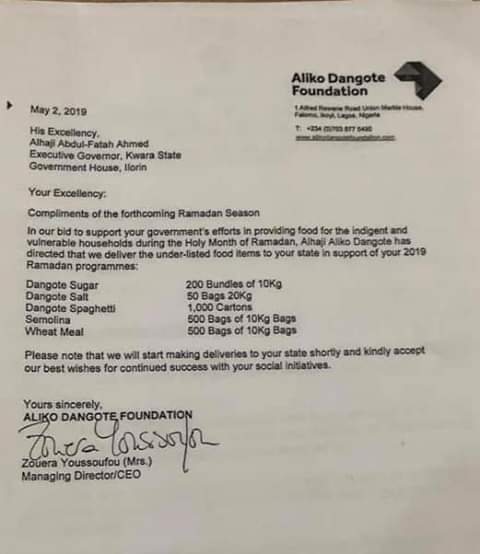
In a letter written to the Kwara State Governor, Alhaji Abdulfatah Ahmed on May 2, 2019 and signed by the Managing Director, Aliko Dangote Foundation, Mrs. Zouera Youssoufou, the foundation informed Governor Ahmed that philanthropist, Alhaji Aliko Dangote had directed the delivery of food items in support of the government’s 2019 Ramadan programs.

The Foundation’s letter to the state governor read in part, “In our bid to support your government’s efforts in providing foods for the indigent and vulnerable households during the Holy Month of Ramadan, Alhaji Aliko Dangote has directed that we deliver the under-listed food items to your state in support of your 2019 Ramadan Programmes”.

“Dangote Sugar……..200 Bundles of 10kg
Dangote Salt………..50 bags of 20kg
Dangote Spaghetti… 1,000 cartons
Semolina ……………500 Bags of 10kg bags
Wheat Meal……….500 Bags of 10kg Bags”.

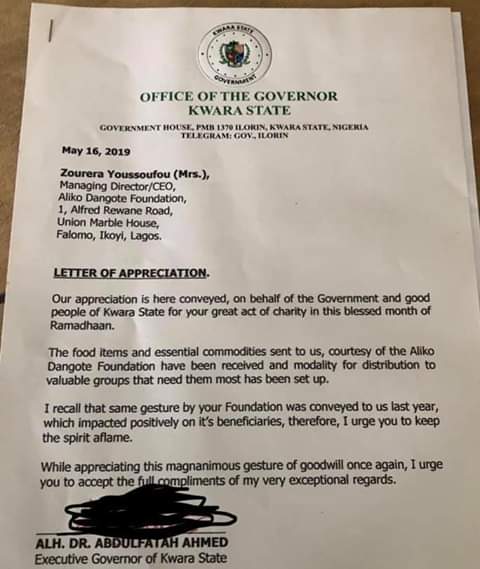
The State Governor, Mr Abdulfatah Ahmed, in his response dated May 16, 2019, confirmed the receipt of the food items and appreciated the foundation on behalf of the people of the state, saying that the process of distributing the items to the needy had been mapped out.

”I recall that same gesture by your foundation was conveyed to us last year, which impacted positively on its beneficiaries. Therefore, I urge you to keep the spirit aflame”, said the Governor.

Providing further clarification, Mr Akorede confirmed the items were delivered to Government House, Ilorin on the above-listed dates by Dangote Industries trucks carrying different food items on separate days as part of general deliveries by the company.

Mr Akorede said following the individual deliveries, the trucks left Government House with the rest of their consignment to other destinations unknown to the state government.

He said the donated items are distributed by the state government through Muslim groups and stakeholders across the 193 wards in the state every year.

The statement reiterated that in keeping with the due process, an inventory of government properties located in every office and building in Government House has been compiled and kept in respective offices including the Store Department and the Government Asset Management Unit. It, therefore, urged the public to disregard the attempt to misrepresent an obviously well-intentioned charity effort by a private individual as wrongdoing by the administration or any of its officials.
Modupe Gbadeyanka is a fast-rising journalist with Business Post Nigeria. Her passion for journalism is amazing. She is willing to learn more with a view to becoming one of the best pen-pushers in Nigeria. Her role models are the duo of CNN's Richard Quest and Christiane Amanpour.

Click to comment

Leave a Reply

Your email address will not be published. Required fields are marked *

General

FCCPC Seals Premises of Solar Battery Importer at Alaba International Market

Published

on

Solar Battery Importer

By Adedapo Adesanya

The Federal Competition and Consumer Protection Commission (FCCPC) has sealed the premises of a major importer at the Alaba International Market, Lagos, over its alleged refusal to comply with regulatory directives relating to the sale of a defective solar battery to customers.

The Southwest Zonal Coordinator of the FCCPC, Mrs Olubunmi Otti, who led the enforcement team and security operatives to the market on Tuesday, said the commission sealed the company’s premises under Section 150(4)(a) of the Federal Competition and Consumer Protection Act (FCCPA), 2018.

According to her, the action followed the company’s failure to comply with a compliance notice issued by the agency after an investigation into a consumer complaint.

Mrs Otti explained that the matter originated from a complaint involving a defective solar battery purchased and fully paid for in February 2025.

Following the complaint, she said the organisation commenced an investigation and invited the importer and the company on several occasions to appear before the commission, but they allegedly failed to honour the invitations.

She further stated that the FCCPC subsequently issued a summons compelling the importer and the company to appear, but they again failed to comply.

As part of its regulatory process, Mrs Otti said the commission later served the company with a Compliance Notice under Section 150(1) of the FCCPA, outlining the nature of the alleged violation, the remedial actions required, the deadline for compliance, and the consequences of non-compliance.

She noted that despite being duly served and granted what the commission described as a reasonable period to remedy the breach, the importer and the company allegedly failed to comply with the notice.

“Consequently, and in direct exercise of FCCPC powers under Section 150(4)(a) of the FCCPA, 2018, the Commission has today proceeded to seal these premises,” she said.

Mrs Otti explained that the law empowers the commission to shut down or close any premises where a compliance notice continues to be breached until the violation is remedied.

She emphasised that the action was not intended as a punitive measure but rather as a protective and corrective intervention aimed at ensuring compliance with consumer protection laws.

According to her, the premises will remain sealed until the commission is satisfied that the breach has been fully addressed, after which a compliance certificate will be issued in accordance with Section 150(3) of the Act.

Otti urged importers and businesses to take compliance notices seriously, warning that the law leaves little room for discretion where violations persist after regulatory directives have been ignored.

Reacting to the enforcement action, President of the Industrial Material Dealers Association, Alaba International Market, Mr Opara Martins, said officials of the commission visited his office before carrying out the enforcement exercise, which he advised them to proceed with in line with their lawful duties.

He said while he was unaware of the specific circumstances that led to the commission’s action, he could not fault the agency for carrying out its statutory responsibilities.

Mr Martins, however, described the company as reputable, adding that the importer is a key stakeholder within the Alaba business community.

He further stated that the market had not been known for practices that undermine consumer protection.

He expressed optimism that the dispute would be resolved amicably in due course.

On his part, the General Manager of the firm, Mr Tochukwu Munachukwu, insisted the company did not receive the series of letters and notices the FCCPC claimed to have served.

He described the dispute as a civil commercial matter that should be resolved through engagement and dialogue rather than public enforcement action, noting that the incident has caused embarrassment to both the company and its management.

Continue Reading

General

Dangote Cement Host Communities in Ogun Receive Rice

Published

on

Dangote cement host communities

By Modupe Gbadeyanka

Some vulnerable households around host communities of Dangote Cement Plc in Ogun State recently received bags of rice from the Aliko Dangote Foundation (ADF) to alleviate the burden of rising food costs on them.

Beneficiaries were mainly low-income families, elderly residents, and other vulnerable groups within 17 communities in Ibese and 36 others in Itori and Ijebu-Igbo.

The organisation distributed thousands of 10kg bags of rice to residents of the communities, who could not hide their joy at the gesture.

At several distribution points, orderly processes were put in place to ensure transparency and equitable access. Local coordinators, in collaboration with community representatives, supervised the exercise to guarantee that the items reached intended beneficiaries.

At the Ibese distribution centre, the Aboro of Ibeseland, Mr Rotimi Oluseyi Mulero, thanked Mr Dangote for the gift, describing the rice distribution as operation feed the families.

“On behalf of our people, I extend our profound gratitude to the Aliko Dangote Foundation for this timely and commendable gesture. At a time when many families are facing economic challenges, this distribution of food items will go a long way in alleviating hardship within our communities.

“We appreciate Dangote Group not only as a business partner but as a responsible corporate citizen that continues to demonstrate genuine concern for the well-being of its host communities. We pray that this partnership continues to flourish for the benefit of all.

“Today, our hearts are filled with appreciation. This support has come at a very critical time for our people. Many households are under pressure, and this intervention will bring relief and hope to families,” the traditional ruler enthused.

Also, at Itori, the Olu of Itori, Mr Abdulfatai Akorede Akamo, said his people’s hearts were filled with appreciation, saying, “This support has come at a very critical time for our people. Many households are under pressure, and this intervention will bring relief and hope to families.

“We thank Mr Aliko Dangote and his Foundation for remembering the grassroots and standing by us in times of need. We are deeply grateful for this act of kindness. May the Almighty bless the Dangote Group and increase its capacity to continue doing good for humanity.”

Speaking on the initiative, the chief executive of ADF, Ms Zouera Youssoufou, represented by the ADF Head of Operations, Mr Victor Ejiro, reaffirmed that the food intervention programme reflects the organisation’s long-standing dedication to food security and poverty alleviation, particularly during periods of economic strain.

“This intervention is designed to provide immediate relief to households grappling with high food prices. As a socially responsible organisation, we recognise the importance of supporting our host communities beyond business operations.

“At the Aliko Dangote Foundation, we recognise the current economic realities facing many Nigerian households. This intervention is aimed at providing immediate relief while reinforcing our long-standing commitment to the well-being of our host communities.

“We understand the difficulties families are facing at this time. This support is our way of standing with our communities and ensuring that no household is left behind during these challenging times. Sustainable development goes beyond business operations. Through this programme, we are strengthening community resilience and contributing to national efforts to improve food access and social stability,” she stated, adding that the intervention is focused on delivering real, immediate support to vulnerable households, promising to expand it to more families.

The initiative forms part of the foundation’s National Food Intervention Programme aimed at cushioning the effects of prevailing economic challenges on ordinary Nigerians.

Continue Reading

General

NERC to Allow Solar Power Users, Others Earn from Surplus Electricity

Published

on

Solar Power Project

By Adedapo Adesanya

The Nigerian Electricity Regulatory Commission (NERC) has commenced implementation of the Net Billing Regulations 2026, opening the electricity market to qualified consumers who generate renewable energy and supply excess power to the national distribution network.

The new framework is expected to accelerate solar energy adoption, deepen private sector participation in power generation, and provide businesses and large consumers with additional opportunities to reduce energy costs while earning credits for surplus electricity exported to the grid.

Announcing the commencement of the regulations, NERC said the framework establishes a formal mechanism that allows eligible electricity customers, known as “Prosumers,” to generate electricity from renewable energy sources, primarily solar photovoltaic systems, for their own use and export excess energy to distribution companies under a Net Billing Arrangement.

According to a statement issued by the commission, the regulations are designed to promote cleaner energy sources and strengthen Nigeria’s electricity supply system.

“The Regulations establish a framework that enables eligible electricity customers (Prosumers) to generate electricity from renewable energy sources, primarily solar photovoltaic systems, for their own consumption and export surplus energy to the distribution network under a Net Billing Arrangement,” NERC stated.

The commission explained that the scheme seeks to stimulate investments in distributed generation and improve power reliability for consumers.

Among the objectives of the regulations are to “promote the adoption of renewable energy technologies, enhance energy security and reliability for electricity consumers, encourage private sector participation in distributed generation, support the reduction of greenhouse gas emissions, and facilitate efficient integration of renewable energy systems into distribution networks.”

Under the framework, only customers connected to a distribution company’s network and operating approved renewable energy systems will be eligible to participate.

NERC stated that participating customers must install renewable energy systems that comply with technical and regulatory standards, obtain approval from the relevant Distribution Licensee, execute a Net Billing Agreement, and register with the Commission.

The regulations specify that eligible Renewable Energy Systems must have a minimum installed capacity of 50 kilowatt peak (kWp) and a maximum capacity of 1.5 megawatt peak (MWp).

“Customers seeking to participate in the Net Billing Scheme must be connected to a Distribution Licensee’s network, install renewable energy systems that comply with applicable technical standards and regulatory requirements, obtain approval from the relevant Distribution Licensee, execute a Net Billing Agreement and register with the Commission,” NERC said.

The commission further explained that prospective participants would first undergo a technical feasibility assessment by their respective distribution companies before being admitted into the programme.

“Interested customers are required to apply to their Distribution Licensee for a technical feasibility assessment. Upon approval and execution of a Net Billing Agreement, the applicant shall register with NERC in accordance with the provisions of the Regulations,” it stated.

To ensure accurate accounting of energy flows, NERC said approved participants would be equipped with bidirectional net meters capable of measuring electricity imported from and exported to the distribution network.

“Approved participants shall be provided with appropriate bidirectional net metering facilities to measure electricity imported from and exported to the distribution network. Exported energy shall be credited in accordance with the export tariff approved by the Commission,” NERC added.

Continue Reading

Trending