General
Dangote Cement Host Communities in Ogun Receive Rice
By Modupe Gbadeyanka
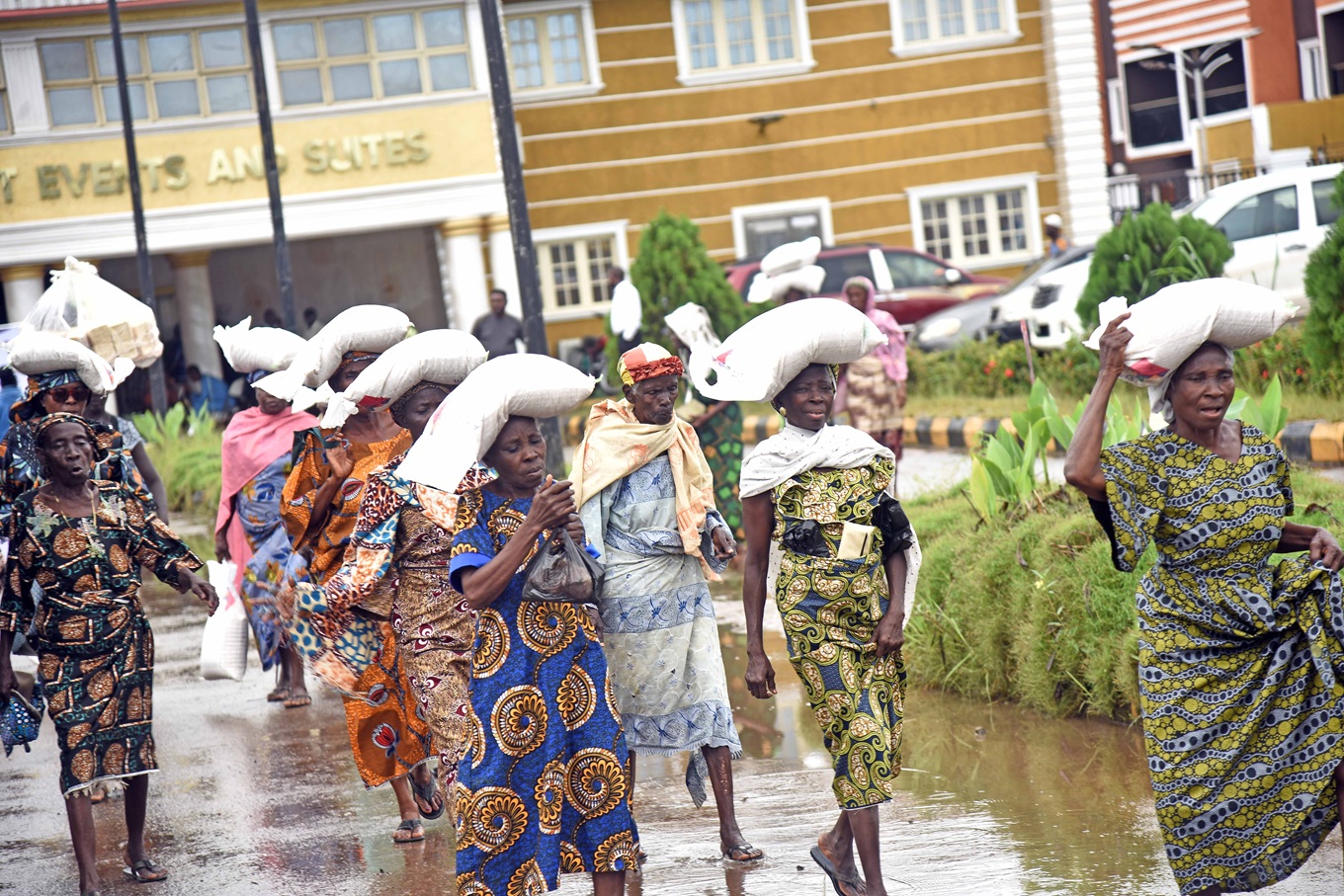
Some vulnerable households around host communities of Dangote Cement Plc in Ogun State recently received bags of rice from the Aliko Dangote Foundation (ADF) to alleviate the burden of rising food costs on them.
Beneficiaries were mainly low-income families, elderly residents, and other vulnerable groups within 17 communities in Ibese and 36 others in Itori and Ijebu-Igbo.
The organisation distributed thousands of 10kg bags of rice to residents of the communities, who could not hide their joy at the gesture.
At several distribution points, orderly processes were put in place to ensure transparency and equitable access. Local coordinators, in collaboration with community representatives, supervised the exercise to guarantee that the items reached intended beneficiaries.
At the Ibese distribution centre, the Aboro of Ibeseland, Mr Rotimi Oluseyi Mulero, thanked Mr Dangote for the gift, describing the rice distribution as operation feed the families.
“On behalf of our people, I extend our profound gratitude to the Aliko Dangote Foundation for this timely and commendable gesture. At a time when many families are facing economic challenges, this distribution of food items will go a long way in alleviating hardship within our communities.
“We appreciate Dangote Group not only as a business partner but as a responsible corporate citizen that continues to demonstrate genuine concern for the well-being of its host communities. We pray that this partnership continues to flourish for the benefit of all.
“Today, our hearts are filled with appreciation. This support has come at a very critical time for our people. Many households are under pressure, and this intervention will bring relief and hope to families,” the traditional ruler enthused.
Also, at Itori, the Olu of Itori, Mr Abdulfatai Akorede Akamo, said his people’s hearts were filled with appreciation, saying, “This support has come at a very critical time for our people. Many households are under pressure, and this intervention will bring relief and hope to families.
“We thank Mr Aliko Dangote and his Foundation for remembering the grassroots and standing by us in times of need. We are deeply grateful for this act of kindness. May the Almighty bless the Dangote Group and increase its capacity to continue doing good for humanity.”
Speaking on the initiative, the chief executive of ADF, Ms Zouera Youssoufou, represented by the ADF Head of Operations, Mr Victor Ejiro, reaffirmed that the food intervention programme reflects the organisation’s long-standing dedication to food security and poverty alleviation, particularly during periods of economic strain.
“This intervention is designed to provide immediate relief to households grappling with high food prices. As a socially responsible organisation, we recognise the importance of supporting our host communities beyond business operations.
“At the Aliko Dangote Foundation, we recognise the current economic realities facing many Nigerian households. This intervention is aimed at providing immediate relief while reinforcing our long-standing commitment to the well-being of our host communities.
“We understand the difficulties families are facing at this time. This support is our way of standing with our communities and ensuring that no household is left behind during these challenging times. Sustainable development goes beyond business operations. Through this programme, we are strengthening community resilience and contributing to national efforts to improve food access and social stability,” she stated, adding that the intervention is focused on delivering real, immediate support to vulnerable households, promising to expand it to more families.
The initiative forms part of the foundation’s National Food Intervention Programme aimed at cushioning the effects of prevailing economic challenges on ordinary Nigerians.
General
Preparing Pot of Jollof Rice Now Costs Nearly N30,000—SBM Jollof Index
By Adedapo Adesanya
Preparing a pot of Nigeria’s most valued delicacy, jollof rice, costs as much as N29,578 in June 2026 compared to N25,798 in July 2025, an increase of 14.6 per cent, according to a new survey by SBM Intelligence.
The data and research firm, in its Jollof Index Q2 2026 report, titled Rebasing, Redefining, and the Weather’s Toll on the Pot, stated that it rebased the index in the July edition to a higher standard as of July 2025 and introduced re-standardised ingredient measures.
According to the report, the index now more accurately captures how households navigate the current affordability crisis.
The study collected monthly price data on 12 key ingredients: rice, vegetable oil, turkey or chicken, beef, tomatoes, pepper, onions, tinned tomatoes, salt, curry, thyme, and seasoning cubes from 13 markets across Nigeria’s six geopolitical zones.
The markets include Nyanya and Wuse II (North Central), Bauchi (North East), Kano (North West), Awka and Onitsha (South East), Port Harcourt, Calabar Municipal, and Bayside Mbakpa (South South), and Bodija, Dugbe, Trade Fair, and Balogun (South West).
The report stated that the upward trajectory in the cost of jollof rice since July 2025 was non-linear, with prices dipping in September and October 2025 before accelerating from November through the first half of 2026.
It revealed that the index has risen from N4,087 in July 2016 to N29,578 in June 2026, a staggering 624 per cent increase over 10 years.
“The data confirms that food inflation is not a cyclical phenomenon but a structural crisis, embedded in Nigeria’s failure to secure supply chains, stabilise its currency, invest in agricultural resilience, and now adapt to a changing climate,” the SBM survey stated.
Throughout the second quarter of 2026, Nigeria’s agricultural supply chain has been gripped by a compounding crisis driven by extreme weather patterns and structural logistical failures, the report stated.
From April through June, reports from urban markets across the country- Port Harcourt, Calabar, Onitsha, Lagos, Ibadan, Bauchi, Kano, and Abuja- revealed a consistent pattern of food scarcity and sharp price volatility.
Meanwhile, the National Bureau of Statistics (NBS) said Nigeria’s food inflation stood at 17.52 per cent on a year-on-year basis in June.
“The crisis has been most acute for perishable crops, particularly tomatoes and peppers, but its reach has extended to staples such as yams, plantains, garri, and even grains.
“Across every region, the story is the same: heavy rains have flooded roads, damaged farmland, delayed harvests, and driven up transport costs. Consumers are adapting, but their options are narrowing,” the report stated.
According to the report, consumers across the country are responding in similar ways: buying in smaller quantities, substituting fresh produce with dried or processed alternatives, and reducing portions.
“But these are coping strategies, not solutions,” the report added.
Geographically, the gap between Nigeria’s cheapest and most expensive markets has widened to N14,700.
According to the SBM report, Calabar Municipal is the most expensive market to cook a pot of jollof rice at N34,750, while Awka is the cheapest at N22,050.
“The most expensive markets are either in the South-South (where protein costs and import restrictions have surged) or in Lagos (the import gateway).
“The cheapest markets are in the South-east, which has benefited from local farming and shorter supply chains,” the report stated.
In North-central, ingredient prices at Abuja’s two markets, Nyanya and Wuse II, rose significantly.
Over the year to June 2026, Nyanya rose from N24,300 to N25,450, a modest 4.7 per cent increase, while Wuse II climbed from N28,150 to N29,200, a 3.7 per cent increase.
The report stated that Abuja’s food economy is fundamentally distorted by its dependence on distant supply corridors.
“Every grain of rice, every tomato, every onion must travel from Benue, Kaduna, Nasarawa, Niger, or beyond.
“When diesel prices surge, when insecurity blocks roads, when checkpoints multiply, or when heavy rains flood roads, Abuja’s markets feel it first and most acutely,” the report stated.
In the North-east, Bauchi recorded the most dramatic price movement of any market. The index fell from N38,850 in July 2025 to N32,350 by June 2026, a 16.7 per cent decline.
This correction followed a period of hyperinflation in mid-2025, during which Bauchi’s index peaked above N41,000.
“The decline reflects a combination of factors: a localised influx of early harvest yields, a collapse in demand as prices became unsustainable, and some improvement in supply routes,” the report stated.
In the North-west region, Kano’s Jollof Index rose from N24,520 in July 2025 to N25,820 in June 2026, a 5.3 per cent increase.
The modest rise showed a deeper reality because Kano’s index has been structurally expensive for years, driven by high protein costs and logistical challenges in moving goods into the region.
“Customers will have less money to spend on beauty products when they are struggling to buy food,” a cosmetics seller in Kano captured the sentiment.
Additionally, the South-east remains Nigeria’s cheapest region for jollof, but the gap with the rest of the country is narrowing.
At Awka, the index price of jollof rice rose from N21,700 in July 2025 to N22,050 in June 2026, a 1.6 per cent increase, while the index price at Onitsha market climbed from N22,200 to N22,550, a similar increase.
“These are the only markets below N23,000. The region’s relative affordability reflects its strong local farming culture and shorter supply chains,” the report stated.
It further clarified that the trend is upward because of the South-east’s reliance on food imports from North-central states for staples such as yams and vegetables.
The report stated that this reliance exposed the region to the same transport cost increases that impact Abuja and Kano.
The South-south region recorded the steepest increases of any zone, driven by a combination of structural shifts, policy changes, weather disruptions, and logistics costs.
Port Harcourt rose from N26,400 in July 2025 to N31,200 in June 2026, an 18.2 per cent increase.
Calabar Municipal jumped from N25,500 to N34,750, a 36.3 per cent surge, while Bayside Mbakpa climbed from N25,500 to N34,650, a 35.9 per cent increase.
The South-west region, and Lagos in particular, recorded dramatic price increases.
According to the report, the index price at Trade Fair and Balogun markets rose from N23,200 in July 2025 to N34,700 in June 2026, a 49.6 per cent increase, the sharpest of any market.
“The surge reflects Lagos’s position as Nigeria’s import gateway,” the SBM report stated.
According to the survey, when global oil prices spike, when the naira weakens, when shipping costs rise, or when heavy rains disrupt supply routes, Lagos feels it first.
The Iran war fuel shock in March 2026 pushed both markets from N20,400 in February to N25,200 in March, a 23.5 per cent monthly increase, the report stated.
The upward momentum continued through April, May, and June.
At Ibadan’s markets, Bodija and Dugbe, prices rose more moderately but still significantly.
Both increased from N25,930 in July 2025 to N28,550 in June 2026, a 10.1 per cent rise.
“The gap between Lagos and Ibadan has widened, reversing a trend of convergence seen in previous years.
“In Oyo State, researchers reported that fresh pepper, tomatoes, yam, and plantain are in extreme short supply,” the report stated.
General
Xenophobia: Reps to Document Losses, Seek Compensation For Nigerians in South Africa
By Adedapo Adesanya
The House of Representatives has called for a comprehensive investigation into the losses, casualties and properties abandoned by Nigerians following recent xenophobic attacks in South Africa.
This development comes after the final batch of Nigerians was evacuated from South Africa following mass protests calling for the exit of other Africans from their country, leaving many to abandon their livelihoods and businesses.
The lawmakers urged the federal government to intensify diplomatic engagements, pursue legal measures and strengthen bilateral cooperation with South Africa to ensure the safety and protection of Nigerians living in the country.
The resolution followed the adoption of a motion sponsored by the member representing Ikorodu Federal Constituency of Lagos State, Mr Babajimi Benson, during Tuesday’s plenary session presided over by Speaker Abbas Tajudeen.
The motion seeks to mandate the House Committees on Diaspora and Foreign Affairs to document the human and economic losses suffered by Nigerians during the attacks, compile an inventory of abandoned properties and recommend diplomatic and legal measures to improve the protection of Nigerians residing in South Africa.
Lawmakers argued that a thorough assessment of the impact of the attacks is necessary to support affected Nigerians and strengthen the country’s response to future incidents.
Also at plenary, the House considered a motion calling for a comprehensive audit of all seized, forfeited and recovered assets since May 29, 1999.
The motion, sponsored by Ibe Osonwa, who represents Arochukwu/Ohafia Federal Constituency of Abia State, advocates the creation of a national digital registry of recovered assets and the establishment of an ad hoc committee to enhance transparency, accountability and legislative oversight in asset management.
General
FG to Partner Stakeholders for Affordable, Inclusive Housing
By Aduragbemi Omiyale
The federal government has promised to collaborate with stakeholders in the real estate sector to drive affordable and inclusive housing, aligning with broader initiatives aimed at improving access to decent homes for low-income and informal-sector workers.
The Minister of Housing and Urban Development, Mr Muttaka Rabe Darma, made this pledge at the 2026 Abuja International Housing Show (AIHS), where industry heavyweights like Dangote Cement, HBM Nigeria and others showcased their products.
Mr Darma noted that the government was ready to partner with organisations to address Nigeria’s housing challenges, remarking that the exhibition’s theme, Housing Solutions for Low-Income and Informal Workers in Africa, aligned with government efforts to expand access to affordable and inclusive housing.
He lauded Dangote Cement and others for their significant contribution to affordable housing and infrastructure development in Nigeria, describing them as key partners in efforts to bridge the nation’s housing deficit and improve access to quality building materials.
The Minister also commended Mr Aliko Dangote for his commitment to Africa’s industrialisation and economic transformation, noting that his investments continue to drive sustainable growth across the continent.
In the same vein, the chief executive of AIHS, Mr Festus Adebayo, described Dangote Cement as a dependable partner whose consistent support has contributed to the growth and success of the annual housing exhibition.
Dangote Cement’s Regional Sales Director for North Central, Mr Bankole George, who represented the National Sales Director, Dolapo Alli, said housing remains critical to dignity, social stability, economic productivity and inclusive development.
He identified major barriers to affordable housing as high land costs, expensive building materials, limited access to mortgage financing, weak rental systems and planning regulations.
He advocated innovative housing finance models tailored to low-income earners and informal workers, including micro-mortgages, rent-to-own schemes, cooperative savings programmes, employer-assisted housing and incremental housing loans.
The exhibition attracted thousands of policymakers, investors, housing professionals, exhibitors and delegates from several countries, reinforcing its status as one of Africa’s leading platforms for housing and urban development dialogue.