Feature/OPED
X-raying the Giant strides of the Nigerian Army
By Odeyemi Oladimeji
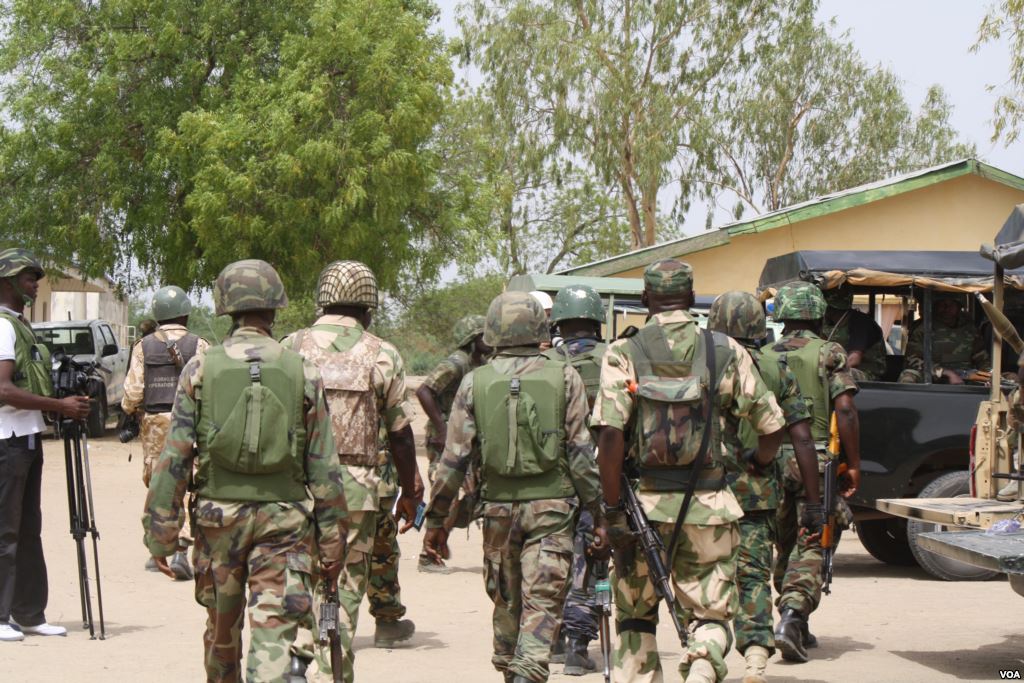
The Nigerian Army, no doubt remains one of the strongest in Africa. There are several tales of the force’s exploits both on the foreign mission and on the home soil. It is an Army of disciplined and committed Officers and Men.
Despite the challenges posed by the Boko Haram insurgency and other internal security challenges, their moral is always high and this was made possible by the visionary and dynamic leadership style of Lt. General Tukur Yusufu Buratai , the Chief of Army staff, Nigerian Army, under whose leadership the Army has continued to record tremendous successes both against the insurgents and in the general wellbeing of Officers and Men of the force.
General Buratai, brutal on Boko Haram and Bandits is not only a pacesetter in the history of the Nigeria Army, he is a man with many firsts. It was under his leadership that the Nigerian Army gets its own prestigious University.
In addition to the establishment of this University, the Nigerian Army under General Buratai’s command do not take for granted the training and re-training of its personnel.
They have expanded their in-theatre training for troops in the frontlines to afford them the required capabilities to operate and conduct effective operations. Special attention was also given to providing local and foreign training opportunities for all cadre of officers and soldiers.
The fight against Boko Haram terrorists in the North East under General Buratai has brought terrorism to the barest minimum.
The Army in conjunction with other security agencies have continued to carry out sustained operations against the Boko Haram Terrorist in line with President Buhari’s focus to eliminate the remnants of the insurgents within the shortest possible time. A mission General Buratai is leading with all vigour.
The nations’ territorial integrity, particularly along our land borders has not been breached unlike what was obtainable before now. The army continually maintained a posture to defend Nigeria’s territorial rights and interests.
General Buratai understands the power of unity and that is why he maintained a robust security relation with the neighboring countries of Benin, Cameroon, Chad and Niger Republic in the fight against the ISWA which is terrorising all the aforementioned countries. Together they have achieved tremendous success and the Boko Haram days are numbered.
The internal security in the country has also improved drastically from where it used to be before 2015, when General Buratai took over command of the Nigerian Army.
The Army/Civil relationship has also improved tremendously and the civilian population now sees more reasons to support the Army like never before. A situation which has enables the Army to carry out many successful operations with the help of the civilians who volunteers information to them.
The Army has also supported the Federal Government’s efforts at encouraging Internally Displaced Persons (IDPs) to return to their homes. This effort which has helped over 10,000 IDPs returned back to their communities in the North East and other parts of the country was given a boast by General Buratai’s commitment at ensuring that Nigerians are not held captive in their country.
The success recorded by INEC in the 2019 General Elections, is not without the support of the Nigerian Army, who conducted themselves in a more professional and efficient manners ever. The whole nation owns the Nigerian Army a gratitude for this and kudos to General Buratai who commands the Army according to the world best practice.
The Nigerian Army under General Buratai is witnessing a lot of reorganization and redeployment in a bid to improve their overall operational responsiveness and professionalism.
The Chief of Army Staff regularly approved the redeployment of field and operational commanders in order to inject new ideas in the command and control structure in various operations across the country.
The provision of adequate healthcare to personnel and their families has continued to remain one of General Buratai’s priorities.
Many officers, soldiers and their family members have benefited in the Nigerian Army Medical Evacuation both within and outside the Country.
General Buratai Enhanced innovation and partnerships in the defence industry have also encouraged and supported all officers and soldiers who have innovative ideas and competencies.
It has also resumed full collaboration with the Defence Industries Corporation (DICON) for needed parts and small arms and ammunition.
Similarly, the Nigerian Army is partnering with several companies in Nigeria including Innoson Motors, Proforce Limited and Nigeria Machine Tools, among others, towards the production of light and heavy armoured vehicles, critical equipment as well as protective clothing for the troops.
These collaborations have led to the development of the TYB Rover, Infantry Patrol Vehicle (IPV) and the Bionbion Helicopter, among several other equipment.
The Army also engaged some foreign technical companies and Original Equipment Manufacturers (OEM) to help in the repair and refurbishing of some of the heavier and more delicate platforms.
A number of new developments that have taken place includes: The establishment of the Nigerian Army Women Corps (NAWC) to develop female officers and soldiers that can be employed in all operational engagements of the Army.
The Nigerian Army University Biu (NAUB) has commenced its academic programmes. The Nigerian Army Vehicle Manufacturing Company (NAVMC) was also established to support its strides in vehicle manufacturing.
The Army has also commenced direct training for personnel to acquire sufficient knowledge and communication skills in the three major Nigerian languages to better fit in anywhere they may be deployed.
It is equally worth of note, the establishment of the first ever Cyber Command. The Command which has been effectively tackling the fake news against the Army, the country and secure the cyber domain from hostile elements.
In spite of the Army’s successes, it is faced with challenges and insinuations of human rights abuses.
To this effect the Chief of Army Staff approved the establishment of a Human Rights Desk offices in all Army formations for speedy attention to human rights allegations.
However, the Chief of Army Staff and the Nigerian Army could not have achieved these millstones without the unwavering support of their Commander in Chief, President Muhammadu Buhari who gave all the needed support to the Nigerian Armed Forces in general and to the Nigerian Army in particular.
Nigerian Army has remained apolitical, professional and responsive in the discharge of its constitutional roles and total commitment to the defense of the Constitution of the Federal Republic of Nigeria.
The Chief of Army Staff, Nigerian Army, Lt General Tukur Yusufu Buratai’s patriotism and commitment to Nigeria is unparalleled, and as the popular maxim says, the reward for hard work and exemplary leadership skills is more work.
This article was contributed by Com Oladimeji Odeyemi, a security analyst and a counter terrorist expert, who is the Convener of the Coalition of Civil Society Groups against Terrorism in Nigeria.
Feature/OPED
Dangote, Monopoly Power, and Political Economy of Failure
By Blaise Udunze
Nigeria’s refining crisis is one of the country’s most enduring economic contradictions. Africa’s largest crude oil producer, strategically located on the Atlantic coast and home to over 200 million people, has for decades depended on imported refined petroleum products. This illogicality has drained foreign exchange, weakened the naira, distorted investment incentives, and hollowed out state institutions. Instead of catalysing industrialisation, Nigeria’s oil wealth became a mechanism for capital flight, rent-seeking, and institutional decay.
With the challenges surrounding the refining of crude oil, the establishment of Dangote Refinery signifies an important historic moment. The refinery promises to reduce fuel imports to a bare minimum, sustain foreign exchange growth, ensure there is constant fuel domestically, and strategically position Nigeria as a regional exporter of refined oil products if functioned at full capacity. Dangote Refinery symbolises what private capital, technology, and ambition can achieve in Africa following years of fuel queues, subsidy scandals, and global embarrassment.
Nigerians must have a rethink in the cause of celebration. Nigeria’s refining problem is not simply about capacity; it is about systems. Without addressing the policy failures and institutional weaknesses that made Dangote an exception rather than the rule, the country risks replacing one failure with another, this time cloaked in private-sector success.
For a fact, Nigeria desperately needs the emergence of Dangote refinery, and its success is in the national interest. Hence, this is not an argument against the Dangote Refinery. But history warns that structural failures are not solved by scale alone. Over the year, situations have shown that without competition and strong institutions, concentrated market power, whether public or private, can undermine price stability, energy security, and consumer welfare.
The Long Silence of Refinery Investments
Perhaps the most troubling question in Nigeria’s oil history is why none of the global oil majors like Shell, ExxonMobil, Chevron, Total, or Agip has built a major refinery in Nigeria for over four decades. These companies operated profitably in Nigeria, extracted their crude, and sold refined products back to the country, yet never committed capital to domestic refining.
Over the period, it has been shown that policy incoherence has been the cause, not a matter of technical incapacity, such as price controls, resistant licensing processes, subsidy arrears, frequent regulatory changes, and political interference, which made refining an unattractive investment. Importation, by contrast, offered quick returns, lower political risk, and guaranteed margins, often backed by government subsidies.
Nigeria carelessly designed a system that rather rewarded importers and punished refiners. Dangote did not succeed because the system improved; he succeeded despite it. His refinery exists largely because of the concessions from the government, exceptional financial capacity, political access, and a willingness to absorb risks that institutions should ordinarily mitigate. This raises a deeper concern; when institutions fail, progress becomes dependent on extraordinary individuals rather than predictable systems.
The Tragedy of NNPC Refineries
If private investors stayed away, Nigeria’s state-owned refineries should have filled the gap. Instead, the Port Harcourt, Warri, and Kaduna refineries became monuments to mismanagement. Records have shown that between 2010 and 2025, Nigeria reportedly wasted between $18 billion and $25 billion, over N11 trillion, just for Turn Around Maintenance and rehabilitation. Kaduna Refinery alone is estimated to have consumed over N2.2 trillion in a decade.
Despite these expenditures, output remained negligible. This was not merely a technical failure but a governance one. Contracts were poorly monitored, accountability was absent, and consequences were nonexistent. In functional systems, such outcomes trigger investigations, sanctions, and reforms. In Nigeria, the cycle simply repeated itself, eroding public trust and deepening dependence on imports.
Where Is BUA?
Dangote is not the only Nigerian conglomerate to announce refinery ambitions. In 2020, BUA Group unveiled plans for a 200,000-barrels-per-day refinery. Years later, progress remains unclear, timelines have shifted, and execution appears stalled.
This pattern is revealing. When multiple large investors struggle to translate plans into reality, the issue is not ambition but environment. Refinery projects in Nigeria appear viable only at a massive scale and with extraordinary political leverage. Smaller or mid-sized players are effectively crowded out, not by market forces, but by systemic dysfunction.
Policy Failure and the Singapore Comparison
Nigeria often aspires to emulate Singapore’s refining and petrochemical success. The comparison is instructive. Singapore has no crude oil, yet built one of the world’s most sophisticated refining hubs through consistent policy, investor protection, infrastructure planning, and regulatory certainty.
Nigeria chose a different path: price controls, subsidies, weak contract enforcement, and politically motivated policy reversals. Refineries became tools of patronage rather than productivity. Capital exited, infrastructure decayed, and import dependence deepened. The outcome was predictable.
The Cost of Import Dependence
For years, Nigeria spent billions of dollars annually importing petrol, diesel, and aviation fuel. This placed constant pressure on foreign reserves and the naira. Petrol subsidies alone were estimated at N4-N6 trillion per year, often exceeding national spending on health, education, or infrastructure.
Even after subsidy removal, legacy costs remain: distorted consumption patterns, weakened public finances, and entrenched interests built around importation. These interests did not disappear quietly.
Who Really Benefited from the Subsidy?
Although framed as pro-poor, fuel subsidies disproportionately benefited importers, traders, shipping firms, depot owners, financiers, and politically connected intermediaries. Smuggling across borders meant Nigerians subsidised fuel consumption in neighbouring countries.
Ordinary citizens received marginal relief at the pump but paid far more through inflation, deteriorating infrastructure, and underfunded public services. The subsidy system functioned less as social protection and more as elite redistribution.
The Traders’ Dilemma
Why did major fuel marketers like Oando invest in refineries abroad but not in Nigeria? Again, incentives explain behaviour. Importation offered faster returns, lower capital requirements, and political insulation. Domestic refining demanded long-term investment under unstable rules.
In an irrational system, rational actors optimise accordingly. Importation thrived not because it was efficient, but because policy made it so.
FDI and the Confidence Problem
Sustainable Foreign Direct Investment follows domestic confidence. When local investors, who best understand political and regulatory risks, avoid long-term industrial projects, foreign investors take note. Capital flows to environments with predictable pricing, rule of law, and policy consistency.
Nigeria’s challenge is not attracting speculative capital, but building conditions for patient, productive investment.
Dangote and the Monopoly Question
Dangote Refinery deserves credit. But scale brings power, and power demands oversight. If importers exit and no competing refineries emerge, Dangote could dominate refining, pricing, and supply. Nigeria’s experience with cement, where domestic production rose but prices soared due to limited competition, offers a cautionary tale.
Markets function best with competition. Without it, price manipulation, supply risks, and weakened energy security become real dangers, especially in countries with fragile regulatory institutions.
The Way Forward: Competition, Not Replacement
Nigeria does not need to weaken Dangote; it needs to multiply Dangotes. The goal should be a competitive refining ecosystem, not a replacement of a public monopoly with a private monopoly.
This requires transparent crude allocation, open access to pipelines and storage, fair pricing mechanisms, and strong antitrust enforcement. State refineries must either be professionally concessional or decisively restructured. Stalled projects like BUA’s should be unblocked, and modular refineries should be supported.
The Litmus Test
Nigeria’s refining crisis was decades in the making and cannot be solved by one refinery, however large. Dangote Refinery is a turning point, but only if embedded within systemic reform. Otherwise, Nigeria risks trading one form of dependency for another.
The true test is not whether Nigeria can refine fuel, but whether it can build fair, open, and resilient institutions that serve the public interest. In refining, as in democracy, excessive concentration of power is dangerous. Competition remains the strongest safeguard.
Blaise, a journalist and PR professional, writes from Lagos and can be reached via: [email protected]
Feature/OPED
How AI Levels the Playing Field for SMEs
By Linda Saunders
Intro: In many small businesses, the owner often starts out as the bookkeeper, the customer-service desk, the IT technician and the person who steps in when a delivery goes wrong. With so many balls up in the air – and such little room for error – one dropped ball can derail the entire day and trigger a chain of problems that’s hard to recover from. Unlike larger companies that have the luxury of spreading the load across dedicated teams and systems, SMEs carry it all on a few shoulders.
South Africa’s SME sector carries significant weight, contributing around 19% of GDP and a third of formal employment, according to the latest available Trade & Industrial Policy Strategies (TIPS) 2024 review. That is causing persistent constraints, including tight margins, erratic demand, high administrative load, and limited internal capacity.
This is not unique to South Africa. Many smaller businesses across the continent still rely on manual processes. It is common to find sales records kept separately from customer notes, or inventory data that is updated only occasionally. The result is slow turnaround times, duplicated effort and a lack of visibility across the business. Given that SMEs have such a huge influence on national economies, accounting for over 90% of all businesses, between 20-40% of GDP in some African countries, and a major source of employment, providing around 80% of jobs, these operational constraints have a broad impact on economies.
What has changed in recent years is that digital tools once seen as the preserve of larger companies have become more attainable for smaller operators. They do not remove the structural challenges SMEs face, but they can ease the load. Better systems do not replace judgement, experience or customer relationships; they simply give small companies more room to work with.
Cloud-based systems, automation and integrated customer-management tools have become more affordable and easier to deploy. They do not remove the structural pressures facing small businesses, but they can ease the operational load and create more space for productive work.
Doing more with the teams SMEs already have
Small teams often end up wearing several hats. One person might take customer calls, update stock records, handle service issues and manage follow-ups. When demand rises, these manual processes become harder to sustain. Local surveys regularly point to this strain, showing that smaller companies spend significant portions of the week on paperwork, compliance and routine administrative tasks – work that adds little value but cannot be ignored.
This is where automation is proving useful. Routine tasks such as onboarding new customers, checking documents, routing queries to the right person, logging interactions and sending follow-ups can now run quietly in the background. In larger companies, whole departments handle this work. In small businesses, the same burden has traditionally fallen on one or two people. When these processes run reliably without constant attention, a business with 10 employees can manage busier periods without rushed outsourcing or slipping service standards.
The point is not to replace staff, but to reduce the operational drag that limits what small teams can deliver. Structured workflows give SMEs a level of steadiness they have rarely had the time or money to build themselves.
Using better data to make better decisions
A second constraint facing SMEs is disorganised information. When customer details are lost in email, sales notes in chat groups, stock figures in spreadsheets and queries in separate systems, decisions depend on whatever information happens to be at hand. Forecasting becomes guesswork, and early warning signs are easy to miss.
Putting all this information in a single place changes the quality of decision-making. When sales, service and stock data can be viewed together, patterns become easier to spot: which products are moving, which customers are becoming less active, where delays tend to occur, and which periods consistently drive higher demand.
Importantly, SMEs do not need corporate analytics teams for this. Modern CRM platforms can organise information automatically and surface basic trends. For retailers preparing for 2026, this can help avoid over – or under – stocking. For service businesses, it can highlight customers who may be at risk of leaving, prompting earlier intervention. In competitive markets, having clearer information is a practical advantage.
Building a foundation before the pressure arrives
Rapid growth can be as destabilising for SMEs as an economic downturn. When orders increase, manual processes quickly reach their limit. Errors are more likely, staff become overwhelmed and the customer experience suffers. Many small businesses only upgrade their systems once these problems appear, by which time the cost, both financial and reputational, is already significant.
Putting basic workflow tools and a unified customer record in place early provides a useful buffer. Tasks follow the same steps every time, reducing inconsistency. Customers reach the right person more quickly. Staff spend less time checking or re-entering information and more time on work that matters. These small operational gains compound over time, especially during busy periods.
This is not about chasing every new technology. It is about avoiding a common pattern in the SME sector: when demand rises, systems buckle, and growth becomes more difficult.
Confidence matters as much as capability
Smaller companies understandably worry about risk when adopting new systems. Data protection, monitoring, and compliance can feel daunting without an IT department. The advantage of modern platforms is that many of these protections, like encryption, audit trails, and event monitoring, are built in. Transparent design also helps SMEs understand how automated decisions are made and how customer data is handled.
This reassurance is important because SMEs should not have to choose between improving their operations and protecting their customers’ information.
2026 will reward readiness
Technology will not replace the qualities that give SMEs their edge: personal service, flexibility, and the ability to respond quickly to customer needs. What it can do is relieve the administrative load that prevents those strengths from being fully used.
SMEs that invest in simple automation and better data practices now will enter 2026 with greater capacity and clearer insight. They won’t be competing with larger companies by matching their resources, but by removing the disadvantages that have traditionally held them back.
In the year ahead, the most competitive businesses will not be the biggest; they’ll be the ones that prepared early for the year ahead.
Linda Saunders is the Country Manager & Senior Director Solution Engineering for Africa at Salesforce
Feature/OPED
Why Africa Requires Homegrown Trade Finance to Boost Economic Integration
By Cyprian Rono
Africa’s quest to trade with itself has never been more urgent. With the African Continental Free Trade Area (AfCFTA) gaining momentum, governments are working to deepen intra-African commerce. The idea of “One African Market” is no longer aspirational; it is emerging as a strategic pathway for economic growth, job creation, and industrial competitiveness. Yet even as infrastructure and regulatory reforms advance, one fundamental question remains; how will Africa finance its cross-border trade, across markets with diverse currencies, regulations, and standards?
Today, only 15 to 18 percent of Africa’s internal trade happens within the continent, compared to 68 percent in Europe and 59 percent in Asia. Closing this gap is essential if AfCFTA is to deliver prosperity to Africa’s 1.3 billion people.
A major constraint is the continent’s huge trade finance deficit, which exceeds USD 81 billion annually, according to the African Development Bank. Small and medium-sized enterprises (SMEs), which provide more than 80 percent of the continent’s jobs, are the most affected. Many struggle with insufficient collateral, stringent risk profiling and compliance requirements that mirror international banking standards rather than the realities of African business.
To build integrated value chains, exporters and importers must operate within trusted, predictable, and interconnected financial systems. This requires strong pan-African financial institutions with both local knowledge and continental reach.
Homegrown trade finance is therefore indispensable. Pan-African banks combine deep domestic roots with extensive regional reach, making them the most credible engines for financing trade integration. By retaining financial activity within the continent, homegrown lenders reduce exposure to external shocks and keep liquidity circulating locally. They also strengthen existing regional payment infrastructure such as the Pan-African Payment and Settlement System (PAPSS), developed by the Africa Export-Import Bank (Afreximbank) and backed by the African Continental Free Trade Area (AfCFTA) Secretariat, enabling faster, cheaper and seamless cross-border payments across the continent.
Digital transformation amplifies this advantage. Real-time payments, seamless Know-Your-Customer (KYC) verification, automated credit scoring and consistent service delivery across markets are essential for intra-African trade. Institutions such as Ecobank, operating in 34 African countries with integrated core banking systems, demonstrate how such digital ecosystems can enable continent-wide commerce.
Platforms such as Ecobank’s Omni, Rapidtransfer and RapidCollect, together with digital account-opening services, make it much easier for traders to operate across borders. Rapidtransfer enables instant, secure payments across Ecobank’s 34-country network, reducing delays in regional trade, while RapidCollect gives cross-border enterprises the ability to receive payments from multiple African countries into a single account with real-time confirmation and automated reconciliation. Together, these solutions create an integrated digital ecosystem that lowers friction, accelerates payments, and strengthens intra-African commerce.
Trust, however, remains a significant barrier. Cross-border commerce depends on the confidence that partners will honour contracts, deliver goods as promised, pay on time, and present authentic documentation. Traders often lack reliable information on potential partners, operate under different regulatory regimes, and exchange documents that are difficult to verify across borders. This heightens the risk of fraud, non-payment, and contractual disputes, discouraging businesss from expanding beyond familiar markets.
Technology is closing this trust gap. Artificial Intelligence enables lenders to assess risk using alternative data for SMEs without formal credit histories. Distributed ledger tools make shipping documents, certificates of origin, and inspection reports tamper-proof. In addition, supply-chain visibility platforms enable real-time tracking of goods and cross-border digital KYC ensures that both buyers and sellers are verified before any transaction occurs.
Ecobank’s Single Trade Hub embodies this trust infrastructure by offering a secure digital marketplace where buyers and sellers can trade with confidence, even in markets where no prior relationships exist. The platform’s Trade Intelligence suite provides customers instant access to market data from customs information and product classification tools across 133 countries.
Through its unique features such as the classification of best import/export markets, over 25,000 market and industry reports, customs duty calculators, and local and universal customs classification codes, businesses can accurately assess market opportunities, anticipate trends, reduce compliance risks, and optimise supply chains, ultimately helping them compete and grow in regional and global markets.
SMEs need more than financing. Many operate in cash-heavy cycles where suppliers and logistics providers require upfront payment. Lenders can support these businesses with advisory services, business intelligence, compliance guidance, and platforms for secure partner verification, contract negotiation, and secure settlement of payments. Trade fairs, industry forums, and partnerships with chambers of commerce further build the trust networks needed for cross-border trade.
Ultimately, Africa’s path toward meaningful trade integration begins with financial integration. AfCFTA’s promise will only be realised when enterprises can trade with confidence, knowing that payments will be honoured, partners verified, and disputes resolved. This requires collaboration between banks, regulators, and trade institutions, alongside harmonised financial regulations, interoperable payment systems, and continent-wide verification networks.
Africa can no longer rely on external actors to finance its trade. Its economic transformation depends on strong, trusted, and digitally enabled African financial institutions that understand Africa’s unique risks and opportunities. By building an African-led trade finance ecosystem, the continent can unlock liquidity, reduce dependence on external currencies, empower SMEs, and retain more value locally. Africa’s trade revolution will accelerate when its financing is driven by African institutions, African systems, and African ambition.
Cyprian Rono is the Director of Corporate and Investment Banking for Kenya and EAC at Ecobank Kenya
-
Feature/OPED6 years agoDavos was Different this year
-
Travel/Tourism9 years ago
Lagos Seals Western Lodge Hotel In Ikorodu
-
Showbiz3 years agoEstranged Lover Releases Videos of Empress Njamah Bathing
-
Banking7 years agoSort Codes of GTBank Branches in Nigeria
-
Economy3 years agoSubsidy Removal: CNG at N130 Per Litre Cheaper Than Petrol—IPMAN
-
Banking3 years agoFirst Bank Announces Planned Downtime
-
Banking3 years agoSort Codes of UBA Branches in Nigeria
-
Sports3 years agoHighest Paid Nigerian Footballer – How Much Do Nigerian Footballers Earn