Connect with us

General

Human Rights Watch Condemns Deadly Crackdown on Shia Protesters

Published

on

By Modupe Gbadeyanka

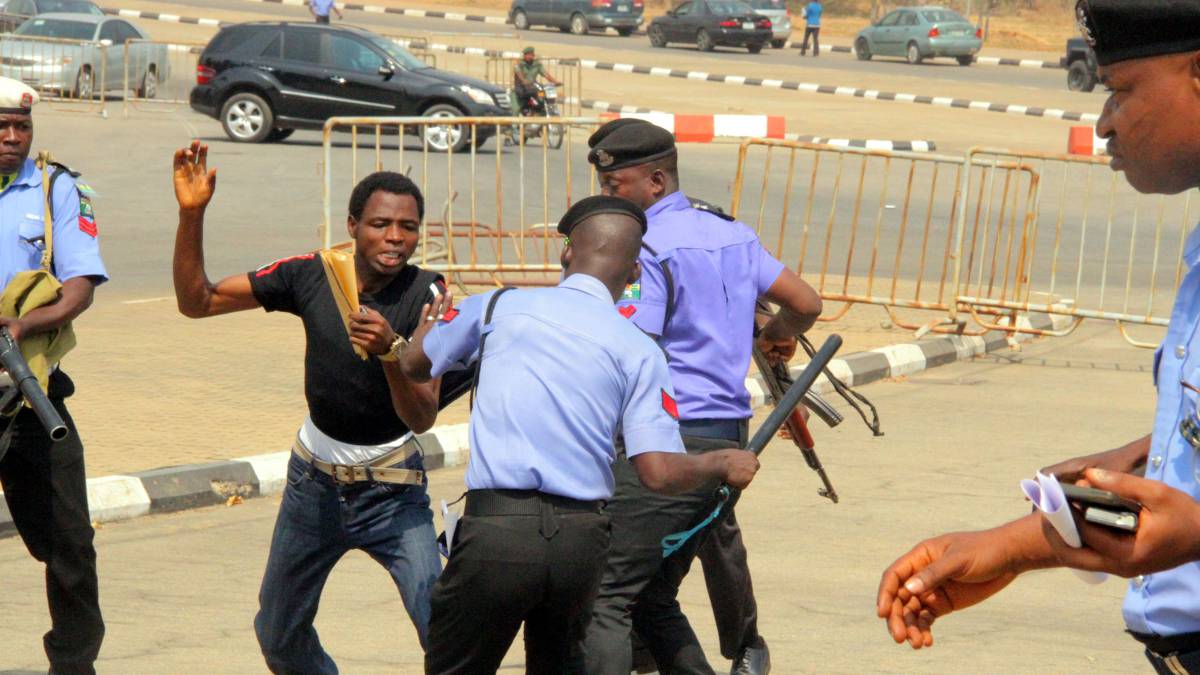
Authorities in Nigeria have been criticised by the Human Rights Watch for the “excessive use of force” on members of the Shia Islamic Movement in Nigeria (IMN) during their peaceful protest in Abuja, on July 22, 2019.

At the demonstration, which later turned deadly, Nigerian police fired shots at the religious group who are demanding the release of their leader, Sheikh Ibrahim El Zakzaky, who has been kept in detention since 2015 by the government despite court granting him bail to seek medical attention.

At Monday’s protest, a senior policeman and a journalist with Channels Television were among the 11 persons killed during a fracas between members of the Shia Movement and the cops.

Reacting to the incident in a statement on Tuesday, the Human Rights Watch called on the authorities to allow the detained religious leader proper medical care.

“The Nigerian police’s apparent rush to use firearms against Shia movement protesters is unlawful and counterproductive,” said Anietie Ewang, Nigeria researcher at Human Rights Watch. “The authorities should bring an end to their violent crackdown on the Shia Islamic Movement in Nigeria, and investigate the excessive use of force by the police.”

The July 22 protest began at about 12:30 p.m., when several thousand protesters marched toward the Federal Government Secretariat to register their grievances. As they approached the Federal Ministry of Foreign Affairs, the Nigerian Police Force opened fire and threw teargas at the protesters, said Mohammed Ibrahim Gamawa, a member of the Resource Forum, an IMN-associated group.

Gamawa said he saw the police shoot two women and two men and that the women were shot in the head. A local journalist said he saw 11 bodies of protesters who had been shot. The Shia movement also said that about 11 had died.

At least 30 members of the group were injured, Gamawa said. He said that in many cases, hospital staff wouldn’t treat gunshot wounds unless the victims first presented a police report, to ensure the police are notified of gun incidents.

“They started shooting toward us, at everyone – they didn’t care who the bullets hit,” said a 26-year-old University of Abuja student. “A bullet hit my left leg, and I was carried away by my brothers in the movement.” He said that he participated in the march with his friends until policemen opened fire on the group. He said he went to the university hospital’s emergency room but left when police arrived to arrest protesters. “We have changed our location twice because we’re afraid of the police. The bullet is still in my leg; I think my leg is broken. I feel so much pain all over my body.”

A 20-year-old protester said that he was shot in the ankle. He was afraid he would be arrested if he went to the hospital, so he was being treated in hiding by friends with medical training.

The Nigerian broadcaster Channels Television Station reported that a stray bullet killed one of their journalists covering the protest, Precious Owolabi.

The police issued a statement on July 22, confirming the death of Deputy Commissioner of Police Usman A.K Umar, who the police claim was shot by the protesters. The statement said that two other senior police officials were also injured by protesters who “violently attacked innocent citizens and Police personnel on duty” and “also razed down a National Emergency Management Agency (NEMA) Response Post close to the Federal Secretariat, Abuja and two (2) vehicles.”

The Shia movement denied all allegations of violence by their members who took part in the protest. They alleged that the police were responsible for the deaths of Deputy Commissioner Umar and the reporter.

The police announced that they had arrested 54 IMN members since the protest. They are currently “under interrogation” but have not been charged.

Nigerian security forces should abide by the United Nations Basic Principles on the Use of Force and Firearms by Law Enforcement Officials, Human Rights Watch said. The Basic Principles state that security forces shall “apply non-violent means before resorting to the use of force and firearms,” and that whenever the lawful use of force and firearms is unavoidable, security forces should exercise restraint and act in proportion to the seriousness of the offense and the legitimate objective to be achieved. They should also minimize injury and preserve human life. The intentional lethal use of firearms may only be made “when strictly unavoidable in order to protect life.” The Basic Principles further provide that in cases of death or serious injury, “a detailed report shall be sent promptly to the competent authorities.”

Nigerian judicial officials and the National Human Rights Commission should carry out credible, impartial investigations into the violence during the July 22 protest, Human Rights Watch said. Those responsible for the unlawful use of force should be brought to justice in fair trials. Authorities should immediately release protesters who were arbitrarily arrested and who have not been charged with a credible offense, and they should ensure that all injured protesters have safe access to urgent medical care.

Nigerian authorities have used excessive force against Islamic Movement in Nigeria protests since 2015, Human Rights Watch said. On December 12, 2015, the Nigerian army used excessive force against the group’s street procession in Zaria, Kaduna State, in northwest Nigeria, allegedly to clear the way for the army chief’s convoy. In an ensuing three-day crackdown, the army killed 347 members of the group and arrested hundreds more, including the group’s leader, El Zakzaky, and his wife, Ibraheemat.

In September 2016, a Kaduna State Judicial Commission of Inquiry recommended prosecuting soldiersinvolved in the Zaria killings. State prosecutors ignored that recommendation. However, they brought charges against 177 members of the Shia movement for the killing of Cpl. Dan Kaduna Yakubu, the only military casualty in the incident.

IMN representatives allege that subsequent crackdowns on the group’s activities and protests in Kaduna, Kano, Katsina, Yobe, Plateau, Sokoto, and Abuja calling for justice and the release of their leader have resulted in the deaths of at least 110 people.

In one of the most violent incidents, in October 2018 soldiers opened fire on large groups of Shia protesters in Abuja, killing at least 42 IMN members during three days of protests, according to the group.

Human Rights Watch confirmed that at least 21 people were fatally shot during the violence in Karu, Abuja on October 29.

“Nigerian authorities should put an end to using excessive and lethal force against processions and protesters,” Ewang said. “Those responsible for the latest deadly crackdown on Shia movement members, as well as the earlier bloody incidents, should be fairly brought to justice.”


Modupe Gbadeyanka is a fast-rising journalist with Business Post Nigeria. Her passion for journalism is amazing. She is willing to learn more with a view to becoming one of the best pen-pushers in Nigeria. Her role models are the duo of CNN's Richard Quest and Christiane Amanpour.

Advertisement
Click to comment

Leave a Reply

Your email address will not be published. Required fields are marked *

General

Gbajabiamila Remains President Tinubu’s Chief of Staff—Presidency

Published

on

femi gbajabiamila Hakeem Muri-Okunola

By Modupe Gbadeyanka

The presidency has reacted to speculations that Mr Femi Gbajabiamila has been removed as the Chief of Staff to President Bola Tinubu.

It was alleged that Mr Gbajabiamila has been replaced with the President’s Principal Private Secretary, Mr Hakeem Muri-Okunola.

Mr Muri-Okunola went to Abuja to take up this role after leaving as the Head of Service of the Lagos State Civil Service.

Reacting to the reports on social media on the purported removal of Mr Gbajabiamila, a former Speaker of the House of Representatives, the presidency said no such change has been made.

In a statement signed on Thursday by the Special Adviser to the President on Information and Strategy, Mr Bayo Onanuga, members of the public were advised to disregard the report as “there is absolutely no truth to this story.”

“The Chief of Staff remains in his position. The Principal Private Secretary likewise remains in his role. Hakeem Muri-Okunola has not replaced Femi Gbajabiamila as Chief of Staff.

“The viral claim is a fabrication by mischievous purveyors of fake news whose sole aim is to create disharmony within the government.

“We reiterate that news media should always verify their information before publishing or sharing on social media,” the statement said.

Continue Reading

General

Eyesan Promises Bold Reset in Nigeria’s Upstream Sector as New NUPRC Head

Published

on

oritsemeyiwa Eyesan

By Adedapo Adesanya

The new chief executive of the Nigerian Upstream Petroleum Regulatory Commission (NUPRC), Mrs Oritsemeyiwa Eyesan, has assumed office with a clear message to advance the country’s upstream oil and gas sector in line with the mandate of the commission as enshrined in the Petroleum Industry Act (PIA) 2021.

According to a statement signed by Mr Eniola Akinkuotu, the Head of Media & Strategic Communications at the upstream regulator, the NUPRC boss made this assertation during her first town hall meeting with management and staff on Tuesday December 23, 2025.

She further disclosed plans to make the commission a business enabler and re-ignite investments in the upstream sector.

Recall that President Tinubu nominated Mrs Eyesan to take over the NUPRC after the abrupt resignation of her predecessor, Mr Gbenga Komolafe as well as his counterpart in the Nigerian Midstream and Downstream Petroleum Regulatory Authority (NMDPRA), Mr Farouk Ahmed.

In her new capacity, Mrs Eyesan also set a firm production ambition of growing Nigeria’s output and increasing gas production.

“The goal is that we must enable the industry, we are regulators. We must enable the industry from our interactions with the stakeholders, from our interactions with everybody.

“My main objective is to ensure that we make a difference. I believe the NUPRC is at the Center of the industry,” she said.

The commission boss who has served for over three decades in the oil and gas sector, promised to entrench digitisation, transparency and efficiency in operations.

The NUPRC head said with the support of staff and management, the NUPRC will become the gold-standard regulator in Africa. She also promised capacity development, stronger technical depth and sustained engagement with stakeholders, unions and professional teams.

On leadership style, Mrs Eyesan promised an open-door policy and frequent staff engagement, while also soliciting for support and cooperation as the industry embarks on the next phase of transformation.

“If we work together we can unleash opportunities, I don’t see impediments only opportunities,” she added.

Continue Reading

General

Christmas: Tinubu Calls for Religious Tolerance Amid Rising Insecurity

Published

on

Tinubu's Portrait

By Adedapo Adesanya

President Bola Tinubu has called on Nigerians to embrace religious tolerance, peace, and unity, urging citizens of all faiths to reject violence and intolerance amid ongoing security challenges across the country.

In his 2025 Christmas goodwill message issued on Wednesday by his Special Adviser on Information and Strategy, Mr Mr Bayo Onanuga, the President emphasised that no Nigerian should suffer discrimination or violence because of their religious beliefs, reaffirming his administration’s commitment to safeguarding freedom of worship and national cohesion.

“As your President, I remain committed to doing everything within my power to enshrine religious freedom in Nigeria and to protect all people of different faiths from violence,” Mr Tinubu said, noting that all Nigerians have the constitutional right to live, worship, and pursue their aspirations in safety and dignity.

The President acknowledged growing concerns around religious intolerance and insecurity, revealing that he had engaged extensively throughout the year with leaders of Nigeria’s two major faiths.

In the last few months, the country faced a spate of attacks including kidnapping of school children and armed terror, involving the death of a high ranking army personnel.

He also said the government would continue to build on these engagements to strengthen collaboration with religious institutions, prevent conflict, and promote peaceful coexistence.

President Tinubu described Christmas as a period for reflection on the message of Jesus Christ as the Prince of Peace, urging Nigerians to draw inspiration from values of love, compassion, and goodwill that cut across all major religions.

He commended Christians in Nigeria for their contributions to national development, particularly their role in caring for the vulnerable and promoting harmony within communities.

“The love for God and love for humanity is at the heart of all the great faiths. These shared values must continue to bind us together as one indivisible and resilient people,” he said.

Reiterating his administration’s stance on security, the President said the government’s commitment to protecting Nigeria’s unity and stability has remained unwavering since he assumed office in 2023. He stressed that the state would not tolerate violence targeted at any group on the basis of ethnicity or belief.

President Tinubu also appealed to Nigerians travelling during the festive season to exercise patience and discipline on the roads, wishing them safe journeys and returns.

Expressing optimism about the country’s future, the President said that with faith in God and collective resolve, Nigeria would overcome its challenges and build a nation that future generations would be proud of.

He concluded by wishing Christians in Nigeria and around the world a Merry Christmas and Nigerians a happy New Year in advance.

Continue Reading

Trending