Connect with us

General

DPR Shuts Down 12 Petrol Stations for Infractions

Published

on

By Adedapo Adesanya 

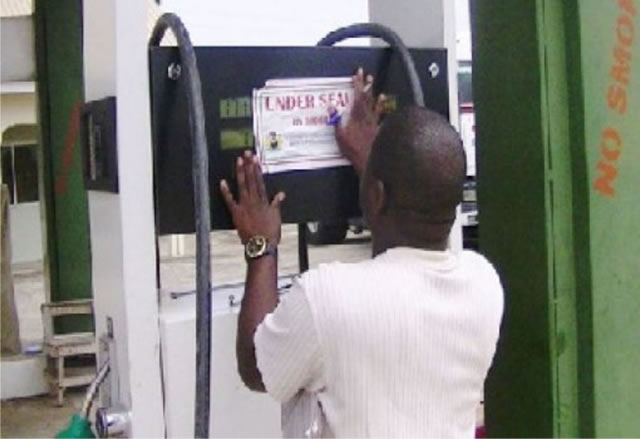
Twelve filling stations in Sokoto and Kebbi states were closed down by the Department of Petroleum Resources (DPR) for under-dispensing and operating without valid licence.

This was disclosed by the Zonal Operations Controller of DPR in charge of Sokoto and Kebbi states, Mr Muhammad Makera.

Mr Makera said the stations were sealed during unscheduled inspection by the department’s officials between Tuesday, September 17 and Thursday, September 19.

He said five filling stations were sealed for under-dispensing of petroleum products while the remaining seven were sanctioned for operating without valid licence and non-adherence to required safety precautions.

The DPR top employee also said the agency officials inspected at least 99 filling stations in both Sokoto and Kebbi states within the period, expressing shock that most of the stations’ managers feigned ignorance of the regulations of the department.

He then used the opportunity to warn petroleum marketers to desist from such sharp practices, saying severe sanctions awaited offenders. According to him, fuel stations ought to update their operational licences and regularize their operations promptly to avoid clampdown.

He charged consumers to report any suspicious or sharp practice noticed in any fuel station to the department for necessary action, kicking against the current trend of short-changing customers by filling stations.

He said that the department’s surveillance team was working to ensure availability of petrol at regulated price of N145 per litre and further cautioned marketers against flouting government regulations and customers against panic buying.


Adedapo Adesanya is a journalist, polymath, and connoisseur of everything art. When he is not writing, he has his nose buried in one of the many books or articles he has bookmarked or simply listening to good music with a bottle of beer or wine. He supports the greatest club in the world, Manchester United F.C.

Click to comment

Leave a Reply

Your email address will not be published. Required fields are marked *

General

Ogun APC Guber Candidate’s Wife Gives Cash Grants, Business Tools to Widows

Published

on

Yayi's wife Chadash Empowerment Foundation

By Modupe Gbadeyanka

About 3,000 widows in Ogun State have been empowered with cash grants and business tools by the wife of the governorship candidate of the All Progressives Congress (APC) in the state, Mrs Temitope Adeola.

Her husband, Mr Solomon Olamilekan Adeola, popularly known as Yayi, is currently the Senator representing Ogun West Senatorial District at the National Assembly.

He was picked as the consensus candidate of the ruling APC for the 2027 gubernatorial election.

Mrs Adeola is the founder of Chadash Empowerment Foundation, and to commemorate 2026 International Widows’ Day, she gave out the items through the organisation’s annual Widows’ Empowerment Programme, which birthed in 2021, as part of efforts to promote economic independence.

The empowerment programme, held at the Ake Palace Amphitheatre in Abeokuta, Ogun State, brought together widows from across the state for a day of capacity building, entrepreneurship support and social inclusion.

As part of the initiative, widows who completed the foundation’s vocational training programme received business tools to help them establish or expand their enterprises. The tools distributed included sewing machines, grinding machines, hair dryers, makeup kits, deep freezers, and gas cookers. In addition, 2,000 widows received cash grants of N50,000 each to strengthen existing businesses, improve household income and enhance their economic resilience.

Mrs Adeola said the initiative reflects the organisation’s unwavering commitment to empowering widows through sustainable economic opportunities rather than one-time interventions.

According to her, empowering widows extends far beyond financial assistance, as providing practical skills, vocational tools and start-up capital equips them to build sustainable livelihoods, regain their confidence and become financially self-reliant.

“Seeing more than 3,000 widows gathered here today with renewed hope and confidence reminds us why we remain committed to restoring dignity, creating opportunities, and empowering vulnerable women to achieve financial independence.

“At the Chadash Empowerment Foundation, empowerment goes beyond giving; it is about equipping people with the skills, resources, and confidence to build sustainable livelihoods that will positively impact their families and communities,” the politician’s wife stated.

She urged beneficiaries to make productive use of the support provided by investing in viable businesses that generate sustainable income and improve their families’ welfare.

“The heartfelt testimonies we continue to receive from our beneficiaries reaffirm our mission. Their stories of renewed hope, restored confidence, and brighter futures inspire us to do even more. Together, we are transforming grief into growth, despair into hope, and challenges into opportunities,” Mrs Adeola stated.

Since its inception, the Chadash Empowerment Foundation has impacted more than 15,000 widows across Ogun State and the Federal Capital Territory through vocational training, entrepreneurship support, cash grants, and sustainable livelihood initiatives.

Continue Reading

General

Xenophobia: FG to Seek Reparations for Nigerians Leaving South Africa

Published

on

nigerians in south africa1

By Adedapo Adesanya

The federal government will seek reparations from South Africa for Nigerians compelled to leave behind businesses and other assets as they voluntarily return home ahead of planned anti-immigrant protests.

Acting Nigerian High Commissioner to South Africa, Mr Alexander Ajayi, disclosed the plan on Tuesday during an appearance on Channels Television’s The Morning Brief, as another batch of evacuees was expected to arrive in Lagos under the government’s voluntary evacuation programme.

Mr Ajayi said the Nigerian government had instructed returnees to comprehensively document all businesses, vehicles, shops and other movable and immovable properties they were leaving behind to facilitate formal engagement with the South African authorities.

“I have asked them before they left yesterday to document very accurately those things they were leaving behind in terms of businesses, in terms of even cars, movable and immovable properties. We can now take it up with the South African government. That is the next step we are going to take.

“So, this repatriation will not end with just taking people to Nigeria. We are going to systematically follow up on the information given to us, and I told them to be very accurate with what they are going to give because we are going to work with the South African government to get to the exact locations of all these businesses, shops and properties and present them to the South African government for possible compensation because we will not allow the labour people have suffered to build over the years to just go down the drain or be taken over by people,” Mr Ajayi said.

According to him, Nigerian officials had already initiated discussions with South Africa’s Deputy Minister of Finance on the matter and would systematically verify the information provided by returnees before presenting claims for possible compensation.

He stressed that the evacuation exercise would not end with bringing Nigerians home, adding that the government was determined to ensure that years of investment and hard work by its citizens were not lost without redress.

The envoy also rejected claims that most Nigerians living in South Africa were undocumented, arguing that many entered the country legally but became victims of prolonged delays in the renewal of immigration documents due to administrative backlogs at the country’s Home Office.

He explained that the delays affected many foreign nationals, not only Nigerians, making it inaccurate to classify them as undocumented migrants.

Meanwhile, an Air Peace aircraft departed Nigeria on Monday to evacuate another group of Nigerians who voluntarily opted to return ahead of demonstrations planned by anti-immigration groups from June 30.

The federal government has continued its voluntary evacuation programme for Nigerians willing to leave South Africa as tensions over anti-immigrant protests persist.

Continue Reading

General

FG Delivers First Phase of Abuja-Kaduna-Kano Highway, Targets November Completion

Published

on

Abuja-Kaduna-Kano Highway

By Adedapo Adesanya

The federal government said it has completed the first section of 118-kilometre of the Abuja-Kaduna-Kano Highway, costing N257 billion, with the last section of 164-kilometre to be completed by November 2026.

The Minister of Works, Mr David Umahi, announced the development while briefing journalists after the Federal Executive Council meeting held at the Presidential Villa, Abuja, on Monday.

According to him, President Bola Tinubu has approved 27 road projects valued at over N3.9 trillion across 15 states as part of the Federal Government’s drive to improve road infrastructure nationwide.

According to the minister, the approved projects span Adamawa, Benue, Cross River, Ebonyi, Ekiti, Kogi, Kwara, Lagos, Niger, Ondo, Osun, Oyo, Plateau, Taraba, and Yobe states.

Mr Umahi said the council approved the re-award of the 409-kilometre dual carriageway project in Niger State under the tax credit scheme to businessman Aliko Dangote at a cost of N1.8 trillion.

“Other major approvals include N276 billion for the dualisation of the Ilorin-Ogbomoso Road; N265 billion for the reconstruction of the Iseyin-Eruwa-Agbesi Road linking Oyo and Kwara states; N217 billion for the dualisation of the old alignment from Ijaye through the Federal Government College to Ilorin Road with a spur to Akinmorin; and N116 billion for the 21-kilometre Abakaliki-Afikpo Road in Ebonyi State.

“The council also approved N110 billion for the Ogbomoso-Oko-Illupu Road in Oyo and Osun states; N104 billion for the rehabilitation of Sections One and Two of the Ilorin-Omorin-Ebe-Kabba-Obajana Road in Kwara and Kogi states; N98 billion for the construction of the 30-kilometre Idi-Araba-Ayede-Olodo Road in Oyo State; and N92 billion for the rehabilitation of the Baban-Lamba-Sharan Phase Two Road in Plateau State,” he said.

The minister stated that other approvals include N86 billion each for the reconstruction of the Enugu-Abakaliki Road with a flyover and the Adikpo-Ajayi-Tese-Akpa-Otukpo Road traversing Benue and Cross River states.

“Projects approved by the council further include N83 billion for the Jimeta-Mayo Belwa Road in Adamawa State; N82 billion for the rehabilitation of Igbeti Road in Oyo State; N74 billion for the construction of the Igbeti-Soro-Kishi Road in Oyo State; N71 billion for the 52-kilometre Dabban-Makina Road in Niger State; and N62.99 billion for the Tungo-Karamti Road with five bridges connecting Adamawa and Taraba states.

“The council also approved N58 billion for the rehabilitation of the Yola-Hong-Mubi Road Phase Two; N46 billion for the Amasiri-Okporojo Road; N34 billion for the 18-kilometre Ikere-Ekiti-Ijare Road linking Ekiti and Ondo states; N26 billion for a new flyover on the ongoing Trans-Sahara Road; N24.7 billion for the rehabilitation of the Kabba-Ifaki-Ado Ekiti Road linking Kogi and Ekiti states; and N21 billion for the construction of a flyover at Oko-Olowo Junction in Kwara State.

“Additional approvals include N15.7 billion for the construction of the Pacific Road linking Igbe Laara to Ikorodu in Lagos State; N15.5 billion for the 13-kilometre Badeku-Jaiye Road in Oyo State; N15.246 billion for Phase Two of the Yola-Fufore-Gurin Road project in Adamawa State, covering an additional 20 kilometres after the completion of the first 17-kilometre phase; and N15 billion as augmentation for the 32.2-kilometre Gashua Road project in Yobe State, which was originally awarded in 2022,” he stated.

Mr Umahi also said the council approved the full business case for the operation and maintenance concession of the Lagos-Ibadan Expressway and directed the commencement of reconstruction of failed sections along the Ibadan axis using concrete pavement.

Continue Reading

Trending