Connect with us

General

Nigeria Loses $157bn to Illicit Financial Flows in Nine Years

Published

on

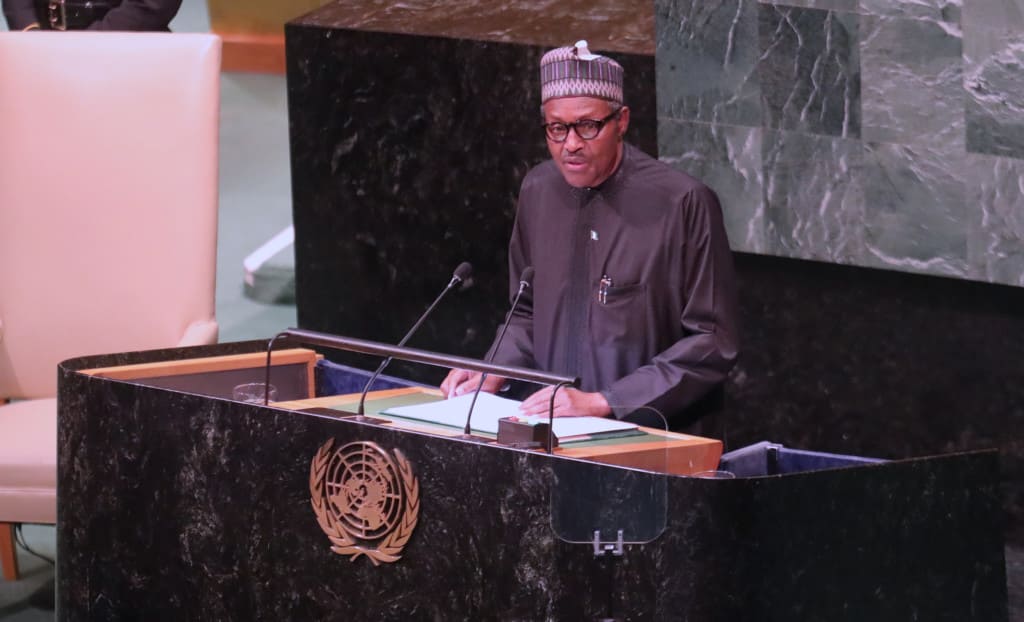
buhari at UNGA 73

By Adedapo Adesanya

President Muhammadu Buhari has disclosed that Nigeria lost over $157 billion to illicit financial flows in nine years between 2003 and 2012.

Mr Buhari made this disclosure during his address to the High-Level National Side-Event organised by the African Union Development Agency and New Partnership for Africa’s Development (AUDA-NEPAD) and the Economic and Financial Crimes Commission (EFCC) on Wednesday.

This came on the back of the 74th United Nations General Assembly, themed Promotion of International Cooperation to Combat Illicit Financial Flows and Strengthen Good Practices on Assets Recovery and Return to Foster Sustainable Development in New York.

The Nigerian president, quoting from the 2014 Global Financial Integrity Report, noted that the massive loss of assets resulted in dearth of resources to fund public services or to alleviate poverty in the country.

President Buhari, who in the 2015 presidential elections promised to focus on fighting corruption, reiterated his commitment to fighting corrupt practices, saying “This is why, as Africans, we have no choice but to break the back of corruption.”

Acknowledging lack of sufficient capital and corruption as impediments to socio-economic development of the continent, Mr Buhari said, “That is why our government has made it a war we intend to win. We will give all it takes to ensure there is no hiding place for purveyors of corrupt practices who are truly enemies of the people.”

Mr Buhari stressed that his administration had made significant progress to cub corruption and stressed the need to strengthen good practices on asset recovery and return, adding that Nigeria has recovered millions of dollars stolen from her shores.

However, he explained: “there are still a lot of other funds that are stuck in foreign bank accounts due to international laws, different jurisdictions and justice systems that make it difficult for repatriation.”

President Buhari lamented that these illicit financial flows do not only reduce Africa’s internally generated revenues but affects foreign exchange earnings, reduces tax revenues, drains natural resources, facilitates corruption and also hinders the growth of the private sector.

President Buhari also said tax avoidance was a major and stated that over $200 billion per year was lost by developing countries as a result of multinational enterprises defaulting on their taxes.

He said, “This amount is significantly higher than the annual development aid received by these countries which are estimated to be about US$143 billion.”

President Buhari, calling for cohesion on tackling illicit financial flows, said: “Any lasting solution to the above challenges will require international cooperation and coordination,” of African countries and their international counterparts.

“This is one reason why the Nigerian Government supports this initiative of AUDA/NEPAD and remains committed until we ensure that there are no safe-havens for stolen assets from Africa,” he declared.


Adedapo Adesanya is a journalist, polymath, and connoisseur of everything art. When he is not writing, he has his nose buried in one of the many books or articles he has bookmarked or simply listening to good music with a bottle of beer or wine. He supports the greatest club in the world, Manchester United F.C.

Click to comment

Leave a Reply

Your email address will not be published. Required fields are marked *

General

Jim Ovia Bets on Luxury Housing With New Multi-Billion Naira Lagos Towers

Published

on

Quantum Luxury Towers

By Adedapo Adesanya

Nigerian business leader and Zenith Bank founder, Mr Jim Ovia, is expanding his footprint in real estate with the construction of a 26-floor Metropolitan Towers residential development in Lagos, where units start at $1.85 million (N2.5 billion), as well as the completion of a 44-unit Quantum Luxury Towers high-rise, where apartments start from $2.8 million (N3.8 billion).

Mr Ovia, who until recently retired as the chairman of Zenith Bank, Nigeria’s biggest lender by market value, through his Quantum Luxury Properties Limited business, is seeking to deepen his property investments.

Among his most notable property investments is the transformation of previously underutilised waterfront land on Ozumba Mbadiwe in Lagos into premium commercial and hospitality assets. These developments include the Civic Centre, Civic Towers and hospitality properties that have become prominent landmarks within Lagos’ commercial landscape.

At a recent gathering, the businessman described real estate as a more profitable venture than banking, pointing to the significant value created through strategic property investments over the years.

Mr Ovia noted that some of his most rewarding investments have come from real estate developments rather than traditional banking operations.

His latest play comes as rapid urban population growth and increasing demand for commercial space have strengthened the real estate sector’s long-term fundamentals, while the country faces rising housing deficits.

After his retirement from Zenith Bank, following the completion of the regulatory maximum tenure of 12 years as a non-executive director and chairman under corporate governance guidelines of the Central Bank of Nigeria (CBN), Mr Mustafa Bello was announced as the new chairman, effective April 27, 2026.

Beyond banking and real estate, the tycoon has also developed a significant interest in telecommunications and technology, particularly Visafone in 2007, which he built to become Nigeria’s largest Code Division Multiple Access (CDMA) telco serving over 2 million subscribers and owned 800MHz spectrum licenses, setting the foundation for future 4G services.

In January 2016, South African telco group MTN bought Visafone for over N47 billion to improve its broadband services in its biggest market.

Continue Reading

General

Navy Intercepts 92,660 Litres of Illegally Refined Diesel in Rivers

Published

on

Illegally Refined Diesel

By Adedapo Adesanya

The Nigerian Navy has recorded another breakthrough in its campaign against crude oil theft and illegal refining in the Niger Delta, recovering 92,660 litres of suspected illegally refined Automotive Gas Oil (AGO), commonly known as diesel, along the Rivers-Bayelsa border.

The recovery was made under Operation Delta Sentinel following intelligence reports that led personnel of the Nigerian Navy Ship (NNS) SOROH to the Okolomade community in Abua-Odual Local Government Area of Rivers State.

According to a statement issued by the Director of Naval Information, Captain Abiodun Folorunsho, aerial surveillance and follow-up search operations uncovered about 138 sacks containing suspected illegally refined diesel. The products were reportedly hidden beneath thick vegetation and at several concealed locations along adjoining waterways.

The maritime force said the discovery highlights the evolving tactics being adopted by illegal petroleum operators, who increasingly use remote creek corridors and hidden storage points to evade detection by security agencies.

Mr Folorunsho noted that the recovered products were handled in line with existing regulatory procedures, effectively preventing them from being distributed through illegal channels.

He stated that the operation forms part of ongoing efforts to dismantle networks involved in crude oil theft, illegal refining and unauthorised petroleum distribution across the Niger Delta. Solid minerals reports

“The operation demonstrates our continued commitment to intelligence-driven actions aimed at disrupting economic sabotage and protecting Nigeria’s critical oil and gas assets,” the statement said.

The latest recovery adds to a series of recent successes recorded by security agencies in the region as authorities intensify efforts to curb oil theft, protect national revenue, improve environmental security in oil-producing communities and help the Nigerian economy

The Nigerian Navy reaffirmed its resolve to sustain surveillance and enforcement operations across the Niger Delta, stressing that collaboration with local communities and timely intelligence remain critical to combating illegal petroleum activities.

Continue Reading

General

Nigerian Telco Operators Reject NBS Telecom Foreign Investment Figures

Published

on

nigerian Telco Operators

By Adedapo Adesanya

Nigerian telecommunication operators, under the Association of Licensed Telecommunications Operators of Nigeria (ALTON), have disputed capital importation data released by the National Bureau of Statistics (NBS), insisting it underrepresents the sector’s total investment, which they put at N2.13 trillion in capital expenditure in 2025.

The stats office in the Nigerian Capital Importation data for the first quarter of 2026, released last Friday, said foreign investment in the telecom sector fell 91 per cent to $7.24 million from $80.78 million in 2025.

In a statement issued on Monday, jointly signed by ALTON’s Chairman, Mr Gbenga Adebayo, and Publicity Secretary, Mr Damian Udeh, the group said it welcomed the NBS report but stressed that the data needed a broader context to properly reflect sector dynamics.

“While we recognise the importance of accurate data in shaping investor perceptions and guiding policy decisions, we believe that additional context regarding the telecommunications sector’s current investment landscape will provide stakeholders with a more comprehensive understanding of the industry’s health and trajectory,” ALTON stated.

The telco operators argued that although the report shows a decline in foreign capital importation from $80.78 million in 2025 to $7.24 million in the first three months of 2026, the figures capture only a portion of total capital deployed in the sector.

The statement noted that the industry’s capital expenditure profile suggests investment is increasingly being driven by domestic capital sources and reinvested earnings, financial mechanisms that may not be fully captured in traditional capital importation data.

“The sector’s recovery is reflected in sustained capital deployment. In 2025, mobile network operators, tower companies, and other players in the sector recorded a total capital expenditure of N2.13tn, with a planned capital expenditure of N1.86tn for 2026, directed towards network infrastructure expansion,” the association said.

According to ALTON, the investment momentum reflects the impact of policy support measures, including a 50 per cent tariff increase approved in 2025 by the federal government.

ALTON said the tariff adjustment in January 2025 played a pivotal role in stabilising the telecoms sector, addressing critical revenue sustainability gaps, and restoring operational viability during a particularly challenging period.

It added that operators have since moved from financial distress toward a more sustainable investment cycle, with continued capital deployment into network infrastructure.

The group warned that the gap between official foreign inflows and actual sector spending highlights limitations in how telecom investment is currently measured.

“This disparity between reported foreign capital inflows and actual infrastructure investment highlights a gap in how sectoral capital deployment is currently measured and reported,” ALTON said.

It then called for a joint framework involving the Nigerian Communications Commission (NCC), the NBS, and the Central Bank of Nigeria (CBN) to improve tracking of telecom investment flows.

Continue Reading

Trending