Connect with us

Economy

Investor Grabs $629m Loan to Deliver Lekki Seaport 2022

Published

on

By Dipo Olowookere

A $629 million financing facility to accelerate the completion of the Lekki Deep Seaport project, which started in 2011, has been sourced from China Development Bank (CDB).

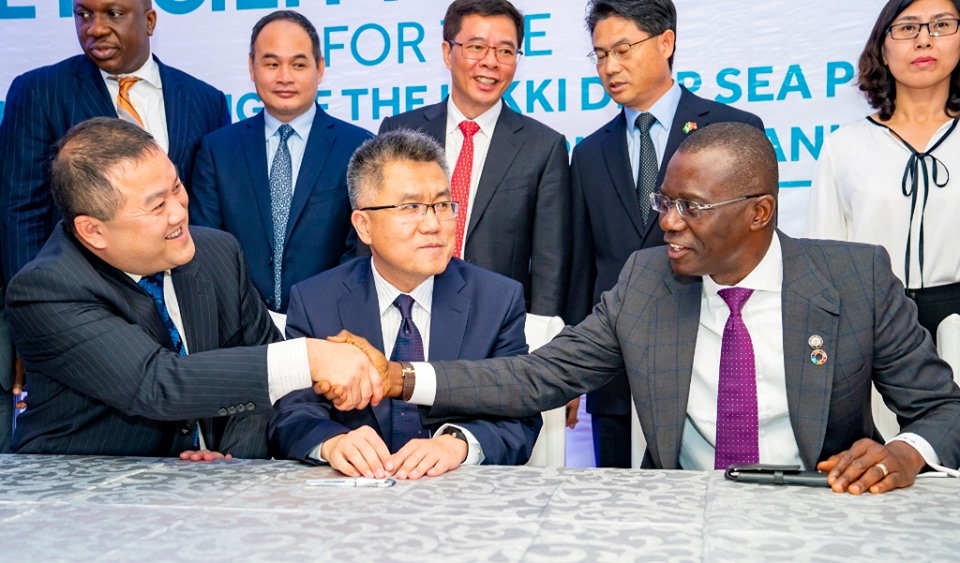
With this loan secured, China Harbour Engineering Company (CHEC), which owns majority shares in the project, is posed to complete the project in 30 months’ time (2022). The company signed a 45-year concessionary agreement with Lekki Port LFTZ Enterprise Limited (LPLTZ) to complete the Phase 1 of the deep seaport project.

This was witnessed on Wednesday by Governor Babajide Sanwo-Olu of Lagos State, who described this development as “another milestone” for the state in infrastructural development and commerce, saying the signing of the agreements ended period of uncertainty that had trailed the delivery of the project.

He noted that the completion of the project would invigorate the Lagos economy and push it up in the index of largest economy in the world.

After completion, the deep seaport would have two container berths of 680-metre long and 16.5-metre water depth. It will also have the capacity to be berthed by fifth generation container ships, which has a capacity of 18,000 TEU ship.

“This is a new beginning for us in Lagos. We have achieved another milestone in our efforts to transform the State and accomplish the 21st century economy ambition. As a Government, we are fully in support of the project. We will do all we can to ensure the terms of the agreements signed today are delivered within 30 months as agreed and we expect the outcome would catalyse Lagos’ fifth largest economy and take it up more in the index of largest economies in years to come,” the Governor said.

He said further that in the coming weeks, more trade agreements would be signed with foreign investors, adding that his administration would continue to explore investments and partnerships that would accelerate growth and benefit residents of the state.

Chairman of CHEC, Mr Lin Yichong, said the Chinese engineering firm took interest to invest in the deep seaport to enable Nigeria strengthen its maritime infrastructure and business by building the first deep seaport that would ease of pressure at Tin Can Island and Apapa ports.

The Phase 1 of the project, Mr Yichong said, will be built with annual handling capacity of 1.2 million TEU, adding that the capacity would be increased to 2.5 million TEU upon the completion of the second phase.

“After the completion of the Lekki port, it would become the first deep seaport in Nigeria and the container transportation hub in Africa. It would also release big pressure off Apapa and Tin Can Island ports.

“In the course of the construction of the project, it is expected that a huge number of employment opportunities would be generated for residents of Lagos,” he assured.

CDB Deputy General Manager, Mr Zhang Aijun, said the bank approved the loan facility, given the strategic importance of the project to Lagos’ economic growth. He said the bank considered the investment as basis for expanding its business in Nigerian and contributing to the development of the nation.

Managing Director of Tolaram Group in Africa, Mr Haresh Aswani, hailed Lagos Government for supporting the project since the beginning, adding that the completion of the deep seaport would change narrative of foreign partnerships with the government of Nigeria.

Chairman of Lekki Port Board of Director, Mr Biodun Dabiri, noted that the development of the seaport was strategic for the growth of Lekki Free Trade Zone, pointing out that it would make “immense impact” on the nation’s economy by creating more than 200,000 jobs and generating about $350 billion in revenue for the State over the period of the concession.

“The loan facility represents a significant milestone, which when combined with foreign direct investment of $230 million through equity injection by CHEC, will ensure a successful delivery of the seaport and reposition Nigeria as the transshipment hub in sub-Saharan Africa upon the conclusion of the second phase.

“The project is strategic for the economic growth of Lekki Free Zone, as it would support the massive industrial and petrochemical complex being embarked on in the Northern and Southern quadrant of the zone with investment over the next three years peaking at over $20 billion.

“With Lekki Airport in view, there will be an emergence of a Harbour City which would be internationally connected by air and also with world-class integrated transport network of roads, rail and bridges,” he stated.

Mr Dabiri said the concessionary agreements had the support of both the Federal and the Lagos governments, observing that the investors agreed with the terms and conditions laid down by the Nigeria Port Authority (NPA) and Lekki Worldwide Investment.


Dipo Olowookere is a journalist based in Nigeria that has passion for reporting business news stories. At his leisure time, he watches football and supports 3SC of Ibadan. Mr Olowookere can be reached via [email protected]

Advertisement
Click to comment

Leave a Reply

Your email address will not be published. Required fields are marked *

Economy

SEC, NOA to Sensitize Nigerians to Illegal Investment Schemes

Published

on

Investments and Securities Act 2025

By Adedapo Adesanya

The Securities and Exchange Commission (SEC) and the National Orientation Agency (NOA) have partnered to enlighten Nigerians on illegal investment schemes in Nigeria.

The director-general of SEC, Mr Emomotimi Agama, stated this during a meeting with his NOA counterpart, Mr Lanre Issa-Onilu, in Abuja on Thursday, according to a statement from SEC.

Mr Agama said the capital market is an available tool for national development, but beyond all that, there is a tendency for people to do the wrong things that will lead to the impoverishment of Nigerians.

According to him, these are not supposed to be, but many people fall victim due to a lack of knowledge. He stated that these schemes are springing up daily, and those involved are defrauding Nigerians, as people are always gullible because of the need to survive.

“As a management, we decided to move out to enlighten people; we cannot assume that people know, we need to go out for mass communication, hence this collaboration. It is only by co-operation that we can achieve the purpose of our existence,” he stated.

The SEC DG solicited the co-operation of the NOA to reach Nigerians because of its capacity and vast network of mass media, in a bid to ensure that the message reaches every nook and cranny of the country.

“This collaboration is important because it will go a long way in ensuring that Nigerians are no longer victims of these fraudulent schemes. We appreciate that you value this country, and we value the work that you do,” he added.

On his part, Mr Issa-Onilu commended the SEC for the capital market’s achievements in recent times, adding that the commission has not been celebrated enough.

“We commend you and thank you on behalf of the country, but most Nigerians are not aware of the opportunities in the capital market. An ignorant society will fall victim to many things that are avoidable. It is our responsibility to enlighten people to make the right decisions.

“We request that you provide information on what you do to enable us to propagate them. Our primary assignment is to serve all government institutions as the communications arm. We do a lot of enlightenment in places like the religious houses, motor parks, town halls, among others.”

Mr Issa-Onilu said the NOA engages in civic education to create the right values that will help most Nigerians be better citizens, saying that “many Nigerians are deficient in good behaviour. Both the Ponzi scheme promoters and those who patronise them are suffering from the wrong attitude and values.

“We have to encourage people to have the right attitude so they do not fall victim to Ponzi schemes. We have created a lot of platforms to interact with Nigerians.”

Continue Reading

Economy

NNPC Records N5.7trn Post-Tax Profit in 2025, Generates N60.52trn

Published

on

NNPC guarantee energy security

By Adedapo Adesanya

The Nigerian National Petroleum Company (NNPC) Limited booked a Profit after Tax of N5.760 trillion after generating N60.517 trillion in revenue in 2025.

According to its monthly report published on Thursday, the sum of N14.706 trillion was remitted to statutory government agencies.

It said crude production dipped slightly in December, the last month of the year, from earlier months due to scheduled maintenance and several unplanned outages.

The report indicated that crude oil and condensate production averaged 1.54 million barrels per day in December 2025, while natural gas production stood at 6.914 billion standard cubic feet per day.

NNPC further disclosed that its retail outlets achieved 65 per cent product availability in December, while upstream pipelines recorded 100 per cent availability during the period.

On key infrastructure projects, the company stated that the Obiafu-Obrikom-Oben (OB3) pipeline project reached 91 per cent completion, while the Ajaokuta-Kaduna-Kano (AKK) pipeline project also attained 91 per cent completion.

The report from the Nigerian state oil company noted that December production performance was affected by planned maintenance at the Stardeep-Agbami and Renaissance–Estuary Area facilities, as well as unplanned production outages.

In its previous monthly update, NNPC disclosed that revenue declined by 14.17 per cent in November 2025 to N4.358 trillion, down from N5.078 trillion recorded in October.

Despite the drop in revenue, profit after tax rose by 12.3 per cent to N502 billion in November, compared with N447 billion in October.

The report also showed that the company made statutory payments of N967 billion to the government in October, bringing total remittances between January and October to N12.117 trillion.

NNPC said all figures remain provisional pending final reconciliation with stakeholders.

Continue Reading

Economy

N636bn BoI Loans to MSMEs Validate Economic Reform Agenda—Tinubu

Published

on

Bank of Industry BoI MSMEs

By Modupe Gbadeyanka

President Bola Tinubu has expressed satisfaction with the disbursement of N636 billion as loans to business owners in the Micro, Small and Medium Enterprises (MSMEs) in the country by the Bank of Industry (BoI) in 2025.

In a statement signed by his Special Adviser on Information and Strategy, Mr Bayo Onanuga, the Nigerian leader disclosed that the development validates his government’s economic reform agenda.

Over 7,000 enterprises were given soft loans worth N636 billion by the lender last year, the highest annual financing volume in the institution’s history.

A breakdown of the financing shows that N202 billion was allocated to agro-allied enterprises, N100 billion to critical national infrastructure, including broadband, power, aviation, and transportation, N79 billion to manufacturing, N77 billion to extractive industries, and N55 billion to services.

In addition, the bank deployed N73 billion in managed and matching funds on behalf of state governments and institutional partners.

Under the BoI 2025 disbursement, strategic interventions included upgrading a tomato processing facility from 3.1 metric tonnes per hour to 10 metric tonnes per hour and linking 47,508 smallholder farmers to formal processing value chains.

The bank also supported the deployment of 100 mini-grids in partnership with global development finance institutions, connecting 11,777 new customers to electricity. BOI-financed projects contributed to an estimated annual reduction of over 20,000 tonnes of carbon emissions.

“The N636 billion disbursed by the Bank of Industry in 2025 translates directly into productive capacity across Nigeria. It financed agro-processing expansion, strengthened manufacturing output, supported infrastructure delivery, and empowered thousands of enterprises across our states.

“At a time of global financing constraints, Nigeria expanded access to long-term capital for its businesses. That is a direct outcome of reform, credibility, and institutional discipline,” Mr Tinubu said.

It was observed that disbursement by business size reflects a deliberate inclusion strategy. Nano enterprises received N51 billion. Micro businesses accessed N32 billion. Small and medium enterprises received N178 billion in financing, while large enterprises accounted for N375 billion.

Under the federal government’s N200 billion MSMEs intervention programme, BoI recorded over 95 per cent performance as the disbursing institution. The Presidential Conditional Grant Scheme reached 957,400 beneficiaries in 2025 alone.

In addition, BOI’s financing activities led to the creation and retention of approximately 1.6 million jobs. The bank supported more than 7,000 MSMEs and 570 startups during the year.

Inclusive financing initiatives also recorded a measurable impact. Through the Guaranteed Loans for Women Programme, a N10 billion gender-focused facility providing up to N50 million per beneficiary, women-owned enterprises expanded access to affordable credit. Youth-owned enterprises received N12 billion in financing. Under the Rural Area Programme on Investment for Development, 880 rural-based enterprises across the 36 states and the FCT accessed over N6.5 billion.

The President further noted that BOI maintained strong asset quality, recording a non-performing loan ratio below 1.5 per cent despite macroeconomic headwinds. He also acknowledged the €2 billion syndicated facility secured in 2024 and the additional €210 million mobilised from international partners in 2025, which strengthened the Bank’s lending capacity.

“Development finance must be disciplined, measurable, and aligned with national priorities. What we are witnessing is the transition from strategy to scale.

“Our economic transformation will be built on production, value addition, and enterprise growth. We will continue to crowd in capital, deepen institutional reform, and ensure that access to finance supports real sector expansion across Nigeria,” President Tinubu stated.

He reaffirmed his administration’s resolve to consolidate reform gains and expand credit access to enterprises as part of a long-term strategy to accelerate industrialisation and inclusive economic growth.

Continue Reading

Trending