Connect with us

Feature/OPED

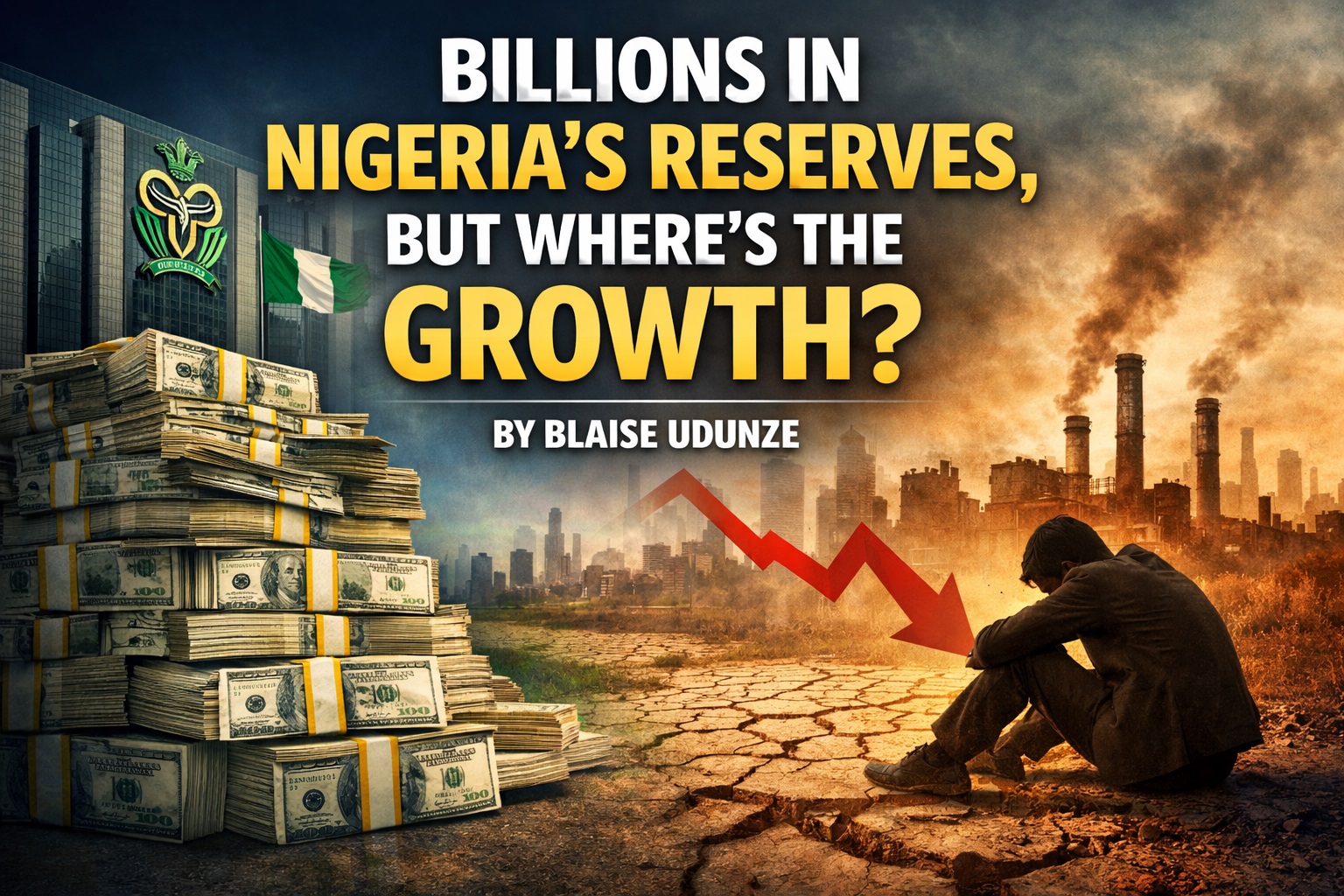
Billions in Nigeria’s Reserves, But Where is the Growth?

Published

on

Billions in Nigeria’s Reserves

By Blaise Udunze

The moment the Governor of the Central Bank of Nigeria (CBN), Olayemi Cardoso, recently announced that Nigeria’s foreign reserves had inched to $49 billion as of February 5, 2026, the news was received with understandable enthusiasm.

He described the development as “a very important statistic” when speaking at the 2nd National Economic Council (NEC) Conference in Abuja, while noting a 4.93 per cent increase and emphasising that Nigeria had moved from being a net seller to a net buyer of foreign exchange. He cited improved remittance inflows, a narrowing gap between official and parallel market exchange rates, and greater confidence in the naira as evidence that reforms were working.

On the surface, the numbers are reassuring. The premium between official and parallel market rates has reportedly fallen to under 2 per cent. Remittances have improved following deliberate engagement with the diaspora. Nigerians can increasingly rely on naira cards for international transactions. It can be said that investors are earning positive real returns, banks are recapitalising, equity markets are recovering, and macroeconomic indicators such as GDP growth of 3.98 per cent, a current account surplus of $3.42 billion in the third quarter of 2025, and a reported moderation in inflation to 15.15 per cent are presented as signs of stabilisation.

So far, beyond the celebratory headlines lies a deeper and more consequential question, in the form of, what does the fixation on foreign reserves really tell us about the underlying strength of the Nigerian economy?

History and economic logic suggest that when a central bank repeatedly elevates foreign reserves as a central achievement, it often signals that the true engines of growth are either weak or underdeveloped. Strong reserves are not built through declarations, press conferences, or defensive monetary manoeuvres. They are built through systems that generate value, exports, productivity, and trust. Countries with durable reserve positions did not chase reserves; they built economies that produced them naturally.

This distinction matters greatly for Nigeria.

Foreign reserves are important, but they are not a development strategy. They are a buffer, not a foundation. They are an outcome of economic vitality, not a substitute for it. When reserves become the centrepiece of economic storytelling, there is a risk that policymakers mistake statistical comfort for structural strength.

Even Nigeria’s celebrated $49 billion reserve figure requires closer scrutiny, which appears to be more of sexing up the figures. Gross reserves make headlines, but net usable reserves are what protect a currency in moments of stress. A significant portion of reported reserves is often tied up in swaps, forward commitments, and external obligations. When these are stripped out, the net buffer available to defend the naira is far smaller than the headline figure suggests. The gap between gross and net reserves is too large to justify unqualified confidence about currency stability, especially in an economy that remains import-dependent and structurally fragile.

The danger of over-fixating on reserves is not unique to Nigeria, but it is particularly acute here because of the economy’s narrow production base, which subliminally calls for sexing up the figures. Despite decision-makers prematurely applauding the reserves’ growth, the apex bank must rethink its approach. The reserves are not generated through production-based or stronger export means but rather largely from borrowing (sales of Eurobonds) or through government loans, which come in as dollars to the CBN that temporarily boost dollar inflows.  This points to the fact that Nigeria still exports little beyond crude oil, imports most manufactured goods, and relies heavily on volatile capital inflows. In such a context, reserves require constant defence rather than organic replenishment. Tight monetary policy, FX restrictions, and moral persuasion may buy time, but they do not solve the underlying problem of insufficient foreign exchange generation.

By contrast, countries with strong reserve positions followed a very different path. Unlike Nigeria, countries like Saudi Arabia, with foreign reserves of about $410 billion, paired subsidy reforms with visible reinvestment in infrastructure, social welfare, and alternative energy systems. Indonesia, with reserves of roughly $153 billion, combined fiscal reforms with expanded social assistance and a shift toward targeted household support, ensuring that reform pain was offset by tangible benefits. Reserves are mainly meant to grow from productive economic activities like Singapore, whose reserves stood at approximately $397 billion at the end of 2025, as it built its position through decades of disciplined industrial policy, export competitiveness, domestic savings, and institutional credibility. In all these cases, reserves were not the objective; they were the by-product of deliberate economic architecture.

In most successful developmental states, public expenditure plays a catalytic role in growth. Unlike Nigeria’s, most countries’ expenditures It crowds in private investment, expand infrastructure, lower transaction costs, and build productive capacity. Over time, this deepens domestic capital formation, drives industrial productivity, supports export diversification, and strengthens external balances. Nigeria’s recent experience, however, appears to diverge from this model.

Rather than deploying fiscal policy aggressively to stimulate productive capacity, government financing has increasingly leaned on the domestic capital market. While this approach has attracted foreign capital inflows, much of this capital has been short-term portfolio investment into treasury bills, government bonds, and money market instruments. A fact that is well established is that these inflows can temporarily stabilise liquidity and support the exchange rate, but their multiplier effects on the real economy are minimal. In the absence of strong productive investment for a country like Nigeria, the giant of Africa, this pattern resembles constructing a skyscraper on weak foundations, which is impressive in appearance, but structurally fragile.

This fragility is evident in the broader economy. Especially this kind of growth is associated with Nigeria in 2025, which portrays a country that is increasingly survival-led rather than productivity-driven. The underlying challenge today is that households, small businesses and even industrial firms are left with no option but to adapt to rising costs and shrinking real incomes by expanding low-productivity activities. Industrial depth remains shallow. Domestic capital accumulation is weak. Export capability outside oil is limited. Labour productivity continues to lag. These are not the conditions under which reserves become self-sustaining.

This is why the central bank’s strategic focus must extend far beyond reserve accumulation. If the CBN genuinely seeks to grow the economy and build reserves sustainably, it must prioritise the mechanisms that generate foreign exchange organically. The most important of these is productive credit expansion. Central banks around the world are expected to shape economies not only through interest rates but through the direction of credit. Prolonged monetary tightness may suppress inflation at the margins, but it also suppresses investment, output, and employment, as is the case in Nigeria. Contrary to Nigeria’s lived experience, countries that successfully built reserves deliberately channelled affordable, long-term credit to manufacturing, agro-processing, and export-oriented sectors, but the same cannot be said of Nigeria. Nigeria cannot tighten its way into prosperity.

Closely linked to this is the need for a serious export-led industrial strategy. Nigeria’s trade challenge is often framed as an import problem, but it is fundamentally an export deficiency. Banning imports or rationing foreign exchange does not create competitiveness. Export growth does. Sustainable reserves come from selling more to the world than one buys, particularly in manufactured goods and tradable services. Oil exports may still matter, but they are volatile and finite. Value-added exports are repeatable, scalable, and employment-intensive.

Exchange rate stability, too, must be approached through supply rather than fear. Currency pressure reflects insufficient FX supply more than excessive demand. Strengthening real economic fundamentals, which calls for expanding non-oil exports, formalising remittance channels, and attracting long-term productive capital, will do more to stabilise the naira than administrative controls mixed with sexing up figures. Predictability matters, and for this reason, investors may tolerate risk, but they may be forced to withdraw when policies are inconsistent.

Infrastructure financing is another critical missing link. No economy exports competitively without reliable power, efficient transport, and functional logistics. While infrastructure is often treated as a purely fiscal responsibility, central banks in many emerging economies have played catalytic roles in financing industrial infrastructure. Supporting industrial parks, logistics hubs, processing zones, and energy projects would address one of the root causes of Nigeria’s weak export performance and fragile reserves.

Equally important is the mobilisation of domestic savings. Strong reserves are easier to build when a country funds its development internally. One of its domestic savings that has been lying fallow is that Nigeria’s pension and insurance funds remain under-deployed in productive sectors. For a country that is truly angling for growth and with the right regulatory frameworks, these long-term pools of capital can support infrastructure, manufacturing, and export industries, reducing dependence on volatile foreign inflows.

Inflation control must also be re-examined. This is one grey area with Nigeria’s system as its inflation is largely cost-driven, fueled by energy costs, logistics bottlenecks, FX shortages and insecurity. It must be understood that addressing it solely through interest rate hikes risks shrinking output in terms of economic production and growth while prices remain elevated, as is the case today. The policy-makers in Nigeria must understand that supply-side interventions that reduce production costs and stabilise input availability are more likely to deliver durable price stability and stronger reserves than monetary tightening, especially in the case of raising interest rates alone.

The CBN has projected that GDP growth could reach 4.49 per cent, inflation could moderate to 12.9 per cent, and reserves could exceed $50 billion. These projections are presented as evidence of consolidation. Yet many economists caution that macroeconomic stability, while necessary, is not synonymous with sustainable growth. Even if the provided official statistics may suggest that the economy is improving, the reality is that the majority of the populace are not experiencing the benefits, as is the case in Nigeria, where the unemployment rate is high, wages aren’t keeping up with costs, and many households are barely making ends meet.

To further drive the point, Gbenga Olawepo-Hashim has argued that the true measure of economic performance is not headline figures but the living conditions of citizens. This is to say that economic growth is meaningless if it doesn’t create jobs, purchasing power, and opportunity, cannot sustain political or social stability, nor can foreign reserves grow sustainably.

Going forward, it is advisable that the foreign reserves, therefore, should be read for what they are, as a reflection of deeper economic health. When production expands, exports diversify, infrastructure improves, capital deepens, and trust is restored, reserves grow quietly and sustainably. When these foundations are weak, reserves require constant defence and loud celebration.

Today, Nigeria is at a critical point where it must make a major decision, either the choice is between managing reserves endlessly or building an economy that earns them effortlessly. The former offers headlines and is unsustainable. The latter offers prosperity, and it is sustainable in the long term.

Blaise, a journalist and PR professional, writes from Lagos and can be reached via: [email protected]

Click to comment

Leave a Reply

Your email address will not be published. Required fields are marked *

Feature/OPED

Nigerian Opposition: What You Have to Do

Published

on

Nigerian Opposition

By Prince Charles Dickson, PhD

“And Jesus said to Judas… what you are going to do, do quickly.”

There is a hard, almost rude lesson in that line. History does not wait for the timid to finish their committee meeting. Politics, especially Nigerian politics, is not kind to hesitation dressed as strategy. It rewards those who understand timing, nerve, structure, and the brutal arithmetic of power. That is where the Nigerian opposition now stands: not at the edge of impossibility, but at the edge of urgency.

The first truth is the one opposition politicians do not enjoy hearing at rallies where microphones are loud, and introspection is scarce. They are not getting it right. The evidence is not only in Tinubu’s strength, but in their own disorder. INEC said on February 5, 2026, that there were now 21 registered political parties and warned that persistent internal leadership crises within parties pose a serious threat to democratic consolidation. Eight days later, the commission formally released the notice and timetable for the 2027 general elections. In other words, this is no longer the season of abstract grumbling. The whistle has gone. The race is live.

Yet the opposition often behaves like students who entered the examination hall with righteous anger but forgot their pens. Too much of its energy is spent on lamentation, rumours, courtroom oxygen, personality feuds, and that old Nigerian hobby of mistaking noise for architecture. You cannot defeat an incumbent machine by forming a WhatsApp coalition of wounded egos and calling it national salvation. Voters may clap for drama, but they still ask the unromantic question: who is in charge, what is the plan, and why should we trust you with the keys?

Now comes the more uncomfortable truth. The opposition is not facing an ordinary incumbent. It is facing Bola Ahmed Tinubu, a man whose political DNA was forged in opposition. He is not merely benefiting from power; he understands opposition as craft, pressure, infiltration, timing, persistence, and theatre. In his June 12, 2025, Democracy Day speech, he taunted rivals by saying it was “a pleasure to witness” their disarray, while also reminding Nigerians that he once stood almost alone against an overbearing ruling machine. This was not casual banter. It was a warning shot from a politician who knows both the grammar of resistance and the machinery of incumbency.

That is why copying Tinubu’s old template will not be enough. Yes, the coalition instinct is understandable. In July 2025, major opposition figures, including Atiku Abubakar and Peter Obi, aligned under the ADC banner, presenting themselves as a bulwark against one-party drift, with David Mark as interim chairman. But here is the problem: Tinubu’s own coalition history worked not simply because men gathered in one room and glared at the ruling party. It worked because there was a disciplined merger logic, state-level anchoring, message coordination, and a ruthless understanding of elite bargaining. What the present opposition sometimes offers instead is photocopy politics with low toner: a coalition of convenience trying to frighten a man who practically wrote the Nigerian handbook on political accommodation, defection management, and patient conquest.

This is also why the opposition’s moral complaint, though not baseless, cannot be its only language. Yes, concerns about democratic shrinkage are real. Tinubu himself publicly denied that Nigeria is moving toward a one-party state, even as defections from opposition parties to the APC intensified and his own party welcomed them. But to say “democracy is in danger” is not yet the same thing as building a democratic alternative. Nigerians do not eat constitutional anxiety for breakfast. They want a credible opposition that can protect pluralism and still explain food prices, jobs, security, power supply, transport costs, and what exactly it would do on Monday morning after taking office.

On the government’s side, the picture is mixed enough to make both triumphalism and apocalypse look unserious. Reuters reported this week that the World Bank expects Nigeria’s economy to grow by about 4.2% in 2026, with external buffers improving and the debt-to-GDP ratio falling for the first time in a decade. Inflation had eased to 15.06% in February from roughly 33% in late 2024. Those are not imaginary numbers, and any fair-minded analysis must admit that Tinubu’s reforms have altered the macroeconomic conversation. But the same report warned that the Iran war has pushed fuel prices up by more than 50%, with obvious consequences for transport, food, and household pain. Add the continuing insecurity, underscored again this week by the killing of a Nigerian army general in Borno, and the government begins to look like a man who has repaired the roof but left half the house still flooding. That is not a collapse. It is not a command either. It is a meandering reform under political stress.

So, what must the opposition do, and do quickly? First, it must stop making Tinubu the only subject of the campaign. Anti-Tinubu is not a manifesto. It is a mood. Moods trend; structures win. Second, it must settle leadership questions early and publicly, because no voter wants to hire a rescue team still fighting over the steering wheel. Third, it needs an issue coalition, not just an elite coalition. Security, inflation, youth jobs, electricity, federalism, and institutional reform must become a coherent national offer, not a buffet of press conference talking points. Fourth, it must build from the states upward. Presidential romance without subnational organisation is political karaoke: loud, emotional, and usually off-key by the second verse.

Fifth, it must look seriously at the legal terrain. The Electoral Act 2026 has made party organisation even more central. PLAC notes that the new law tightens party registration rules, removes deemed registration, expands INEC’s regulatory discretion, and preserves the fact that candidates still need political parties as the vehicle for contesting most elective offices because independent candidacy is not permitted. In plain language, parties matter even more now. A fragmented opposition is therefore not just aesthetically untidy. It is strategically suicidal.

Still, there are dangers in the opposite direction, too. A desperate anti-Tinubu mega-bloc could become a cargo truck of incompatible ambitions. If all it offers is the promise to defeat one man, it may reproduce the same habits it condemns once power arrives. Nigeria does not need a ruling party so swollen that democracy gasps for air. But it also does not need an opposition whose only ideology is turn-by-turn revenge. The health of democracy lies somewhere between monopoly and mob. It requires competition with content, not merely competition with bitterness. Tinubu himself, in that same June 12 speech, defended multiparty politics even while mocking the opposition’s disorder. That irony should not be wasted. He has thrown them both an insult and an assignment.

So, yes, the opposition is right to worry. But worry is not a strategy. Outrage is not an organisation. The coalition is not coherent. And history is not sentimental. The man they are up against is ruthless, seasoned, and intimate with the dark arts of democratic combat. He knows the game. Some of his opponents are still learning the rules from old newspaper cuttings.

Which brings us back to the scripture. What you are going to do, do quickly. Not recklessly. Not hysterically. Quickly. Settle your house. Name your purpose. Offer something fresher than recycled indignation. Build a machine that is not merely anti-Tinubu but pro-Nigeria in a way ordinary Nigerians can feel in their pockets and in their pulse. Otherwise, the opposition will keep arriving at battle dressed in borrowed armour, only to discover that the tailor works for the man they came to unseat—May Nigeria win!

Continue Reading

Feature/OPED

The Digital Imperative for Women-Led Businesses in Nigeria

Published

on

Gloria Onosode FairMoney

By Gloria Onosode

Nigeria is targeting an ambitious $1 trillion economy by 2030. To achieve this, women-led businesses must transition from mere passive observers to primary growth drivers at the heart of the economy and strategic participants in their respective industries.

According to the National Bureau of Statistics (NBS), the increased ownership rate of MSMEs by women represents a significant contribution to economic growth and job creation. Digital empowerment for these enterprises must move from being a social responsibility or gender support initiative to contributing to broader economic development.

To reach the $1 trillion GDP milestone, women-led businesses must be positioned to operate at a macroeconomic scale. This requires moving beyond subsistence trading and into the digital value chain.  For instance, a fashion designer in Aba, through digital positioning, can access broader markets and commercial networks and thereby facilitate better record-keeping and data-driven decision-making, supporting improved financial record-keeping, which may be considered in credit assessments by financial institutions.

FairMoney Microfinance Bank (MFB), a bank licensed and regulated by the Central Bank of Nigeria, contributes to the digital transitioning of small businesses in Nigeria by providing tools specifically designed for the realities of the Nigerian entrepreneur. For women, whose businesses often fluctuate with seasonal demands or family needs, the ability to protect and grow capital is paramount. FairMoney MFB offers features that empower women to move from informal ‘under-the-mattress’ savings to digitised interest-bearing savings products. By embracing digital transition, tech-based saving platforms can enable business owners to set specific goals, such as purchasing new equipment,  saving towards business goals in a disciplined manner, while earning interest at applicable rates.

For that business owner who requires immediate liquidity, our flexible savings feature offers interest while allowing for withdrawal access that is subject to applicable terms and conditions to cover emergency restocks. For longer-term scaling, our fixed-term savings feature allows entrepreneurs to lock away funds for a fixed period and accrue interest based on product terms, subject to terms and conditions. By automating savings and providing interest at applicable rates, FairMoney MFB is designed to support financial planning and resilience over time for women-led SMEs.

Nigerian women are among the most entrepreneurial globally, consistently defying structural barriers to build enterprises from the ground up. According to the Small and Medium Enterprise Development Agency of Nigeria (SMEDAN), Nigeria has approximately 39.6 million nano, micro, small, and medium enterprises. Charles Odii, Director General at SMEDAN in 2024, also recently shared that approximately 72% of these enterprises are now classified as being owned or led by women. This is a significant jump from previous years, which hovered around 40–43%, largely due to the surge in ‘nano’ and ‘micro’ home-based businesses. These female-led enterprises are the primary engines of job creation and community stability.

Despite this drive, women entrepreneurs face a unique set of structural hurdles that stifle their ability to scale. The ‘financing gap’ remains the most formidable obstacle. The World Bank IFC Nigeria2Equal initiative reports that while Nigeria has one of the highest female entrepreneurship rates globally, the credit gap for these women is estimated at over 2.9 trillion Naira, forcing them into the ‘savings and family’ funding model.

The case for supporting these businesses extends beyond equity; it is rooted in the ‘multiplier effect’. Research demonstrates that women reinvest up to 90% of their income into their families and communities, specifically in education, healthcare, and nutrition. Supporting these enterprises is, therefore, a direct investment in Nigeria’s human capital.  By bringing these businesses into the formal sector, the accuracy of economic planning will be improved. When a woman-led SME flourishes, the benefits ripple across the entire socioeconomic landscape.

The future of the Nigerian economy is intrinsically tied to the success of its women. When we prioritise women-led businesses, we are not merely fulfilling a gender quota; we can contribute to unlocking economic potential across sectors. By bridging the digital gap and providing robust financial tools for saving and credit to women-led businesses,  Nigeria can begin to support the growth of micro-enterprises over time.  A $1 trillion Nigeria is not just a dream; it represents a significant opportunity that can be progressively realised by the resilient women entrepreneurs of our nation.

Gloria Onosode is the Director of Enterprise Sales at FairMoney Business

Continue Reading

Feature/OPED

Premium Entertainment Without the Premium Price Tag

Published

on

GOtv Logo

These days, surviving in Nigeria feels like a full-time job on its own.

Before the month even properly begins, salary has already been divided into transport, fuel, food, bills, subscriptions, and every other expense that somehow keeps increasing. For many 9–5ers, the routine has become painfully familiar: wake up early, battle traffic, survive the stress of work, battle traffic again, and get home completely drained, only to realise even the simple things that help you unwind now have to be carefully budgeted for.

Because in this economy, everybody is cutting costs. People are thinking twice before ordering food. They are postponing shopping plans. They are reducing unnecessary spending. And for many, one of the first things to go has been entertainment.

The same streaming platforms and premium subscriptions people once paid for without thinking have now become part of the “maybe next month” list. Not because people suddenly stopped loving movies, series, football, or reality TV, but because when inflation keeps rising, and fuel costs continue to affect everything, entertainment starts to feel like a luxury.

But that is exactly why affordability in entertainment matters now more than ever and why GOtv continues to stand out as a brand that genuinely keeps everyday Nigerians in mind.

Rather than assuming quality entertainment should only be accessible to people willing to spend heavily, GOtv has consistently positioned itself as a platform built with everyday Nigerians in mind, creating options that allow people to still enjoy premium entertainment without having to break the bank.

Take the GOtv Smallie package, for example.

For as low as ₦1,900 a month, subscribers get access to over 35 channels, including approximately 19 to 21 local channels, sports content, and 15+ channels across news, music, movies, lifestyle, kids, and general entertainment.

And for those who prefer longer payment plans, it is also available in:

  • Quarterly – ₦5,100

  • Annual – ₦15,000

What makes this even better is that, despite being the most affordable package, Smallie still offers something for everyone.

It is not one of those basic plans where you pay less and get almost nothing. Whether you are the family member who loves African movies, the sports enthusiast who never wants to miss a match, the parent looking for kids’ content, or the person who just wants background TV after a stressful day, there is something to watch.

And for viewers who want even more variety, GOtv has other packages across different price points:

  • GOtv Jinja – ₦3,900

  • GOtv Jolli – ₦5,800

  • GOtv Max – ₦8,500

  • GOtv Supa – ₦11,400

  • GOtv Supa Plus – ₦16,800

So, whether you’re going for the most affordable option or something with a more premium feel, there’s always a GOtv package that fits comfortably into different lifestyles and budgets.

At a time when everyday decisions are increasingly shaped by cost, GOtv quietly fills an important gap by keeping quality entertainment within reach for more people, because beyond the hustle, the traffic, the deadlines, and the constant pressure of trying to keep up with life in today’s economy, there is still a need for simple moments of joy and escape. Those small pauses in the day where you can switch off, relax, and just enjoy something light without overthinking it.

And that’s really the point: entertainment shouldn’t feel like another financial burden.

Continue Reading

Trending