Connect with us

Economy

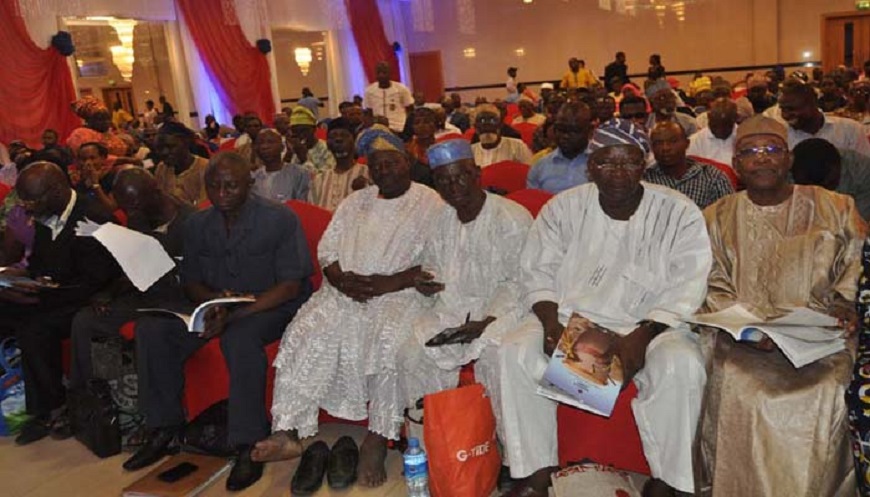
Shareholders Meet to Decide for Dangote Cement, Greif Nigeria

Published

on

dangote cement shareholders AGM

By Modupe Gbadeyanka

This Wednesday and Thursday, shareholders of Dangote Cement and Greif Nigeria Plc will meet in Lagos to either approve or disapprove requests of their respective boards.

On Wednesday, January 22, 2019 at the Eko Convention Centre, Lagos at 11am, investors of Dangote Cement will gather for an Extraordinary General Meeting (EGM) to decide on the share buy-back programme proposed by the board.

The board said the company intends to repurchase a total of 1.704 billion ordinary shares of Dangote Cement from the stock market, representing 10 percent of the total issued shares of the cement giant; 17,040,507,405 ordinary shares.

The shareholders will also agree on what price the shares should be bought, but from what the firm said, the offer price must not be more than 5 percent above the five-day average trading price and this would be calculated using the five days preceding the offer date.

The programme is expected to be funded from the company’s retained earnings, while none of the board of directors would be allowed to participate in the buy-back programme, which would be executed through an open market and or self-tender offer at a prevailing market price.

“The buyback will be completed within 12 months from the date of receipt of the approval of shareholders for the programme. The board may delay, amend or terminate the programme at any time by releasing an announcement to that effect to the NSE, irrespective of whether any or all of the shares have been repurchased.

“Unless otherwise approved by the regulator, the company shall not implement the programme within 15 days prior to the publication of its annual or interim results,” the board disclosed in a notice released last month concering the meeting.

On the part of Greif Nigeria shareholders, they will take a decision on the proposal by the board to delist shares of the firm from the Nigerian Stock Exchange (NSE).

The Extra-Ordinary Meeting (EGM) is fixed for Thursday, January 23, 2020 at at Greif Board Room, No 1, Alapata Road, Apapa, Lagos at 11:00am.

In addition, investors will authorise the sale of the company’s properties in Lagos; the one at its present head office and another property around the area.

“That the company’s land and buildings known and designated as ‘Factory at No. 1 Alapata Road, Apapa, Lagos and Residence at No. 3/5 Barracks Road, Apapa, Lagos’ be sold at a price and upon such terms and conditions negotiated and determined by the board;

“That the company’s shares be delisted from the Nigerian Stock Exchange;

“That the board be and is hereby authorised to take such steps or actions and to do all things as may be necessary to give full effect to the above-mentioned resolutions,” a disclosure issued by the firm last month said.


Modupe Gbadeyanka is a fast-rising journalist with Business Post Nigeria. Her passion for journalism is amazing. She is willing to learn more with a view to becoming one of the best pen-pushers in Nigeria. Her role models are the duo of CNN's Richard Quest and Christiane Amanpour.

Advertisement
Click to comment

Leave a Reply

Your email address will not be published. Required fields are marked *

Economy

Expect Naira Below N1,000/$1 with Dangote Refinery at Full Capacity—Otedola

Published

on

otedola dangote

By Adedapo Adesanya

Nigerian businessman, Mr Femi Otedola, has congratulated his billionaire friend, Mr Aliko Dangote, on the Dangote Refinery achieving its full nameplate capacity of 650,000 barrels per day, expressing optimism that this will further strengthen the Naira against the US Dollar in the currency market.

In an X post on Thursday, Mr Otedola described it as a transformative milestone for Nigeria and Africa, noting that the refinery’s operations could ease pressure on Nigeria’s foreign exchange reserves.

“I congratulate my friend and brother, @AlikoDangote, on the remarkable achievement of the Dangote Petroleum Refinery reaching its full 650,000 barrels per day capacity.

“More importantly, it is transformational for Nigeria and Africa. Supplying up to 75 million litres of PMS daily changes our energy narrative and conserving foreign exchange.

“With domestic refining now firmly underway after decades of reliance on imports, pressure on the foreign exchange market should ease significantly. I am optimistic that the Naira will strengthen meaningfully, and trading below N1,000/$1 before year-end is increasingly within reach,” he wrote.

Earlier today, it was reported that all key components, including the naphtha hydrotreater, isomerisation unit, and reformer unit, of the single train refinery are now operating steadily at 650,000 barrels per day. This enables the facility to produce up to 75 million litres of Premium Motor Spirit (petrol) daily, significantly boosting Nigeria’s domestic fuel supply and reducing reliance on imports.

The $20 billion refinery, Africa’s largest, began operations in 2023 and has been ramping up production amid challenges, including crude supply issues.

Mr Dangote announced plans in October 2025 to expand capacity to 1.4 million barrels per day, which would make it the world’s largest refinery, surpassing India’s Jamnagar facility.

Mr Otedola added that his best friend is investing an additional $12 billion in this expansion, including the production of polypropylene and Linear Alkyl Benzene for detergents, with work already underway.

“Aliko is not stopping here. He has embarked on an additional $12 billion expansion to increase refining capacity to 1.4 million barrels per day, alongside 2.4 million tons of polypropylene and 400,000 metric tons of Linear Alkyl Benzene for detergent production. Work has already commenced in earnest.

“Congratulations once again, my brother. Nigeria is proud of you,” he said.

Continue Reading

Economy

Trade Facilitation: Customs Okays Lagos Free Zone Green Channel

Published

on

Lagos Free Zone Green Channel

By Modupe Gbadeyanka

The Nigeria Customs Service (NCS) has approved the activation of the Lagos Free Zone Green Channel to enable the seamless and controlled movement of Free Zone cargo directly from the Lekki Deep Sea Port to the Lagos Free Zone (LFZ).

This development makes LFZ the first and only zone in the country to operate a sanctioned green channel, reflecting globally recognised port-to-free-zone logistics and customs integration models successfully implemented in leading trade hubs in the Middle East and Asia.

With this, businesses in the Lagos Free Zone can now scale their industrial output with total peace of mind, as every consignment is protected by an unbroken chain of 24/7 CCTV surveillance, telemetry, and tamper-evident digital logs that ensure absolute cargo integrity.

This integration not only secures the supply chain but also builds unrivalled investor confidence by establishing a transparent, high-compliance trade environment monitored directly by the customs.

For manufacturers and distributors, the outcome is a predictable, ultra-fast logistics flow that solidifies LFZ as the most efficient regional hub for Nigerian and West African operations.

“This approval is a testament to our commitment to trade modernisation. The Lagos Free Zone Green Channel will enhance Customs visibility while significantly improving investor confidence in Nigeria’s Special Economic Zones,” the Comptroller-General of Customs, Mr Bashir Adeniyi,” stated.

On her part, the chief executive of LFZ, Mrs Adesuwa Ladoja, said, “The activation of the Lagos Free Zone Green Channel is the latest testament to our customer-centricity and our commitment to continually deliver enhanced ease of doing business for our tenants.

“The Green Channel solidifies the advantages of Lekki Deep Sea Port being physically and digitally integrated into our zone. We have effectively removed the ‘last mile’ uncertainty that has historically challenged Nigerian logistics.

“Our tenants no longer need to navigate the complexities of traditional port exits; instead, they benefit from a high-velocity, customs-integrated corridor that moves cargo with precision and speed.

“This is a game-changer for manufacturing and regional distribution, reinforcing Lagos Free Zone as the premier gateway for those looking to dominate the West African market.”

Continue Reading

Economy

Dangote Refinery Finally Hits Full 650,000-Barrel Per Day Capacity

Published

on

dangote refinery 1.5 billion litres

By Adedapo Adesanya

Dangote Refinery has reached its full capacity of 650,000 barrels per day following the successful optimisation of critical processing units, marking a turning point for Africa’s largest refinery, located in Lagos.

The $20 billion facility is now operating at full capacity, a world-record milestone for a single-train refinery.

This achievement comes after the completion of an intensive performance testing on the refinery’s Crude Distillation Unit and Motor Spirit production block.

According to the chief executive of Dangote Refinery, Mr David Bird, the refinery is now positioned to supply up to 75 million litres of petrol daily to the domestic market, a dramatic increase from the 45 million – 50 million litres delivered during the recent festive period.

The development can reshape Nigeria’s energy landscape and reduce the country’s longstanding dependence on imported refined products.

“Our teams have demonstrated exceptional precision and expertise in stabilising both the CDU and MS Block,” Mr Bird said. “This milestone underscores the strength, reliability, and engineering quality that define our operations.”

The refinery has completed a 72-hour series of performance test runs in collaboration with technology licensor UOP, a Honeywell company, to validate operational efficiency and confirm that all critical parameters meet international standards.

The tests covered the naphtha hydrotreater, isomerisation unit, and reformer unit, which together form the backbone of the facility’s gasoline production capability.

The milestone marks another achievement for the businessman and majority stake owner at the facility in his ambition to transform Nigeria from Africa’s largest crude oil producer into a refining powerhouse.

Since the commencement of the facility in 2016, it has faced numerous setbacks, including pandemic-related delays, foreign exchange challenges, and technical complications.

It was finally commissioned in May 2023 to help wean Nigeria off imported petroleum products, due to the chronic underperformance of its state-owned refineries.

Despite being Africa’s largest crude producer, the country has not been able to self-produce, even with four state-owned refineries with a combined capacity of 445,000 barrels per day. This has led to decades of high dependency on importation.

The Dangote refinery’s emergence at full capacity has the potential to eliminate this import dependence while positioning Nigeria as a net exporter to West African markets.

Yet, the refinery faces difficulty securing adequate crude oil supplies from Nigerian producers, forcing it to import feedstock from the US, Brazil, Angola, and other countries.

Mr Bird also confirmed that Phase 2 performance test runs for the remaining processing units are scheduled to commence next week, suggesting further capacity optimisation ahead.

The official emphasised the refinery’s commitment to “enhancing Nigeria’s energy security while supporting industrial development, job creation, and economic diversification.”

Continue Reading

Trending