General
US to Return $308m Confiscated Funds to Nigeria
By Adedapo Adesanya
The Governments of Jersey, Nigeria and the United States of America on Monday, February 3, entered into an Asset Recovery Agreement to repatriate over $308 million of forfeited assets to Nigeria.
The disclosure was made in a joint press release posted on the US embassy website on Tuesday and sighted by Business Post.
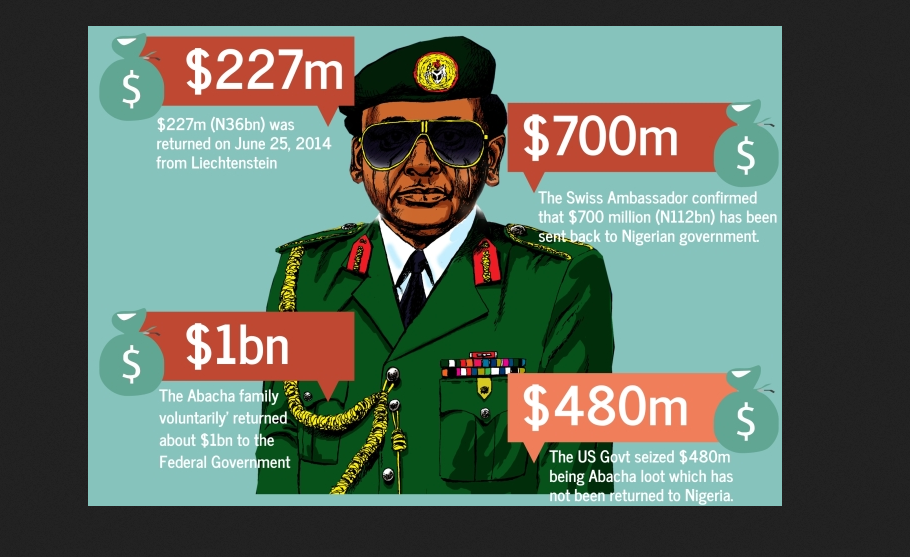
In the statement, it was disclosed that the funds were laundered through the US banking system and then held in bank accounts in Jersey under the name of Doraville Properties Corporation, a BVI company, and in the name of the son of the former Head of State of Nigeria, General Sani Abacha.
It was also revealed that in 2014, a US Federal Court in Washington DC forfeited the money as property involved in the illicit laundering of the proceeds of corruption arising from Nigeria during the period from 1993 to 1998 when General Abacha was Head of State.
The statement reads, “This case is a result of extensive co-operation between the Jersey authorities, the Money Laundering and Asset Recovery Section of the United States Department of Justice and the Federal Bureau of Investigation, and the Federal Republic of Nigeria, with crucial assistance from other governments around the world.
“At the time the case was filed as part of the U.S. Department of Justice’s Kleptocracy Asset Recovery Initiative in 2013, it was the largest U.S. kleptocracy forfeiture action ever commenced. In 2014 the Attorney General of Jersey applied for, and was granted, a Property Restraint Order over the Jersey bank account balance of Doraville.
“This was challenged in the Royal Court of Jersey and Court of Appeal, and an application for permission to appeal to the Privy Council by Doraville was refused. France and the United Kingdom restrained additional funds at U.S. request.”
It was also disclosed that General Abacha and his associates stole and laundered many hundreds of millions of dollars of public money during his military regime, doing vast harm to the futures of his own people. The monies were laundered by his family, including his sons Ibrahim and Mohammed, and a number of close associates.
The laundering operation extended to the United States and European jurisdictions such as the UK, France, Germany, Switzerland, Lichtenstein and Luxembourg.
In 2018, Governments of the Federal Republic of Nigeria, United States of America and the Bailiwick of Jersey commenced the negotiation of the procedures for the repatriation, transfer, disposition and management of the assets. The tripartite agreement signed this week represents a major watershed in international cooperation in asset recovery and repatriation, and will provide benefit to people throughout Nigeria.
The projects on which the funds will be expended will be administered by the Nigeria Sovereign Investment Authority and independently audited. The Federal Republic of Nigeria will establish a Monitoring Team to oversee the implementation of the projects and to report regularly on progress. The Nigerian government, in consultation with the other Parties, will also engage Civil Society Organisations, who have expertise in substantial infrastructure projects, civil engineering, anti-corruption compliance, anti-human trafficking compliance, and procurement to provide additional monitoring and oversight.
According to Mr Abubakar Malami, the Attorney General of the Federation and Minister of Justice, who signed on behalf of the Nigerian government noted that this agreement has “culminated in a major victory, for Nigeria and other African countries as it recognizes that crime does not pay and that it is important for the international community to seek for ways to support sustainable development through the recovery and repatriation of stolen assets.
He noted further that “without the commitment of the three parties to the Agreement (Nigeria, Jersey and the United States) and that of the legal experts and Attorneys representing Nigeria, it would have been impossible to achieve the success recorded today.
“As you are aware, the government of Nigeria has committed that the assets will support and assist in expediting the construction of the three major infrastructure projects across Nigeria – namely Lagos – Ibadan expressway, Abuja – Kano express way and the second Niger bridge.
“These projects currently been executed under the supervision of the Nigeria Sovereign Investment Authority (NSIA) as a public private partnership (PPP) will boost economic growth and help alleviate poverty by connecting people and supply chains from the East to the West and to the Northern part of Nigeria, a vast area covering several kilometers with millions of the country’s population set to benefit from the road infrastructures.“
He urged for greater cooperation and mutual respect amongst countries in the implementation of expeditious cooperation measures already set out in the United Nations Convention Against Corruption and in the implementation of the GFAR principles on the repatriation of stolen assets.
He called for civil society organizations and the Nigerian public to be involved in the monitoring of the implementation of the key infrastructure projects that will greatly enhance road transportation in Nigeria.
On his part, the Solicitor General and Attorney General designate of Jersey, Mark Temple QC, who signed the Agreement on behalf of Jersey, commented:
“This Agreement represents the culmination of two decades of intensive work by Law Officers in Jersey, the United States and Nigeria. The return of the assets to Nigeria had been delayed by a number of hard-fought challenges by third parties which were defeated in the Courts in Jersey and the United States.
“The Agreement establishes a framework based on fruitful co-operation, trust and respect so that the forfeited funds can be repatriated to benefit the people of Nigeria, from whom they had been taken. The use of the funds will be subject to monitoring and reporting obligations.
“This is a very significant achievement, and, once again, demonstrates Jersey’s commitment to tackling international financial crime and money laundering.” He added.
General
NLNG Says Low-Risk Key to Unlocking Value in Nigeria’s Gas Industry
By Adedapo Adesanya
Nigeria LNG (NLNG) has reaffirmed that a well-structured, low-risk approach in Nigeria’s energy sector is essential to unlocking investments, accelerating economic development and strengthening energy security.
NLNG’s General Manager, Production, Mr Nnamdi Anowi, said this at a panel session titled De-Risking Investments in African Oil and Gas Projects during the Sub-Saharan Africa International Petroleum Exhibition and Conference (SAIPEC) in Lagos, noting that when oil and gas projects are perceived as too risky, investors tend to withdraw, leading to stalled projects, job losses, and missed revenue opportunities critical for national growth.
According to a statement by Mrs Anne-Marie Palmer-Ikuku, Manager, Corporate Communication and Public Affairs, he stated that reducing risks in oil and gas projects, beyond being a business strategy, was a matter of national importance for Nigeria’s economy, energy security, and long-term development.
He further explained that for NLNG, lowering risk means keeping gas flowing reliably, meeting long-term contracts, and ensuring the company remains a trusted supplier to global and domestic markets.
He said this will allow investors to fund projects at a lower cost, which ultimately benefits both companies and the country.
Mr Anowi also highlighted the importance of good infrastructure, local skills, and modern technology in reducing everyday operational risks.
He said that when pipelines, processing facilities, and digital systems work well, projects are safer, cheaper to run, and more reliable over time.
“If we reduce risk the right way and work together, investment will come; the next decade must focus on growing proven, bankable projects that deliver real value to the country, ” he further said.
In his closing remarks, Mr Anowi noted that Africa and Nigeria in particular are investable when risks are planned for and managed carefully, not ignored.
General
NUPRC, NNPC Pledge Deeper Collaboration for Operational Efficiency
By Adedapo Adesanya
The Nigerian Upstream Petroleum Regulatory Commission (NUPRC) and the Nigerian National Petroleum Company (NNPC) Limited have pledged to deepen collaboration to boost operational efficiency.
This was the outcome of a meeting between the managements of the NUPRC and the NNPC at the commission’s corporate headquarters in Abuja, where the chief executive of the former, Mrs Oritsemeyiwa Eyesan, said the two oil regulators, as creations of the Nigerian government, have similar goals.
“As major instruments of the government in the industry, we are aligned toward the same goal, and I think this is pivotal, and we must not lose this golden opportunity,” she disclosed.
Further addressing the NNPC team, led by its chief executive, Mr Bayo Ojulari, Mrs Eyesan said the NUPRC is focused on reducing the cost of operations by harmonising fees and rents to make Nigeria’s oil and gas sector more competitive.
To this end, the NUPRC boss revealed that the agencywas working closely with the Oil Producers Trade Section, OPTS, to address the multiplicity of fees and rents to improve Nigeria’s competitiveness.
“We are working with the industry on harmonising the fees and rents that we charge. The whole idea is to harmonise and reduce it to the barest minimum so that we can reduce the cost of operations,” she said.
Mr Eyesan further stated that the Commission is working on enhancing measurement and hydrocarbon accounting.
“We have done the first phase, which is to audit what we already have. The second phase, which will commence shortly, will be the real implementation of the metering standards, and this entire programme will entail us having a data centre and having all the meters in all our locations to standard,” she stated.
The NUPRC boss said the Host Community Development Trust (HCDT) had so far been a success but maintained that there was a need to fully utilise these funds for its intended purpose, as this would enhance community peace and improve the operating environment.
Mrs Eyesan encouraged NNPC, as the country’s national oil company, to participate in the ongoing 2025 licensing round and deepen exploration.
In his remarks, the NNPC GCEO reiterated the need for an improved relationship between the national oil company and the regulator.
Mr Ojulari hailed Mr Eyesan, noting that, “Your antecedents, your track records, your integrity, your forthrightness and clarity for those who have had the privilege of interacting with you, excite the industry.”
He said the NUPRC had continued to demonstrate exceptional leadership in terms of regulation and has been promoting transparency and shaping an enabling environment crucial for investment and operational excellence, which is good for the industry.
The NNPC boss said the national oil firm had recently launched the national gas master plan, which would boost the country’s gas production.
Mr Ojulari said critical projects like the OB3 and the AKK gas pipeline have continued to progress. He also presented a copy of the Gas masterplan to the CCE.
He, however, maintained that there was a need to reduce the cost of operation in Nigeria to attract fresh investments and boost Nigeria’s energy security. This, he said, would not be possible without the NUPRC’s regulatory role.
“As the national energy company operating commercially under the Petroleum Industry Act, our success is intertwined with the regulatory stewardship, which we are absolutely confident will be taken to the next level. We believe that deepening this partnership will greatly enhance our ability to unlock more value for Nigeria,” he stated.
General
Electricity Workers Issue 21-Day Strike Notice Over Pay, Working Conditions
By Adedapo Adesanya
Electricity workers, under the aegis of the National Union of Electricity Employees (NUEE), have issued a 21-day nationwide strike notice to the federal government, citing unresolved labour grievances and what they described as worsening conditions across the power sector.
They formally notified the Minister of Power, Mr Adebayo Adelabu, of their intention to embark on industrial action if urgent steps are not taken to address the persistent violations of workers’ rights within the Nigerian Electricity Supply Industry (NESI).
In the letter, the union accused power sector operators of refusing to honour collective agreements, implement the 2025 National Minimum Wage Act and effect its consequential adjustments. It also alleged widespread anti-labour practices across power generation and distribution companies.
“We have written several letters to the ministry on these issues, but there has been little or no response,” the union stated, expressing frustration over what it described as official indifference.
Among the grievances listed are non-remittance of pension deductions and Pay-As-You-Earn (PAYE) taxes, denial of workers’ right to unionise, intimidation of staff, and failure to improve welfare despite repeated tariff increases.
The union said in some distribution companies, pension contributions deducted from workers’ salaries have allegedly remained unpaid for years, leaving employees uncertain about their retirement security.
The electricity workers also criticised what they termed the “militarisation” of workplaces, alleging harassment and threats in certain power firms.
According to the union, labour is increasingly being treated as an adversary rather than a critical stakeholder in a sector already struggling with public confidence.
The notice further questioned the performance of investors who acquired power assets during the 2013 privatisation exercise.
The union argued that promises of improved infrastructure, capital injection, metering expansion and better service delivery have not translated into meaningful gains for workers or consumers.
While electricity tariffs have risen multiple times in recent years, the union said workers have seen no corresponding improvement in salaries, promotions, bonuses or working conditions.
Business Post reports that the ultimatum likely places the federal government under pressure to act as a nationwide strike would significantly disrupt power generation and distribution, affecting homes, hospitals, small businesses and critical infrastructure already grappling with unreliable supply.
-
Feature/OPED6 years agoDavos was Different this year
-
Travel/Tourism10 years ago
Lagos Seals Western Lodge Hotel In Ikorodu
-
Showbiz3 years agoEstranged Lover Releases Videos of Empress Njamah Bathing
-
Banking8 years agoSort Codes of GTBank Branches in Nigeria
-
Economy3 years agoSubsidy Removal: CNG at N130 Per Litre Cheaper Than Petrol—IPMAN
-
Banking3 years agoSort Codes of UBA Branches in Nigeria
-
Banking3 years agoFirst Bank Announces Planned Downtime
-
Sports3 years agoHighest Paid Nigerian Footballer – How Much Do Nigerian Footballers Earn