Economy
Oil Rises Ahead of OPEC+ Meeting Today
By Adedapo Adesanya
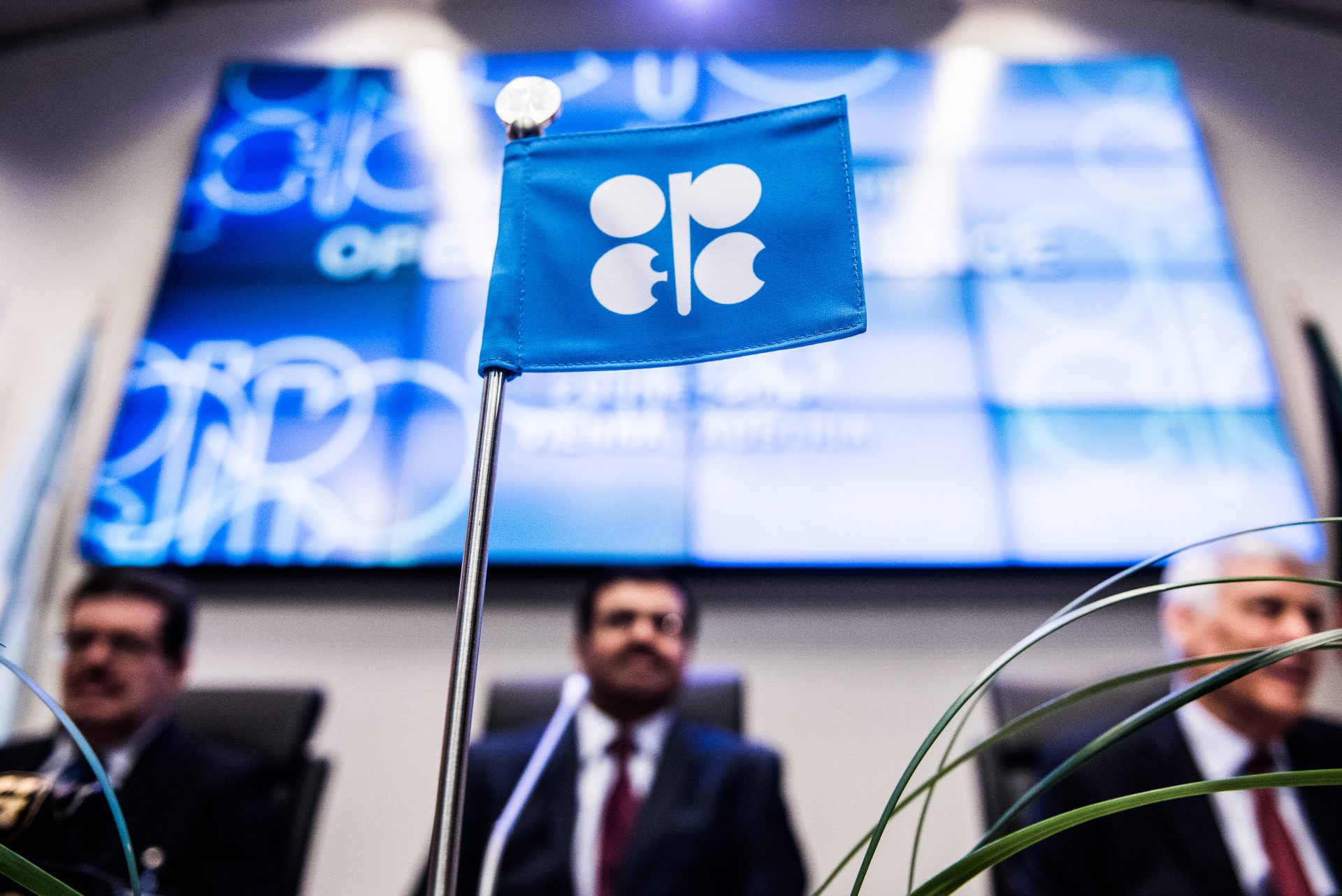
Major oil futures prices are positive ahead of today’s meeting among nations that make up the Organisation of the Petroleum Exporting Countries (OPEC) to discuss a possible end to the oil price war between Saudi Arabia and Russia that has tanked oil prices since last month.
The emergency meeting, which will be held via videoconference, could bring about the largest oil production cut deal ever made in history as OPEC states and its allies in addition to Brazil, Norway, and Canada, could cut oil production by 10 million barrels per day.
On Thursday morning, Brent crude, the global benchmark, rose $1.19 or 3.62 percent to trade at $34.03 per barrel, while the West Texas Intermediate (WTI) crude garnered $1.16 equivalent to 4.62 percent to sell at $26.24 per barrel.
The market was met with fresh optimism as one of the member states of the cartel, Algeria, which also holds the mantle of the organisation’s presidency said the meeting was going to be “undoubtedly fruitful”.
The OPEC President and Algerian Energy Minister, Mr Mohamed Arkab, on Wednesday said, “The meeting will undoubtedly be fruitful in order to rebalance the market through measures we will take tomorrow.”
Saudi Arabia and Russia, which are the major players in the proposed deal, are expected to make or break the chances of a production cut agreement. Failure to reach a compromise last month was very brutal to the oil market.
Both producers contribute more than 22 million barrels per day and a 10 million barrels per day cut being put forward might not prove much in the long term, according to analysts, due to the drop in the demand for oil lately as a result of coronavirus.
Global demand for oil has been significantly affected by the coronavirus outbreak which triggered travel restrictions and temporary business closure across the globe and an oil price war between Russia and Saudi Arabia further made matters worse.
However, with Russia now struggling to find buyers for its crude and the possibility of prices dropping in unfavourable levels, the country may need to quickly agree to an output ceiling.
Russian news agencies reported on Wednesday that the country could cut up to 1.6 million barrels per day of supply.
The meeting is scheduled to hold by 3 pm Nigerian time (GMT +1).
Economy
Tax Filing: Abuja Chamber Calls for Penalty Waiver During Transition Period
By Adedapo Adesanya
The Abuja Chamber of Commerce and Industry (ACCI) has urged the government to suspend penalties on late tax filings until business owners adjust and fully understand new tax laws and systems.
According to Mr Aliyu Hong, Chairman, National Policy Advocacy Centre (NPAC), ACCI, a one or two-year grace period on penalties linked to the new tax laws would allow business owners to adjust to compliance procedures.
According to him, business owners require time to adapt to Nigeria’s new tax laws and online filing systems.
“Online tax submission platforms should be properly tested and widely understood before enforcement of penalties for non-compliance.
“So, the government should allow a one or two-year moratorium on penalties as taxpayers are still learning the new tax system.
“The government should also prioritise building a reliable online tax infrastructure before enforcing strict compliance measures.
“Therefore, penalties should only begin after the infrastructure becomes stable, tested and widely understood by taxpayers,” he said, in an interview with the News Agency of Nigeria (NAN) on Wednesday in Abuja.
Mr Hong, who is also the Second Deputy President of the chamber, said the ACCI had a tax roundtable recently, which aimed to provide a clearer understanding of the new tax framework for business owners.
According to him, the roundtable aims to educate members on the requirements, implementation process and obligations under the new laws.
“It is also meant to simplify the new tax laws for business owners and improve understanding among stakeholders,” he said.
Hong said that many Nigerians still lacked adequate understanding of the new tax laws and their practical implications.
He noted that implementation structures for the laws were yet to be fully developed and properly coordinated.
He urged the government to adopt a gradual implementation process to enable business owners to adjust effectively to the reforms.
The chairman said that taxation should not focus solely on revenue generation but also on economic stability, employment and national development.
He said that no nation could achieve prosperity through taxation alone without creating conditions that encourage economic growth.
According to him, Nigeria’s business environment remains highly challenging for enterprises operating across different sectors.
The official said many business owners independently provide electricity, water and security, increasing operational and production costs.
Mr Hong noted that local enterprises would struggle to compete if unrestricted importation continued without adequate protection for domestic industries, urging the government to address infrastructure challenges and create policies that support business growth, competitiveness and employment generation.
Economy
Strong Competitive Position Earns Fidson Healthcare Rating Upgrade
By Aduragbemi Omiyale
The national scale long-term issuer rating of Fidson Healthcare Plc has been upgraded to A+(NG) from A(NG), with its short-term issuer ratings of A1(NG) affirmed.
This action was taken by GCR Ratings, which also accorded the leading healthcare organisation in Nigeria with a stable outlook in a statement obtained by Business Post.
It was explained that the company achieved this latest development amid its strong competitive position and improved financial profile.
GCR said Fidson Healthcare’s debt metrics remain moderate, bolstered by a successful N21 billion rights issue expected in Q2 2026 and robust cash flows that support strong liquidity, though large expansionary investments and heightened working capital requirements slightly constrain the rating.
Fidson is a prominent pharmaceutical manufacturer in Nigeria, with over 350 products registered with the National Agency for Food and Drug Administration and Control (NAFDAC). Its product portfolio encompasses a wide range of therapeutic categories, including antibiotics, infusion products, over-the-counter products, and lifestyle healthcare solutions.
The company is enhancing its market position through ongoing investments in manufacturing capacity, product innovation, automation, and operational efficiency.
The firm operates through an extensive network of over 120 distributors across Nigeria, ensuring strong retail visibility and market penetration.
To further strengthen its competitive position, the company is investing in a greenfield automated manufacturing facility, additional infusion lines, and expanded tablet lines, all expected to become operational in the near term. This capital expenditure will significantly increase productive capacity, improve operational efficiency, and enhance export competitiveness in the medium term.
In terms of its liquidity assessment, its 12-month sources versus uses coverage at 1.6x and 24-month coverage at 1.4x, supported by access to diverse funding sources.
Estimated liquidity sources include forecasted operating cash flow of N15.1 billion, cash holdings of N4.7 billion, inventory valued at approximately N17.5 billion, and cash of N21 billion from the equity raise. These resources are sufficient to cover anticipated near-maturing debt obligations of N23.4 billion and forecast medium-term capital spending of around N20 billion, as well as a dividend payout of N3.7 billion in 2026.
Economy
Esiet Promises Open-door Policy at Customs Eastern Marine Command
By Bon Peters
The new acting Comptroller of the Eastern Marine Command of the Nigeria Customs Service (NCS), Mr Esien Etim Esiet, a Deputy Comptroller of Customs, has promised to maintain an open-door policy with stakeholders, including licensed agents and partners.
He gave this assurance when he officially assumed leadership of the command on Wednesday, May 20, 2026, according to a statement issued by the command’s spokesman, Mr Joshua Iliya, a Deputy Superintendent of Customs (DSC), in Port Harcourt, Rivers State.
In a proactive move to strengthen maritime security and trade facilitation, he immediately initiated an extensive tour of operational facilities and high-level engagements across the region, including Rivers (Abonnema and Onne Outstations), Akwa Ibom (Oron Outstation), and Cross River (Calabar Outstation) States.
During the visitations, Mr Esiet conducted rigorous inspections of equipment and personnel readiness, emphasising that the success of the command relied on a united front, adding that a “sustained synergy is our greatest weapon in combating smuggling and maritime crimes,” insisting that a united front was non-negotiable for national security.
On the inter-agency level to foster a one-service approach, DC Esiet held strategic meetings with the Customs Area Controllers of Port Harcourt II (Onne), the Oil and Gas Free Trade Zone, and the Cross River/Calabar Free Trade Zone/Akwa Ibom Area Command.
To further reinforce maritime safety, he equally paid courtesy visits to top maritime security brass, including the Commander, NNS Pathfinder, Port Harcourt, the Commanding Officer, Navy Forward Operation Base (FOB), Ibaka, the Flag Officer Commanding (FOC), Eastern Naval Command, and the Cross River State Commissioner of Police.
On community and private sector partnership and in recognition of the vital role of grassroots support, DC Esiet visited monarchs in the region, underscoring commitment to maintaining deep-rooted ties with host communities, among others.
On fiscal policy compliance, he reiterated his administration’s resolve to strictly align with the policy direction of the Comptroller-General of Customs, Mr Bashir Adewale Adeniyi, emphasising that his leadership would focus on streamlining maritime enforcement protocols, ensuring officers were motivated and equipped while maintaining an open-door policy with licensed agents and partners.
The Eastern Marine Command, which is a specialised wing of customs, is dedicated to patrolling the nation’s Eastern Waterways, preventing smuggling, and ensuring the security of maritime trade.
-
Feature/OPED6 years agoDavos was Different this year
-
Travel/Tourism10 years ago
Lagos Seals Western Lodge Hotel In Ikorodu
-
Showbiz3 years agoEstranged Lover Releases Videos of Empress Njamah Bathing
-
Banking8 years agoSort Codes of GTBank Branches in Nigeria
-
Economy3 years agoSubsidy Removal: CNG at N130 Per Litre Cheaper Than Petrol—IPMAN
-
Banking3 years agoSort Codes of UBA Branches in Nigeria
-
Banking3 years agoFirst Bank Announces Planned Downtime
-
Sports3 years agoHighest Paid Nigerian Footballer – How Much Do Nigerian Footballers Earn