Economy
Bayelsa Governor to Spend N242.3bn in 2020
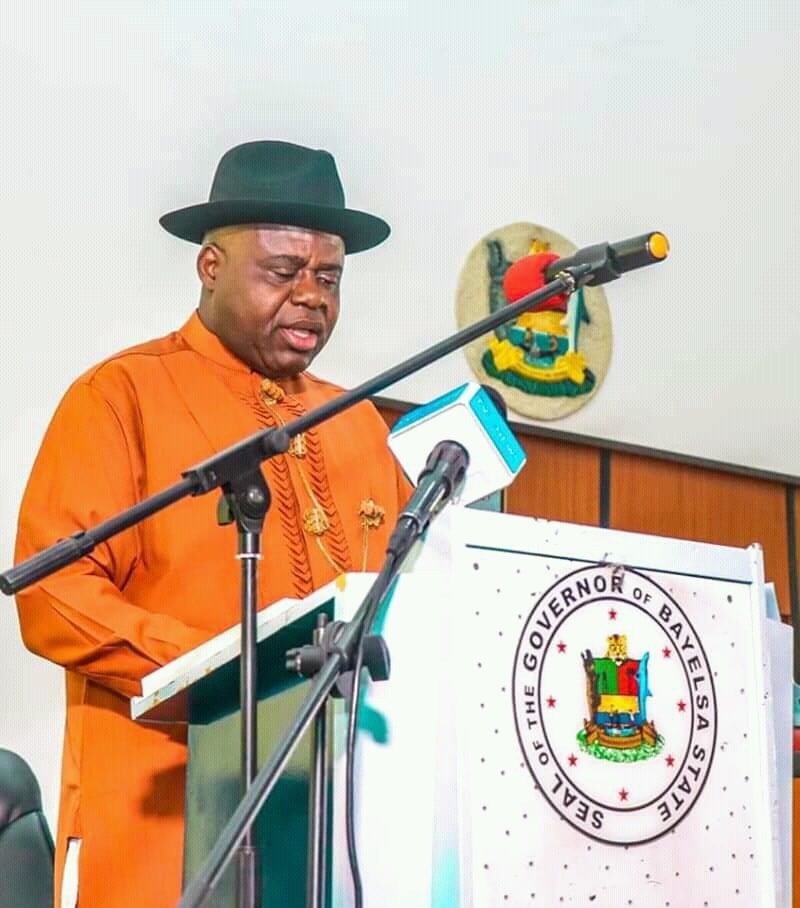
Governor Douye Diri of Bayelsa State on Tuesday said his administration intends to spend the sum of N242.3 billion in the 2020 fiscal year.
Mr Diyi made this disclosure when he presented the 2020 appropriation bill to the Bayelsa State House of Assembly today.
This was his first budget presentation since he assumed office about two months ago after succeeding Mr Seriake Dickson, who governed the state for eight years.
Mr Diri, who tagged his maiden budget as Consolidation for Prosperity 2020, informed the state lawmakers that the appropriation bill defines the structure for the economic activities to be undertaken in the fiscal year.
He emphasised that the policy thrust of his administration in the next four years remains consolidating on the gains already made by the previous government.
In a statement issued by his acting Chief Press Secretary, Mr Daniel Alabrah, the Governor said his administration would embark on special programmes and projects aimed at wealth creation.
Accordingly, he said his administration would encourage the people to participate in agriculture, small and medium scale enterprises and create opportunities toward attracting the private sector for industrialisation.
He equally highlighted other programmes to include infrastructure development, housing and urban renewal, human capital development and public sector and financial management reforms.
On the current economic outlook, the Governor said as a result of the ravaging effect of COVID-19 on the global economy, there was need for prudent management of resources.
He said the price of crude oil had nosedived drastically as against the federal government’s benchmark pegged at $55 per barrel, thus affecting revenue from statutory allocations from the federation account.
As part of efforts to reduce the cost of governance and enhance transparency, Mr Diri maintained that the human resources, financial reporting, budgeting and procurement component of the state’s Integrated Financial Management Information System (SIFMIS) would be fully implemented this year.
The Governor, who assured that his administration would continue with the implementation of the federal government approved minimum wage for workers, said the payment of gratuity arrears had already commenced for pensioners.
In his remarks, Speaker of the House of Assembly, Mr Abraham Ingobere, commended Governor Diri and his team for the steps taken by his administration to prevent the spread of COVID-19 into the state.
He stressed the need for the state government to adopt more strategies to raise funds from alternative sources and seek ways to cushion the effects occasioned by the virus.
He assured that the Assembly would expedite passage of the appropriation bill.
Economy
Ayobo-Ipaja LCDA Explores Commercial Ostrich, Crocodile Farming
By Dipo Olowookere
As part of moves to boost its internally generated revenue (IGR) and increase its streams of income, Ayobo-Ipaja Local Council Development Area (LCDA) is considering commercial ostrich and crocodile farming.
The council recently held a sensitisation programme, where agribusiness experts engaged stakeholders, including residents and entrepreneurs, on the viability of this.
The programme provided participants with the knowledge on investment requirements, training opportunities, startup funding, and regulatory frameworks guiding ostrich and crocodile farming in Nigeria.
The chairman of Ayobo-Ipaja LCDA, Mr Lukmon Agbaje, commended the initiative, reiterating his administration’s commitment to promoting innovative agricultural practices as a pathway to sustainable development.
He described agriculture as a critical driver of economic transformation, stressing that modern farming has evolved into a profitable business venture with immense potential for youth empowerment and enterprise development.
Mr Agbaje further assured participants of the council’s readiness to partner with investors, agricultural institutions, and other relevant stakeholders to facilitate training, capacity building, and access to opportunities across the agricultural value chain.
On his part, the council’s Head of Department of Agriculture, Mr Wale Atepe, emphasised the growing market demand for products such as leather, meat, feathers, and other valuable by-products, adding that strategic investment in the sector could unlock significant opportunities for employment, wealth creation, and export earnings.
Economy
Naira Tumbles to N1,360/$1 at Official Market
By Adedapo Adesanya
The Naira depreciated against the United States Dollar by 0.21 per cent or N2.89 in the Nigerian Autonomous Foreign Exchange Market (NAFEX) on Wednesday, June 17, to N1,360.07/$1 from Tuesday’s closing rate of N1,357.18/$1.
In the same vein, the Nigerian Naira weakened against the Pound Sterling in the official market during the session by N4.42 to trade at N1,824.81/£1 versus the preceding session’s N1,820.39/£1, and lost N4.19 on the Euro to sell at N1,577.96/€1 compared with the previous day’s N1,573.79/€1.
However, at the GTBank segment, the local currency gained N1 against the greenback yesterday to exchange at N1,372/$1 versus N1,373/$1, and at the parallel market, it remained unchanged at N1,385/$1 at midweek.
The Naira’s performance comes amid tight inflows from exporters, non-bank corporates, and foreign investors, evidenced by the slow movement of the country’s gross external reserves level of $50.505 billion, despite muted inflows from oil sales after a recent drop in prices.
There have been reduced FX market interventions by the Central Bank of Nigeria (CBN) as it maintains its stance to keep the local unit stable enough to retain foreign investments.
The Nigerian government also dismissed a report suggesting that it was considering new taxes on telecommunications services and petroleum products, which would have spooked investors.
The federal government said that the reports misrepresented recommendations contained in the International Monetary Fund (IMF) Article IV Consultation Report on Nigeria, explaining that the recommendations were advisory and do not constitute government policy or binding obligations on Nigeria.
In the cryptocurrency market, prices were negative as traders and investors shrugged off a signed Iran peace deal that lifted stocks, after the Federal Reserve held interest rates but made clear it is more worried about inflation than growth.
Under the new Chair, Mr Kevin Warsh, the Federal Reserve left rates unchanged at 3.5 per cent to 3.75 per cent, in line with expectations, but its updated projections pointed to higher inflation and a slower pace of future rate cuts, and some officials floated the possibility that rates may still need to rise.
Cardano (ADA) slid 4.5 per cent to trade at $0.1731, Ripple (XRP) went down by 4.2 per cent to $1.16, Ethereum (ETH) shrank by 3.5 per cent to $1,727.55, Solana (SOL) lost 3.4 per cent to sell $71.05, Dogecoin (DOGE) also fell by 3.4 per cent to $0.0843, Binance Coin (BNB) slumped by 3.1 per cent to $587.53, and Bitcoin (BTC) crashed by 2.6 per cent to $63,892.28, while TRON (TRX) gained 0.7 per cent to finish at $0.3201, with the US Dollar Tether (USDT) and the US Dollar Coin (USDC) closing flat at $1.00 each.
Economy
Financial Stocks Further Bleeds Customs Street by 0.49%
By Dipo Olowookere
Customs Street further depleted by 0.49 per cent on Wednesday as a result of sustained profit-taking in the financial services industry.
Data showed that the insurance space lost 2.29 per cent, and the banking counter depreciated by 1.04 per cent. However, the energy index gained 0.03 per cent, and the consumer goods segment grew by 0.01 per cent, while the industrial goods sector remained unchanged.
When the Nigerian Exchange (NGX) Limited closed for business at 4 pm yesterday, the All-Share Index (ASI) was down by 1,182.08 points to 240,802.72 points from 241,984.80 points, and the market capitalisation decreased by N759 billion to N154.445 trillion from N155.204 trillion.
Business Post reports that the market breadth index was negative after finishing with 13 price gainers and 51 price losers, indicating weak investor sentiment as a result of the sell-offs.
Geregu Power lost 10.00 per cent to trade at N1,019.30, Okomu Oil declined by 9.97 per cent to N1,418.00, Red Star Express shed 9.95 per cent to close at N27.60, International Energy Insurance dropped 9.90 per cent to quote at N5.19, and Legend Internet slipped by 9.48 per cent to N5.25.
Conversely, Neimeth gained 9.47 per cent to settle at N9.25, Cornerstone Insurance appreciated by 9.26 per cent to N5.90, SUNU Assurances expanded by 3.91 per cent to N3.72, UPDC grew by 2.82 per cent to N3.65, and GTCO chalked up 2.38 per cent to close at N129.00.
A total of 663.0 million equities valued at N40.0 billion exchanged hands in 51,143 deals during the session compared with the 535.5 million equities worth N36.8 billion traded in 55,123 deals a day earlier, representing a shortfall in the number of deals by 7.22 per cent, and a surge in the trading volume and value by 23.81 per cent and 8.70 per cent, respectively.
Yesterday, Access Holdings led the activity chart after transacting 130.3 million shares for N3.1 billion, Jaiz Bank traded 114.9 million stocks valued at N1.1 billion, Sterling Holdings exchanged 31.1 million equities worth N237.2 million, International Breweries sold 22.1 million shares for N247.6 million, and Linkage Assurance traded 17.0 million stocks for N27.7 million.
-
Feature/OPED6 years agoDavos was Different this year
-
Travel/Tourism10 years ago
Lagos Seals Western Lodge Hotel In Ikorodu
-
Showbiz3 years agoEstranged Lover Releases Videos of Empress Njamah Bathing
-
Banking8 years agoSort Codes of GTBank Branches in Nigeria
-
Economy3 years agoSubsidy Removal: CNG at N130 Per Litre Cheaper Than Petrol—IPMAN
-
Banking3 years agoSort Codes of UBA Branches in Nigeria
-
Banking3 years agoFirst Bank Announces Planned Downtime
-
Sports3 years agoHighest Paid Nigerian Footballer – How Much Do Nigerian Footballers Earn