General
North East Conflict Renders 1.9m Nigerians Homeless—UNICEF
By Adedapo Adesanya
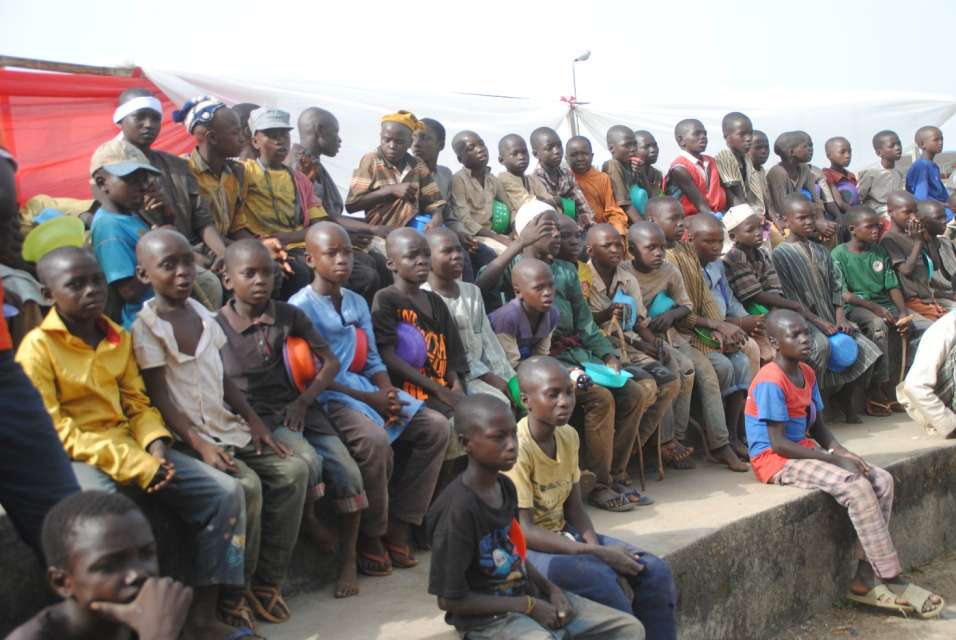
The conflict in the North East of Nigeria has uprooted 1.9 million Nigerians from their homes, the United Nations Children Fund (UNICEF) has disclosed.
This was made known in a statement issued by the UN specialised agency’s Communications Specialist for Nigeria, Mr Geoffrey Njoku, on Tuesday, May 5.
The UNICEF report stressed that internally-displaced children in Nigeria accounted for one of the world’s most vulnerable to the COVID-19 pandemic.
The agency, in the report titled Lost at Home to assess the risks and challenges facing internally- displaced children, called for urgent actions to protect them.
“In North-East, Nigeria, there are currently 1.9 million people displaced from their homes. Sixty percent of them are children, with one in four under the age of five,” it said.
The report stated that globally, an estimated 19 million children, more than ever before, were living in displacement within their own countries, due to conflict and violence in 2019.
“’Lost at Home’ looks at the risks and challenges internally- displaced children face and the urgent actions needed to protect them,” it said.
The UN agency said that as COVID-19 continues to spread around the world, children are among the most vulnerable to feel its direct and indirect impacts.
“Hundreds of thousands of children in North-East, Nigeria, are living in the shadow of conflict and now in the increasingly-challenging shadow of a global pandemic and its potential socio-economic aftermath.
“When a new crisis like the COVID-19 pandemic emerges, displaced children are especially vulnerable and the gaps in our ability to keep them safe are even starker.
“We must urgently work together; all of us, government and humanitarian partners, to keep them safe, healthy, learning and protected,” it said.
According to the report, the COVID-19 pandemic is making a critical situation for displaced children and families around the world even worse.
It said that they often lived in overcrowded camps or informal settlements, where access to basic hygiene and health services was limited, and where physical distancing was not possible.
“This is true in Nigeria’s North-East, where conditions pose a particular challenge to containing the possible spread of diseases like COVID-19.
“Internally-displaced children around the world often lack access to basic services and are at risk of exposure to violence, exploitation, abuse and trafficking,” the report stated.
Assessing the challenges facing children, UNICEF explained that they were also at risk of child labour, child marriage and family separation, all of which posed direct threats to their health and safety.
The report said there are 12 million new displacements of children in 2019, with 3.8 million of them caused by conflict and violence and 8.2 million by disasters linked mostly to weather-related events, like flooding and storms.
UNICEF further said it was collaborating with its partners to protect displaced children in the North-East through critical health and nutrition services.
Others, it said, were provision of access to life-saving WASH (Water, Sanitation and Hygiene) services through accelerated construction of facilities, and adapted solutions to continuing education, including provision of radio for distance learning, while schools were closed.
“What we really need now are strategic investments and united efforts by government, civil society organisations, private sector, humanitarian actors and the children themselves, to find solutions to the effects of displacement, especially as we face the COVID-19 pandemic.
“The efforts must also address and help mitigate the long term impacts this can have on children’s health and education,” it said
General
Jim Ovia Bets on Luxury Housing With New Multi-Billion Naira Lagos Towers
By Adedapo Adesanya
Nigerian business leader and Zenith Bank founder, Mr Jim Ovia, is expanding his footprint in real estate with the construction of a 26-floor Metropolitan Towers residential development in Lagos, where units start at $1.85 million (N2.5 billion), as well as the completion of a 44-unit Quantum Luxury Towers high-rise, where apartments start from $2.8 million (N3.8 billion).
Mr Ovia, who until recently retired as the chairman of Zenith Bank, Nigeria’s biggest lender by market value, through his Quantum Luxury Properties Limited business, is seeking to deepen his property investments.
Among his most notable property investments is the transformation of previously underutilised waterfront land on Ozumba Mbadiwe in Lagos into premium commercial and hospitality assets. These developments include the Civic Centre, Civic Towers and hospitality properties that have become prominent landmarks within Lagos’ commercial landscape.
At a recent gathering, the businessman described real estate as a more profitable venture than banking, pointing to the significant value created through strategic property investments over the years.
Mr Ovia noted that some of his most rewarding investments have come from real estate developments rather than traditional banking operations.
His latest play comes as rapid urban population growth and increasing demand for commercial space have strengthened the real estate sector’s long-term fundamentals, while the country faces rising housing deficits.
After his retirement from Zenith Bank, following the completion of the regulatory maximum tenure of 12 years as a non-executive director and chairman under corporate governance guidelines of the Central Bank of Nigeria (CBN), Mr Mustafa Bello was announced as the new chairman, effective April 27, 2026.
Beyond banking and real estate, the tycoon has also developed a significant interest in telecommunications and technology, particularly Visafone in 2007, which he built to become Nigeria’s largest Code Division Multiple Access (CDMA) telco serving over 2 million subscribers and owned 800MHz spectrum licenses, setting the foundation for future 4G services.
In January 2016, South African telco group MTN bought Visafone for over N47 billion to improve its broadband services in its biggest market.
General
Navy Intercepts 92,660 Litres of Illegally Refined Diesel in Rivers
By Adedapo Adesanya
The Nigerian Navy has recorded another breakthrough in its campaign against crude oil theft and illegal refining in the Niger Delta, recovering 92,660 litres of suspected illegally refined Automotive Gas Oil (AGO), commonly known as diesel, along the Rivers-Bayelsa border.
The recovery was made under Operation Delta Sentinel following intelligence reports that led personnel of the Nigerian Navy Ship (NNS) SOROH to the Okolomade community in Abua-Odual Local Government Area of Rivers State.
According to a statement issued by the Director of Naval Information, Captain Abiodun Folorunsho, aerial surveillance and follow-up search operations uncovered about 138 sacks containing suspected illegally refined diesel. The products were reportedly hidden beneath thick vegetation and at several concealed locations along adjoining waterways.
The maritime force said the discovery highlights the evolving tactics being adopted by illegal petroleum operators, who increasingly use remote creek corridors and hidden storage points to evade detection by security agencies.
Mr Folorunsho noted that the recovered products were handled in line with existing regulatory procedures, effectively preventing them from being distributed through illegal channels.
He stated that the operation forms part of ongoing efforts to dismantle networks involved in crude oil theft, illegal refining and unauthorised petroleum distribution across the Niger Delta. Solid minerals reports
“The operation demonstrates our continued commitment to intelligence-driven actions aimed at disrupting economic sabotage and protecting Nigeria’s critical oil and gas assets,” the statement said.
The latest recovery adds to a series of recent successes recorded by security agencies in the region as authorities intensify efforts to curb oil theft, protect national revenue, improve environmental security in oil-producing communities and help the Nigerian economy
The Nigerian Navy reaffirmed its resolve to sustain surveillance and enforcement operations across the Niger Delta, stressing that collaboration with local communities and timely intelligence remain critical to combating illegal petroleum activities.
General
Nigerian Telco Operators Reject NBS Telecom Foreign Investment Figures
By Adedapo Adesanya
Nigerian telecommunication operators, under the Association of Licensed Telecommunications Operators of Nigeria (ALTON), have disputed capital importation data released by the National Bureau of Statistics (NBS), insisting it underrepresents the sector’s total investment, which they put at N2.13 trillion in capital expenditure in 2025.
The stats office in the Nigerian Capital Importation data for the first quarter of 2026, released last Friday, said foreign investment in the telecom sector fell 91 per cent to $7.24 million from $80.78 million in 2025.
In a statement issued on Monday, jointly signed by ALTON’s Chairman, Mr Gbenga Adebayo, and Publicity Secretary, Mr Damian Udeh, the group said it welcomed the NBS report but stressed that the data needed a broader context to properly reflect sector dynamics.
“While we recognise the importance of accurate data in shaping investor perceptions and guiding policy decisions, we believe that additional context regarding the telecommunications sector’s current investment landscape will provide stakeholders with a more comprehensive understanding of the industry’s health and trajectory,” ALTON stated.
The telco operators argued that although the report shows a decline in foreign capital importation from $80.78 million in 2025 to $7.24 million in the first three months of 2026, the figures capture only a portion of total capital deployed in the sector.
The statement noted that the industry’s capital expenditure profile suggests investment is increasingly being driven by domestic capital sources and reinvested earnings, financial mechanisms that may not be fully captured in traditional capital importation data.
“The sector’s recovery is reflected in sustained capital deployment. In 2025, mobile network operators, tower companies, and other players in the sector recorded a total capital expenditure of N2.13tn, with a planned capital expenditure of N1.86tn for 2026, directed towards network infrastructure expansion,” the association said.
According to ALTON, the investment momentum reflects the impact of policy support measures, including a 50 per cent tariff increase approved in 2025 by the federal government.
ALTON said the tariff adjustment in January 2025 played a pivotal role in stabilising the telecoms sector, addressing critical revenue sustainability gaps, and restoring operational viability during a particularly challenging period.
It added that operators have since moved from financial distress toward a more sustainable investment cycle, with continued capital deployment into network infrastructure.
The group warned that the gap between official foreign inflows and actual sector spending highlights limitations in how telecom investment is currently measured.
“This disparity between reported foreign capital inflows and actual infrastructure investment highlights a gap in how sectoral capital deployment is currently measured and reported,” ALTON said.
It then called for a joint framework involving the Nigerian Communications Commission (NCC), the NBS, and the Central Bank of Nigeria (CBN) to improve tracking of telecom investment flows.
-
Feature/OPED6 years agoDavos was Different this year
-
Travel/Tourism10 years ago
Lagos Seals Western Lodge Hotel In Ikorodu
-
Showbiz3 years agoEstranged Lover Releases Videos of Empress Njamah Bathing
-
Banking8 years agoSort Codes of GTBank Branches in Nigeria
-
Economy3 years agoSubsidy Removal: CNG at N130 Per Litre Cheaper Than Petrol—IPMAN
-
Banking3 years agoSort Codes of UBA Branches in Nigeria
-
Banking3 years agoFirst Bank Announces Planned Downtime
-
Sports3 years agoHighest Paid Nigerian Footballer – How Much Do Nigerian Footballers Earn