

World
Egypt Hopes for Russia’s Nuclear Plant Construction

By Kester Kenn Klomegah
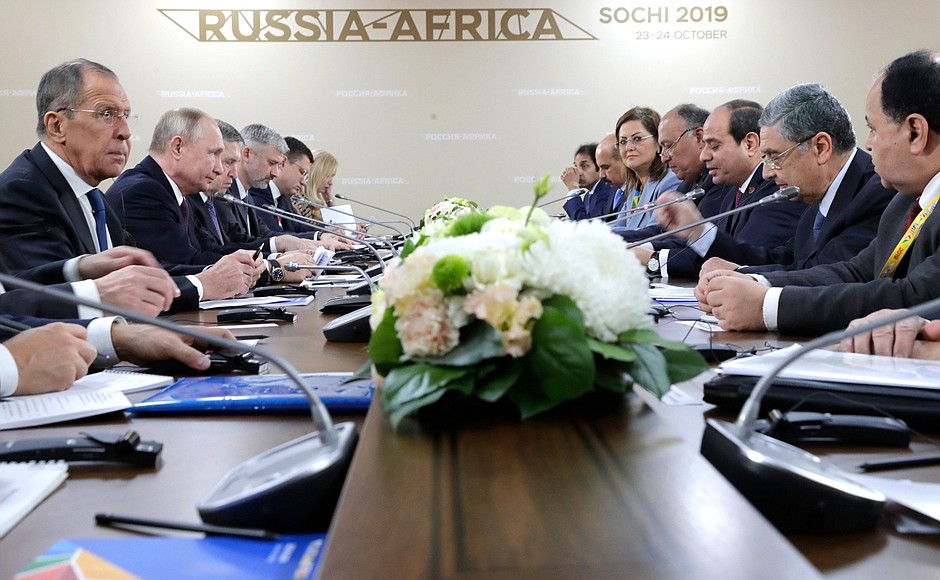
Last October 2019, during the first Russia-Africa Summit, Russian President Vladimir Putin and Egyptian President Abdel Fattah al-Sisi reaffirmed commitment to scale-up cooperation in various economic sectors and particularly expedite work on the special industrial zone and the construction of proposed four nuclear power plants, raising hopes for an increased power supply in Egypt.
Seated in a sizeable conference hall on October 23, Putin told the Egyptian delegation: “As for our bilateral relations, we continue to implement ambitious projects that have been coordinated by us, including a nuclear power plant and an industrial zone in Egypt. We are working very actively in these areas, and we are planning to invest $190 million in infrastructure development projects and to attract up to $7 billion.”
In his response, Abdel Fattah el-Sisi warmly expressed gratitude for holding the first Russia-Africa Summit, added that relations have had a long history in many fields and spheres, starting with Russia’s support to the liberation movement, its contributions helped many African countries to attain practical results based on mutually beneficial cooperation in Africa.
“I would like to point out that we view Russia as a reliable partner of the African continent. We hope very much that Russia will be working in Africa in all spheres and fields, including in that of the development, as well as in the financing of infrastructure projects on the continent and in particular in energy and road construction,” the Egyptian leader told Putin.
Egypt attaches great importance in its relations with Russia. But what is particularly important for their bilateral relations, Abdel el-Sisi assertively reminded: “I would like to assure you of our high appreciation of our bilateral relations, which are developing in various formats, especially after we signed a comprehensive cooperation agreement. We sincerely hope that our relations will continue to develop in all fields and spheres.”
“As for the nuclear power plant, we set a high value on our bilateral cooperation. We strongly hope that all topics related to this project will be settled without delay so that we can start implementing the project in accordance with the signed contract. Mr President, we hope that the Russian side will provide support to nuclear energy facilities in Egypt so that we can work and act in accordance with the approved schedule,” he added, in conclusion.
Related Russian ministries, departments and agencies are, usually, tasked to coordinate and implement bilateral agreements. In the case of nuclear power, State Atomic Energy Corporation is the main player. According to the description made available on its website, State Atomiс Energy Corporation, popular referred to as Rosatom, is a global leader in nuclear technologies and nuclear energy. It is established 2007 [a non-profit entity type] and headquartered in Moscow.
In fact, Rosatom has shown business interest in Africa. Over the past two decades, at least, it has signed agreements that promised construction of nuclear energy plants and training of specialists for these countries. The Director General, Alexey Likhachev, emphasized these points at the Russia-Africa Summit that Rosatom has already been cooperating with more than 20 African countries, in particular, building the largest “El-Dabaa” NPP in Egypt with an installed capacity of 4.8 GW.
While still there in Sochi, Alexey Likhachev noted that more reliable, affordable and stable energy is the basic condition for achieving sustainable development goals. “We can make a qualitative breakthrough in Africa in terms of technological development and the use of nuclear technology in the next few years,” he said during one of the plenary sessions.
According to Reuters, the Egyptian Electricity and Renewable Energy Minister Mohamed Shaker said earlier at the International Atomic Energy Agency’s ministerial conference that Russia had asked for $12 billion for the nuclear plants, a reliable solution for energy deficit. In this regard, the development of nuclear energy is important for Egypt.
“We made significant strides in the preparation of all strategic agreements [regarding the construction of a NPP in Egypt] with our strategic partner, Russia. We have also completed all technical, financial and legal aspects,” he said.
Shaker said that Egypt decided to build an NPP due to the need to redress the energy balance to reduce emissions of greenhouse gases and to save hydrocarbons which the country has earmarked for petrochemicals. “We have few traditional sources of electricity generation. The potential of hydro energy is gradually waning. Following the adoption of a special plan to cut greenhouse gas emissions we stopped using coal plants, however, energy consumption will grow,” according to the Minister.
It raises many questions about practical implementation of the several [paperwork] nuclear agreements that were signed with African countries. According to historical documents from the Ministry of Foreign Affairs and information from published media reports, specifically about Egypt, the proposed Russian nuclear plants has a long history, at dating back to Soviet days.
Nuclear deals with Russia:
Egypt has been considering the use of nuclear energy for decades. The Nuclear Power Plants Authority [NPPA] was established in 1976, and in 1983 the El Dabaa site on the Mediterranean coast was selected.
Egypt’s nuclear plans, however, were shelved after the Chernobyl accident. However, in 2006, Egypt announced it would revive its civilian nuclear power program, and build a 1,000 MW nuclear power station at El Dabaa. Its estimated cost, at the time, was $12.5 billion, and the plans were to do the construction with the help of foreign investors. In March 2008, Egypt signed an agreement with Russia on the peaceful uses of nuclear energy.
Early February 2015, President Putin and President Abdel Fattah el-Sisi signed an agreement to set up a nuclear plant in Dabaa, on the Mediterranean coast west of the port city of Alexandria, where a research reactor has stood for years. The deal was signed after a comprehensive bilateral discussion held and both expressed high hopes that Russia would help construct the country’s first nuclear facility.
Interfax news agency reported that Sergei Kiriyenko, the Head of the Rosatom state corporation, had presented to the authorities in Egypt, Russia’s proposals on construction of the first nuclear power plant in that country. The proposal is for construction of four power blocks, each with 1,200 megawatts of capacity.
Rosatom and Egypt’s Electricity and Energy Ministry signed the agreement on development of the nuclear plant construction project in February 2015. The project assumes that Russia will provide an intergovernmental loan to Egypt. Commercial contracts would be concluded once the intergovernmental agreements on construction of the facility and on the loan were signed.
In assertive remarks carried by local Russian news agencies, Kiriyenko said at that time that the technical and commercial details of the project were not finalized, but envisaged the new technology with strong safety measures taken into account. That included the lessons learned during the March 2011 Fukushima disaster in Japan, as well as a loan requested by the Egyptian government for the project construction.
Russia and Egypt Courtship
Interestingly, Egypt’s dreams of building nuclear plant has spanned several years, with agreement that was signed [as far back in March 2008] during an official visit to the Kremlin by the ousted Egyptian President Hosni Mubarak, and then through another former Egyptian leader Mohammed Morsi who discussed the same nuclear project with Putin in April 2013 in Sochi, southern Russia.
Mohammed Morsi had sought $4.8 billion loan from International Monetary Fund [IMF], and had also asked for an unspecified amount of loan from Russia to build the nuclear power plant. He hoped Russia would accelerate and expedite efforts, and provide financial backing for the project during his political administration.
The same year, following the revolutionary events and after a wave of mass anti-government actions, the army outsted the Moslem Brotherhood and their leader Mohammed Morsi, resulting in postponing or suspending the nuclear construction agreement. Since July 2013, Abdel Fattah el-Sisi has been in power after removing Morsi from office.
It is well-known fact that Egypt had long ties with the former Soviet Union. Those bilateral diplomatic ties resulted in several development projects in late 1950s including the building of the Aswan dam. During the Soviet times, many specialists were trained for Egypt. Hosni Mubarak, a former pilot, received training in what is now Kyrgyzstan, and further studied at the Soviet Military Academy in Moscow in the 1960s.
Egypt, first, began its nuclear program in 1954 and in 1961, acquired a 2-megawatt research reactor, built by the Soviet Union. Plans to expand the site have been decades in the making but repeatedly fell through. In 2010, that reactor suffered a breakdown, though no radiation was reported to have leaked out.
Renewable Energy Sources
Egypt is classified as having a high power system size [24,700 MW installed generation capacity in 2010 with more than 40 grid-connected plants]. As of 2010, 99% of the Egyptian population has access to electricity.
Since the early 2000s, power outage rates and durations, as well as distribution system losses, have trended downwards indicating that distribution companies have improved their overall customer service quality over the past decade; however, Egypt has seen a great weakening in its supply security. The power system’s generation reserve capacity declined from 20% in the early 2000s to 10% by the 2010s.
The weakening of Egypt’s supply security has caused widespread social issues in the 2010s. To deal with the extremely high demand for electricity, rolling blackouts and power cuts were implemented throughout the summer of 2012 causing great tension between the government and the people of Egypt.
Egypt has Renewable energy projects. The current energy strategy in Egypt [adopted by the Supreme Council of Energy in February 2008] is to increase renewable energy generation up to 20% of the total mix by 2020. The energy mix includes the use of hydropower, solar wind and nuclear.
Hydropower – The majority of Egypt’s electricity supply generated from thermal and hydropower stations. There are four main hydroelectric generating stations currently operating in Egypt. Experts have questioned why Egypt could not maximize the use of the river Nile that stretches 6.695 kilometers, especially for agricultural, industrial and generating energy for the region.
Solar – Egypt has a high solar availability as a result of hot desert climate.
Wind – Egypt has a high potential for wind energy, especially in the Red Sea coast area. As of 2006, 230 MW of wind energy was installed, and again 430 MW of wind power was installed in 2009.
In March 2015, British Petroleum [BP] signed a $12 billion deal to develop natural gas in Egypt intended for sale in the domestic market starting in 2017. Egypt is an important non-OPEC energy producer. It has the sixth largest proved oil reserves in Africa. Over half of these reserves are offshore reserves. Although Egypt is not a member of OPEC, it is a member of the Organization of Arab Petroleum Exporting Countries.
Swinging for Nuclear Power
Nuclear experts have also shown some concern. Lack of electricity supply is a huge restraint on African economies and specifically for Egypt, nuclear power could be an excellent source of large-scale grid electricity. Nuclear is not expensive compared with other energy sources. But for African countries to develop nuclear power, the governments must first establish the necessary legal and regulatory framework.
The project must comply with all international standards and regulation on nuclear power. Africa has a shortage of skills for nuclear power. However, Africa has a shortage of skill for any energy technology, so developing nuclear power would necessarily mean increasing African skills, which is in itself a good thing.
Despite the long technical negotiation process, the current Egyptian leadership, indeed, shows high optimism toward adoption of nuclear power as an important and indispensable source of energy that will underpin sustainable growth of the economy in the country. The four blocks of the nuclear power plant will cost about $20 billion, according a website report of the Egyptian Ministry of Electricity and Renewable Energy.
Apparently, experts expect that such mega-projects would have thorough discussion in parliament, financing sources broadly identified and approved by the government. Egypt has yet to make an official announcement of the tender for the contract to build its nuclear plants. Media reports have also revealed that nuclear companies from China, the United States, France, South Korea and Japan seek to take part in international tender.
Egypt’s Economic Potentials
With over 100 million inhabitants, Egypt is the most populous country in North Africa, popular referred to as Maghreb region and part of the Arab World. Egypt is the third most populous country after Nigeria and Ethiopia in Africa. About half of Egypt’s residents live in urban areas, with most spread across the densely populated centres of greater Cairo, Alexandria and other major cities along the Nile Delta.
The economy has been transforming from one based upon agriculture to an economy with more emphasis on services sector, for example its fast-growing tourism and hospitality, and to some extent manufacturing. It has experienced a fall in Foreign Direct Investment [FDI] to the country.
Egypt’s economy mainly relies on sources of income: tourism, remittances from Egyptians working abroad and revenues from the Suez Canal. Egypt has received United States foreign aid [an average of $2.2 billion per year], and is the third-largest recipient of such funds from the United States.
Remittances, money earned by Egyptians [estimated 2.7 million] living abroad and sent home, reached a record $21 billion in 2012, according to the World Bank. Tourism is one of the most important sectors in Egypt’s economy. More than 15.8 million tourists [2018] visited Egypt, providing revenues of nearly $11 billion. The tourism sector employs about 12% of Egypt’s workforce.
With one of the largest and most diversified economies in the Middle East, which is projected to become one of the largest in the world in the 21st century, Egypt has the third largest economy in Africa. Egypt is a founding member of the United Nations, the Non-Aligned Movement, the Arab League, the Organization of Islamic Cooperation and the African Union.
Kester Kenn Klomegah writes frequently about Russia, Africa and the BRICS.


