Connect with us

Economy

NASD OTC Exchange’s Key Indicators Remain Flat

Published

on

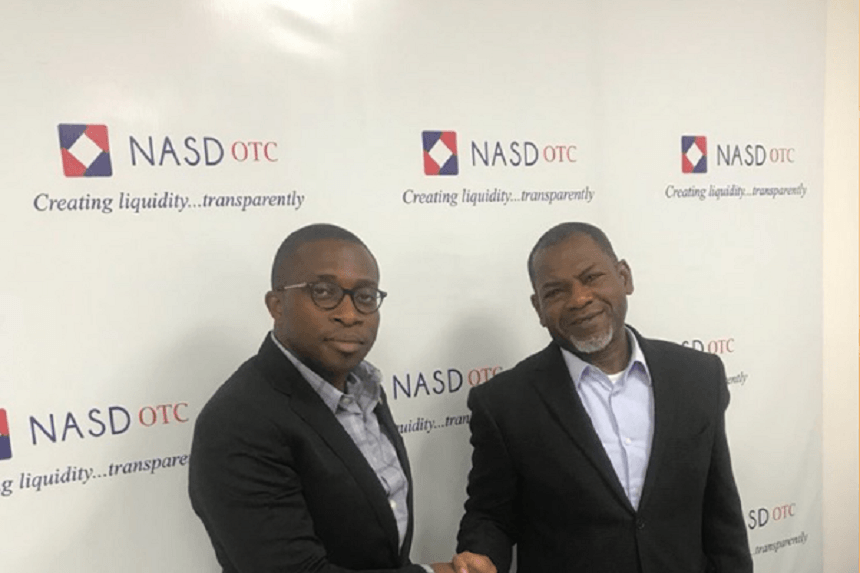
NASD OTC Exchange

By Adedapo Adesanya

The NASD Over-the-Counter (OTC) Securities Exchange closed in the flat territory at the end of the first trading session on Monday, July 6 as the market’s key performance indicators remained at their previous levels.

Last Friday, the market capitalisation and unlisted securities index (NSI) ended at N525.65 billion and 716.95 points respectively. At the close of transactions yesterday, both indicators remained unchanged.

However, the volume of shares transacted by investors depreciated by 90.7 percent on Monday to 10,600 units in contrast to 116,404 units of the preceding session.

Also, the value of shares traded by market participants during the trading day reduced by 55.3 percent as shares worth N1.3 million exchanged in hands yesterday at the bourse compared with the N2.8 million recorded last Friday.

In the same vein, there was a 72.7 percent decline in the number of deals carried out yesterday at the unlisted securities market.

According to data from the exchange, only three deals were executed at the NASD OTC market as against the 11 deals of the preceding session.

A breakdown of these deals showed that FrieslandCampina WAMCO Nigeria Plc, Niger Delta Production and Exploration (NDEP) Plc and VFD Group Plc recorded one deal each.

Business Post reports that there were no price gainers or losers on Monday as all the 40 securities admitted to the bourse retained their previous values.

ARM Life Plc closed the session as the most active stock by volume (year-to-date) on Monday with 7.4 billion units of its shares transacted for N4.6 billion. Central Securities Clearing Systems (CSCS) Plc was in second place with 196.8 million units worth N2.6 billion, while Food Concept Plc held the third position with 110 million units of its shares worth N80.5 million.

In terms of the most attractive stock by value (year-to-date), ARM Life Plc also maintained the top spot with 7.4 billion units of its securities traded for N4.6 billion, while CSCS Plc followed with 196 .8 million units exchanged for N2.6 billion, with NDEP Plc trailing after trading 7.9 million units of its securities valued at N2.4 billion.


Adedapo Adesanya is a journalist, polymath, and connoisseur of everything art. When he is not writing, he has his nose buried in one of the many books or articles he has bookmarked or simply listening to good music with a bottle of beer or wine. He supports the greatest club in the world, Manchester United F.C.

Economy

FG Maps Disputed Oil Wells to Reset Derivation Revenue

Published

on

Disputed Oil Wells

By Adedapo Adesanya

The federal government has launched the plotting of coordinates of disputed and newly drilled oil and gas wells, a critical process that could redefine derivation revenue flows and fiscal entitlements among Nigeria’s oil-producing states.

The exercise, formally flagged off by the Revenue Mobilisation Allocation and Fiscal Commission (RMAFC) in Abuja, follows the October 2025 flag-off of verification in the Niger Delta, triggered by petitions from the Governors of Anambra, Delta, Imo, Edo, Ondo and Rivers States, seeking clarity on ownership and boundaries of oil and gas resources.

According to the commission’s chairman, Mr Mohammed Bello Shehu, the process is a constitutional necessity rather than a political choice.

“This is not optional; it is a constitutional obligation,” Mr Shehu said. “The Constitution provides that 13 per cent of revenue from minerals, especially crude oil and gas, should be paid to the states where they are produced, and this is why the verification and plotting of coordinates of the new and disputed oil and gas wells must be done transparently and correctly.”

Mr Shehu disclosed that the Inter-Agency Technical Committee (IATC), comprising the National Boundary Commission (NBC), Office of the Surveyor-General of the Federation (OSGoF); Nigerian Upstream Petroleum Regulatory Commission (NUPRC), and RMAFC, has completed the verification phase and is now moving to the plotting stage.

“The IATC has verified the coordinates, and the next phase is to plot them, which will lead to resolving the location of the disputed oil and gas wells and properly attributing newly drilled wells to their rightful owners,” Mr Shehu said.

According to the RMAFC chairman, the exercise covers Akwa Ibom, Cross River, Bayelsa, Ondo, Rivers, Delta and offshore locations, where overlapping claims frequently emerge whenever new oil fields come on stream.

“Disputes arise when new fields are developed, because multiple states may lay claim,” he explained. “But it is the facts on ground that will reveal who actually owns what, and where ownership must be shared.”

To guarantee credibility, Mr Shehu revealed that the Commission conducted extensive fieldwork between September 2025 and January 2026, covering creeks, high seas and offshore terrains.

“We went to the field ourselves, and where we could not physically access, we deployed drones to take the coordinates,” he said. “All data collected were witnessed by representatives of the affected states.”

He assured that RMAFC would remain neutral throughout the process.

“RMAFC will be an unbiased umpire and will deploy justice, equity and fairness for which it is known,” he stated.

The Secretary to the Commission, Mr Joseph Okechukwu Nwaze, said the exercise reflects strong inter-agency cooperation.

“This process reinforces confidence in RMAFC as a neutral institution committed to fairness in revenue administration and fiscal federalism,” he said.

On her part, the Director, Crude Oil Department, Mrs Khadija Kumo, described the initiative as “timely and critical to the future of energy governance in Nigeria,” adding that “data-driven decision-making must now define oil and gas administration.”

Coordinator of the IATC, Mr Folorunsho Aderinwala, lauded the commission for providing full institutional support, noting that it enabled the committee to successfully complete verification across difficult terrains.

The mapping of coordinates is expected to become one of the most consequential fiscal governance exercises in Nigeria’s oil and gas sector in recent years, potentially redrawing the economic map of the Niger Delta.

Continue Reading

Economy

SEC Recapitalisation: Capital Market Stakeholders Seek Six-Month Extension

Published

on

Investments and Securities Act 2025

By Adedapo Adesanya

Some stakeholders in the Nigerian capital market, including the Capital Market Academics of Nigeria (CMAN) and the Chartered Institute of Stockbrokers (CIS), have called on the Securities and Exchange Commission (SEC) to extend the deadline for the ongoing recapitalisation of regulated capital market entities from June 2027 to December 2027.

SEC, the capital market regulator, recently raised the minimum capital requirements, with brokers asked to increase their capital base from N200 million to N600 million, while dealers are required to have N1 billion instead of the current N100 million.

For broker-dealers, they are to get N2 billion instead of N300 million, reflecting multi-role exposure across trading, execution, and margin lending.

The agency said fund and portfolio managers with assets above N20 billion must hold N5 billion, while mid-tier managers must maintain N2 billion with private equity and venture capital firms to have N500 million and N200 million, respectively.

Digital sub-brokers are required to maintain N100 million in capital and corporate sub-brokers N50 million, up from N10 million each previously.

The SEC stated that the reforms aim to strengthen market resilience, enhance investor protection, discourage undercapitalised operators, and align capital adequacy with the evolving risk profile of market activities.

Speaking at a roundtable themed, Deconstructing the New Minimum Capital Requirements for Regulated Capital Market Entities in Nigeria, CMAN, led by Professor Uche Uwaleke, said while recapitalisation is necessary and deserves full support, the proposed timeline remains debatable considering the 2027 general elections.

He said election years are typically characterised by uncertainty and erratic investor behaviour, which could make capital mobilisation difficult.

Professor Uwaleke urged the SEC to consider extending the deadline to December 2027, effectively shifting the implementation period from 18 months to 24 months, saying that “There is no doubt that recapitalisation is necessary, but extending the deadline would better align with market realities.”

On her part, the first vice president of the Chartered Institute of Stockbrokers (CIS), Mrs Fiona Ahimie, said the timing of the exercise was problematic, even if the absolute capital amounts were not excessive, stressing that operators should not be conflicted between executing client transactions and sourcing capital for themselves, adding that extending the deadline was the most practical solution.

Continue Reading

Economy

PAYE Cuts Boosting Workers’ Take-Home Pay Under New Tax Laws—Oyedele

Published

on

taiwo oyedele tax reform

By Adedapo Adesanya

The chairman of the Presidential Fiscal Policy and Tax Reforms Committee, Mr Taiwo Oyedele, has said that, as a result of the recently introduced tax laws, Nigerian employees are beginning to experience a rise in their take-home pay due to the reduction in PAYE (Pay As You Earn) deductions.

Mr Oyedele disclosed this on Monday via his official X handle, referencing feedback from employees who have received their January 2026 salaries. He noted that early responses indicated that the revised tax framework was already delivering tangible relief to salary earners, particularly those whose income taxes are deducted at source.

According to him, the decline in PAYE deductions reflects the initial impact of the federal government’s ongoing tax reforms, which are aimed at easing the financial burden on workers, increasing disposable income and supporting broader economic growth.

He added that the reforms were also designed to simplify tax administration and improve compliance nationwide.

The committee chairman expressed satisfaction with the early outcomes of the policy changes, saying they demonstrated the government’s commitment to ensuring that tax reforms translate into tangible benefits for workers.

He explained that the reforms were structured to provide targeted relief for employees within the formal sector, where PAYE remains the primary mode of income tax collection.

Mr Oyedele said the Presidential Fiscal Policy and Tax Reforms Committee was taking steps to ensure effective and uniform implementation of the new tax regime across organisations.
He disclosed that the committee, in collaboration with the Joint Revenue Board, would host an engagement session for key stakeholders responsible for applying PAYE deductions across both the public and private sectors.

The tax titan said the session would focus on clarifying the provisions of the new tax laws and aligning payroll administrators with the revised requirements to ensure employees fully benefit from the changes.

According to Mr Oyedele, the government will continue to monitor the implementation of the reforms and engage relevant stakeholders to address emerging issues, with the overarching goal of strengthening Nigeria’s tax system and improving workers’ welfare.

Continue Reading

Trending