Connect with us

General

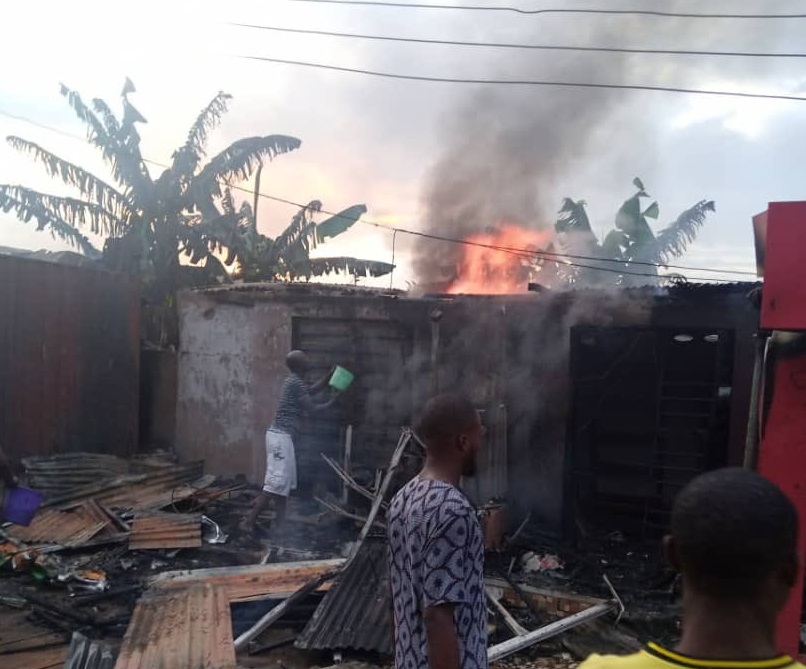
Panic as Gas Station Explodes in Baruwa Lagos

Published

on

Baruwa Gas Station explosion

By Modupe Gbadeyanka

Another gas explosion has occurred in Lagos, about two few weeks after a similar incident happened in the commercial capital of Nigeria.

This time, according to reports, the inferno occurred at the gas station located at Baruwa in Ipaja under Alimosho Local Government Area of Lagos State.

It was gathered that the explosion started at about 5:45am on Thursday, October 8, 2020, at Best Roof Cooking Gas and the Director-General of the Lagos State Emergency Management Agency (LASEMA), Mr Olufemi Oke-Osanyintolu, four persons lost their lives.

“Unfortunately, four mortalities were recorded and several others injured,” the LASEMA chief stated.

The cause of the explosion, Mr Oke-Osanyintolu, could not be ascertained, but security officials, as well as men of the Lagos Fire Service and LASEMA, were seen at the scene of the fire.


Modupe Gbadeyanka is a fast-rising journalist with Business Post Nigeria. Her passion for journalism is amazing. She is willing to learn more with a view to becoming one of the best pen-pushers in Nigeria. Her role models are the duo of CNN's Richard Quest and Christiane Amanpour.

Click to comment

Leave a Reply

Your email address will not be published. Required fields are marked *

General

$83m IFC-Backed Funding Boosts Nigeria’s Off-Grid Electricity Drive

Published

on

Off-Grid Electricity

By Adedapo Adesanya

Nigeria has secured $83 million in fresh financing to expand off-grid electricity supply as the country continues to shift towards decentralised power solutions to boost accessibility and alternative solutions.

The funding, backed by the International Finance Corporation (IFC) under the Distributed Access through Renewable Energy Scale-Up programme, is targeted at private developers deploying solar mini-grids and standalone systems in rural and underserved communities.

The agreement was signed during the 2026 Spring Meetings of the World Bank Group and IMF in Washington, marking a transition from small pilot projects to large-scale execution.

This intervention comes at a critical time, when Nigerians are tapping into solar alternatives as petrol prices continue to rise amid current Middle East disruptions.

According to the World Bank, about 85 million Nigerians, roughly 40 per cent of the population, still lack access to electricity. Even among those connected to the grid, supply remains unreliable. National output continues to hover between 4,000 and 5,000 megawatts, a level widely considered inadequate for an economy of Nigeria’s size.

The Head of the Nigeria Electrification Programme, Mr Olufemi Akinyelure, made it clear that the market is evolving beyond experimentation.

“This marks a shift from programme design to execution at scale. Distributed renewable energy in Nigeria is now a bankable market, not a pilot segment,” he said.

The $83 million facility is designed as a revolving debt model, combining concessional and commercial funding to provide long-term capital to developers. This approach reduces risk, improves access to finance, and allows projects to scale across multiple locations without repeated funding bottlenecks.

In practical terms, the first phase will support companies such as Darway Coast, PriVida Power, Prado Power, GVE Projects and StarTimes Smart Energy, while another group of developers is already lined up for the next round. The fund will allow the shortlisted firms to deploy power faster to communities that have waited decades for reliable electricity.

Backed by a $750 million World Bank facility, the initiative aims to reach over 17.5 million Nigerians by 2028 and deliver about 465 megawatts of distributed renewable energy capacity. Current data from the Nigeria Electrification Programme shows that more than 4.1 million people have already benefited, alongside the installation of over 175 mini-grids and 1.1 million solar home systems.

For many rural communities, it will help boost small businesses, healthcare delivery, and education. Traders can extend operating hours, clinics can preserve vaccines, and students can study beyond daylight. In areas where petrol and diesel generators dominate, the shift to solar also cuts fuel costs and reduces exposure to volatile energy prices.

According to the IFC Managing Director, Mr Makhtar Diop, the role of blended finance in unlocking scale helps address long-standing barriers within the energy ecosystem.

Special Adviser to the President on the Economy, Ms Sanyade Okolie, who represented the Minister of Finance and Coordinating Minister of the Economy, Mr Wale Edun, said the federal government sees investment as critical to lifting millions of Nigerians out of poverty.

She added that the focus remains on attracting capital that delivers measurable improvements in living standards.

“For Mr President, the priority is to transform the Nigerian economy in a way that lifts people out of poverty. People must feel the difference,” she said.

On his part, the Minister of Communications, Innovation and Digital Economy, Mr Bosun Tijani, linked the programme to Nigeria’s ambition of building a one trillion-dollar economy, stressing that infrastructure, particularly power and digital systems, will determine how fast that target can be reached.

Continue Reading

General

Terra to Expand Defence Tech Manufacturing Footprint with New Ghana Facility

Published

on

Terra Industries

By Adedapo Adesanya

Nigerian defence technology startup, Terra Industries, is constructing a drone manufacturing facility in Accra, Ghana, as it continues its expansion.

The plant, designated Pax-2, will cover 34,000 square feet and serve as the company’s primary production base for drone and counter-drone systems in the region. The company has a mega-factory of a 15,000-square-foot Pax-1 plant located in Abuja.

The Ghana facility is expected to be operational by the end of June 2026 and will create 120 engineering jobs, running on a continuous production schedule. At full capacity, it is projected to manufacture 50,000 units annually across the company’s aerial systems portfolio.

The company said the expansion is part of a broader plan to scale manufacturing capacity across the continent. The need for security architectures has risen in recent years, as groups such as Islamic State and al-Qaeda are gaining ground in Africa, converging along a swathe of territory that stretches from Mali to Nigeria.

The startup produces long- and mid-range drones, autonomous sentry towers and unmanned ground vehicles to help secure infrastructure assets.

It will be looking at building a range of systems, including the Archer VTOL, a long-range surveillance and strike platform; the Iroko UAV, built for tactical deployment; and Kama, a counter-drone interceptor capable of speeds up to 300 kilometres per hour. The Kama system is designed for high-volume production to meet demand for kinetic drone interception.

Speaking on the latest development, Mr Nathan Nwachuku, co-founder and CEO of Terra Industries, said the only way Africa can have lasting peace is by uniting to build sovereign defence, not by relying on foreign security architecture, which instructed the choice of Ghana for the next phase of its expansion.

“We chose Ghana for Pax-2 because of its talent, strategic position, and political will to become a serious defence exporter,” he said.

In February, Terra extended its funding round to $34 million after securing an additional $22 million from investors, after an initial $11.75 million in January. Among its investors are 8VC, founded by the co-founder of Palantir Technologies Inc., Mr Joe Lonsdale, Lux Capital, with injections from the chief executive officer of Lagos-based unicorn Flutterwave, Mr Gbenga Agboola, as well as angel investors such as American actor Jared Leto and Jordan Nel, among others.

In the same month, the firm and the Defence Industries Corporation of Nigeria (DICON) signed a Memorandum of Understanding (MoU) for the establishment of a joint venture company (JVC) to boost the country’s defence industrial capacity and advance indigenous high-technology development.

Continue Reading

General

Lagos, Japan to Unlock Investment Opportunities in Wastewater Management Value Chain

Published

on

Wastewater Management Value Chain

By Modupe Gbadeyanka

The Lagos State government is looking to partner with Japan to unlock investment opportunities across the wastewater management value chain.

The Lagos State Wastewater Management Office (LSWMO) recently engaged the Japan International Cooperation Agency (JICA) survey team to advance a comprehensive model for wastewater infrastructure development in the metropolis, focusing on system integration, efficiency and long-term urban resilience.

The General Manager of LSWMO, Mr Adefemi Afolabi, informed his guests that Lagos, as a rapidly growing megacity with increasing pressure on its infrastructure, presents significant opportunities for investors to explore.

“Unlocking investment opportunities and improving service delivery across the State remains a top priority of the government. We have continued to create an enabling environment for private sector participation through the State Public-Private Partnerships (PPP) system.

“The Office of PPP provides a robust regulatory and institutional framework that supports investors, safeguards infrastructure assets, and ensures the protection of investments and returns on investment,” he stated.

Across the wastewater management value chain, the agency continues to explore innovative solutions, including brownfield and greenfield projects, to expand infrastructure capacity and create viable investment opportunities capable of boosting revenue generation for the State.

He expressed appreciation to JICA for its continued investment and technical support in the environmental sector, acknowledging that the support and intervention of development partners are essential to achieving long-term sustainability goals.

In his remarks, the JICA Team Lead, Mr Teketoshi Fujiyama, commended LSWMO for its systematic and policy-driven approach to wastewater management, describing it as a strong foundation for scalable infrastructure development.

He also acknowledged the detailed PPP model of the state, adding that such a framework will attract investors, ensure operational efficiency, and guarantee the long-term viability of wastewater projects in Lagos State.

While seeking deeper insights into the agency’s current operations, plans, and inter-agency coordination mechanisms, he noted that such engagements would help identify priority areas for technical support, capacity development and integrated infrastructure planning.

He disclosed that JICA is currently collaborating on water-related projects with the African Development Bank and other partners, including the EU Waterworks initiatives in select Nigerian communities.

“JICA is exploring modalities with relevant stakeholders to improve water supply and distribution networks across Lagos, while also considering the integration of wastewater management systems into broader urban water planning,” he added.

Mr. Fujiyama further emphasised the importance of embedding wastewater solutions into existing and future infrastructure projects, noting that sustainable urban development cannot be achieved without a holistic approach to water resource management.

Continue Reading

Trending