Connect with us

General

Social Media Overblew Lekki Toll Gate Shooting—Sanwo-Olu

Published

on

Lekki Toll Gate CCTV

By Modupe Gbadeyanka

Governor Babajide Sanw0-Olu of Lagos State has blamed the social media for overblowing the proportion of the unfortunate shooting at the Lekki Toll Gate by the military on Tuesday evening with what he described as “false information” being shared by those who were not at the scene of the incident.

According to him, “There have been several false information that we have seen over the incident and we will appeal to people to show more restraint in posting information that cannot be verified.”

One of such “false information” was the accusation that the state government was aware of the use of soldiers to disperse the peaceful and unarmed #EndSARS protesters demanding for a better police in the country.

Speaking on Wednesday on the Morning Show programme on Arise News, the Governor maintained that the state government did not order the military shooting, which left about 11 of the youths severely injured.

He also sustained his earlier assertion that no protester died in the incident, stressing that he and officials of the state government had gone round private and public health facilities across the state without being able to identify bodies of those allegedly killed in the incident except one that died from blunt force trauma and another corpse that was recovered by the police in the Victoria Island area with bullet wounds, noting that his administration was already investigating whether the deceased was a protester.

Mr Sanwo-Olu asked members of the public with credible information on anyone or group of persons killed in the incident to come forward with the claim.

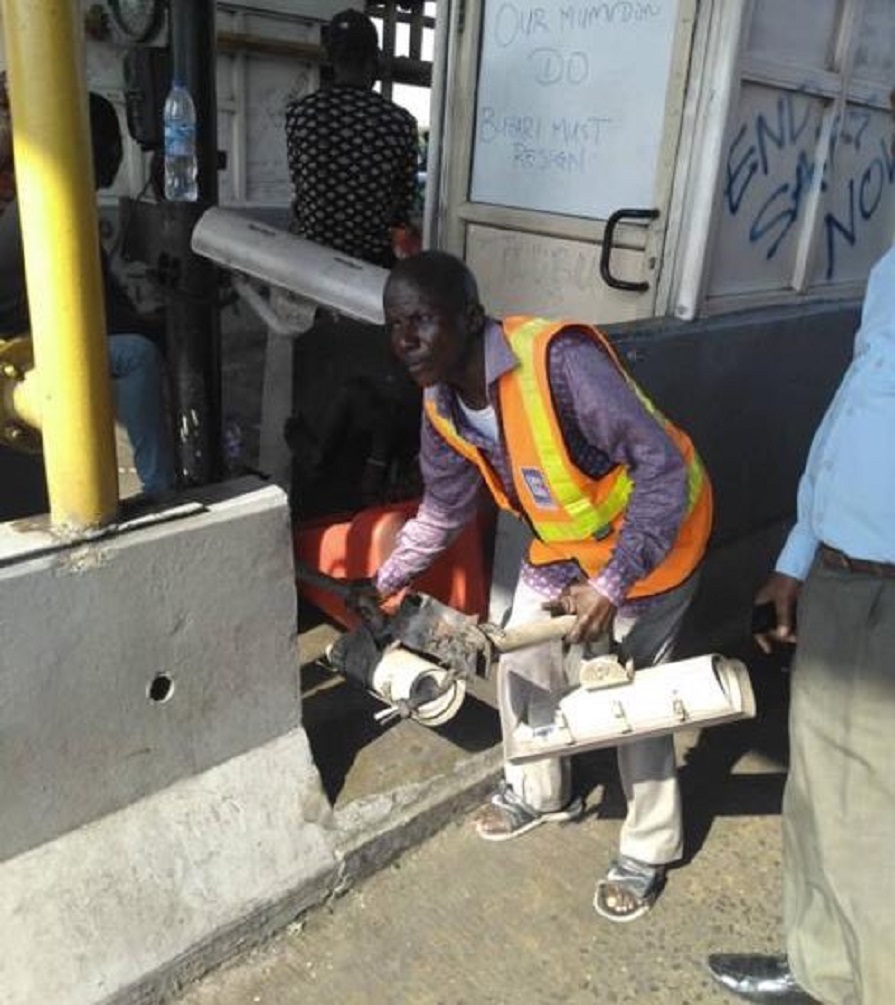
On the alleged removal of Close-Circuit Television (CCTV) security cameras at the Toll Plaza before the shooting started, the Governor debunked the claims that he ordered the action.

He explained that the cameras that were removed were not security cameras but laser cameras meant to capture vehicles’ electronic tags and number plates. He said the removal of the laser cameras was a decision taken by Lekki Concession Company (LCC) that owns the facility.

“When I spoke to the Managing Director of LCC over the matter, he told me the company took the decision to remove installations critical to their service when the curfew was announced.

“Those cameras that were displayed in the viral pictures were not security or motion cameras. They are laser cameras for vehicles, specifically designed to pick electronic tags and number plates on cars.

“Security cameras installed at the Toll Plaza are still there as I speak and the footages from them are the ones that we will be using in probing the Lekki incident. Since Tuesday, the security cameras at the Toll Plaza are still there and nobody can touch them,” he said.

The Governor said the multi-agency investigation into Lekki incident may begin next Monday when the order would have been fully restored across the State, pointing out that the recordings of the CCTV security cameras at the Toll Plaza would be useful in unravelling the circumstance that surrounded the incident.

Members of the public, the Governor said, will be part of the investigation for transparency. He added that security experts would be involved to analyse the recordings of the CCTV security cameras to ensure the footages captured since the time the protesters started camping at the tollgate were not tampered with.

On the allegation that he influenced the switching off of the billboard that illuminated the Toll Plaza area at night, Mr Sanwo-Olu said the concessionaire that operates the billboard took the decision independently after the curfew order was announced.

Speaking on the aftermath of the organised attacks on government properties, iconic buildings and private assets, Mr Sanwo-Olu said the nature of the destruction indicated an attempt by the arsonists to keep the State in limbo. He said the attacks were specifically targeted at emergency response infrastructure of the State to weaken its response in the case of large-scale violence.

The Governor disclosed that the arsonists, in the organised destruction, razed four State-owned fire stations and five fire trucks. He said the reconstruction of the damaged assets would cost billions but said the state would bounce back after the devastation.

Mr Sanwo-Olu said it would be insensitive for him to buttress the narrative linking the arsonist attacks on public buildings to sectarian elements, saying his immediate priority was to salvage the damaged assets and prevent further attacks. He, however, said all materials suggesting the arson may have been organised by secessionists would be left for security agencies for proper analysis.

Clarifying his statement that forces beyond him were behind the deployment of troops to Lekki axis, the Governor said: “The hierarchy and chains of command in the military are not within my purview. This is not something I have responsibility for. I do not have such power to control or activate the military. That essentially is what I was trying to say in that particular phrase.”

He also explained that he reached out to President Muhammadu Buhari on two occasions to seek for more help as public assets in the state were being destroyed. He said the President responded, directing the Chief of Defence Staff to liaise with him.

He said: “I made phone calls to speak to the President twice yesterday (Wednesday). The first time, he (president) hadn’t come to the office. The second time, he was at the Federal Executive Council (FEC) meeting.

“Indeed, I haven’t spoken to him directly. He was actually the one who directed the Chief of Defence Staff to call me and I feel that it was when he got my message. Because, when the Chief of Defence Staff called me, he said to me it was the President that asked him to call. But, I haven’t spoken to the President directly; maybe later today, that might happen.”

Aftermath of the destruction, Mr Sanwo-Olu urged the residents of Lagos to come together and heal the wounds inflicted on the state by the arsonists. He said the ugly incident put citizens’ patriotism to test, urging them to unite and re-build the State from the ruins left by the attacks.

He said: “We are at a point where all of us as a people living in the State must come together more than ever before. Our patriotism has been put to test and we need to re-engage ourselves and heal the several wounds that have been inflicted on us. We do not have any other country; this is our country.

“In Lagos, we cannot afford to put to waste what our forefathers and the generation of leaders before us have put in place. We need to preserve our heritage and we need to know that indeed we can build a future for our children. We need to put an end to any form of anger, protest, confrontation and bleeding. Let us come together and start a real healing process.”


Modupe Gbadeyanka is a fast-rising journalist with Business Post Nigeria. Her passion for journalism is amazing. She is willing to learn more with a view to becoming one of the best pen-pushers in Nigeria. Her role models are the duo of CNN's Richard Quest and Christiane Amanpour.

Click to comment

Leave a Reply

Your email address will not be published. Required fields are marked *

General

Tinubu Approves N3.3trn to Clear Power Sector Debts

Published

on

Electricity Tariff Hike

By Aduragbemi Omiyale

The sum of N3.3 trillion has been approved by President Bola Tinubu to finally clear the outstanding debts in the power sector.

A statement issued on Sunday by the Special Adviser to the President on Information and Strategy, Mr Bayo Onanuga, said the “long-standing debts accumulated between February 2015 and March 2025.”

It was stated that the payment plan for the debts under the Presidential Power Sector Financial Reforms Programme should restore ​reliable electricity to the country.

“Following verification, N3.3 trillion has been agreed as a full and final settlement, ensuring a fair and transparent resolution,” a part of the statement noted.

“Implementation has begun, with 15 power plants signing settlement agreements totalling N2.3 trillion. The federal government has already raised N501 billion to fund these payments. Out of the amount, N223 billion has been disbursed, with further payments underway,” it added.

The statement said, “With payments reaching the power value chain, generation will be more stable. With power plants supported, electricity reliability will improve.”

“This programme is not just about settling legacy debts. It is about restoring confidence across the power sector — ensuring gas suppliers are paid, power plants can keep running, and the system begins to work more reliably,” the Special Adviser to the President on Energy, Ms Olu Arowolo-Verheijen, was quoted as saying in the statement.

“It is part of a broader set of reforms already underway — including better metering and service-based tariffs that link what you pay to the quality of electricity you receive.

“The government is also prioritising power supply to businesses, industries, and small enterprises — because reliable electricity is critical to creating jobs, supporting livelihoods, and growing the economy.

“The goal is simple: more reliable power for homes, stronger support for businesses, and a system that works better for all Nigerians,” she added.

President Tinubu has commended all stakeholders who supported efforts to resolve the legacy issues in the power sector. He has also confirmed that the next phase (Series II) will begin this quarter.

Continue Reading

General

Atiku Hires US Lobby Firm for $1.2m to Boost Reputation, Counter FG Narratives

Published

on

atiku press conference

By Adedapo Adesanya

Former Vice-President Atiku Abubakar has hired Von Batten-Montague-York, L.C., a Washington-based lobbying firm, to protect and strengthen his “reputational standing” in the United States for $1.2 million.

According to The Cable, the contract agreement was signed by Mr Karl Von Batten, the managing partner at the firm, and Mr Fabiyi Oladimeji, a Nigerian politician, on March 9 and 10, 2026, respectively.

Based on a document filed with the US Department of Justice, one of the contract’s objectives entails that the firm will “counterbalance” the Nigerian government’s “lobbying narratives” in the US. It comes after the federal government reportedly spent $9 million to strengthen lobbying with the US government earlier this year.

Mr Abubakar, who is eyeing the Nigerian presidency, is currently with the African Democratic Congress (ADC). He will use the firm to “advance understanding” within US policymaking institutions of his “leadership posture and policy vision”.

Based on the contract details, the firm will facilitate and arrange meetings for the former vice-president to engage with US government officials and members of Congress.

Von Batten-Montague-York will also provide the politician with “guidance on policy positioning, reputational considerations, and engagement strategy”.

“These activities include lobbying and government affairs engagement with Members of Congress, congressional staff, and executive branch officials concerning issues related to democratic governance, regional stability, economic development, and U.S. engagement with Nigeria and the broader West African region,” part of the contract details reads.

“The Registrant (lobbying firm) may advocate for policies and perspectives aligned with the foreign principal’s stated positions, including matters relating to governance, economic policy, and bilateral relations with the United States.

“The Registrant also engages in promotion, perception management, and public relations activities designed to enhance understanding among U.S. policymakers and relevant stakeholders of the foreign principal’s policy positions, leadership posture, and strategic priorities.

“This includes the development of messaging strategies, narrative positioning, and reputational advisory services.

“In furtherance of these activities, the Registrant prepares, distributes, and may assist in the dissemination of informational materials, including briefing memoranda, policy papers, talking points, and related communications, intended to inform U.S. government officials and stakeholders.”

The former vice-president is expected to pay the $1.2 million for the 12-month contract in six instalments.

Continue Reading

General

Middle East Crisis: AfDB, Others Task Africa on Long‑term Structural Reforms

Published

on

Africa Long‑term Structural Reforms

By Dipo Olowookere

The need for Africa to protect itself from many external shocks not of its making has again been emphasised by the African Development Bank (AfDB), the African Union Commission (AUC), the United Nations Development Programme (UNDP), and the UN Economic Commission for Africa (UNECA).

On the margins of the 58th session of the Economic Commission for Africa in Tangier, Morocco, the continent was tasked to strengthen regional integration, accelerate African-led financial solutions, and invest decisively in energy, food, and trade resilience so as to move from vulnerability to preparedness.

The meeting focused on the spikes in energy, food and fertiliser prices caused by the ongoing conflict in the Middle East.

The United States and Israel launched airstrikes on Iran in February 2026, and since then, global oil prices have surged by more than 50 per cent as of late March. Twenty-nine currencies in Africa have weakened, raising the cost of servicing external debt and importing food, fuel, and fertiliser.

Disruptions linked to Gulf energy supplies limit access to ammonia and urea during the critical March–May planting season. This will affect agricultural production, compounding risks of crisis and emergency levels of food insecurity, especially for low‑income households and import‑dependent economies.

To address these issues, the quartet has asked African leaders to, in the short-term, stabilise fuel, food, and fertiliser supply, and execute medium‑term reforms to strengthen energy security, targeted social protection, and regional trade under the African Continental Free Trade Area (AfCFTA).

They also tasked leaders to come up with long‑term structural reforms towards stronger domestic resource mobilisation and African financial safety nets, including accelerated implementation of the African Financing Stability Mechanism.

“Continued escalation of the conflict worsens global instability, with serious implications for energy markets, food security, and economic resilience, particularly in Africa, where economic pressures remain acute,” the chairperson of AUC, Mr Mahmoud Ali Youssouf, said.

Also commenting, the UN Under-Secretary-General and Executive Secretary of UNECA, Mr Claver Gatete, said, “Africa has been hit by too many external shocks not of its making. Crises like this reinforce why Africa must finance more of its own future and strengthen regional solutions that build resilience before the next shock hits.”

On her part, the UN Assistant Secretary‑General and Director of UNDP’s Regional Bureau for Africa, Ms Ahunna Eziakonwa, submitted that, “With the right mix of policy choices, financing tools, and political resolve, Africa can weather this shock and emerge more resilient, more self-reliant, and better positioned to shape its own economic future.”

“As global crises multiply, Africa’s response must evolve from managing shocks to fostering resilience. African institutions and development partners need to act swiftly and in concert, leveraging their comparative advantages to cushion short-term shocks while laying the foundations for long-term resilience,” the president of AfDB, Mr Sidi Ould Tah, stated.

Continue Reading

Trending