Connect with us

Health

Heritage Bank Unveils LAWMA Recycle Card for Cleaner Lagos

Published

on

LAWMA Recycle Card

By Adedapo Adesanya

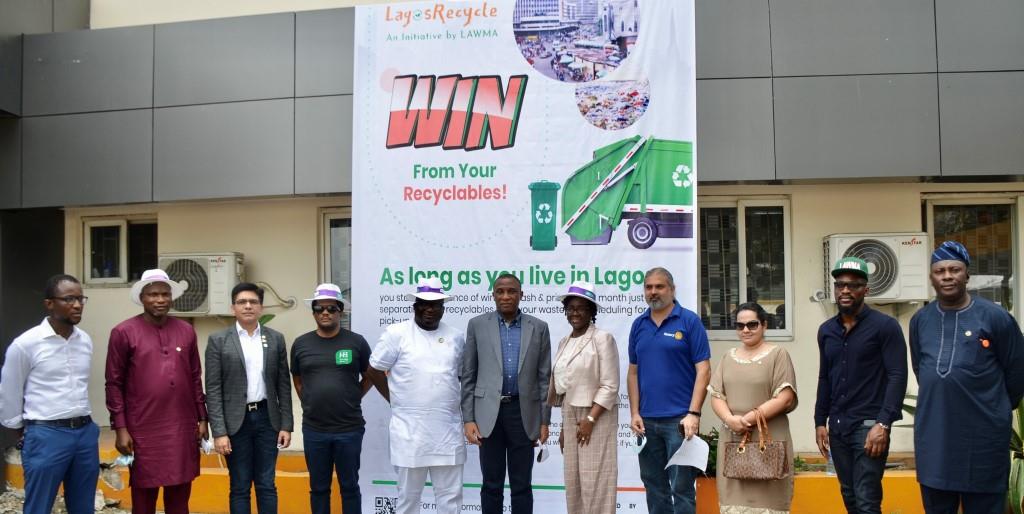
Heritage Bank has partnered with the Lagos Waste Management Authority (LAWMA) to launch a LAWMA Recycle Card as part of efforts to attain a sustainable greener and cleaner Lagos.

The collaboration marked the unveiling of the Lagos Recycle Initiative, which is targeted at curbing the huge challenge of plastic pollution for a better ecosystem through recycling and waste management reward system for residents of the state.

Speaking on the innovation, the MD/CEO of Heritage Bank, Mr Ifie Sekibo, affirmed that the collaboration was part of the move to promote the implementation of the Central Bank of Nigeria (CBN) initiative on Nigeria Sustainable Banking Principle to deliver positive development effects to society and businesses.

Specifically, he stated that Heritage Bank entered into this partnership to assist the Lagos State Government and recyclers generate employment whilst making the environment cleaner and better.

Mr Sekibo, who was represented by the Regional Executive, Lagos and South West, Heritage Bank, Mr Dike Dimiri, further explained that “as a bank that has been at the forefront of corporate social responsibility roles considered it key to be involved in societal development, supports the project through promoting recycling for export and domestic use, help individuals to de-plastic Lagos and get a reward from the state government”.

Explaining the modalities for the reward system which will be conducted via a raffle draw, he said, “Heritage Bank developed a simple payment system and presented the LAWMA Recycle Card which would allow the state government give its prizes to the aggregators and other benefits associated with the recycling project that consumers and participants of the Lagos Recycle Initiative are meant to benefit from.

“This card will be in the hands of the six million households in Lagos, it will also form the foundation for the transmission of every payment, raffle draws that will be conducted,” he said.

In his welcome address, the Managing Director/CEO of LAWMA, Mr Ibrahim Odumboni, said recycling was key in the authority’s drive to make Lagos cleaner and livable, stressing that moving plastic materials from the Lagos waste stream would reduce the volume of waste that eventually got to dumpsites.

Mr Odumboni said the Lagos Recycle initiative would deploy an attractive reward system, to encourage waste segregation and timely pick-up of recyclables across the state, emphasizing that residents would be rewarded for gathering their plastic items and handing them over to LAWMA accredited recyclers.

He said further that LAWMA would place recycling tools at various public facilities, for the collection of recyclables, noting that the initiative, apart from ridding the environment of plastic waste and its ugly effects, would provide jobs for thousands of unemployed people in society.

In her closing remark, the Permanent Secretary, Ministry of the Environment and Water Resources, Mrs Belinda Odeneye, stressed that the vision of the state government was to have a cleaner, beautiful and more hygienic environment, which would be promoted by the Lagos recycle program.


Adedapo Adesanya is a journalist, polymath, and connoisseur of everything art. When he is not writing, he has his nose buried in one of the many books or articles he has bookmarked or simply listening to good music with a bottle of beer or wine. He supports the greatest club in the world, Manchester United F.C.

Advertisement
Click to comment

Leave a Reply

Your email address will not be published. Required fields are marked *

Health

Local Packaging of WHO-Approved HIV Tests, a Shift in Africa’s Diagnostic Capacity

Published

on

WHO-Approved HIV Tests

By Chidinma Onwumere

Nigeria’s public health system has taken a further step toward strengthening diagnostic self-reliance with the local packaging of a WHO pre-qualified HIV Rapid Diagnostic Test (RDT) at a facility in Lagos. The development highlights a broader shift in how essential health commodities are produced, supplied, and regulated across the continent.

The HIV test in question, the Standard Q HIV 1 & 2 RDT was previously manufactured and distributed as a fully imported finished product. Through regulatory approval granted under the WHO Pre-Qualification Change Notification, local packaging is now authorised at Colexa Biosensor, a Nigerian facility, making it the only site in Africa currently approved to package a WHO-prequalified HIV RDT.

While the technical designation may appear procedural, its implications are significant. WHO pre-qualification is a globally recognised quality benchmark used by national governments and international donors to guide procurement decisions for public health programs. Any change to a pre-qualified product, including where it is packaged, requires rigorous assessment to ensure that quality, safety, and performance remain unchanged.

For Nigeria, the approval represents more than a regulatory milestone. It addresses a longstanding vulnerability in health systems across Africa: dependence on imported diagnostics and the fragility of global supply chains. During recent global disruptions, including the COVID-19 pandemic, many countries experienced delays in access to essential medical commodities, exposing the risks of over-reliance on distant manufacturing hubs.

By enabling local packaging of a WHO-approved HIV test, Nigeria improves its ability to respond more quickly to demand fluctuations, reduce lead times, and maintain continuity of supply for national HIV programs. The test has been evaluated and approved by the Federal Ministry of Health and the National AIDS and STI Control Programme and is listed on the National HIV Testing Algorithm, making it eligible for procurement by government agencies and international partners supporting HIV services in the country.

From a programme perspective, inclusion on the national algorithm is critical. It ensures that test kits used in public health settings meet required performance standards and align with national testing strategies. It also allows donor-funded programs, such as those supported by multilateral agencies and global health initiatives, to procure the product locally while maintaining compliance with international quality requirements.

The shift toward local packaging also brings economic and institutional benefits. Shorter supply chains can lower logistics costs, improve predictability, and create opportunities for skills transfer in quality management, regulatory compliance, and manufacturing operations. Importantly, local involvement does not replace global standards; rather, it requires demonstrable adherence to them. WHO-approved local packaging is contingent on standardised processes, full traceability, and the ability to consistently prove compliance through documentation and audits.

Health policy experts note that such approvals challenge persistent assumptions that high-quality diagnostic manufacturing must occur outside Africa. Instead, they suggest a growing recognition that African facilities, when supported by strong regulatory oversight and technical partnerships, can meet the same benchmarks applied globally.

Beyond HIV diagnostics, the Lagos facility also produces blood glucose meters and test strips, reflecting a parallel focus on non-communicable diseases such as diabetes, which are rising rapidly across Nigeria and the continent. This dual focus on communicable and non-communicable diseases aligns with evolving health priorities, as African countries face a growing burden of chronic illness alongside infectious diseases.

The broader significance of this development lies in its potential scalability. While the immediate impact is national, the regulatory pathway demonstrated in Nigeria could inform similar initiatives elsewhere in Africa. Regional health bodies and policymakers have long advocated for greater local production of essential medical products as part of health security and economic development strategies. However, progress has often been constrained by regulatory complexity, quality assurance requirements, and limited technical capacity.

By meeting WHO pre-qualification standards for local packaging, Nigeria offers a practical example of how these barriers can be addressed. It also underscores the importance of collaboration between global manufacturers, local operators, regulators, and international agencies in building sustainable diagnostic capacity.

As demand for HIV testing remains high, particularly among key populations and in underserved areas, reliable access to quality-assured diagnostics remains central to prevention, treatment, and surveillance efforts. Local packaging does not eliminate the need for global supply chains, but it can make them more resilient, responsive, and context-appropriate.

More broadly, the development contributes to an ongoing debate about how African countries can move beyond consumption toward greater participation in the value chain of global health products. In this sense, the local packaging of a WHO-approved HIV test is less about a single facility or product and more about what it represents: a gradual but meaningful shift toward health system self-reliance grounded in global standards

As African governments and development partners continue to prioritise pandemic preparedness, universal health coverage, and supply chain resilience, such models may play an increasingly important role in shaping the future of healthcare delivery on the continent.

Continue Reading

Health

Interswitch Takes eClinic Electronic Medical Records to Abia

Published

on

Electronic Medical Records

By Aduragbemi Omiyale

To boost public healthcare delivery, the health-tech subsidiary of Interswitch, Interswitch eClat, has deployed its eClinic Electronic Medical Records (EMR) platform across public health facilities in Abia State.

This would be done in phases, with the kick-off phase to span six public health facilities, including three primary healthcare centres, two secondary facilities, and one tertiary hospital, creating an end-to-end digital care pathway that strengthens patient referrals, supports continuity of care, and enables data-driven decision-making across all levels of service delivery.

The EMR solution is built to reduce patient waiting times, strengthen referral processes, and ensure the secure handling of both clinical and administrative data, supported by a hybrid infrastructure that enables local hosting with cloud-based backup.

Officials of the leading African technology company held talks with the state government, especially from the Abia State Ministry of Health in Umuahia.

They discussed the implementation framework, and expected outcomes of the proposed eClinic deployment.

Discussions focused on deploying Interswitch’s eClinic solution in alignment with Abia State’s broader healthcare reform agenda under the current government’s administration, particularly the transition from fragmented, paper-based systems to secure, interoperable digital platforms across public health facilities.

“The Ministry of Health in Abia State is excited about the digitisation of health facilities, starting with Interswitch’s eClinic pilot phase involving three primary, two secondary, and one tertiary health centre.

“This initiative will enhance efficiency, accountability, and patient care by linking records across different levels of care.

“Global evidence shows that digital health improves access, reduces the cost of care, and maximises human resources while personalising services for our people.

“This partnership with Interswitch represents a key deliverable for this administration and aligns with the Governor’s vision for a modern, technology-driven health system,” the Commissioner for Health for Abia State, Mr Enoch Ogbonnaya Uche, said.

“Abia State has demonstrated a strong commitment to innovation and system reform. The alignment of the state’s healthcare priorities with national health digitisation objectives creates a solid foundation for meaningful progress.

“Interswitch’s eClinic platform is designed to improve hospital operations by automating workflows, securing patient data, and providing healthcare managers with reliable insights to guide decisions.

“Beyond improving patient experience, it supports stronger revenue tracking, operational efficiency, and accountability. Our focus is to ensure the success of this pilot phase and deliver tangible improvements across productivity, service delivery, and patient satisfaction,” the Vice President for Health Ecosystem (Public Sector) at Interswitch, Mr Babatunde Fadeyi, stated.

Continue Reading

Health

Polaris Bank Sponsors Free Breast, Prostate Cancer Screenings

Published

on

Polaris Bank free cancer screenings

By Modupe Gbadeyanka

To commemorate World Cancer Day observed on Wednesday, February 4, 2026, Polaris Bank Limited is bankrolling free screenings for breast and prostate cancers across the country.

The financial institution partnered with a non-governmental organization (NGO) known as Care Organization and Public Enlightenment (COPE) for this initiative.

At least 100 women would be screened during the exercise, scheduled for Saturday, February 21, 2026, at the C.O.P.E Centre on 39B, Adeniyi Jones Avenue, Ikeja, Lagos, from 10:00 am to 2:00 pm.

The exercise will be conducted by trained health professionals and volunteers, ensuring participants receive both screening services and educational guidance on cancer prevention, self-examination, and follow-up care.

To participate in the free breast cancer screening programme, the applicants must be women, must be Polaris Bank account holders, and must have registered ahead of the day via bit.ly/BCS2026, with selection based on early and confirmed submissions.

Polaris Bank said the initiative was designed to promote awareness, screening, early detection, and preventive care, reinforcing its belief that access to health services is a critical foundation for individual and economic well-being.

The organization is already supporting an on-going free prostate cancer screening programme for 250 men aged 40 years and above across Nigeria.

The prostate cancer screening is being conducted at the Men’s Clinic, situated at 18, Commercial Avenue, Sabo, Yaba, Lagos, providing accessible, professional medical support for male participants seeking early detection and preventive care for prostate cancer.

Both initiatives (free breast and prostate cancer screenings) directly aligns with the United Nations Sustainable Development Goals, particularly SDG 3 (Good Health and Well-being) through improved access to preventive healthcare and early detection services, SDG 5 (Gender Equality) by prioritizing women’s health and empowerment, and SDG 17 (Partnerships for the Goals) through strategic collaboration with civil society organizations such as C.O.P.E to deliver community-centered impact.

Educational materials, community engagement sessions, and digital awareness campaigns will be deployed to reinforce key messages around early detection, lifestyle choices, and the importance of regular medical check-ups.

The Head of Brand Management and Corporate Communications for Polaris Bank, Mr Rasheed Bolarinwa, emphasised that early detection remains one of the most effective tools in the fight against cancer.

Continue Reading

Trending