Connect with us

Banking

AfCFTA Will Benefit Africa, Ecobank Customers—Ayeyemi

Published

on

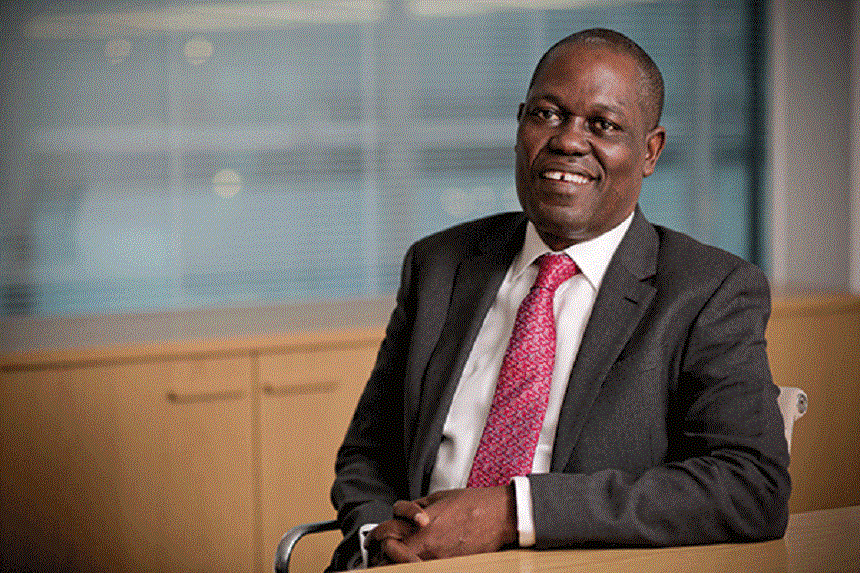
Ade Ayeyemi Ecobank

By Ahmed Rahma

The Group Chief Executive Officer of the Ecobank Transnational Incorporated (ETI), Mr Ade Ayeyemi, has declared that the banking group remains one of the key supporters of the African Continental Free Trade Area Agreement (AfCFTA).

The AfCFTA is a free trade area founded in 2018 but came into effect this January 1, 2021. The policy aims at creating a single African wide market for goods and services.

It is expected to pave the way for a rapid dismantling of impediments to cross-border trade leading to free movement of business, persons and investments across the continent, thus leading to the establishment of the Customs Union.

Mr Ayeyemi, who believes AfCFTA will be of great benefit to both the continent and the bank’s customers, affirmed that the pan-African banking group is facilitating smooth and instant payments as countries start the implementation of AfCFTA.

He said the bank has been able to affect international payment across the 33 countries where it operates on the continent through its Rapid Transfer platform.

He also emphasised that the bank’s platform can be scaled to accommodate other African countries under the AfCFTA based on their respective regulations.

According to him, “With this Pan-African exposure, the governments and our customers will re-evaluate their businesses to efficiently take charge of bigger opportunities.”

He said, “So, if you manufacture goods in Aba for the Nigerian market, you can now start thinking of how to expand your manufacturing capacity to be able to export across West Africa and also other African countries, not just looking at Nigeria as a market alone.

“And as you change your demand forecast, you need to now improve your capacity to produce and that will mean importing new machinery to expand your manufacturing base, develop bigger market and hire more people.”

He further added that, “Banks will work with other banks like Afrexim Bank to provide a swift payment platform as Africa will be the first market for most African products. For instance, there is no need for Nigeria to import rubber from Malaysia when rubber is being exported by Côte d’Ivoire.

“It is better within the African space. So, there is a whole range of businesses that we are having conversations with our customers, the governments and the African Union, because of our pan-African presence.”


Ahmed Rahma is a journalist with great interest in arts and craft. She is also a foodie who loves new ideas. She loves to travel and would love to visit other African countries someday. She is a sucker for historical movies and afrobeat.

Advertisement
Click to comment

Leave a Reply

Your email address will not be published. Required fields are marked *

Banking

CIBN to Back ACAMB on Professional Development, Industry Advocacy

Published

on

CIBN Back ACAMB

By Modupe Gbadeyanka

The Chartered Institute of Bankers of Nigeria (CIBN) has promised to support the ambitious plans of the Association of Corporate and Marketing Professionals in Banks (ACAMB).

At a meeting between the leaderships of the two organisations on Tuesday, the president of CIBN, Professor Pius Deji Olanrewaju, said it was impressed with the capability development and the undergraduate mentorship schemes of ACAMB under its leader, Mr Jide Sipe.

The CIBN chief commended the forward-thinking vision of the group, saying it had raised standards across Nigeria’s banking sector.

“ACAMB’s support has given CIBN and the banking sector brand equity,” he said, praising the association’s record in reputation management. recalling ACAMB’s role in addressing crises within the sector, describing the partnership as strategic and beneficial.

He further pledged support for ACAMB’s 30th anniversary in September 2026, its AGM, and other programmes, including fundraising initiatives.

“I want to assure you that everything you have presented today has been clearly noted and will be acted upon.

“We are fully committed to working closely with you so as to translate these discussions and vision into measurable progress. Our shared goal is to strengthen the sector, protect its reputation, and enhance its public image in a meaningful and lasting way.

“This meeting discussed various initiatives and reforms crucial for the future of our industry, including the need for continuous training and adaptation to new programs,” Mr Olanrewaju stated.

Speaking at the meeting, the president of ACAMB described the visit as a crucial first step in his tenure, aimed at contributing significantly to giving flight to his vision and that of ACAMB.

“When we assumed office, one of the first things we agreed on was the need to visit key stakeholders.

“However, before reaching out more broadly, we felt it was important to begin with our primary constituency and core stakeholders. We want them to understand the direction we are taking and to support the work we are doing, so that ACAMB can achieve greater success than it has in the past.

“We couldn’t have properly started our tenure without this very important meeting with the CIBN,” Mr Sipe stated

He introduced the newly constituted ACAMB Exco, which includes the 2nd Vice President, Morolake Phillip-Ladipo; General Secretary, Olugbenga Owootomo; Assistant General Secretary, Ademola Adeshola; Publicity Secretary, Abiodun Coker; and Executive Secretary, Fadekemi Ajakaiye.

Continue Reading

Banking

All Set for Second HerFidelity Apprenticeship Programme

Published

on

HerFidelity Apprenticeship Programme

By Modupe Gbadeyanka

Registration for the second HerFidelity Apprenticeship Programme (HAP 2.0) organised by Fidelity Bank Plc has commenced.

The Divisional Head of Product Development at Fidelity Bank, Mr Osita Ede, informed newsmen that the initiative was designed to empower women with sustainable entrepreneurship skills.

The lender created the flagship women-empowerment initiative to equip women with practical, income‑generating skills and structured pathways to entrepreneurship.

“HerFidelity Apprenticeship Programme 2.0 reflects our commitment to continuous improvement. Having evaluated feedback from the first edition, we have returned with stronger partnerships and deeper mentorship programmes to ensure that women acquire not just skills, but sustainable economic opportunities,” he said.

“At the heart of the programme is guided, real‑world learning. Participants will undergo intensive apprenticeship training under reputable institutions and industry experts across select fields such as hair styling, shoe making, auto mechatronics, and interior decoration,” Mr Ede added.

He noted that HerFidelity Apprenticeship Programme 2.0 goes beyond skills acquisition by offering participants a wide range of business advisory services. These include business and financial literacy training, mentorship support throughout the apprenticeship journey, access to Fidelity Bank’s women‑focused and SME financial solutions, as well as guidance on business formalisation and growth strategies.

Further emphasising the bank’s vision, Mr Ede said, “By integrating structured mentorship with entrepreneurial development, Fidelity Bank is positioning women not just as trainees, but as future employers, innovators, and economic contributors within their communities. This aligns with our mandate to help individuals grow, businesses thrive, and economies prosper.”

Continue Reading

Banking

The Alternative Bank Opens New Branch in Ondo

Published

on

Alternative Bank

By Modupe Gbadeyanka

A new branch of The Alternative Bank (AltBank) has been opened in Ondo State as part of the expansion drive of the financial institution.

A statement from the company disclosed that the new branch would support export-oriented agribusinesses through Letters of Credit and commodity-backed trade finance, ensuring that local producers can scale beyond state borders.

For SMEs, the bank is introducing robust payment rails, asset financing for equipment and inventory, and supply chain-backed facilities that strengthen working capital without trapping businesses in interest-based debt cycles.

The Governor of Ondo State, Mr Lucky Aiyedatiwa, represented by his Chief of

Staff, Mr Olusegun Omojuwa, at the commissioning of the branch, underscored the importance of financial institutions in economic development.

“The pivotal role of financial institutions to economic growth and development of any economy cannot be overemphasised. It provides access to capital, supporting small and medium-scale enterprises and encouraging savings.

“Therefore, I have no doubt in my mind that the presence of The Alternative Bank in Ondo State will deepen financial services, create employment opportunities and stimulate economic activities across various sectors,” he said.

In her remarks, the Executive Director for Commercial and Institutional Banking (Lagos and South West) at The Alternative Bank, Mrs Korede Demola-Adeniyi, commended the state government’s leadership and outlined the lender’s long-term vision for Ondo State.

“As Ondo State steps into its next fifty years, and into the future anchored on the sustainable development championed during the recent anniversary celebrations, The Alternative Bank is here to be the financial engine for that vision. We didn’t come to Akure to hang banners. We came to fund work, farms, shops, and factories.”

With Ondo State’s economy anchored largely on agriculture, particularly cocoa production, poultry farming, and other cash crops, alongside a growing SME and trade ecosystem, AltBank is deploying sector-specific financing solutions tailored to these strengths.

For cocoa aggregators, processors and poultry operators, the bank will provide production financing, facility expansion support, machinery lease structures, and structured trade facilities under its joint venture and cost-plus financing models, with transaction cycles of up to 180 days for commodity trades and longer-term structured asset financing for equipment and infrastructure.

The organisation is a notable national non-interest bank with a physical network now surpassing 170 locations, deploying capital to solve real-world challenges through initiatives such as the Mata Zalla project, which saw to the training of hundreds of women as electric tricycle drivers and mechanics.

Continue Reading

Trending