Connect with us

Economy

House of Representatives to Pass PIB in April

Published

on

Pass PIB in April

By Aduragbemi Omiyale

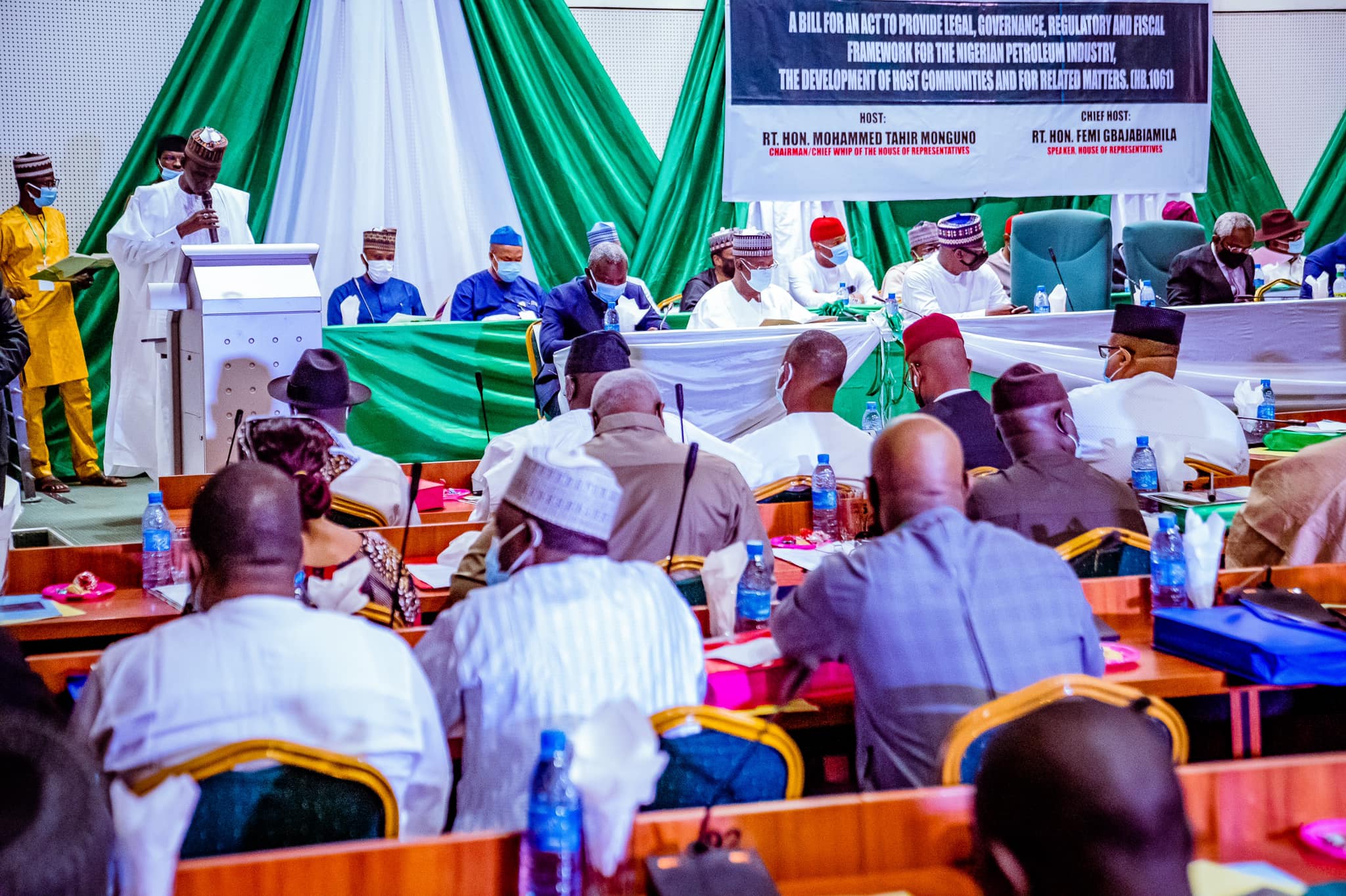
All things being equal, the much-awaited Petroleum Industry Bill (PIB) will be passed by the House of Representatives in April 2021.

Speaker of the lower chamber of the National Assembly, Mr Femi Gbajabiamila, said this on Wednesday while declaring open a two-day public hearing on the bill organised by the ad-hoc committee.

He explained that the public hearing was put together to get the different views of stakeholders in the industry, urging the participants not to close their minds or ears to the views and the positions that may be advanced by various interest groups.

According to him, “We are in a world, an economic world, so there must be interest groups, they will be interest groups and we cannot deny that.”

He said after the public hearing, the legislative arm of government continue to engage stakeholders “to accommodate the diversity of interests and ensure all critical views form part of the deliberations that inform the final legislation.”

“We are not oblivious to the fact of many contending interests in this sector. These contentions do not need to result in conflict, especially when we know the objective of national prosperity benefits us all,” the leader of the green chamber of the parliament reminded the audience.

However, he assured that the House of Representatives will protect the interest of Nigeria in new PIB, which he said consumed a lot of energy and expertise to prepare.

“A lot of work has gone into the preparation of this Bill, but it’s not strait-jacketed. The idea of a public hearing is to have interests that may have not been accommodated prior to the introduction of the Bill to lend their voices and to understand perhaps the bigger environment where they are coming from,” he said.

According to him, “There have been various prior attempts to meet this obligation. Let us remember those attempts and be motivated by the knowledge that we can now correct past mistakes and fulfil the responsibility we owe these communities once and for all.”

Mr Gbajabiamila expressed confidence that the ad-hoc committee on PIB headed by the Chief Whip, Mr Mohammed Tahir Monguno, would do a thorough job because it was a national consensus that there should be a comprehensive reform of the oil and gas industry.

Business Post reports that the PIB has been long coming in the last 20 years, but due to contending and vested interests, nothing meaningful has been achieved.


Aduragbemi Omiyale is a journalist with Business Post Nigeria, who has passion for news writing. In her leisure time, she loves to read.

Advertisement
Click to comment

Leave a Reply

Your email address will not be published. Required fields are marked *

Economy

NCS Denies Manipulating FX Rates in Import, Export Valuation

Published

on

customs exchange rate

By Adedapo Adesanya

The Nigeria Customs Service (NCS) has clarified how foreign exchange rates are applied in its import and export valuation, saying it neither determines nor alters rates used in cargo clearance.

The service, in a statement by its National Public Relations Officer, Mr Abdullahi Maiwada, explained that it relies solely on official figures transmitted by the Central Bank of Nigeria (CBN).

Mr Maiwada stated that recent public commentary surrounding forex pricing, investor reactions, and customs valuation had prompted NCS to explain the operational framework guiding its digital clearance platform.

“It is worthy of note that the reported exchange rate of N1,451.63/US$ for February 6, 2026 did not originate from the B’Odogwu system.

“That figure was sourced from trade.gov.ng, a legacy public trade information portal that does not reflect live Customs processing data,” it stated.

According to him, all exchange rates used in trade processing are automatically integrated into its Unified Customs Management System, known as B’Odogwu, which it described as the sole official portal for declarations, clearance, and valuation.

“It is important to provide factual clarification on how exchange rates are received, processed, and applied within the NCS digital clearance system, B’Odogwu, a Unified Customs Management System which serves as the sole official platform for Customs declarations, clearance, and valuation,” the statement reads.

The NCS spokesman said the Service receives rates electronically from the apex bank and applies them uniformly across commands nationwide, ensuring transparency, predictability, and compliance with statutory fiscal and monetary policies.

He argued that NCS does not generate or manipulate exchange rates under any circumstances.

Instead, it explained that the platform operates structured data-integration protocols designed to ingest and apply exchange-rate feeds exactly as transmitted.

“For the avoidance of doubt, the Nigeria Customs Service does not independently determine, generate, alter, or apply margins to foreign exchange rates used for import and export valuation.

“All exchange rates applied within the B’Odogwu platform are official rates electronically transmitted by the Central Bank of Nigeria, which remains the competent authority for exchange rate determination under Nigeria’s monetary framework,” Mr Maiwada added.

Continue Reading

Economy

Dangote Gets $400m Chinese Construction Equipment for Refinery Expansion

Published

on

Dangote Group

By Aduragbemi Omiyale

To fast track the expansion of its Lagos-based refinery, Dangote Group has sealed a $400 million construction equipment deal with one of the leading manufacturers of construction machinery in China, XCMG Construction Machinery Company Limited.

A statement from the conglomerate disclosed that beyond refining, the expansion programme will see polypropylene production increase from 900,000 metric tonnes per annum to 2.4 million metric tonnes per annum.

Urea capacity in Nigeria will be tripled from 3 million to 9 million metric tonnes per annum, in addition to the 3 million metric tonnes per annum capacity in Ethiopia, strengthening the Group’s position as the largest urea producer globally.

There are plans to expand the Dangote Petroleum Refinery and Petrochemicals from 650,000 barrels per day to 1.4 million barrels per day, positioning it to become the largest refinery in the world.

The Chinese deal will enable Dangote Group to acquire additional wide range of advanced construction equipment to support ongoing and forthcoming projects across refining, petrochemicals, agriculture and large-scale infrastructure development. The new equipment will complement existing assets deployed for the refinery expansion, which is expected to be completed within three years.

Production capacity for Linear Alkyl Benzene (LAB) will also be increased to 400,000 metric tonnes per annum, positioning the Group as the largest producer in Africa and strengthening supply to the detergent and cleaning agents manufacturing industry. Additional base oil production capacity also forms part of the broader expansion programme.

Dangote Group described the agreement as a strategic investment aimed at deepening its construction footprint and accelerating its ambition to build a $100 billion enterprise by 2030.

“The additional equipment we are acquiring under this partnership will significantly enhance execution across our projects. With this investment, we are positioning ourselves to become the number one construction company in the world,” it stated.

Continue Reading

Economy

NASD Unlisted Security Index Crosses 4,000 Basis Points

Published

on

NASD Unlisted Security Index

By Adedapo Adesanya

The NASD Over-the-Counter (OTC) Securities Exchange further appreciated by 0.67 per cent on Monday, February 16.

During the session, the NASD Unlisted Security Index (NSI) reached another milestone after it chalked up 26.65 points to 4,001.42 points from the preceding session’s 3,974.77 points.

Equally, the market capitalisation added N15.94 billion to end the trading day at N2.394 trillion, in contrast to last Friday’s N2.378 trillion.

Yesterday, the volume of securities rose by 389.6 per cent to 46.2 million units from 9.4 million units, but the value of securities went down by 24.3 per cent to N703.6 million from N703.6 million, and the number of deals dipped 2.2 per cent to 44 deals from the preceding session’s 45 deals.

Central Securities Clearing System (CSCS) Plc was the most traded stock by value on a year-to-date basis with 31.4 million units exchanged for N1.8 billion, followed by Resourcery Plc with 1.05 billion units traded for N408.6 million, and Geo-Fluids Plc with 71.2 million units valued at N296.9 million.

Resourcery Plc finished the trading session as the most traded stock by volume on a year-to-date basis with 1.05 billion units worth N408.6 million, trailed by Geo-Fluids Plc with 71.2 million units sold for N296.9 million, and CSCS Plc with 31.4 million units sold for N1.8 billion.

During the trading session, there were four price gainers and one price loser, led by CSCS Plc, which went down by 38 Kobo to N80.09 per share versus last Friday’s closing value of N80.47 per share.

However, MRS Oil Plc increased its price by N17.00 to N187.00 per unit from N170.00 per unit, FrieslandCampina Wamco Nigeria Plc gained N5.83 to trade at N71.35 per share compared with the previous session’s N65.52 per unit, Geo-Fluids Plc appreciated by 20 Kobo to N3.50 per share from N3.30 per share, and First Mortgage Bank Plc grew by 7 Kobo to 82 Kobo per unit from N75 Kobo per unit.

Continue Reading

Trending