Connect with us

General

SERAP Tasks NASS to Identify Lawmakers Involved in Missing N4.1bn

Published

on

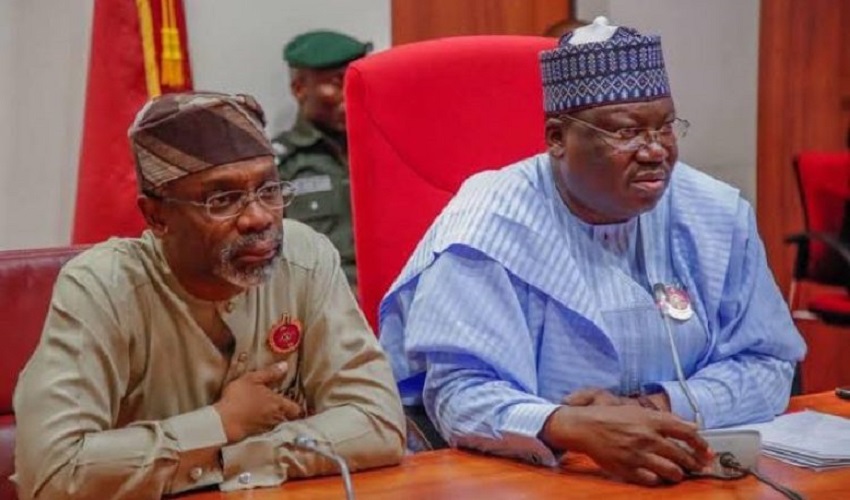
Lawan Gbajabiamila NASS Leadership

By Adedapo Adesanya

The leadership of the National Assembly has been tasked to probe the N4.1 billion budgeted for the parliament alleged to be missing.

This charge was given by the Socio-Economic Rights and Accountability Project (SERAP) in a letter addressed to the Senate President, Mr Ahmad Lawan, and Speaker of the House of Representatives, Mr Femi Gbajabiamila.

In the letter dated May 15, 2021, and signed by SERAP deputy director, Mr Kolawole Oluwadare, the parliament was asked to “urgently probe and refer to appropriate anti-corruption agencies fresh allegations that N4.1 billion of public money budgeted for the National Assembly is missing, misappropriated, diverted or stolen, as documented in the 2016 audited report by the Office of the Auditor-General of the Federation.”

SERAP noted that: “These allegations are not part of the disclosure by the Auditor-General in other audited reports that N4.4 billion of National Assembly money is missing, misappropriated, diverted or stolen.”

“As part of its legislative and oversight functions, the National Assembly has a key role to play in the fight against corruption in the country.

“But little can be achieved by the legislative body in the anti-corruption fight if the leadership and members do not first confront the spectre of alleged corruption and mismanagement within their ranks,” the letter reminded Mr Lawan and Mr Gbajabiamila.

SERAP also urged both men “to identify the lawmakers and staff members suspected to be involved, and hand them over to appropriate anti-corruption agencies to face prosecution, if there is sufficient admissible evidence, and to ensure full recovery of any missing public funds.

In the letter, SERAP stressed that it was “concerned that allegations of corruption continue to undermine economic development, violate social justice, and destroy trust in economic, social, and political institutions. Nigerians bear the heavy economic and social costs of corruption. The National Assembly, therefore, has a responsibility to curb it.”

“According to the Auditor-General Report for 2016, N4,144,706,602.68 of National Assembly money is missing, diverted or stolen. The National Assembly paid some contractors N417,312,538.79 without any documents. The Auditor-General wants the Clerk to the National Assembly to ‘recover the amount in question from the contractors.

“The National Assembly reportedly spent N625,000,000.00 through its Constitution Review Committee between March and June 2016 but without any document. The Auditor-General wants the Clerk to the National Assembly to ‘recover the amount from the Committee and furnish evidence of recovery for verification.

“The National Assembly also reportedly spent N66,713,355.08 as ‘personnel cost’ but ‘the payees in the Cashbook did not correspond with those in the Bank Statement’. The Auditor-General wants ‘the irregular expenditure recovered from the officer who approved the payments.

“The National Assembly also reportedly paid N116,162,522.60 to some contractors between April and June 2016 without any document. The National Assembly deducted N56,985,568.55 from various contract payments in respect of Withholding Tax and Value Added Tax but without any evidence of remittance.

“The National Assembly also reportedly paid N126,264,320.00 as cash advances to 11 staff members between March and December 2016 to procure goods and services but failed to remit the money.

“The Senate reportedly paid N747,286,680.00 as personal advances to staff members between February and December 2016 for various procurements and services but failed to retire the money. The Senate also deducted N118,625,057.48 as Withholding and Value Added Taxes but failed to show any evidence of remittance to the Federal Inland Revenue Service (FIRS).

“The Senate also spent N109,007,179.73 from the Capital Expenditure vote but without any document.

“The House of Representatives reportedly deducted N821,564,296.48 from staff salaries but failed to remit the money to tax authorities. The House also paid N254,059,513.70 as advances to staff members to procure goods and services between January and December 2016 but failed to retire the money.

“The National Institute for Legislative Studies reportedly spent N375,867,000.00 to buy 11 motor vehicles in April 2016. But the Institute also paid the same contractor N36,610,000.00 in September 2016 under the same contract without approval.

“The Institute also reportedly paid N10,927,768.80 to 7 members of staff who were redeployed from the National Assembly to provide specialized services but without details about the staff paid, and without any justification.”

“The National Assembly Service Commission reportedly approved N109,995,400.00 to train some officers in Dubai, United Arab Emirates but spent N127,629,600.00 as Estacode Allowances to participants, and fees for two consultants engaged for the training. The Commission also spent N9,975,000.00 as course fees for 34 officers but it also paid a consultant N4,987,500.00 for the same course fees.

“The Legislative Aides Section earned N12,274,587.77 as interests on Bank accounts in a commercial bank between January and December 2016 but failed to remit the money to the Consolidated Revenue Fund,” it stated.


Adedapo Adesanya is a journalist, polymath, and connoisseur of everything art. When he is not writing, he has his nose buried in one of the many books or articles he has bookmarked or simply listening to good music with a bottle of beer or wine. He supports the greatest club in the world, Manchester United F.C.

General

Nigerian Bottling Company Bridges Education, Employability Gap

Published

on

Nigerian Bottling Company UNILAG

By Modupe Gbadeyanka

The Nigerian Bottling Company (NBC) has reaffirmed its determination to bridge the gap between education and employability in the country by sustaining its flagship Youth Empowered (YE) programme.

This initiative provides hands-on learning, real-world insights, and access to career-shaping opportunities to young Nigerians.

The 2026 edition of the scheme commenced on February 2 at the University of Lagos (UNILAG), with participants mainly young people between the ages of 16 and 35.

A statement from the organisation said this year’s rollout will expand to more tertiary institutions, including the Federal University of Technology, Akure (FUTA). This follows a successful 2025 tour that reached seven cities across the country, including Makurdi, Jos, Benin, Kaduna, Asaba, Akure, and Port Harcourt.

Participants in the 2026 programme will receive training across key modules designed to support personal, professional, and business growth, including Business Life Skills, Adaptability and Resilience, Financial Literacy, Customer Service and Communication, Sales and Negotiation Skills, and Workplace Ethics.

The sessions will also feature breakout workshops on Business Planning, Project Management, and Time Management, alongside the Director’s Grant Pitch Competition, where participants can pitch their ideas for a chance to win business funding.

In addition to skills development, NBC’s People and Culture team will be present throughout the programme to identify outstanding talent for future opportunities within the organisation, further strengthening the connection between learning, employment, and long-term career growth.

One of the participants at the UNILAG training, Waliat Adedogun, who received a cash grant through the Director’s Grant Pitch Competition to support her small business, said: “Youth Empowered gave me more than training; it gave me clarity and confidence. Winning the grant means I can finally take my business idea from a dream into something real. I now feel prepared to build, grow, and create opportunities not just for myself, but for others too.”

Since its launch in 2017, the scheme has impacted more than 70,000 young Nigerians, equipping participants with practical skills, confidence, and exposure needed to succeed in today’s dynamic workplace and entrepreneurial landscape.

This year’s programme is being delivered in collaboration with Fate Foundation as the implementing partner, with funding support from The Coca-Cola HBC Foundation.

Last year, 10 beneficiaries were selected for six-month paid internships across NBC locations in Lagos, Ibadan, Asejire, and Challawa, gaining direct industry exposure.

Additionally, three outstanding participants received sponsorship for an all-expenses-paid intensive culinary training programme and were awarded N1 million each to support the launch of their businesses.

Continue Reading

General

INEC Fixes February 20 for 2027 Presidential, NASS Elections

Published

on

Incorruptible INEC Chairman

By Modupe Gbadeyanka

The 2027 presidential and National Assembly elections will take place on Saturday, February 20, the Independent National Electoral Commission (INEC) has revealed.

In a notice for the 2027 general polls issued on Friday, the electoral umpire also disclosed that the governorship and state assembly elections for next year would be on Saturday, March 6.

Speaking at a news briefing in Abuja today, the chairman of INEC, Mr Joash Amupitan, expressed the readiness of the commission to conduct the polls next year, which is 12 months away.

The timetable issued by the organisation for the polls comes when the federal parliament has yet to transmit the amended electoral bill to President Bola Tinubu for assent.

This week, the Senate passed the electoral bill, reducing the notice of elections from 360 days to 180 days, while the transmission of results was mandated with a proviso.

Recall that on February 4, INEC said it was ready to go ahead with preparations for the elections despite the delay in the passage of the amended electoral law of 2022.

Continue Reading

General

NGIC Pipeline Network to Experience 4-Day Gas Supply Shortage

Published

on

NGIC Pipeline Network

By Modupe Gbadeyanka

The pipeline network of the NNPC Gas Infrastructure Company Limited (NGIC) will witness a temporary reduction in gas supply for four days.

This information was revealed by the Chief Corporate Communications Officer of the Nigerian National Petroleum Company (NNPC) Limited, Mr Andy Odeh, in a statement on Thursday night.

A key supplier of gas into the NGIC pipeline network is Seplat Energy Plc, a joint venture partner of the state-owned oil agency.

It was disclosed that the facility would undergo routine maintenance from Thursday. February 12 to Sunday, February 15, 2026.

The NNPC stated that, “This planned activity forms part of standard industry safety and asset integrity protocols designed to ensure the continued reliability, efficiency, and safe operation of critical gas infrastructure.”

“Periodic maintenance of this nature is essential to sustain optimal system performance, strengthen operational resilience, and minimise the risk of unplanned outages,” it added.

“During the four-day maintenance period, there will be a temporary reduction in gas supply into the NGIC pipeline network. As a result, some power generation companies reliant on this supply may experience reduced gas availability, which could modestly impact electricity generation levels within the timeframe.

“NNPC Ltd and Seplat Energy are working closely to ensure that the maintenance is executed safely and completed as scheduled. In parallel, NNPC Gas Marketing Limited (NGML) is engaging alternative gas suppliers to mitigate anticipated supply gaps and maintain stability across the network,” the statement further said.

“Upon completion of the maintenance exercise, full gas supply into the NGIC system is expected to resume promptly, enabling affected power generation companies to return to normal operations,” it concluded.

Continue Reading

Trending