General
UN Urges FG to Implement Lagos #EndSARS Panel Recommendations
By Adedapo Adesanya
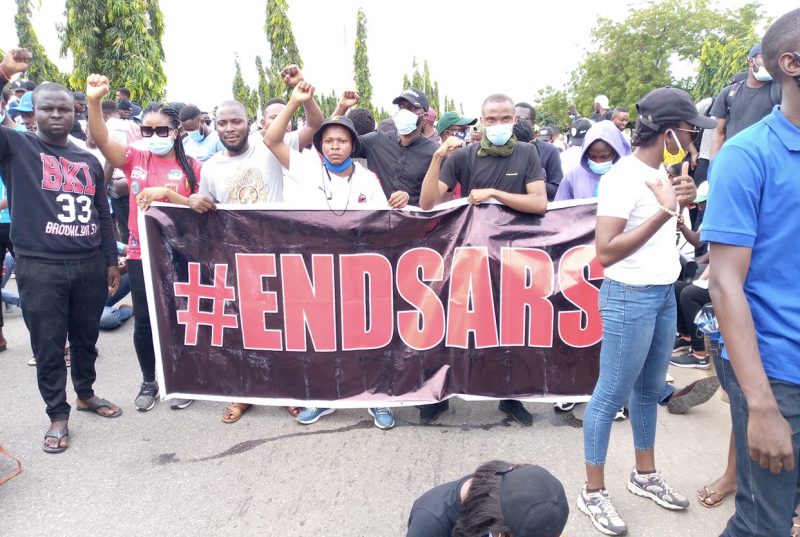
The United Nations (UN) has called on the federal government to implement the recommendations of the Judicial Panel of Inquiry and Restitution set up to investigate issues surrounding the #EndSARS protests of 2020.
This call was given by the UN Resident and Humanitarian Coordinator in Nigeria, Mr Edward Kallon in a statement in Abuja on Wednesday, noting that the submission of the report of the panel was a welcome development.
“I welcome the submission to the Lagos State Governor, H.E. Babajide Sanwo-Olu, of the reports of the judicial panel on claims of brutality and shooting in the Lekki area of Lagos State, during the 2020 #EndSARS protests,” he said.
Mr Kallon noted that the submission of the findings of the judicial panel would accelerate the process of justice and accountability.
“I urge the government to implement the recommendations of the judicial panel of inquiry to rebuild trust and start the process of healing and reconciliation,” he added.
Background
On Monday, the panel, established to look into the shootings at the Lekki Tollgate on October 20, 2020, submitted its report to the Lagos State Government.
However, a leaked version of the report indicting the state government and the Nigerian Army was released on the Internet, leading to an uproar across social media.
In the report, the panel indicted soldiers and implicated Nigeria’s security agents in the killing and forced disappearances of harmless and unarmed youths protesting at Lekki Tollgate on October 20, 2020.
The Justice Doris Okuwobi-led panel made the revelation in a 309-page report submitted to Governor Sanwo-Olu, which found that at least 48 protesters were either shot dead or injured or assaulted.
Also, page 294 of the report read: “The atrocious maiming and killing of unarmed, helpless and unresisting protesters, while sitting on the floor and waving their Nigerian flags while singing the National Anthem can be equated to a ‘massacre’ in context.”
On page 295: “It was alleged and corroborated that the soldiers had their vans parked at the Lekki Toll Gate and removed as many bodies and corpses of the fallen protesters which they took away with their vans.”
According to the report, “the Nigerian Army was invited for intervention in the State and was deployed to Lekki Toll Gate on the 20th of October 2020.
“At the Lekki Toll Gate, officers of the Nigerian Army shot, injured and killed unarmed helpless and defenceless protesters, without provocation or justification, while they were waving the Nigerian Flag and singing the National Anthem and the manner of assault and killing could, in context, be described as a massacre.
“The Panel also found that the conduct of the Nigerian Army was exacerbated by its refusal to allow ambulances render medical assistance to victims who required such assistance.
“The Army was also found not to have adhered to its own Rules of Engagement.
“The Panel found that the Nigerian Police Force deployed its officers to the Lekki Toll Gate on the night of the 20th October 2020 and between that night and the morning of the 21st of October, 2020, its officer shot at, assaulted and battered unarmed protesters, which led to injuries and deaths.
“The police officers also tried to cover up their actions by picking up bullets.
“The panel found that LCC hampered the panel’s investigation by refusing to turn over some useful and vital information/evidence as requested by the Panel and the Forensic Expert engaged by the panel, even where such information and evidence was by the company’s admission, available.
“It manipulated the incomplete CCTV Video footage of the Lekki Toll Gate on the night of the 20th of October 2020, which it tendered before the Panel.
“The Panel found that there was an invitation of the Nigerian Army to Lagos State made by the Lagos State Government through the Governor before the hierarchy of the Nigerian Army deployed its soldiers to the Lekki Toll Gate on the night of the 20th of October.
“The Panel found that there was an attempt to cover up the Incident of the 20th of October by the cleaning of the Lekki Toll Gate and the failure to preserve the scene ahead of potential investigations.”
In its recommendations, the panel recommended various sums of compensation to victims of the Lekki Toll Gate Incident, which must be expeditious in order to accelerate the healing process.
It also recommended that any data that may have been generated over the years on the impunity of the Police across Nigeria be studied and deployed as early warning signs (EWS) mechanism.
Others include sanctioning of the officers of the Nigerian Army and the Nigerian Police Force respectively who participated in the shooting, injuring and killing of unarmed protestors at the Lekki Toll Gate on the 20 and 21st of October 2020; Development of more robust engagement between the Youth and the Government; Setting up of a Standing Committee/Tribunal to deal with cases of Violation of Human Rights by security agencies and a trust fund to settle compensation awarded by such committee/tribunal, among others.
General
QNET’s Global Reach in 100+ Countries: What International Access Means for Local Distributors
Global scale means market access and international supply chains. For individual distributors in direct selling, it can shape everything from product availability to income stability and long-term opportunity.
QNET, the multinational wellness and lifestyle direct selling company, positions its business model around that idea: connecting locally based independent distributors to an international operating platform. With activity spanning more than 100 countries, the company sits within a direct selling industry that, according to the World Federation of Direct Selling Associations (WFDSA), has stabilized after several relatively volatile post-pandemic years.
Global Reach Within a Stabilizing Industry
The WFDSA’s latest global report estimates worldwide direct selling retail sales at roughly $163.9 billion in 2024, essentially flat year over year. That flat performance, however, masks gradual improvement beneath the surface. Nearly half of reporting markets showed growth in 2024, and average market growth rates rebounded to positive territory.
The report estimates more than 104 million independent sales representatives globally in 2024, a figure that has remained largely stable year over year.
This stabilization sets a backdrop for companies like QNET. A global footprint is no longer about rapid expansion alone; it is increasingly tied to resilience: operating across regions with different economic cycles, consumer behaviors, and growth trajectories.
For distributors, this matters because opportunities extend beyond individual effort. They are often shaped by the health of the company’s broader channel and product reach.
A Platform Designed for Distributed Entrepreneurship
QNET’s model centers on local execution supported by centralized infrastructure. Products—ranging from nutritional supplements and wellness devices to home and lifestyle solutions—are sold through the company’s proprietary e-commerce platform. Independent distributors do not manage warehouses, shipment logistics, or customer service systems.
As Ramya Chandrasekaran, who heads communications at QNET, explained in a recent interview, the company views direct selling as a form of accessible “micro-entrepreneurship.” The idea is to reduce the operational burden typically associated with starting a business, allowing distributors to focus on product education, customer relationships, and market development.
Why Global Scale Changes the Distributor Equation
One practical benefit of international reach is product continuity. WFDSA data shows that wellness products account for roughly 29% of global direct selling sales, making it the largest category worldwide. In the Asia-Pacific region, the largest direct selling region by sales, wellness represents more than 40% of total category share.
QNET’s emphasis on wellness and lifestyle products places distributors in line with the strongest demand segments globally. Instead of relying on narrow local trends, distributors operate within product categories that have shown consistent global interest.
International scale also supports consistency in training, compensation structures, and digital tools. Distributors in different countries access identical back-end systems, tracking referrals, commissions, and orders through the same platform. This standardization reduces friction and uncertainty, particularly for individuals operating in markets where informal commerce is common.
Workforce Shifts
The WFDSA’s report highlights notable shifts in the global direct selling workforce. Women continue to make up more than 70% of participants worldwide, and representation among individuals aged 35 to 54 remains the largest cohort.
Independent Distributors increasingly value flexibility, long-term viability, and support systems that allow them to operate sustainably rather than aggressively scale. QNET’s emphasis on digital access, centralized operations, and gradual business building reflects those priorities.
For many participants, especially those balancing work with caregiving or other responsibilities, direct selling infrastructure offers a way to stay engaged at their own pace.
Training, Exposure, and Cross-Market Learning
QNET’s international conventions and training programs connect distributors across regions, creating informal networks for peer learning. Events that draw participants from dozens of countries expose distributors to varied approaches to sales, customer engagement, and market adaptation.
This mirrors one of WFDSA’s broader conclusions: direct selling increasingly functions as a global learning ecosystem, with companies providing tools and education that help individuals navigate uncertain economic conditions.
For distributors, exposure to cross-border experiences can recalibrate expectations, reinforcing that success often comes from steady engagement rather than rapid recruitment or short-term activity.
International Access, Interpreted Locally
Despite its global scale, QNET’s business ultimately plays out in local communities. Distributors adapt messaging around wellness, home quality, and lifestyle enhancement to cultural norms and household priorities. The international platform provides reach and structure, but relevance is built locally.
That balance, global systems supporting local relationships, defines much of modern direct selling. The WFDSA describes the industry not as a single growth story, but as a framework that can scale proportionally with economic conditions across regions.
For QNET distributors, international presence does not guarantee income or uniform outcomes. What it offers is access: to resilient product categories, standardized systems, training resources, and a global marketplace that extends beyond any single region. For local distributors navigating today’s uncertain global economic environment, that is an important foundation to maintain.
General
FCCPC Unseals Ikeja Electric Headquarters
By Adedapo Adesanya
The Federal Competition and Consumer Protection Commission (FCCPC) has unsealed the headquarters of Ikeja Electric Plc in the Lagos State capital after a week under lock and key.
According to a statement on Friday, the electricity distribution company committed to a binding undertaking to comply with the remedial process following consumer rights violations.
The statement signed by Mr Ondaje Ijagwu, Director of Corporate Affairs at the commission, Ikeja Electric undertook to resolve all consumer complaints referred to it by the FCCPC within agreed timelines
The headquarters was earlier sealed on December 11, 2025, because Ikeja Electric allegedly failed to comply with a directive by the Nigerian Electricity Regulatory Commission (NERC) to unbundle a Maximum Demand account into 20 individual accounts for a customer who had been without power for over two and half years.
The FCCPC noted that following the resolution, any breach of the undertaking would expose it to renewed and escalated enforcement action under the Federal Competition and Consumer Protection Act.
Reacting, the Executive Vice Chairman and Chief Executive Officer of the FCCPC, Mr Tunji Bello, said the Commission’s intervention was necessary to enforce the provisions of the FCCPA (2018).
“Our responsibility is to ensure that consumers are treated fairly and that service providers comply with lawful decisions and directives. Enforcement is not an end in itself. Where compliance is achieved and credible commitments are made, the Commission will respond appropriately,” he said.
Clarifying further, Mr Bello said the outcome reflects the commission’s balanced approach to regulation.
“We intervene decisively where consumer harm persists, and we de-escalate where enforceable compliance is secured. What remains constant is our duty to protect consumers and uphold regulatory accountability,” he said.
General
All On’s Clean Energy Access Transforms Over One Million Lives
By Modupe Gbadeyanka
The decision by a leading impact investment company focused on expanding clean energy access, All On, to support over 50 clean energy businesses and provide grants and technical assistance to more than 80 enterprises in Nigeria is already yielding positive results.
This is because the organisation’s Impact Evaluation Report indicated that more than one million lives have been transformed through clean energy access.
The report covered from 2018 t0 2024 and it was discovered that the interventions of All On enabled the connection of over 230,000 households, businesses, and public facilities to reliable energy solutions, while strengthening the operational capacity of energy providers and improving affordability and service reliability for end users.
Prior to the commencement of All On’s operations in 2016, nearly half of Nigeria’s population lacked access to electricity, and the sector faced an estimated 92 per cent annual funding gap.
In response, the group adopted a bold, risk-tolerant strategy—deploying catalytic capital, innovative financing instruments, and ecosystem-building initiatives to unlock private sector participation and drive progress toward universal energy access.
Central to these achievements is All On’s holistic support model, which combines rigorous, tailored due diligence, deep sector expertise, and active ecosystem engagement.
This approach has positioned All On as a trusted partner capable of delivering both commercial viability and systemic impact.
Flagship initiatives such as the Demand Aggregation for Renewable Technology (DART) programme have further amplified results by reducing procurement costs for supported businesses by up to 50 per cent, enabling developers to scale faster and pass cost savings on to consumers due to access to reliable, affordable, and sustainable energy solutions.
In the report, it was revealed that half of supported households reported improved air quality, enhanced safety, and reduced noise pollution, contributing to better health outcomes and improved quality of life, alongside measurable environmental benefits.
“This report confirms that our approach is delivering real results. By combining patient capital, technical assistance, and ecosystem support, we are enabling scalable and sustainable energy solutions for Nigeria’s unserved and underserved communities,” the chief executive of All On, Ms Caroline Eboumbou.
The company plans plans to scale proven models, strengthen local capacity, and expand its reach—particularly in underserved regions such as the Niger Delta.
“While the progress to date is encouraging, our work is far from done. As we look toward 2030, we remain committed to deepening our impact and creating even more meaningful connections across Nigeria,” Ms Eboumbou added.
-
Feature/OPED6 years agoDavos was Different this year
-
Travel/Tourism9 years ago
Lagos Seals Western Lodge Hotel In Ikorodu
-
Showbiz3 years agoEstranged Lover Releases Videos of Empress Njamah Bathing
-
Banking7 years agoSort Codes of GTBank Branches in Nigeria
-
Economy3 years agoSubsidy Removal: CNG at N130 Per Litre Cheaper Than Petrol—IPMAN
-
Banking3 years agoFirst Bank Announces Planned Downtime
-
Banking3 years agoSort Codes of UBA Branches in Nigeria
-
Sports3 years agoHighest Paid Nigerian Footballer – How Much Do Nigerian Footballers Earn