Banking
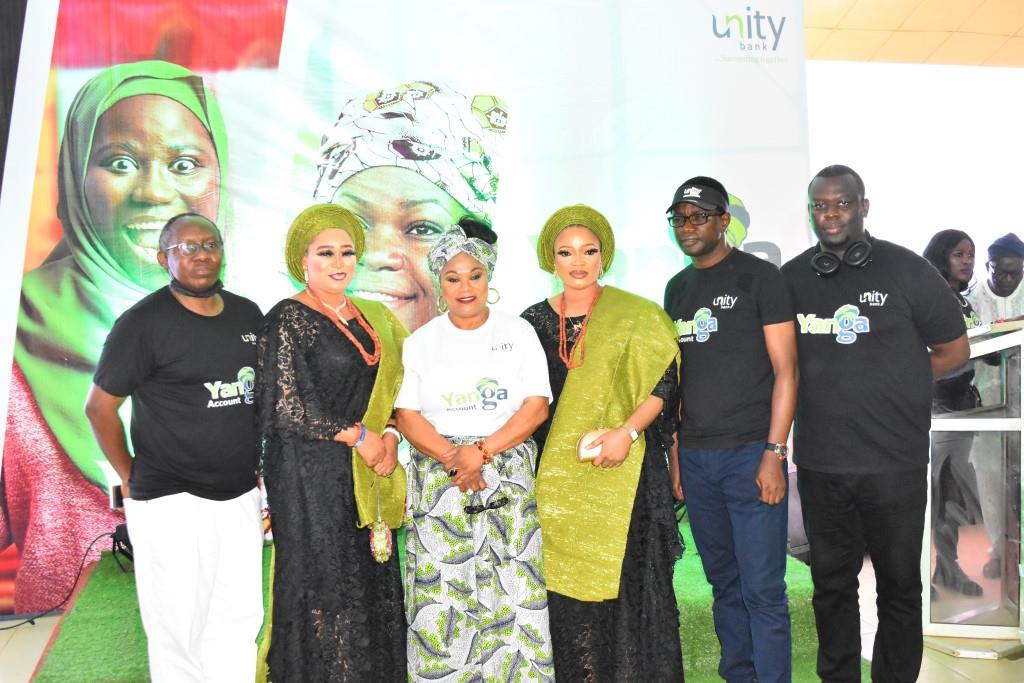
Unity Bank Targets 5 Million Women MSMEs in South West With Yanga Account
By Modupe Gbadeyanka
No fewer than 5 million Micro, Small and Medium Enterprises (MSMEs) being operated by women in the South West region of Nigeria would be engaged by Unity Bank Plc.
The Nigerian retail lender disclosed this at the launch of the Yanga Account in Ibadan, Oyo State.
The account package was specifically designed by the financial institution to promote women MSMEs and create a unique proposition.
At the official launch of the Yanga Account recently in Abuja, a movie star in Nigeria, Sola Sobowale, was unveiled as the brand ambassador.
Yanga Account is a complete suite of services designed to promote financial inclusion among women through stress-free savings and investment, access to the services of dedicated sales agents, agency banking services close to the location of their businesses, special business seminar and training on how to grow business, access to microloans, customized debit cards and other bundled e-banking products.
At the official unveiling of the Yanga Account for the South West region held in Ibadan on Tuesday, the bank pledged its unwavering commitment to empowering women in order to enable them to overcome every obstacle of accessing quality Banking services needed to assist the growth of their businesses.
As part of the efforts to connect directly with the target market, the star actress who is now known as ‘Mama Yanga’ undertook a market tour to interact with the women and gain first-hand knowledge of how the product is being received in the market.
Speaking at the event in Ibadan, the Managing Director/Chief Executive Officer of Unity Bank Plc, Mrs Tomi Somefun stated that the “Yanga Account heralds a new dawn for my fellow women operating businesses in South West Nigeria.”
She noted that “the Yanga account is open to all market women in farming, fashion design, tailoring, frozen food, pastry and baking, cosmetics, jewellery designs and making, skincare, eateries and restaurants, etc. whether living in the communities or cities.”
She reiterated that “the Yanga Account is conceived and designed for the financial literacy and empowerment of Nigerian women. It is about making sure that our women who make up 55 per cent of the financially excluded Nigerians have access to basic and life-changing financial services.”
Also speaking, Sola Sobowale invited all Nigerian women who operate businesses in the South West to embrace the incredible opportunities offered by the Yanga account to grow their businesses.
She said: “This is the first time that a bank will specifically design a product to cater to women and I am excited about the inherent benefits of this account and the endless possibilities that it brings to my fellow women. I invite all my fellow women in South-West Nigeria to sign up for the Yanga Account and watch their levels change.”
On his part, Group Head, Retail, SME Banking and E-Business, Unity Bank Plc, Mr Funwa Akinmade said: “Female-led MSMEs in South West Nigeria continue to play pivotal roles in the contribution of the MSMEs to the economy of Nigeria and that has informed this special activation of Yanga account in Ibadan today.
“The Yanga account is a well-packaged banking product that combines several services that most small businesses owned by women will need to become profitable. We are optimistic that Ibadan women and all others across South West Nigeria will embrace the Yanga Account and leverage its full benefits to grow their businesses.”
With the launch of the Yanga account, Unity Bank said it underscores its retail strategy which continually aligns with the vision of the Central Bank of Nigerian and the financial services ecosystem to provide needed support for Nigerian women by enhancing access to wealth-creating opportunities in the financial services sector.
Industry watchers believe the retail product has the potential to aggressively deepen financial inclusion, which recent research by Enhancing Financial Innovation & Access (EFInA) has shown “can benefit individuals, families, and businesses, supporting key outcomes such as GDP growth.”
Banking
Union Bank Seeks Stronger Collaboration to Confront Climate Change
By Modupe Gbadeyanka
The need for stronger collaboration to address climate change, advance conservation and equip young people to lead a more sustainable future has been emphasised by Union Bank.
At a symposium organised to commemorate 2026 World Environment Day in partnership with the Nigerian Conservation Foundation (NCF) at the Lekki Conservation Centre in Lagos, the financial institution urged businesses to match their commitments with action and pointed to the decisive role of finance in shaping a greener economy.
“As a bank that has been part of Nigeria’s story for over a century, Union Bank recognises that sustainable development and environmental responsibility must go hand in hand,” the company’s Chief Brand and Marketing Officer, Mrs Olufunmilola Aluko, stated.
“We believe businesses have a role to play not only in what they say, but also in what they do. Banks play an important role because they help determine where capital flows. The choices financial institutions make about what to fund and what to encourage help shape the kind of economy we build. This is a responsibility we take seriously at Union Bank, and it is one of the reasons gatherings like these matter to us,” she added.
In his keynote address, the Director General of NCF, Mr Joseph Daniel Onoja, framed conservation as a matter of human survival, noting that “nature has placed all the models that we need to be able to live well in it.”
“When we talk about nature conservation or environmental conservation, we’re saying human conservation because nature, Mother Earth, will always take care of herself.
“If we don’t take care of it, it will take care of itself by getting rid of us. Now, it is in our best interest to take care of the earth and learn from her, because she has provided everything we need to do so,” he further submitted.
A panel session featuring secondary school students from within and beyond Lagos brought an intergenerational dimension to the day. The students urged businesses and individuals to prioritise climate-conscious investments and cleaner energy sources, and exhibited innovations that turned waste into interior décor and clean energy.
Their work offered a vivid illustration of Sustainable Development Goal 12 on responsible consumption and production, and of the creativity a younger generation brings to the climate conversation.
This year’s World Environment Day theme, Inspired by Nature. For Climate. For Our Future, and the event, reflected a growing global consensus, captured in Sustainable Development Goal 13 on climate action and Sustainable Development Goal 17 on partnerships, that no single institution can meet the climate challenge alone.
Banking
BOA Unveils Roadmap to Boost Agricultural Financing, Food Security
By Adedapo Adesanya
The Bank of Agriculture (BOA) has unveiled a strategic roadmap aimed at modernising its operations, expanding grassroots financial inclusion and accelerating agricultural transformation in line with the Federal Government’s food security agenda.
The chief executive of the bank, Mr Ayodeji Sotinrin, disclosed this in a statement issued on Friday that the institution is implementing operational upgrades and forging strategic partnerships to improve the delivery of agricultural intervention programmes and empower smallholder farmers across the country.
According to the statement, the BOA is strengthening its agricultural delivery architecture by expanding collaborations with state-level delivery platforms, licensed input suppliers and international development partners.
A key component of the strategy is a recently signed Memorandum of Understanding with the United Nations Development Programme (UNDP), aligning the bank’s revitalisation agenda with the UN agency’s Integrated Smart States Programme.
The bank said the partnership would help transform Nigeria’s agricultural sector into an investment-ready system capable of attracting blended and climate finance while supporting the One Million Hectare Tree Crop Initiative, described as a presidential priority expected to boost commercial agriculture, job creation and export diversification.
“Our vision for the Bank of Agriculture is to deploy capital in an intelligent, smart, and highly efficient way to reposition the institution as a catalyst for food security and rural prosperity. We are bringing everyone into the financial net, especially the youthful population of farmers in our hinterlands, to create a new, resilient food system for Nigeria,” Mr Sotinrin said.
The bank also disclosed that it had overhauled its verification framework to eliminate fraudulent beneficiaries and ensure interventions reached genuine farmers.
According to the statement, the new credit profiling process incorporates Bank Verification Number checks, Know Your Customer protocols and GPS farm mapping to strengthen transparency and accountability in loan disbursement.
Commenting on the initiative, the National President of the All Farmers Association of Nigeria, Muhammad Magaji, endorsed the verification measures while urging quicker loan disbursement.
“The All Farmers Association of Nigeria recognises the critical role the Bank of Agriculture plays in shielding our farmers from exorbitant commercial interest rates. While we continuously advocate for faster disbursement cycles to match planting seasons, we stand with the BOA on the need for strict verification.
“It is the only way to ensure that these interventions reach the genuine smallholder farmers who actually till the soil, rather than ‘political farmers.’ We remain committed to working closely with the BOA management to fine-tune this delivery framework,” he added.
The BOA further said it is modernising its nationwide operations by deploying digital farmer systems, agency banking models and solar-powered infrastructure across its 110 branches to improve service delivery in rural communities.
It added that recent ICT infrastructure support from the UNDP would strengthen its digital transformation efforts and enable the bank to provide financial and extension services directly to farmers.
The bank said it would continue engaging commodity associations, verified grassroots cooperatives and other agricultural stakeholders through town hall meetings and working groups to identify genuine beneficiaries and support the implementation of the National Agri-food System Investment Plan.
Banking
PalmPay Calls for Trust, Responsible AI to Drive Payment Ecosystem Innovation
By Adedapo Adesanya
Stakeholders, including industry leaders, regulators, and payment experts, have called for stronger infrastructure, responsible artificial intelligence (AI) adoption, and deeper cross-sector collaboration to unlock the next phase of growth in Nigeria’s digital payments ecosystem.
They made the call during the 2026 Digital Pay Expo held in Lagos on June 17 and 18, 2026. This year’s event focused heavily on the transformative role of AI, cybersecurity, cross-border transactions, and deepening financial inclusion across Africa.
Speaking at the event, Dr Rekiya Yusuf, Director of the Payment System Supervision Department at the Central Bank of Nigeria (CBN), represented by Mr Chika Ugwueze, Deputy Director, stated that Nigeria’s payment ecosystem is rapidly evolving beyond digital adoption into deeper digital transformation.
According to Dr Yusuf, artificial intelligence is emerging as a critical driver of this shift, particularly in real-time fraud detection and expanding access to underserved populations.
“The goal is to make financial transactions seamless. AI is now driving innovation, helping in real-time fraud detection and helping to expand access,” she said.
She noted, however, that important gaps remain, particularly around infrastructure and inclusion. Building a resilient digital market system in the AI era requires reliable connectivity, robust infrastructure, intentional talent development, and sustained capacity building.
Echoing the regulator’s call for robust ecosystem support, Mr Chika Nwosu, Managing Director of PalmPay Nigeria, said trust, access, and practical financial support remain critical to helping small businesses participate more meaningfully in the formal economy.
He noted that while micro, small, and medium enterprises (SMEs) contribute an impressive 40 per cent to Nigeria’s Gross Domestic Product (GDP), limited access to credit and reliable payment infrastructure continues to slow their ability to grow and scale.
To drive true innovation, Nwosu argued that financial inclusion must move beyond simply opening accounts and enabling basic transactions; it requires building a foundation of trust and tangible economic empowerment.
“SMEs contribute 40 per cent of the country’s GDP. For us at PalmPay, we don’t just provide payment solutions to them, we also support them with financial tools they need to expand and create jobs,” he said.
Mr Nwosu further emphasised the importance of digital literacy, noting that a stronger understanding of digital tools and AI-enabled systems will be essential to building long-term trust and participation across the ecosystem.
The discussions at Digital Pay Expo 2026 reflected a growing consensus across the industry: the future of African digital payments will depend on getting the fundamentals right. That means stronger infrastructure, responsible use of AI, better cybersecurity, and closer collaboration between regulators, fintechs, and other ecosystem players.
For PalmPay, the event reinforced the importance of building a payments ecosystem that is more resilient, more secure, and better equipped to support inclusion and growth at scale.
Founded in 2019, PalmPay has expanded its operations across emerging markets, providing digital financial services ranging from payments and savings to credit and merchant solutions, while supporting financial inclusion through smartphone financing and access to digital banking services.
-
Feature/OPED6 years agoDavos was Different this year
-
Travel/Tourism10 years ago
Lagos Seals Western Lodge Hotel In Ikorodu
-
Showbiz3 years agoEstranged Lover Releases Videos of Empress Njamah Bathing
-
Banking8 years agoSort Codes of GTBank Branches in Nigeria
-
Economy3 years agoSubsidy Removal: CNG at N130 Per Litre Cheaper Than Petrol—IPMAN
-
Banking3 years agoSort Codes of UBA Branches in Nigeria
-
Banking3 years agoFirst Bank Announces Planned Downtime
-
Sports3 years agoHighest Paid Nigerian Footballer – How Much Do Nigerian Footballers Earn