
Banking
Coronation Bank’s Volatile Customer Deposits Worries Agusto

By Adedapo Adesanya
Nigerian foremost rating agency, Agusto & Co, has assigned top merchant bank in the country, Coronation Merchant Bank, an A+ rating.
In a recently released report, Agusto affirmed the A+ rating assigned to the bank with a stable outlook and stated that the rating reflects the bank’s position in the merchant banking space.
The rating agency stated that Coronation Merchant Bank had good capitalisation, good asset quality and good liquidity position.
However, it emphasised that the lender has high funding costs as well as a very volatile customer deposits, which it said are issues that could cause problems.
It noted that, “The rating assigned to Coronation Merchant Bank Limited is underpinned by good capitalisation, healthy asset quality, acceptable profitability and an experienced management team with a clear succession plan.”
“The rating is, however, constrained by concentration in the loan book, volatile customer deposits and high funding costs,” Agusto stressed.
In preparing the report, the agency said it took into cognisance the impact of the COVID-19 pandemic, which has led to severe uncertainty surrounding the Nigerian economy, on the bank’s businesses.
A review of the bank’s financial performance showed that as of 31 December 2019, the bank’s gross loans and advances stood at N72.7 billion, representing a year-on-year increase of 33.9 percent.
Also at full year 2019, the bank did not record any credit deterioration with the entire credit portfolio classified under stage 1. Its core capital grew by 6.3 percent to N33.7 billion as at December 31, 2019, more than double the regulatory minimum for merchant banks operating in Nigeria.
During the same period, the bank’s Capital Adequacy Ratio (CAR) stood at 19.2 percent surpassing the 10 percent regulatory threshold.
So far into the year, as at Q1 2020 ended March 31, Coronation Merchant Bank had about $310 million in trade finance lines including a $40 million trade finance guarantee facility obtained from the International Finance Corporation (IFC).
Overall, the rating agency is of the opinion that the bank is adequately positioned to grow business volumes moderately due by the prevailing economic conditions globally.
Agusto & Co noted that the rating will expire on June 30, 2020.
Founded in 1992, as a business information company with the view of gathering and providing information on select African economies and industries—the firm assigns risk ratings to issuers and issues present in Nigeria and on the African continent.




By Adedapo Adesanya
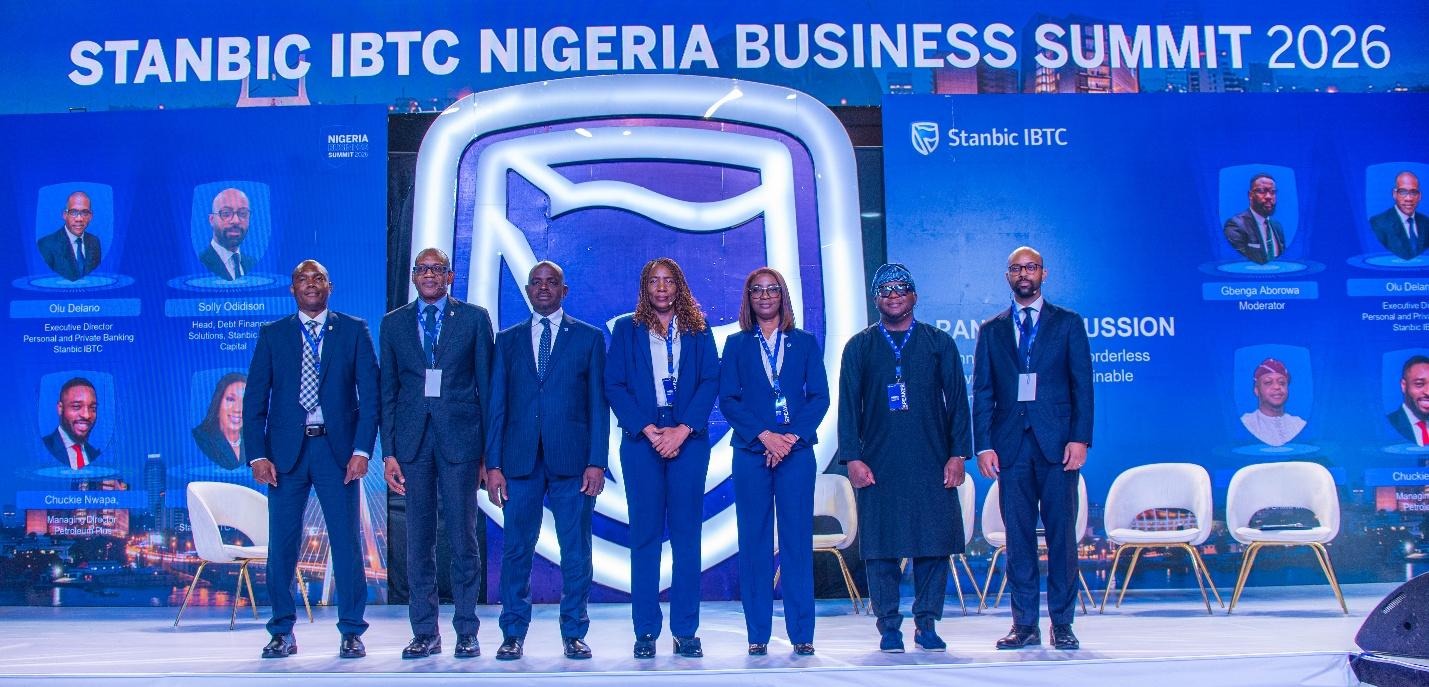
Top financial services provider in Nigeria, Stanbic IBTC, has reiterated its commitment to empowering businesses, strengthening key sectors and positioning Nigeria as a competitive player in the global economy.
This came on the back of the 2026 edition of the Nigeria Business Summit from Wednesday, April 1 to Thursday, April 2, 2026, at the Landmark Event Centre, Victoria Island, Lagos. The two-day summit brought together industry leaders, policymakers, entrepreneurs and stakeholders across multiple sectors to explore sustainable business practices, foster economic growth and unlock global trade opportunities.
With the theme, Nigeria Means Business: Powering Sectors, Growing Sustainable SMEs & Unlocking Global Trade, the summit addressed critical issues across key sectors, including agribusiness, renewable energy, trade and Africa–China banking, as well as ICT and telecommunications. Additional sessions covered areas such as family business sustainability, artificial intelligence, employee value banking, insurance, pension and wealth management.
The event featured a keynote address by the Minister of Finance and Coordinating Minister of the Economy, Mr Wale Edun, who emphasised the urgent need for Nigeria to reposition itself as a leading export-driven economy to achieve sustained growth.
“Our true potential lies in becoming a leading export economy,” Edun stated. “Increased participation in regional and global trade will be critical to diversifying foreign exchange earnings and driving inclusive growth.”
He noted that while Nigeria’s GDP growth has improved to approximately 4 per cent, it remains below the level required to significantly reduce poverty. According to him, the country’s economic strategy is now shifting from stabilisation to growth acceleration, with trade expansion playing a central role.
Mr Edun highlighted ongoing reforms, including improved foreign reserves, rising non-oil revenues and renewed investor confidence, as indicators of a more resilient economy. However, he stressed that enhancing trade competitiveness would require continued investment in infrastructure, logistics and policy coordination.
He also highlighted the importance of small and medium-sized enterprises (SMEs), which account for over 90 per cent of businesses, noting that inclusive growth will depend on stronger collaboration between the public and private sectors.
Participants engaged in a rich line-up of activities, including expert presentations, panel discussions and high-level networking opportunities. Highlights of the summit included the Africa Trade Barometer presentation, client testimonial showcases and insightful discussions on the state of the African economy and intra-African trade opportunities.
Breakout sessions on agribusiness, ICT and healthcare, Africa-China banking and trade, as well as renewable energy, provided attendees with deeper, practical insights into some of the most critical sectors driving Nigeria’s economic future.
Speaking at the event, Mr Chuma Nwokocha, chief executive of Stanbic IBTC Holdings, represented by the organisation’s Chief Finance and Value Management Officer, Mr Kunle Adedeji, emphasised the importance of collaboration and innovation in driving sustainable growth.
“This summit has reinforced the importance of creating platforms where ideas can flourish, and businesses can grow sustainably. By working together, we can unlock new opportunities and drive economic advancement across Nigeria and the African continent,” he said.
The summit also spotlighted practical strategies for integrating sustainability into business operations, encouraging organisations to adopt environmentally conscious practices while maintaining profitability and competitiveness.
Mr Remy Osuagwu, Executive Director, Business & Commercial Banking, expressed satisfaction at the level of interest from participants, a critical element for a successful summit.
“From our conversations on energy and healthcare to the deep dives into trade, Africa-China relations, and agribusiness, Day 1 has offered perspectives that were both insightful and practical. I believe we’re all leaving with a stronger understanding of the opportunities emerging across our industries,” he said.
He acknowledged the level of engagement, questions, contributions and willingness of participants to share experiences, describing this as the real power of the Nigeria Business Summit, and a solid foundation for tomorrow.
The Chief Executive of Stanbic IBTC Bank, Mr Wole Adeniyi, who was represented by Mrs Bunmi Dayo-Olagunju, Deputy Chief Executive of Stanbic IBTC Bank, opened Day Two of the Nigeria Business Summit by highlighting the focus of the summit’s SME Day.
“Today, we build on Day One’s momentum with conversations that are equally critical for the future – from the dynamics of family businesses to the growing influence of artificial intelligence; the evolution of insurance, and the emerging space of electric vehicle banking.”
She further added, “Our goal on Day Two is simple: to explore what’s next. To understand how these developments will shape our businesses and how we can position ourselves ahead of the curve.”

By Dipo Olowookere
Tech enthusiasts interested in participating in the Take on Squad Hackathon, organised by Guaranty Trust Holding Company (GTCO) Plc, can now enter the contest via the official portal at https://squadco.com/hackathon.
The programme enters its third edition in 2026, and the theme for this year is Smart Systems: The Intelligent Economy, according to a statement issued by the organisers.
The hackathon brings together developers, designers and entrepreneurs across Nigeria in a collaborative environment to build practical solutions across key sectors, including financial services, healthcare, commerce and digital inclusion.
Participants are challenged to design and build intelligent, data-driven solutions that transform how communities engage with money.
It is part of the organisation’s commitment to fostering innovation, empowering talent, and supporting the development of technology-driven solutions that address real-world challenges across Africa.
“Today’s dynamic, digitally driven world demands continuous innovation, which is shaping how economies grow, how businesses scale, and how societies evolve.
“Through Take on Squad Hackathon, we are deliberately investing in the ideas and talent that will define the future.
“Our objective is not simply to encourage innovation, but to enable its translation into scalable solutions that deliver real and measurable impact.
“This reflects GTCO’s role as a financial services platform that connects capital, capability, and creativity to drive sustainable progress,” the Managing Director of HabariPay, Ms Eduofon Japhet, stated.
The social coding event remains a cornerstone of HabariPay’s mission to foster creativity and problem-solving among emerging tech talents. Competing teams will leverage Squad’s advanced APIs to create scalable digital tools that address everyday challenges faced by businesses and individuals.
Through initiatives such as this, GTCO continues to position itself at the intersection of finance, technology and enterprise, actively shaping the future of digital transformation in Africa.

By Dipo Olowookere
Banking services will not be interrupted throughout the Easter public holidays, from Friday, April 3, to Monday, April 6, 2026, for any reason, Ecobank Nigeria has assured its customers.
In a message over the weekend, the member of Africa’s leading pan-African banking group, Ecobank Transnational Incorporated, said customers would continue to enjoy quality service delivery during the period.
It noted that its secure and robust digital platforms would remain fully operational to support financial activities during the festive period.
All digital channels, including the Ecobank Mobile App, Ecobank Business App, USSD *326#, Ecobank Online, OmniPlus, Omnilite, EcobankPay, Ecobank Cards, ATMs, PoS terminals, and over 35,000 Ecobank Xpress Point agent locations nationwide, will remain accessible throughout the holiday, the financial institution further said, urging customers to conveniently conduct transactions at any time using this wide range of digital solutions.
Ecobank customers were encouraged to maximise the bank’s alternative channels for transfers, bill payments, airtime purchases, card services, and account management.
They were also advised to stay vigilant by shopping only on trusted websites; avoiding the sharing of PINs, passwords, and one-time passwords (OTPs); refraining from banking on public Wi-Fi networks; being cautious of urgent or emotionally charged messages; and regularly monitoring their account activity.
“Customers will continue to enjoy a full bouquet of services during the holiday, including local and international funds transfers, bill payments, airtime top-ups, merchant payments, balance enquiries, account statements, and cardless cash withdrawals via ATMs,” the Head of Products & Analytics, Consumer & Commercial Banking at Ecobank Nigeria, Mr Victor Yalokwu, stated.
“We understand that festive seasons come with increased financial activity, and our priority is to ensure our customers enjoy fast, reliable, and secure banking wherever they are.
“Our digital channels are designed to support uninterrupted transactions, and we have strengthened our systems to guarantee optimal performance throughout the Easter break,” he added.
Mr Yalokwu noted that, “Ecobank remains committed to providing innovative financial solutions and exceptional customer service. We wish all our customers and partners a peaceful and joyful Easter celebration.”
-
 Feature/OPED6 years ago
Davos was Different this year
-
Travel/Tourism10 years ago
Lagos Seals Western Lodge Hotel In Ikorodu
-

 Showbiz3 years ago
Estranged Lover Releases Videos of Empress Njamah Bathing
-
 Banking8 years ago
Sort Codes of GTBank Branches in Nigeria
-

 Economy3 years ago
Subsidy Removal: CNG at N130 Per Litre Cheaper Than Petrol—IPMAN
-

 Banking3 years ago
Sort Codes of UBA Branches in Nigeria
-

 Banking3 years ago
First Bank Announces Planned Downtime
-

 Sports3 years ago
Highest Paid Nigerian Footballer – How Much Do Nigerian Footballers Earn