
Banking
Ecobank Nigeria Academy Gets CIBN’s Certificate of Accreditation

By Dipo Olowookere
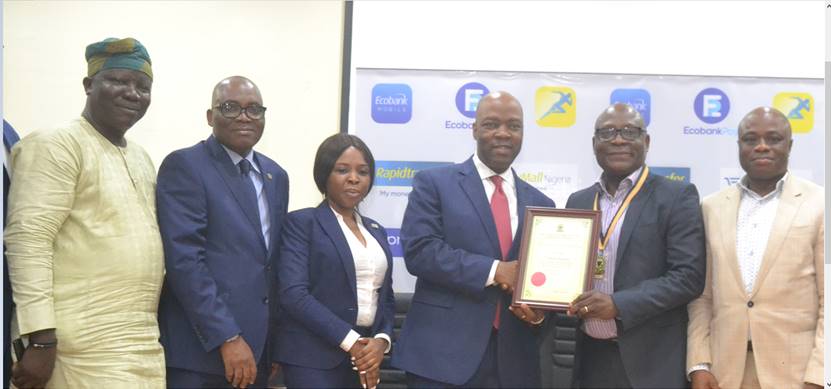
An accreditation certificate has been presented to Ecobank Nigeria for its training institute after scoring above the minimum threshold on all the parameters of measurement.
The certification was presented to the bank by the Chartered Institute of Bankers of Nigeria (CIBN) led by its President, Mr Uche Olowu.
Recall that recently, the CIBN accredited the ultra-modern and state of the art Ecobank Nigeria Academy, which would be used to groom the next bankers to be employed by the lender.
At the presentation, the CIBN called on other financial institutions in the country seeking accreditation of their training school to emulate Ecobank Nigeria.
According to Mr Olowu, Ecobank Nigeria Academy received the institute’s nod based on the report of its Capacity Building and Certification Committee that the training school has met all the parameters of measurement, stressing that it was a manifestation of the importance the management of the bank place on capacity building of its workforce.
“As an Institute, we congratulate Ecobank for the accreditation of its Academy. This comes after rigorous accreditation processes by members of our Capacity Building and Certification Committee which showed that Ecobank has complied with and satisfied the provisions and requirements of the Competency framework for the Nigerian Banking Industry as mandated by the Central Bank of Nigeria (CBN) through CIBN.
“The Academy was found to have scored above the minimum threshold on all the parameters of measurement.
“We firmly believe this accreditation would not only enable Ecobank comply with the provisions of the Competency Framework but also strengthen the intellectual resources and capabilities available in the bank,” the CIBN chief said.
He disclosed further that the institute has so far accredited 18 bank academies, 20 Educational Training Service Providers (ETSPs) and currently executing linkage agreements with 65 tertiary institutions, stressing that apart from addressing competency challenges and enthroning a minimum standard for practitioners in the industry, it is also furthering its mandate as the sole accreditation agency for the implementation of the Competency Framework in the industry.
In his remarks, Managing Director of Ecobank Nigeria, Mr Patrick Akinwuntan, said the accreditation of the academy re-enforces the bank’s commitment to empowering its entire workforce for the millennial age, stressing that it would further enable the Bank to take up its rightful position in the industry as the bank of choice.
“I must salute our Human Resources team and my colleagues in the management team for this landmark step. This underscores the importance we attach to staff training, skills development and capacity building as we seek to transform our Bank to deliver value to customers and shareholders.
“There is no substitute to knowledge. We will continue to upgrade the standard of the Academy to meet with fresh and modern-day industry challenges,” he said.
The Managing Director specifically commended CIBN for the various initiatives targeted at raising standards, promoting ethics and positioning the financial services industry to meet with the new challenges such as digital banking and financial technology (Fintech), adding that the institute was also contributing meaningfully towards the economic development of the country through its various activities in African Continental Free Trade Area (AfCFTA).
He reiterated that Ecobank would continue to partner with the Institute in promoting integrity, professionalism, innovation and ethics in the banking and finance industry.
Commenting, the Manager of Learning and Development at Ecobank Nigeria, Mr Ayotunde Opeoluwa, stated that the accreditation of the academy was an attestation of the bank’s commitment to its roadmap to industry leadership goals through people development, stressing that Ecobank will continuously seek improvement in ensuring that its curriculum is dynamic and meet global standards.
Mr Opeoluwa, who is also the Head of the Academy, further said, “This is a good news for us as a bank. It reinforces our people centric strategy to equipping our staff with the right skills and competence in line with global practices.
“Let me use this opportunity to thank our Management for the great support and members of our internal faculty for their dedication toward achieving this milestone. We will continue to seek improvement to maintain industry and global standards.”
Ecobank Nigeria is a member of Pan African bank, Ecobank Transnational Incorporated (ETI), based in Togo, operating in 36 countries in Africa and with representative offices in Paris, Beijing, Dubai, Johannesburg and London.
Ecobank Nigeria has made many pioneering achievements and ‘firsts’ across various products and digital platforms in the country.




By Modupe Gbadeyanka
The women-focused initiative by Sterling Bank, OneWoman, is already yielding positive results, especially in promoting financial inclusion and empowering female-led enterprises in Nigeria.
Business Post reports that the programme was created to support women through three key pillars of capital, capacity, and community.
In 2025, according to the Head of the OneWoman Initiative, Ms Ezinne Nwokafor, the initiative gave out N43.9 billion loans to 2,450 female entrepreneurs, trained 6,000 of them, served about 380,000 women across three sectors of career women, women in business and freshers, and their vision 2030 is to give out N500 billion loans to one million women across their three sectors.
She noted that a significant majority of Nigerian women remain excluded from formal credit, with only a small percentage able to access structured financing. Despite improvements in financial inclusion, women continue to face systemic barriers that limit their ability to secure funding.
Ms Nwokafor pointed out that women account for a substantial share of micro, small, and medium enterprises and contribute meaningfully to the economy, yet face a financing gap estimated at $42 billion annually, according to the International Finance Corporation.
She also referenced data showing that more than half of women-led businesses identify access to finance as a major constraint, while rejection rates for loan applications remain significantly higher for women than for men.
According to her, these challenges are often linked to structural issues such as gaps in asset ownership, social norms, and limited access to financial data and visibility.
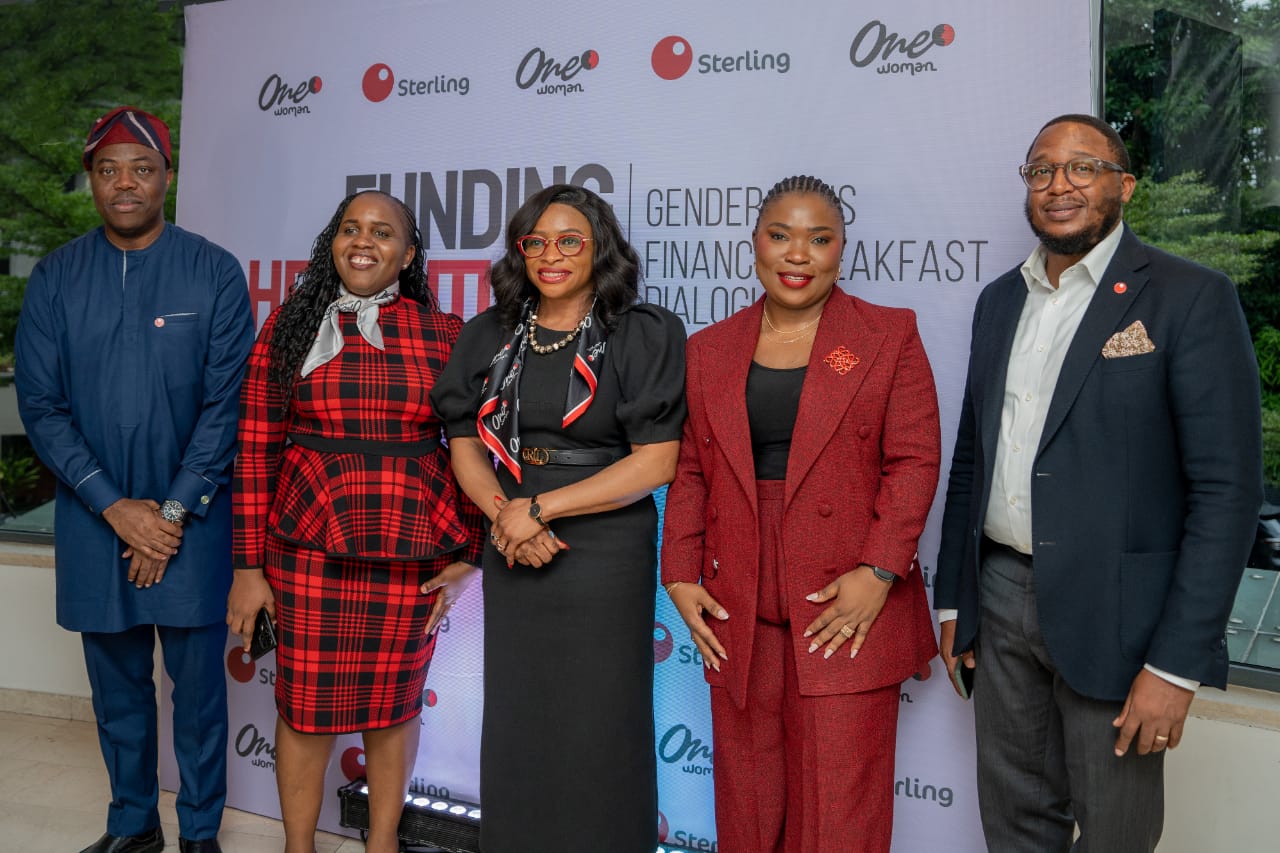
“Sterling’s OneWoman initiative is positioned to bridge this gap by combining financial solutions, mentorship, capacity building, and community support for women across different stages of their journey,” she said at the Funding Her Future Breakfast Dialogue in Lagos.
The session brought together voices from across sectors for a focused and necessary conversation on how to unlock more inclusive and effective financing pathways for women-led businesses in Nigeria.
On his part, the chief executive of Sterling Bank, Mr Abubakar Suleiman, said, “Women-led businesses need the right support systems, the right networks, and the right ecosystem to grow with confidence and scale with resilience.”

By Modupe Gbadeyanka
Alpha Morgan Bank has reaffirmed its commitment to supporting institutions that drive intellectual growth and national development.
The lender gave this reassurance at the commissioning of the Redeemer’s University Business School by Pastor (Mrs) Folu Adeboye, the wife of the General Overseer of the Redeemed Christian Church of God (RCCG), Pastor Enoch Adeboye.
Speaking at the event, the Managing Director of Alpha Morgan Bank, Mr Ade Buraimo, said the company was proud to be associated with the school, noting its commitment to education and institutional development.
As part of its broader focus on knowledge sharing and thought leadership, Alpha Morgan Bank will host its Economic Review Webinar in May 2026, bringing together experts to share insights on key economic trends and opportunities.
The commissioning of the business school was witnessed by distinguished guests, including the Pro-Chancellor and Chairman of the Governing Council of Redeemers University, Professor Oluwatoyin Ogundipe; the Vice Chancellor, Professor Shadrach Olufemi Akindele; Mrs Bola Obasanjo; and other notable dignitaries.

By Adedapo Adesanya
Zenith Bank Plc has announced the successful completion of its acquisition of the entire issued share capital of Paramount Bank Kenya Limited (PBL), following the receipt of all necessary regulatory approvals in both Nigeria and Kenya.
The development marks a significant milestone in the bank’s regional expansion strategy, reinforcing its ambition to deepen its presence across Sub-Saharan Africa.
The acquisition provides Zenith Bank with a strategic entry into the East African market, positioning it to better support cross-border trade and serve its growing base of regional and international clients.
“This acquisition marks a significant step towards our long-term strategic growth agenda and a strong inroad into the East African markets. It further reinforces the Bank’s position as a leading financial institution in Sub-Saharan Africa and affirms the Bank’s mantra of following our customers’ businesses,” the lender said in a statement.
The development comes after Zenith Bank previously refuted recent media reports and online commentary in November 2025, claiming that the bank is in the process of acquiring Paramount Bank in Kenya as part of its expansion into the East African market.
The move also strengthens Zenith Bank’s competitive positioning within Africa’s banking landscape, as Nigerian tier-one banks continue to pursue regional expansion to unlock new growth opportunities. Others like Access Bank and GT Bank have expanded reach in the last few years.
It will be recalled that the management of Zenith Bank, led by Ms Adara Umeoji, at the Nigeria Exchange (NGX), assured shareholders during the recapitalisation exercise that proceeds from the rights issue and public offer would be allocated to the global expansion of Zenith Bank operations, alongside increased funding for the real sector and upgrading technology infrastructure.
According to her, “35 per cent of the proceeds will fund the bank’s global expansion strategy, increasing its footprint in Africa and other parts of the world. 45 per cent will be deployed as working capital to support the real sector of the economy, and 20 per cent will be used to enhance the bank’s IT infrastructure and digital capabilities.”
Last month, Zenith Bank also expanded its operations to the United Kingdom by opening its Manchester branch office. It also unveiled plans to secure a full listing on the London Stock Exchange, one of the world’s leading stock exchanges.
-
 Feature/OPED6 years ago
Davos was Different this year
-
Travel/Tourism10 years ago
Lagos Seals Western Lodge Hotel In Ikorodu
-

 Showbiz3 years ago
Estranged Lover Releases Videos of Empress Njamah Bathing
-
 Banking8 years ago
Sort Codes of GTBank Branches in Nigeria
-

 Economy3 years ago
Subsidy Removal: CNG at N130 Per Litre Cheaper Than Petrol—IPMAN
-

 Banking3 years ago
Sort Codes of UBA Branches in Nigeria
-

 Banking3 years ago
First Bank Announces Planned Downtime
-

 Sports3 years ago
Highest Paid Nigerian Footballer – How Much Do Nigerian Footballers Earn