Connect with us

Banking

Ecobank’s Rapid Transfer App wins Asian Banker Awards

Published

on

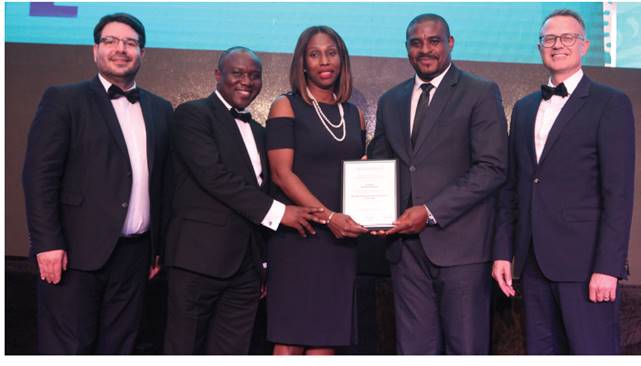
Ecobank’s Rapid Transfer App has been named Best Remittance Product and Service of the Year by the Asian Banker Excellence in Retail Financial Services Awards for West Africa.

The Rapid Transfer App was selected following a rigorous and transparent process that saw the Asian Banker accessing banks and non-bank retail financial services players in several countries in West Africa.

Currently The Asian Banker Awards covers the Asia Pacific, the Middle East and West Africa where more than 300 banks and non-bank retail financial services players in more than 42 countries are evaluated.

Presenting the awards to winners in Lagos, Nigeria, Chairman, The Asian Banker, Emmanuel Daniel, said the Excellence in Retail Financial Services programme is probably the most rigorous, prestigious and transparent awards programme for consumer financial services in the world.

He congratulated Ecobank for winning the award and explained that the programme also assesses all new players such as payments companies, marketplace platforms and alternative financial services platforms made possible by financial technology (fintech) who are greatly contributing to the transformation of the retail financial services industry.

He said through the awards the Asian Banker aim to capture the evolving competitive landscape and recognise the outstanding players and initiatives, from which the industry can learn from to better provide consumer products, services and experience.

Receiving the award on behalf of the Ecobank Group, Executive Director, Commercial Banking, Caro Oyedeji, thanked the organizer for engaging in rigorous exercise to arrive at winners of the various awards, stressing that Ecobank retail business has witnessed substantial transformation, innovation and growth in all its segments and dimensions – customers, products and channels in recent years.

She disclosed that Ecobank is now being commonly regarded as digital payment solution bank because of its offerings such as Rapid Transfer, EcobankPay, OMNI and Xpress account, among others.

Also speaking Linus Adaba, Ecobank Group Head, Remittances & Mobile Money, described the awards as a worthy recognition of the Rapid Transfer App which is one of Ecobank’s landmark initiatives targeted at easing the process and enabling Africans in diaspora send money to their loved ones back home on the continent.

“Many Africans work elsewhere in Africa, or further afield in Europe, America and Asia and financially support their relatives back home.

“Rapidtransfer is a safe and secure low-cost remittance solution, which ultimately will put more money into the hands of the recipient.

“This will have a multiplier effect on the African economy by boosting demand and driving business growth. Rapidtransfer removes all of bottle necks and high cost of sending money back home.

“Its standout affordability is a game changer in the way that Africans send money to their loved ones,” he stated.

The Rapidtransfer App can be downloaded in both App & Play stores and setup is easy in less than 5 minutes.

“I use this opportunity to dedicate these awards to all hard working staff of the Ecobank Group, who have tirelessly worked to see the success of the bank. And also to all Africans who believe in us and have continued to encourage our efforts by adopting our products,” he added.


Modupe Gbadeyanka is a fast-rising journalist with Business Post Nigeria. Her passion for journalism is amazing. She is willing to learn more with a view to becoming one of the best pen-pushers in Nigeria. Her role models are the duo of CNN's Richard Quest and Christiane Amanpour.

Click to comment

Leave a Reply

Your email address will not be published. Required fields are marked *

Banking

NDIC Reimburses 700,000 Heritage Bank Depositors, Moves to Pay Customers of 46 Failed MFBs

Published

on

Heritage Bank headquarters

By Adedapo Adesanya

The Nigeria Deposit Insurance Corporation (NDIC) says it has paid the insured deposits of about 700,000 customers of the defunct Heritage Bank and has commenced the reimbursement of depositors of 46 microfinance banks (MFBs) whose operating licences were recently revoked by the Central Bank of Nigeria (CBN).

The chief executive of NDIC, Mr Oludare Sunday, made this known on Wednesday during a retreat for members of the House of Representatives Committee on Insurance and Actuarial Matters in Lagos.

He said the corporation immediately began settling the insured deposits of customers after the CBN revoked the licences of the 46 microfinance banks and appointed the NDIC as their provisional liquidator.

“We are working on those. The CBN revoked the licences, and we were appointed as the provisional liquidator. We have started paying depositors of those banks, and gradually we intend to cover all the insured depositors,” he said.

Mr Sunday explained that the NDIC’s responsibility extends beyond paying insured deposits to recovering outstanding loans owed to the failed institutions and disposing of their assets to generate funds for the settlement of uninsured depositors.

“Our function as liquidator involves the payment of guaranteed sums. Thereafter, we go after those who owe the institutions and have not paid. We also ensure that we sell the available assets and realise their investments towards paying the uninsured portion of the deposits. So, we have started paying the guaranteed deposits. What we are doing now is also realising the assets of those institutions,” he stated.

Although he declined to disclose the exact number of depositors of the failed microfinance banks who had been reimbursed, Sunday said the Corporation was working with the Nigerian Interbank Settlement System (NIBSS) to identify depositors through their Bank Verification Numbers (BVN) to ensure seamless payments.

“So, the more accounts we discover, the more payments we make,” he added.

Providing an update on the liquidation of Heritage Bank, the NDIC chief said about 700,000 depositors had already received their insured deposits, while efforts were ongoing to trace other customers whose identities could not be verified from available records.

He attributed the challenge to legacy accounts created before the introduction of the BVN system, as well as incomplete customer records inherited from banks that were later merged into Heritage Bank.

“If you know Heritage Bank, you know it is an amalgamation of several banks, including the acquisition of Enterprise Bank in 2014. So, if you think of banks like Guardian Express and Spring Bank, they are all part of Heritage Bank.

“There are depositors we have not been able to trace, and this is an opportunity for them to come forward. I am sure many of us did the National Youth Service Corps (NYSC) and may have left some money in an account, but there was no BVN then.

“Even the addresses we had were sometimes things like ‘opposite filling station.’ How do you trace such a person? Once they come forward, and for those we have been able to identify from the institution’s database, we have been paying them,” he explained.

Mr Sunday added that the Corporation would continue to recover outstanding loans and dispose of Heritage Bank’s assets to generate funds for the payment of liquidation dividends to depositors whose balances exceeded the insured limit.

Earlier in his remarks, he described the NDIC as a critical pillar of Nigeria’s financial safety net, stressing the need for stronger collaboration between regulators and the National Assembly as the banking sector responds to recapitalisation efforts and rapid financial technology developments.

According to him, while the ongoing banking recapitalisation programme has strengthened the resilience of financial institutions, it must be complemented by sound corporate governance, effective risk management, strict regulatory compliance and robust supervision to safeguard long-term financial system stability.

He also disclosed that more than 98 per cent of depositors, representing over 281 million accounts across insured financial institutions, are fully protected under the NDIC’s deposit insurance scheme.

Continue Reading

Banking

Zenith Bank Probes Customer Data Breach, Says Funds Remain Safe

Published

on

zenith bank logo

By Adedapo Adesanya

Zenith Bank Plc is investigating an incident involving unauthorised access to customers’ data, noting that the breach does not involve financial information and has not compromised its banking services or digital channels.

In an email sent to customers on Wednesday, the bank stated that the incident was part of a broader global cyberattack affecting multiple international organisations across various sectors.

The lender stated that it immediately activated its incident response protocols and intensified its cybersecurity and remediation efforts upon discovering the incident.

“This incident is part of a broader, global cyber-attack targeting multiple international organisations across various sectors. Upon discovery, we promptly activated our incident response protocols, cybersecurity actions and remediation efforts,” the bank said.

The bank reassured customers that its banking services and digital channels remain secure and fully operational.

As a precautionary measure, Zenith Bank advised customers to remain alert to potential phishing attempts and other forms of social engineering.

“As a precaution, we encourage our customers to remain vigilant against phishing emails, text messages, or phone calls, and never to disclose their password, PIN, One-Time Password (OTP), or other security credentials to anyone,” the bank said.

The incident is the latest in a series of cybersecurity challenges facing Nigerian financial institutions, with banks in recent months suspending their social media operations over impersonation and other fraudulent activities.

Earlier in April, the Nigeria Data Protection Commission (NDPC) said it was investigating alleged data breaches involving Sterling Bank, Remita and the Corporate Affairs Commission (CAC).

Nigerian banks have long been prime targets for cybercriminals because of the vast amounts of customer data and financial transactions they handle every day.

While many attacks have traditionally sought to steal funds, cybercriminals are increasingly targeting personal information, which can be used for identity theft, phishing schemes, account takeovers and other forms of financial fraud.

Cybersecurity threats have increasingly targeted Nigerian banks in recent years. In 2025, Union Bank of Nigeria warned customers about fraudulent websites and phishing campaigns designed to steal login credentials and personal information by impersonating the bank.

In August 2024, Guaranty Trust Bank experienced a domain-related security incident that temporarily disrupted access to its official website, although the lender assured customers that their deposits and banking services remained secure while it resolved the issue.

Continue Reading

Banking

Otedola Reveals Ambition to Take Majority Control of First HoldCo

Published

on

First Bank Otedola

By Adedapo Adesanya

The chairman of First HoldCo Plc, Mr Femi Otedola, has affirmed plans to increase his 26 per cent holding in the organisation to 51 per cent, confirming a planned takeover of Nigeria’s oldest banking institution.

Mr Otedola spoke in an exclusive interview with Nairametrics published on Monday, giving a rare direction following recent speculations about the financial institution.

The milestone followed a series of share acquisitions, as Mr Otedola sought to tighten his grip as the company’s largest shareholder following the recent acquisition of additional shares worth N222.21 billion.

In the interview, the mogul said he has invested more than N600 billion of his personal wealth in First HoldCo, describing the move as a “long-term generational commitment” rather than another turnaround investment he would eventually exit.

Responding to speculation that he intends to consolidate his position in the group, Mr Otedola hinted that his investment journey is far from over.

“My investment threshold is always over and above 51 per cent,” he said. “One of my key investment principles is that firm shareholder control, with due regard for minority interest, is a key ingredient to executing reforms and restructuring to deliver value to all stakeholders.”

The businessman said the same strategy had guided his investments in African Petroleum Plc, later renamed Forte Oil Plc, where he gradually increased his shareholding from 28 per cent to 75 per cent before exiting the company in 2019.

He said he also increased his stake in Geregu Power Plc from 51 per cent to 95 per cent before reducing it to 77 per cent after the company’s public listing.

“I am on the same trajectory with First HoldCo Plc,” Mr Otedola said.

“To date, I have invested over N600 billion of my personal wealth in First HoldCo Plc — a figure that speaks not to speculation, but to unflinching confidence in the institution’s future, fundamentals and an unwavering personal commitment to its success.”

Mr Otedola said his decision to invest in First HoldCo came at a time when the institution was facing one of the most challenging periods in its history.

The billionaire steadily increased his investment in the group, accelerating his share purchases in 2026. His stake grew from 6.68 billion shares (15.95 per cent) in June 2025 to 8.06 billion shares by March 2026, then to 9.28 billion shares by June after acquiring about 1.22 billion shares in one quarter. A further purchase through Calvados Global Services last month lifted his holdings above 10 billion shares for the first time.

Continue Reading