Banking
GTBank’s Reduction of NPL Ratio to 7.3% Excites Shareholders
By Dipo Olowookere
One of the issues that give serious concerns to stakeholders in the banking sector in Nigeria is the rising rate of non-performing loans (NPLs).
This is because it reduces cash flow, ties up capital, and reduces profitability, making shareholders get less or no dividend at the end of a financial year.
But one financial institution that has been working hard to reduce its bad debts is Guaranty Trust Bank (GTBank) Plc.
Few days ago, the pan-African bank released its numbers for the year ended December 31, 2018 and going by reviews, the company put up a good performance in the period under review.
GTBank is a financial institution listed on both the Nigerian Stock Exchange (NSE) and the London Stock Exchange (LSE).
An analysis of the financial statements showed that gross earnings improved by 3.7 percent to N434.7 billion from N419.2 billion reported in December 2017, while the profit before tax stood at N215.6 billion, representing a growth of 9.1 percent over N197.7 billion recorded in the corresponding year ended December 2017, with the bank’s customer deposits increasing by 10.3 percent to N2.274 trillion from N2.062 trillion in December 2017.
While the NPL ratio dropped to 7.3 percent from 7.7 percent, the loan book dipped by 12.9 percent from N1.449 trillion recorded as at December 2017 to N1.262 trillion in December 2018, with the Cost of Risk closing at 0.3 percent in December 2018 versus 0.8 percent in December 2017.
Business Post reports that though the Capital Adequacy Ratio (CAR) dropped to 23.4 percent from 25.7 percent a year earlier, loans to deposits ended at 53.5 percent against 67.5 percent in FY 2017.
In addition, the coverage ratio for NPL stood at 105.1 percent while the Post Tax Return on Equity (ROAE) and Return on Assets (ROAA) closed at 30.9 percent and 5.6 percent respectively.
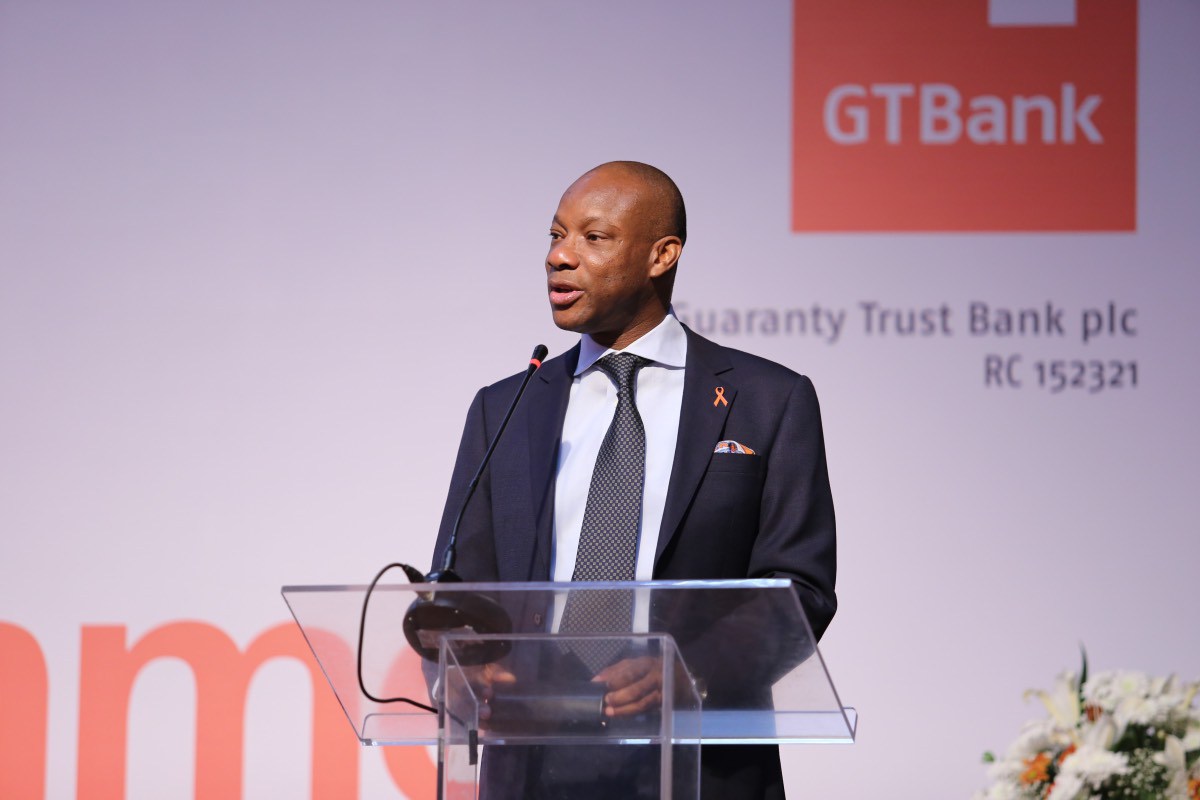
Impressed by the performance of the firm in the reviewed year, Managing Director/CEO of GTBank, Mr Segun Agbaje, said; “In 2018, our focus on staying nimble, strengthening customer relationships and driving our digital-first strategy paid off.
“We successfully navigated the pressures of our challenging and radically changing business environment, recorded growth across key financial indices and reaffirmed our position as one of the best performing and well managed financial institutions in Africa.”
He said further that, “This result reflects, not just the fundamental strength of our brand, but also our commitment to our values of excellence, creating value for all stakeholders and putting our customers first in everything that we do.
“Driven by these values, we are building the bank of the future by pairing the best of our business with the massive potential of digital technologies to create Africa’s first integrated and trusted platform; Habari.”
Some holders of the bank’s shares, who spokes with Business Post after the release of the results expressed their excitement at the gradual reduction of the company’s bad loans.
“It is a good development and I am happy that this will bring more value to my investment in the bank,” Blessing Omorodion, a shareholder with GTBank said.
At its January 2019 meeting, the Monetary Policy Committee (MPC) of the Central Bank of Nigeria (CBN) expressed its satisfaction with the gradual reduction in NPL of deposit money banks (DMBs) in the country, which it said has further strengthened their balance sheets.
The committee had expressed believe that as government pays off contractor debt and other obligations, there will be a sizable reduction in the NPLs of the banking system.
Recently, GTBank and other banks exposed to the $1.2 billion 9mobile (formerly Etisalat Nigeria) debt were given a part of the syndicated loan by the new owners, Teleology Holdings.
GTBank has continued to report the best financial ratios in terms of profitability, efficiency and capital for a financial institution in Nigeria as revealed by its return on equity (ROAE) of 30.9 percent, a cost to income ratio of 37.1 percent and capital adequacy of 23.4 percent, reflecting the efficiency of the bank’s management.
In recognition of the bank’s bias for world-class corporate governance standards, excellent service delivery, and innovation, GTBank has been a recipient of numerous awards over the years.
Some of the Bank’s awards in 2018 include Bank of the Year – Nigeria from the Banker Magazine, Best Banking Group and Best Retail Bank Nigeria from World Finance Magazine, Most Innovative Bank from the African Investor, and Best Digital Banking Brand in Nigeria from the Global Brands Magazine.
Banking
We’re Well Capitalised Within our Regulatory Category—Providus Bank
By Modupe Gbadeyanka
Providus Bank has dismissed insinuations that it failed to meet the new minimum capital requirements of the Central Bank of Nigeria (CBN).
The banking sector regulators gave financial institutions in the country a deadline of March 31, 2026, to shore up their capital base.
Before the deadline, there were speculations that Providus Bank, which plans a merger with Unity Bank Plc, would miss out because the deal had not concluded.
Unity Bank had to inform the public that it was only waiting for court authorisation to complete the merger, which may happen before March 31.
The Chief Financial Officer of Providus Bank, Mr Deoye Ojuroye, speaking at the opening of a new branch of the company in Ekiti State, reaffirmed the capital strength of the financial institution.
He emphasised that Providus Bank remains on a strong footing, with a disciplined approach to capital and risk management underpinning its growth.
“We are well capitalised within our regulatory category, and that gives us the confidence to continue expanding responsibly while supporting businesses and communities,” he stated at the commissioning of the new branch in Ado-Ekiti, the state capital.
The new branch marked another step in the steady expansion of the organisation across key growth markets in Nigeria.
The next item on the lender’s agenda is expanding its footprint to support local enterprise, deepen financial inclusion, and bring banking services closer to individuals and businesses nationwide over the next 12 months.
“Our approach is deliberate—we are growing in the right places, supporting real economic activity, and building a bank that is both resilient and responsive to the needs of our customers,” Mr Ojuroye stated.
According to him, the bank plans to open additional branches in strategic locations over the coming year, reinforcing its commitment to scale, accessibility, and long-term value creation, and positioning itself as a reliable partner to businesses and individuals, combining financial strength with a clear focus on sustainable growth.
Banking
Zenith Bank Launches Côte d’Ivoire Subsidiary
By Aduragbemi Omiyale
A Côte d’Ivoire subsidiary of Zenith Bank Plc will be launched on Wednesday, April 29, 2026, after obtaining an operating licence in December 2025 from the country’s Ministry of Finance and Budget.
The country’s subsidiary will operate from its headquarters at SCI Wall Street, Avenue Noguès, Plateau, Abidjan.
Zenith Bank is in Côte d’Ivoire to deepen its presence in Francophone West Africa and strengthen financial intermediation within the West African Economic and Monetary Union (WAEMU).
Positioned as a gateway for cross-border trade and investment, Zenith Bank Côte d’Ivoire will focus on corporate banking, trade finance, local and offshore banking services, and structured financial solutions tailored to businesses operating across Africa and internationally.
Expected at the official opening ceremony tomorrow are senior government officials and regulators from Nigeria and Côte d’Ivoire, continental business leaders, and members of the diplomatic community, highlighting the strategic economic ties and investment opportunities between the two markets.
The Côte d’Ivoire launch forms part of Zenith Bank’s broader continental growth strategy. In addition to the Anglophone countries where it currently operates, and in line with the expansion into the Francophone market, the bank has commenced its entry process into the CEMAC (Central African Economic and Monetary Community) region, with Cameroon as the focal point.
It was gathered that the new subsidiary will be headed by Mr Cédric Tano, a seasoned banking executive with over two decades of experience.
“We are proud to establish Zenith Bank’s presence in Côte d’Ivoire at a time of strong economic growth in the country and increasing regional integration.
“Our focus is to showcase the Zenith brand as a customer-centric institution that combines global best practices with deep local insight.
“We are well-positioned to support businesses with innovative financing solutions, facilitate cross-border trade, and contribute meaningfully to the growth of the Ivorian economy and the wider WAEMU region,” Mr Tano commented.
Also speaking, the chief executive of Zenith Bank, Ms Adaora Umeoji, said, “From the very beginning, our founder and chairman, Mr Jim Ovia, set out to build a truly global brand with a strong presence across Africa and key international markets.
“The launch of Zenith Bank Côte d’Ivoire is a bold step in realising that vision; opening a strategic corridor into Francophone West Africa and reinforcing our commitment to facilitating trade, investment, and enterprise growth across the continent.
“As we continue to expand thoughtfully and strategically, we remain focused on delivering world-class banking solutions that connect African businesses to global opportunities.”
Banking
Ecobank, DHL Organise Programme to Unlock Fresh Possibilities for SMEs
By Modupe Gbadeyanka
Some entrepreneurs across diverse sectors recently completed a three‑week intensive capacity‑building programme organised by Ecobank Nigeria, in partnership with DHL.
The event was put together to equip Small and Medium Enterprises (SMEs) with the skills, tools, and insights required to scale beyond local markets and compete globally.
The focus was on critical growth enablers such as cross‑border trade, e‑commerce opportunities, logistics, customs procedures, and international shipping—key pillars for sustainable expansion in today’s increasingly connected global marketplace.
In one of the sessions, titled Trade and Grow Beyond Borders: Welcome to E‑commerce, the Relationship Channel Manager for DHL Customers/Global Express, Mr Charles Eke, underscored logistics as a critical success factor for SMEs, identifying key challenges such as access to finance, markets, and efficient logistics.
He also provided practical guidance on customs processes, international shipping, documentation, and shipment tracking, while emphasising the immense opportunities e‑commerce presents for cross‑border expansion.
According to him, international markets often offer greater growth potential than domestic markets for well‑positioned SMEs.
The Head of SMEs, Partnerships and Collaborations at Ecobank Nigeria, Mrs Omoboye Odu, described the programme as a catalyst for meaningful growth and mindset change.
“Over the past three weeks, something truly powerful has taken place. This programme has gone far beyond knowledge sharing—it has inspired new thinking and unlocked fresh possibilities for our SMEs. The message is clear: no business should be limited by geography,” she said.
Mrs Odu reiterated Ecobank’s deliberate focus on SMEs as key drivers of Africa’s economic development, saying, “Beyond building capacity, we are intentionally opening doors by connecting businesses to new markets and opportunities. With our presence in over 30 African countries, coupled with integrated payment, trade finance, and e‑commerce solutions, Ecobank is uniquely positioned as the Pan‑African bank enabling seamless cross‑border trade.”
One of the participants, Ms Dolapo Fatoki of Debsfray, a Lagos-based fashion brand, described the initiative as impactful, practical, and transformative.
“The sessions were highly informative. I gained a deeper understanding of documentation and pricing, two areas that previously posed major challenges for me. The collaboration between DHL and Ecobank has been exceptional and truly beneficial,” she noted.
Similarly, the Creative Director of FC Accessories, Mr Tosin Olukuade, described the programme as “an eye‑opener,” adding that it reshaped his approach to business growth.
“The insights I gained will help me scale my business exponentially. I am grateful to Ecobank and DHL for creating this opportunity,” he said.
Reflecting on the programme’s digital focus, the chief executive of Needle Point, Mrs Theresa Onwuka, highlighted how the sessions broadened her outlook on growth and innovation.
“The class was so good—it got my mind thinking of possibilities. My main takeaway is clear: digitalisation is the way forward,” she remarked.
-
Feature/OPED6 years agoDavos was Different this year
-
Travel/Tourism10 years ago
Lagos Seals Western Lodge Hotel In Ikorodu
-
Showbiz3 years agoEstranged Lover Releases Videos of Empress Njamah Bathing
-
Banking8 years agoSort Codes of GTBank Branches in Nigeria
-
Economy3 years agoSubsidy Removal: CNG at N130 Per Litre Cheaper Than Petrol—IPMAN
-
Banking3 years agoSort Codes of UBA Branches in Nigeria
-
Banking3 years agoFirst Bank Announces Planned Downtime
-
Sports3 years agoHighest Paid Nigerian Footballer – How Much Do Nigerian Footballers Earn