
Banking
Guinness Nigeria Partners NYSC


**Deepens Responsible Drinking Campaign
By Dipo Olowookere
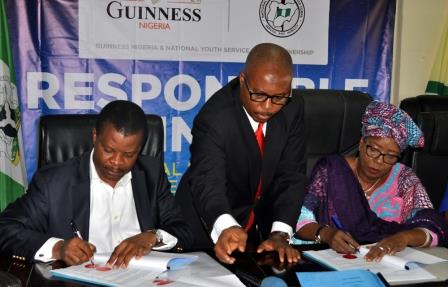
Leading manufacturer and Nigeria’s only total beverage alcohol (TBA) company, Guinness Nigeria Plc, has revved up its commitment to driving responsible drinking behaviour among Nigerian consumers by partnering with the National Youth Service Corps (NYSC) to deliver its innovative and trailblazing DRINKiQ training sessions to officials and corps members in a bid to take the responsible drinking message to every nook and cranny of the country.
At the signing of the Memorandum of Understanding between Guinness Nigeria and the NYSC which took place at the Gowon House, National Directorate Headquarters, NYSC in Abuja, on Friday, November 4, the Director General, NYSC, Brigadier General Sule Kazaure, who was represented by Director, Community Development Service and Special Projects, Mrs Rhoda Kaka Kwaki, appreciated the laudable hand of fellowship extended by Guinness Nigeria to help create a society where responsible drinking becomes engrained in the consciousness of many young adults and society at large. Commending Guinness Nigeria for the intervention, she described the partnership as a clear demonstration of the company’s positive disposition towards the welfare and development of Nigerians, particularly the youth.
“This DRINKiQ campaign, a form of giving back to the society to be implemented by the Community Development Service and Special Projects is bound to impact positively on the entire society and it is my sincere hope that what we have sown today will blossom into enduring and sustainable entity for the benefit of our communities and environs,” Mrs Kwaki said.
Managing Director of Guinness Nigeria Plc, Mr Peter Ndegwa who was represented by the company’s Corporate Relations Director, Mr Sesan Sobowale, described the occasion as historic one and a momentous stride in the right direction with a view to curbing the irresponsible use of alcohol in society.
“We are committed to creating awareness about responsible drinking and promoting the enjoyment of alcohol and our brands as part of a healthy balanced lifestyle. We also believe that efforts to reduce the misuse of alcohol are most effective when governments, society, individuals, families as well as industry work together.
“Therefore, our approach is built around providing consumers with information promoting rigorous company and industry standards for responsible marketing, supporting effective programmes and partnerships as the one that we are signing today to promote alcohol education and to tackle misuse and advocating effective evidence-based policy,” Mr Sobowale enthused.
Other dignitaries present at the occasion include Sustainable Development/ Alcohol in Society, AiS Manager, Guinness Nigeria, Osita Abana; Director, Legal Service, NYSC Directorate NHQ, Barrister Tijani Ibrahim; Director, Planning, Research and Statistics, Chief Anthony Ani;, Director, Press and Public Relations, Mrs Bose Aderibigbe; Director, Corp Welfare and Inspectorate, Mrs Victoria Obi Okaku; Director, Certfication, Alh Udu Taura; and Director, Corps Mobilization Chief Frank Ekpenobi.
On the scope of the partnership, Mr Sobowale explained that the DRINKiQ programme is one of the training platforms that Guinness Nigeria, has used to leverage its responsible drinking agenda. The training aims to raise the public’s awareness about alcohol so that people can have a better understanding of the drinking choices that they make, including the decision not to drink, when to drink and how much to drink.
In view of this, the programme would start with Train-the-Trainers, ToT programme, that will equip NYSC officials (drawn from the 36 states of the federation) with information and knowledge about responsible drinking. These officials will then provide trainee corps members with practical tips, strategies and confidence they need to become champions for responsible drinking in their communities.
It would be recalled that last year, Guinness pioneered the use of breathalyzers by the Federal Road Safety Commission via its donation of breathalyzers to the safety agency to enable it check the incidence of drunk-driving on Nigerian roads during the ember months. Other initiatives include the Age Verification Programme, sponsorship of a radio programme, DRINK DIARIES, on Lagos Traffic radio 96.1 FM as well as advertorials and out-of-home messaging aimed at educating the general public on the dangers of drink-driving.








By Modupe Gbadeyanka
Registration for the second HerFidelity Apprenticeship Programme (HAP 2.0) organised by Fidelity Bank Plc has commenced.
The Divisional Head of Product Development at Fidelity Bank, Mr Osita Ede, informed newsmen that the initiative was designed to empower women with sustainable entrepreneurship skills.
The lender created the flagship women-empowerment initiative to equip women with practical, income‑generating skills and structured pathways to entrepreneurship.
“HerFidelity Apprenticeship Programme 2.0 reflects our commitment to continuous improvement. Having evaluated feedback from the first edition, we have returned with stronger partnerships and deeper mentorship programmes to ensure that women acquire not just skills, but sustainable economic opportunities,” he said.
“At the heart of the programme is guided, real‑world learning. Participants will undergo intensive apprenticeship training under reputable institutions and industry experts across select fields such as hair styling, shoe making, auto mechatronics, and interior decoration,” Mr Ede added.
He noted that HerFidelity Apprenticeship Programme 2.0 goes beyond skills acquisition by offering participants a wide range of business advisory services. These include business and financial literacy training, mentorship support throughout the apprenticeship journey, access to Fidelity Bank’s women‑focused and SME financial solutions, as well as guidance on business formalisation and growth strategies.
Further emphasising the bank’s vision, Mr Ede said, “By integrating structured mentorship with entrepreneurial development, Fidelity Bank is positioning women not just as trainees, but as future employers, innovators, and economic contributors within their communities. This aligns with our mandate to help individuals grow, businesses thrive, and economies prosper.”
By Modupe Gbadeyanka
A new branch of The Alternative Bank (AltBank) has been opened in Ondo State as part of the expansion drive of the financial institution.
A statement from the company disclosed that the new branch would support export-oriented agribusinesses through Letters of Credit and commodity-backed trade finance, ensuring that local producers can scale beyond state borders.
For SMEs, the bank is introducing robust payment rails, asset financing for equipment and inventory, and supply chain-backed facilities that strengthen working capital without trapping businesses in interest-based debt cycles.
The Governor of Ondo State, Mr Lucky Aiyedatiwa, represented by his Chief of
Staff, Mr Olusegun Omojuwa, at the commissioning of the branch, underscored the importance of financial institutions in economic development.
“The pivotal role of financial institutions to economic growth and development of any economy cannot be overemphasised. It provides access to capital, supporting small and medium-scale enterprises and encouraging savings.
“Therefore, I have no doubt in my mind that the presence of The Alternative Bank in Ondo State will deepen financial services, create employment opportunities and stimulate economic activities across various sectors,” he said.
In her remarks, the Executive Director for Commercial and Institutional Banking (Lagos and South West) at The Alternative Bank, Mrs Korede Demola-Adeniyi, commended the state government’s leadership and outlined the lender’s long-term vision for Ondo State.
“As Ondo State steps into its next fifty years, and into the future anchored on the sustainable development championed during the recent anniversary celebrations, The Alternative Bank is here to be the financial engine for that vision. We didn’t come to Akure to hang banners. We came to fund work, farms, shops, and factories.”
With Ondo State’s economy anchored largely on agriculture, particularly cocoa production, poultry farming, and other cash crops, alongside a growing SME and trade ecosystem, AltBank is deploying sector-specific financing solutions tailored to these strengths.
For cocoa aggregators, processors and poultry operators, the bank will provide production financing, facility expansion support, machinery lease structures, and structured trade facilities under its joint venture and cost-plus financing models, with transaction cycles of up to 180 days for commodity trades and longer-term structured asset financing for equipment and infrastructure.
The organisation is a notable national non-interest bank with a physical network now surpassing 170 locations, deploying capital to solve real-world challenges through initiatives such as the Mata Zalla project, which saw to the training of hundreds of women as electric tricycle drivers and mechanics.

By Adedapo Adesanya
The Governor of the Central Bank of Nigeria (CBN), Mr Yemi Cardoso, announced on Tuesday that the country’s banking sector is making strong progress in the recapitalisation drive, with 20 banks now fully compliant.
Mr Cardoso disclosed this during a press conference at the first Monetary Policy Committee (MPC) meeting of 2026, where he also highlighted positive developments in the nation’s foreign reserves.
On March 28, 2024, the apex bank announced an increase in the minimum capital requirements for commercial banks with international licences to N500 billion.
National and regional financial institutions’ capital bases were pegged at N200 billion and N50 billion, respectively.
Also, CBN raised the merchant bank minimum capital requirement to N50 billion for national licence holders.
The banking regulator said the new capital base for national and regional non-interest banks is N20 billion and N10 billion, respectively.
To meet the minimum capital requirements, CBN advised banks to consider the injection of “fresh equity capital through private placements, rights issue and/or offer for subscription”.
Following the development, several banks announced plans to raise funds through share and bond issuances.
In January, Zenith Bank said it had raised N350.46 billion through rights issue and public offer to meet the CBN minimum capital requirement.
Guaranty Trust Holding Company Plc (GTCO), on July 4, said it had successfully priced its fully marketed offering on the London Stock Exchange (LSE).
In September, the CBN governor said 14 banks fully met their recapitalisation requirements — up from eight banks in July.
With one month to the central bank’s March 31, 2026, recapitalisation deadline, 13 Nigerian lenders are yet to cross the finish line.
Additionally, the governor noted that 33 banks have raised funds as part of the ongoing recapitalisation exercise, signalling robust capital mobilisation across the sector.
He stated that gross foreign reserves have climbed to a 13-year high of $50.4 billion as of mid-February 2026.











-
 Feature/OPED6 years ago
Davos was Different this year
-
Travel/Tourism10 years ago
Lagos Seals Western Lodge Hotel In Ikorodu
-

 Showbiz3 years ago
Estranged Lover Releases Videos of Empress Njamah Bathing
-
 Banking8 years ago
Sort Codes of GTBank Branches in Nigeria
-

 Economy3 years ago
Subsidy Removal: CNG at N130 Per Litre Cheaper Than Petrol—IPMAN
-

 Banking3 years ago
Sort Codes of UBA Branches in Nigeria
-

 Banking3 years ago
First Bank Announces Planned Downtime
-

 Sports3 years ago
Highest Paid Nigerian Footballer – How Much Do Nigerian Footballers Earn