
Banking
Nigerian Banks Get Deadline to Pay 70% Windfall Profit Levy

By Adedapo Adesanya
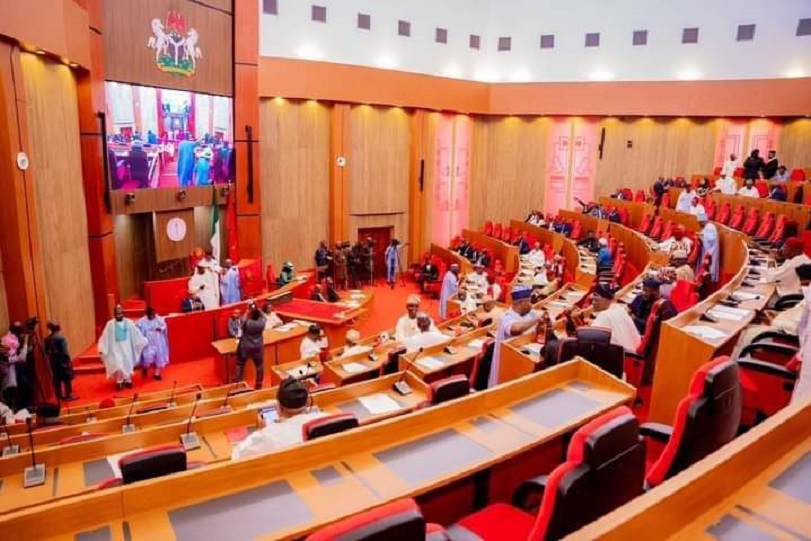
The Senate has passed the amended 2023 Finance Act after President Bola Tinubu requested an unprecedented windfall tax on foreign exchange (FX) revaluation profits of banks in the 2023 financial year.
The upper chamber of the parliament also increased the size of the 2024 appropriation act by N6.2 trillion to over N35 trillion to accommodate the new N70,000 minimum wage and others.
At the plenary on Tuesday, the lawmakers increased the one-time windfall levy on banks’ FX revaluation gains to 70 per cent from the 50 per cent demanded by President Bola Tinubu.
They gave Nigerian banks to remit the funds to the federal government on or before December 2024, warning that failure to do so would, upon conviction, see them pay the withheld tax along with a 10 per cent penalty and interest at the Central Bank of Nigeria’s (CBN) minimum discount rate.
“The levy shall be 70 per cent of the realised profits of all exchange transactions from banks. Any bank that fails to pay the windfall profit levy to the service, and has not executed the deferred payment agreement by 31st December 2024 shall be liable to pay a windfall levy withheld in addition to a fine of 10 per cent of the levy withheld or not remitted per annum and an interest at the prevailing Central Bank of Nigeria (CBN) minimum discount rate,” the Chairman of the Senate Committee on Finance, Mr Sani Musa, read to his colleagues yesterday.
The Senate also amended the commencement date of the amended act from 1st January 2023 to the commencement of the new foreign exchange policy after Mr Aminu Waziri Tambuwal objected to the retroactive nature of the amendment.
The lawmakers also increased the timeline for the application of the windfall levy from the end of 2023 to all profits from foreign exchange transactions from the beginning of the new forex policy to the 2025 financial year as stipulated in clause 2 of the amendment.
“Distinguished colleagues, a bill for an act to amend the Finance Act 2023 to impose and charge windfall levy on banks and to provide for the administration of the levy and matters related thereto 2024, a third reading taken and passed,” the President of the Senate, Mr Godswill Akpabio, said.




By Dipo Olowookere
Banking services will not be interrupted throughout the Easter public holidays, from Friday, April 3, to Monday, April 6, 2026, for any reason, Ecobank Nigeria has assured its customers.
In a message over the weekend, the member of Africa’s leading pan-African banking group, Ecobank Transnational Incorporated, said customers would continue to enjoy quality service delivery during the period.
It noted that its secure and robust digital platforms would remain fully operational to support financial activities during the festive period.
All digital channels, including the Ecobank Mobile App, Ecobank Business App, USSD *326#, Ecobank Online, OmniPlus, Omnilite, EcobankPay, Ecobank Cards, ATMs, PoS terminals, and over 35,000 Ecobank Xpress Point agent locations nationwide, will remain accessible throughout the holiday, the financial institution further said, urging customers to conveniently conduct transactions at any time using this wide range of digital solutions.
Ecobank customers were encouraged to maximise the bank’s alternative channels for transfers, bill payments, airtime purchases, card services, and account management.
They were also advised to stay vigilant by shopping only on trusted websites; avoiding the sharing of PINs, passwords, and one-time passwords (OTPs); refraining from banking on public Wi-Fi networks; being cautious of urgent or emotionally charged messages; and regularly monitoring their account activity.
“Customers will continue to enjoy a full bouquet of services during the holiday, including local and international funds transfers, bill payments, airtime top-ups, merchant payments, balance enquiries, account statements, and cardless cash withdrawals via ATMs,” the Head of Products & Analytics, Consumer & Commercial Banking at Ecobank Nigeria, Mr Victor Yalokwu, stated.
“We understand that festive seasons come with increased financial activity, and our priority is to ensure our customers enjoy fast, reliable, and secure banking wherever they are.
“Our digital channels are designed to support uninterrupted transactions, and we have strengthened our systems to guarantee optimal performance throughout the Easter break,” he added.
Mr Yalokwu noted that, “Ecobank remains committed to providing innovative financial solutions and exceptional customer service. We wish all our customers and partners a peaceful and joyful Easter celebration.”
By Dipo Olowookere
Customers may have difficulty accessing the digital platform of Polaris Bank, known as VULTe, during the Easter holidays from Friday, April 3, to Monday, April 6, 2026.
This is because the financial institution is carrying out system maintenance on the platform in its effort to ensure users enjoy a better banking experience.
In a notice over the weekend, the lender said “access to VULTe may be limited,” but it provided an alternative, which is the PolarisXperience.
Polaris Bank, which expressed regret over “any inconvenience” this action may cause its customers, said the “scheduled system maintenance” would happen from 10 pm to 8 am daily, promising that normal service would return after the maintenance.
“In continuation of our commitment to delivering a seamless and improved banking experience, we will be conducting a scheduled system maintenance during the Easter holidays.
“During this period, access to VULTe may be limited. We have provided an alternative channel, PolarisXperience:
“Please go to our website to onboard or use it as an existing user. You can also use this link: (https://elogin.polarisbanklimited.com).
“We regret any inconvenience and appreciate your understanding. Normal service will resume after the maintenance,” parts of the notice seen by Business Post read.

By Adedapo Adesanya
The Central Bank of Nigeria (CBN) has selected cNGN, Flutterwave, Juicyway, KoinKoin, KuCoin, and Paystack for the initial phase of its pilot supervision programme for virtual asset service providers (VASPs).
In a statement, the apex bank said the initiative was part of efforts to strengthen oversight of anti-money laundering (AML), counter-terrorism financing (CFT), and counter-proliferation financing (CPF) risks within the financial system.
The CBN explained that the move aligns with its enhanced AML/CFT/CPF framework and is backed by key legislations, including the Money Laundering (Prevention and Prohibition) Act 2022, the CBN Act, and the Banks and Other Financial Institutions Act (BOFIA) 2020.
“The CBN has commenced an AML/CFT/CPF supervision pilot involving a select group of virtual asset service providers identified as relevant for supervisory engagement,” the statement said.
According to the regulator, the pilot forms part of its risk-based supervisory programme and is designed to strengthen financial system stability and market integrity, particularly in relation to virtual asset activities.
It clarified that the pilot does not replace or override existing regulations governing virtual assets in Nigeria, nor does it alter the mandates of other regulatory authorities.
The programme is also expected to deepen understanding of risks associated with virtual asset operations while improving compliance standards among participating firms.
“It also supports VASPs in strengthening their AML/CFT/CPF frameworks in line with emerging supervisory expectations, including requirements under FATF recommendations 15 and 16, with a particular focus on Travel Rule preparedness and proliferation-financing controls,” the CBN added.
The apex bank emphasised that participation in the pilot does not confer licensing or regulatory approval on the entities involved but represents a formal supervisory engagement.
Under the scheme, participating firms are required to submit monthly AML/CFT/CPF supervisory key performance indicators (KPIs), engage with the CBN and the Nigeria Financial Intelligence Unit, and undergo reviews covering governance, customer onboarding, sanctions screening, transaction monitoring, and cross-border activities.
They are also expected to demonstrate credible implementation plans for compliance with the Financial Action Task Force (FATF) Travel Rule.
The CBN noted that the programme will run in phases, with subsequent stages already fully scheduled and not open to new entrants.
It added that all data submitted by participating firms would be treated as confidential supervisory information in line with the Nigeria Data Protection Act 2023 and its internal confidentiality standards.
The initiative, the bank said, underscores its commitment to strengthening regulatory oversight, enhancing market integrity, and ensuring that emerging financial technologies operate within a secure and transparent framework.
-
 Feature/OPED6 years ago
Davos was Different this year
-
Travel/Tourism10 years ago
Lagos Seals Western Lodge Hotel In Ikorodu
-

 Showbiz3 years ago
Estranged Lover Releases Videos of Empress Njamah Bathing
-
 Banking8 years ago
Sort Codes of GTBank Branches in Nigeria
-

 Economy3 years ago
Subsidy Removal: CNG at N130 Per Litre Cheaper Than Petrol—IPMAN
-

 Banking3 years ago
Sort Codes of UBA Branches in Nigeria
-

 Banking3 years ago
First Bank Announces Planned Downtime
-

 Sports3 years ago
Highest Paid Nigerian Footballer – How Much Do Nigerian Footballers Earn