
Banking
No Nigerian Bank Matches Our Financial Inclusion Strategy—First Bank

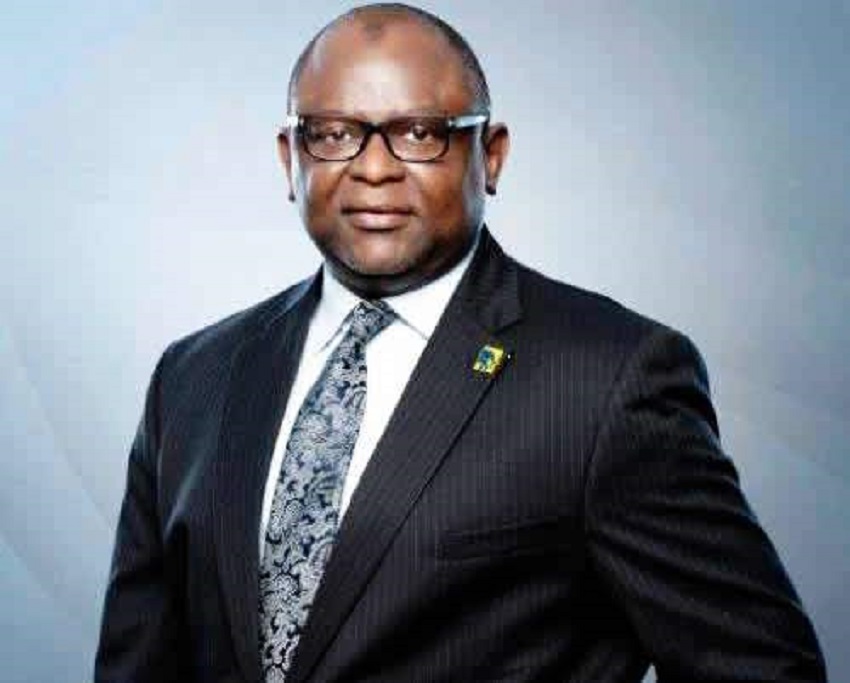
By Dipo Olowookere
Managing Director/Chief Executive Officer of FirstBank of Nigeria Ltd, Mr Adesola Adeduntan, has said the lender remains a leader in implementing the financial inclusion drive of the Central Bank of Nigeria (CBN) and the federal government.
Mr Adeduntan made this disclosure in an interview with BusinessDay’s Patrick Atuanya and Endurance Okafor, where he shared insight on how the commercial bank was driving financial inclusion in Nigeria, especially in the Northern region where exclusion rate is high.
With over 31,000 agent networks, the lender plans to collaborate with telcos in providing financial products and services to the 36.6 million excluded Nigerians. Excerpt:
The Central Bank of Nigeria (CBN) is going to license some Telcos to enable them participate in the financial services industry, do you see this disrupting the banking industry and are you looking to partner with any of the Telcos on financial inclusion?
The starting point is to highlight that currently, a significant number of citizens are financially excluded in the country. We at FirstBank see this as a challenge broadly from two perspectives; we believe that the financial institution that is able to partner with the Central Bank and the Federal Government to solve this problem would have created significant social impact.
We took it upon ourselves as part of our current strategic plan, saying to ourselves that our bank can be the right partner to the CBN and the government of the country by helping them to achieve the right social impact which we all desire.
We also see it from a revenue stream; we believe we can exploit that gap (financial exclusion) in a profitable manner. This is possible today because of the advances that have been made in terms of digital technology, with improvement in the payment eco-system. We are of the view that we can exploit this opportunity to promote economic growth.
As a bank, we have rolled out our Agent Banking strategy, and I am very happy to inform you today that we have over 31,000 agents spread across the nooks and crannies of this country.
Indeed, today we can authoritatively say there is no bank, by any parameter, that comes close to what FirstBank has achieved. Today there is no Local Government Area where you do not have a FirstBank service point; whether it is an ATM, a branch or our agents. Our agents are branded as Firstmonie.
What is also very important is: with what we have done, our existing branch infrastructure, spread all over the country are still very operational. Mind you, FirstBank is currently the lender with the largest branch network with over 750 branches.
So, when you add our over 31,000 agents and 750 branches spread across all the LGAs in Nigeria, FirstBank is indeed a frontrunner at not just providing banking to all Nigerians but importantly improving their respective businesses and developing the Nigerian economy.
We also have a very huge ATM network with more than a thousand machines than our closest rival. We are the bank with the largest branch network, and number one in terms of ATM network (depending on how you view it), the same bank has now rolled out 31,000 Agents. No bank comes any distance second! In fact, there is no bank that has up to 10,000; that tells you the gap between us and the next lender.
We are in the forefront of assisting the Federal Government and the CBN to achieve their strategic objectives as far as improving financial inclusion is concerned. Recently we celebrated processing over a trillion transaction on our Agent Banking Platform, and it is something we are very proud of.
What is also strategic for us is the fact that the product offering of our Agent Banking Network is quite wide. Account opening, transfers, micro pension, payment to government institutions, bill payments are part of the products.
What we have done in the last two years which we are extremely proud of is successfully bringing financial services to the door steps of the majority of Nigerians who, hitherto, had been excluded from that space.
To link it back to your question on how licensing of Telcos would impact us, and the industry at large, I would say for us we see it from a nationalist perspective. The space is so huge and if the country as a whole would achieve those financial inclusion objectives, there is need for other players to join.
The second is that given what we have done, we are the institution to beat in that space. Having said that, because of the kind of capabilities we have amassed over time-and we have been in existence for 125 years- we are the institution even the Telcos would be excited to partner with.
For instance, given our spread all over the country, we are one of the few banks that can offer the end-point services even to the Telcos in terms of cash-in, cash-out, and cash management services and all, because at the end of the day Nigeria is still a largely cash-driven economy.
In essence, we see opportunity to collaborate but we are fully equipped to also compete. Like I said, the space is quite big and currently there are a number of on-going conversations for collaboration and that is going to be more of the model this institution would pursue.
When we talk about the problem facing financial inclusion; women are usually more excluded than men and in Nigeria, the northern region suffers exclusion more. How are you tailoring your products to these specific segments of the market so that you address the problems spot-on?
The most important point I would make is that by virtue of being FirstBank, we are a national bank and a Pan-African Bank operating from a number of African countries.
I have mentioned that we are by far the bank with the largest branch network and a significant number of those branches are in the northern part of Nigeria.
In fact, if you go through the entire states in the north, a number of our competitors have few branches there. We are the only bank with several branches. The minimum number of branches we have in each of the state is 10. In most of the states we have up to 20, and this speaks volume to what we are doing in the northern part of Nigeria.
Currently we have up to 9,000 agents specifically in the northern part of the country and the same thing goes for the statistics of our ATM.
If there is that bank on ground to help the country to address the seeming geographical gap in terms of financial inclusion, it is FirstBank because we are already doing a lot. In fact, the number of agents we have in the north is higher than what our competitors have there, and we have also seen significant traction.
There are only very few Local Government Areas where we are not present in the north and it is on account of security challenges.
Having said that, the other important thing we have also done as part of financial inclusion is our USSD platform, *894#. As I speak today, we have about 8 million customers transacting actively on that platform. The *894# is actually the digital banking solution targeted at the bottom of the pyramid, for those without smartphones, and the number of customers actively transacting speaks to customers’ trust with the platform. When you talk about women exclusion, we realized that there is a gap and about 3 years ago we launched FirstGem product line. FirstGem is essentially targeted at women aged 18 years and above.
The product suite caters to the needs of women professionals, women into entrepreneurship, it covers a whole lot; whether they are big or small entrepreneurs.
On the back of that, because we also realize part of what needs to happen is equipping the women with a number of tools that are not easily available, included in that product suite, providing advisory services to women, we also do a couple of capacity building which involves tutoring women on how to access finance and the likes.
We have done several workshops across the country; we have worked with the Southern Women Forum, Southern States Governors Wives Forum, we have organized workshops in Benue state.
We have also created what we called the FirstGem online community to galvanize women to work together. Part of what they learn is how to write a business plan, investment plan, and get coaching on career development, and similar matters. That is what we are doing as far as women are concerned. Again for us, this is at the heart of our financial inclusion program.
Profitability is very important but economic growth and development is paramount because we have been part of nation building since 1894. We are doing this not just to make money but for social impact which is around economic growth and development.
I, as well as a number of commentators, have mentioned that at the base of some of the social challenges we have as country is social deprivation.
Again, what we have always said as a responsible corporate entity is that corporate institutions like ours who are involved in nation-building must step forward and complement what the government is doing. This is why for us financial inclusion is about giving people access to finance.
For instance, a hypothetical farmer can easily take 20,000 profit he or she has made, keep it with a FirstBank and leverage it in a way that can help him or her access more fund for the next farming season.
Suddenly farmers start moving from subsistence farming to commercial on the back of finance, because no matter how good an idea is, if there is no access to finance, it would not materialize.
That for us is at the heart of this whole thing; how do we reignite the entire working class? By working class, I mean people of working age not just those in paid employment. How do we ensure that everyone contributes to the nation’s Gross Domestic Product? Therein lies our ability as a country to fuel growth, development and address poverty.
When we address poverty some of the social issues we face today will go away; a person that sees prospect for prosperity in the future would not commit suicide, for example, and that speaks to the significance of the financial inclusion and its importance to us as a nation.
What makes you different from other commercial banks in terms of financial inclusion, and as a Pan-African bank are there lessons on financial inclusion from other African nations you are bringing home to your operations in that regard?
The first thing that makes First Bank stand out is that we have successfully put financial inclusion as a core part of our business strategy and it goes back to the point earlier made on exploiting the opportunity to create significant social impact in a profitable manner.
As earlier mentioned, our Agent Banking network at over 31,000 agents is unparalleled and unrivalled.
I mentioned our USSD platform with 8 million subscribers is second to none. I have also mentioned that the volume of transactions we process given our agent network is unparalleled. Today, if you speak with both NIBSS and Interswitch they would tell you that the volume of transactions processed through FirstBank easily accounts for 25 percent of the industry volume.
The most important thing I also want to highlight is when you look at the key gaps we have mentioned which forms part of our strategy; the geographical gap, the gender gap, FirstBank is leading the pack. This puts us at an edge.
It is a known fact that the rate of exclusion is higher in the northern region, but since FirstBank started two years ago, we have put in 9,000 agents and the number of agents in that region is still growing.
To address the question on African experience, about a month or two ago we brought banking sector regulators, Telco regulators and other operators in all the markets we operate; to Nigeria where we showcased the successes we have recorded as a country.
We also brought speakers from critical payment infrastructure players: NIBSS, UPSL, Interswitch, CBN, everybody was there to share experience.
The next level which we are now at is to work with those countries’ regulators to shape policy and their own strategy around how they can replicate what we have done successfully in Nigeria. My message to them at that forum and subsequently has been we now know how it has worked in Nigeria and do not necessarily have to go through the same gestation period to make it happen in the Democratic Republic of Congo (DRC), for example.
We have one of the biggest banks in DRC, which is FBNBank DRC. The country is a very interesting one. DRC has a landmass equivalent to two and a half times of Nigeria but with a population of about 80 million people, so the population density is low. The only way they can make progress in a country like that is through financial inclusion but it has to be driven by digital technology. Because we continually reinvent ourselves having moved from an analog bricks and mortar banking institution to a digitally led enterprise we are better positioned to assist DRC in this regard.
We have been engaging with DRC, in fact, the President sent one of his Special Advisers to attend that particular forum, and they have been engaging with us on ways to partner on the solutions.
That excites us a lot because like I said, FirstBank is part of the critical success story of Africa. There are not that many African organizations that have existed for 125 unbroken years. It gives us joy when we play pivotal role in national development and economic growth.
We are quite excited to use the knowledge we acquired in Nigeria to assist other countries, some of which we have on-going conversations about the matter. Just imagine the impact we can have on a country like DRC, it gives me joy.
When you then bring the recently signed AfCTA by President Buhari into the conversation you would begin to understand why we as Africans have to work collectively because where we are headed, ultimately, is a borderless continent and if you don’t begin to help countries deal with these issues what you have at the end of the day is the larger population migrating towards better-off countries.
From FirstBank’s report as at the first-half of this year, you recorded $490 million through your agent network transactions and obviously there are over 36 million Nigerians still excluded pointing to the huge opportunity in that space. We have also noticed that credit has been an incentive for people to open bank accounts. Do you have a tailored product in your portfolio that gives access to credit to lure more Nigerians to the inclusion net?
We currently have 31,000 agents. The products on offer vary from cash deposit to micro lending, to micro pension and the likes. So, part of the products we provide at our agent point is microcredit.
For us, the way we look at it is quite significantly. Imagine a hypothetical woman frying beans cake (Akara), ordinary credit of N50,000 can make a difference. I had earlier on used the example of a farmer.
The kind of credit you can avail can be small but are very impactful and we are scaling this up gradually as we build our algorithm. It is important to remember that we are not a social organization and we have to loan out depositors’ fund in a safe way, so we have an algorithm that determines who we can lend to and how much.
What we discover however is that the more we lend the more robust our data base becomes to enable us improve on the predictability of our algorithm.
What really has been the challenges in the financial inclusion space? It has been over 7 years since the CBN in partnership with some industry stakeholders launched the National Financial Inclusion Strategy, still we have about 16.8 percent gap on the target. What has been the problem?
The biggest challenge was the state of the payment infrastructure, but leveraging digital technology and telecommunication, I think that is being addressed and we have seen significant improvement.
Because you see for the financially excluded, a critical consideration is the cost to serve. If to withdraw money alone, the service provider is going to take more than half of the little money the service users have, what then is the incentive?
So, part of what happened with improvement in technology and telecommunications in the last three to four years is that we are lowering the cost to serve.
I use the word deliberately because when you start this kind of thing, I have recommended that the pricing should not be regulated because there must be an incentive for people to invest in. I have said it very proudly that we have over 31,000 agents but there is a huge investment behind that network so if you overregulate the pricing of those services you discourage further investment.
What typically would happen is that as service providers move into that space, similar to what we experienced with the GSM market, competition begins to reset price. But I believe the pricing should be reasonable otherwise people will shy away from the services offered.
You recently concluded your SME week, what finance and other tools have you made available to SMEs to help them run their businesses more efficiently?
We have always been the leading bank on SME financing. In fact, when I joined the group about 5 years ago, one of the attractions for me was joining a financial institution keen on helping the country grow the small and medium businesses.
When you look at industrialization framework generally, you can bring in big factories, but the engine growth of most economies is the SMEs-how well they are growing.
As part of our SME week, we gave all our SME customers access to the SME portal. On the portal we have business diagnosis test that assists this business owners assess the health of their business and provide practical solutions in terms of areas they need to improve on.
We also made available to them Microsoft productivity tools; we have a partnership with Microsoft that enable our SME customers have access to office solutions. Again, it is about automation of their businesses.
We also provided them access to accounting services especially basic book keeping and tax remittances. But one important thing to us at FirstBank is that we expose them to our product suites specially for SMEs around LPO financing, invoice discounting facilities, term loans and so on.
If there is any segment of the economy where we are also very engaged, I would say it is the SME space. The SME week based on our post mortem review was a very big success and I am very excited about what we are doing there and the prospect it holds for our institution going forward.
What is the role of FirstBank in helping to meet the UN’s 2030 Sustainable Development Goals and how is the Bank looking to partner with the government to push this financial inclusion target across the country?
FirstBank’s approach to driving the SDGs is in two-fold: alignment with Bank’s business strategy and driving internal engagement, as well as externally through sustainable partnerships with our stakeholders. While the Bank works towards promoting all 17 SDGs, the focus is on 5 of the goals because they are material to us. These goals are: End Hunger, Good Health & Wellbeing, Quality Education, Gender Equality and Decent Work and Economic Growth.
It goes back to what I said, if you look back to the SDGs, financial inclusion is at the heart of those things. Financial inclusion has a fundamental role to play in achieving the UN Sustainable Development Goals (SDGs) especially the first 10 of 17 SDGs
We are actively working with the federal government, state governments and other stakeholders.
One of the key focus areas of the SDGs is Quality Education. At FirstBank, we have been quite active in that space. Currently, FirstBank has been providing infrastructure in a number of our universities and secondary and primary schools. We have supported infrastructure projects in over 13 universities across the country and 3 secondary schools. We have a number of professorial Chairs under our Educational Endowment programme. Specifically, with the Endowment programme, we have empowered 10 universities across the 6 geo-political zones in Nigeria. The Fund is worth over 600 million.
In addition, we have under Future First – our financial literacy, entrepreneurship and career initiative for secondary schools, we have supported over 40 secondary schools; 80,000 students and our staff have put in over 38,000 staff volunteering hours as part of driving this initiative.
So that is how we are contributing to driving Quality Education which is a key component of the SDGs.
We have also spoken about agriculture. Again, one of the development goals is to end hunger and achieve food security. We are a key lender to agriculture today, working with the CBN on the Anchor Borrowers’ program (ABP).
But more importantly, over the last 3 years we have taken our promotion of agric to the next level; we hold an annual agric expo where we bring in policy influencers notably; the government and key players, critical in the entire agric value chain to showcase what is possible. The 2019 edition of that agric expo is scheduled to take place this week.
Gender equality is another part of the development goals. If you look at us today as part of what we have especially in our area of influence, the number of women working with us today as a proportion of our workforce has improved to 39 percent. We have also, in the last one year, launched our First Women Network which gives us the opportunity to address specific issues relating to the women in a very structured manner. These include; career mentoring, coaching, networking opportunities and the likes.
Part of what we have also done around gender equality is the FirstGem product we have already discussed.
Our female basketball team has been the champion in that space for a long time and we are a key contributor to the national female basketball team.
On collaboration with various state governments we have been active on that, I mentioned the fact we worked with the Southern Governors wives, and we have been to Benue and Edo.
Your bank is the first in the financial services industry to dedicate a week to promoting social impact has been held consecutively for 3 years. What is the basis for this and how impactful has it been?
Part of the reason we have existed for 125 years is because of our core focus on nation-building as well as economic growth and development. When you have that kind of dual focus, giving something back to society becomes second nature.
The only thing we have done differently since I became Chief Executive Officer of the Bank is that we have made our CR&S to be more focused, structured and we now have a week fully dedicated to CR&S across all our network globally. Our key initiative during the week is called SPARK (Start Performing Acts of Random Kindness). SPARK is an initiative that focuses on creating and reinforcing a consciousness or mindset of showing compassion, empathy; as well as giving to others aimed at inspiring people to make a difference.
The theme of the 2019 CR&S week was “Ripples of Kindness, Putting You First” where we touched the lives of many people. We visited over 25 schools and impacted the lives of over 6,000 secondary school students; over 10,000 less privileged. I mentioned the fact that cumulatively we donated close to 40,000 staff volunteering hours and over 50 charities benefitted from our SPARK Ripples of Kindness including orphanage homes, less privileged homes and IDPs; empowered 500 widows in partnership with NGOs including the International Women Society.
More importantly, because we operate from 8 different countries, the CR&S week which has held over the last 3 years has been institutionalized, taking place at the same time across all our locations: DRC, Senegal, Sierra Leone, and so on.
This took place simultaneously in different countries which has really been impactful. Our colleagues have been very excited about it and are eager to give back to society.
Following the mudslide in Sierra Leone in 2017, the victims were supported with $100,000 from staff and the Bank under the SPARK initiative. We are using the entire might of FirstBank and galvanizing our very large workforce to touch lives and make impact across Africa and that for us is what we stand for.
Social impact and economic development are very important.
Going forward, are there other financial inclusion products you will be rolling out and are there measures you are outing in place to manage challenge in that space? In addition, from your point at the top of the banking space, are there things you would like to see differently either from the regulatory side or any other, to help drive financial inclusion forward?
The most important thing to highlight is that we have a CBN governor, Mr Godwin Emefiele, that is focused on development. If you look at the 5-year agenda that the governor unveiled, you would understand the mindset of the governor, who is the leader of the financial sector.
The plan is about financial inclusion, economic growth and development and we all need to align public and private resources at the disposal of the country to push that agenda.
If we pursue the CBN governor’s agenda aggressively, we are going to have a much better country.
In terms of products, we continue to improve on our algorithm. I look forward to the day when micro lending would become a sizable portion of the loan book not just for FirstBank but for the entire industry.
If we provide finance to our people, I believe the multiplier effect on the economy would be significant. I also want us to remember we successfully linked it to poverty and helping the country address security challenges.
I am fully aligned with the 5-year thrust of the CBN governor which if pursued would result in a much better Nigeria. We need to play our part, as do others in the public and private sector, to give our countrymen hope by doing the right things and placing our country first.


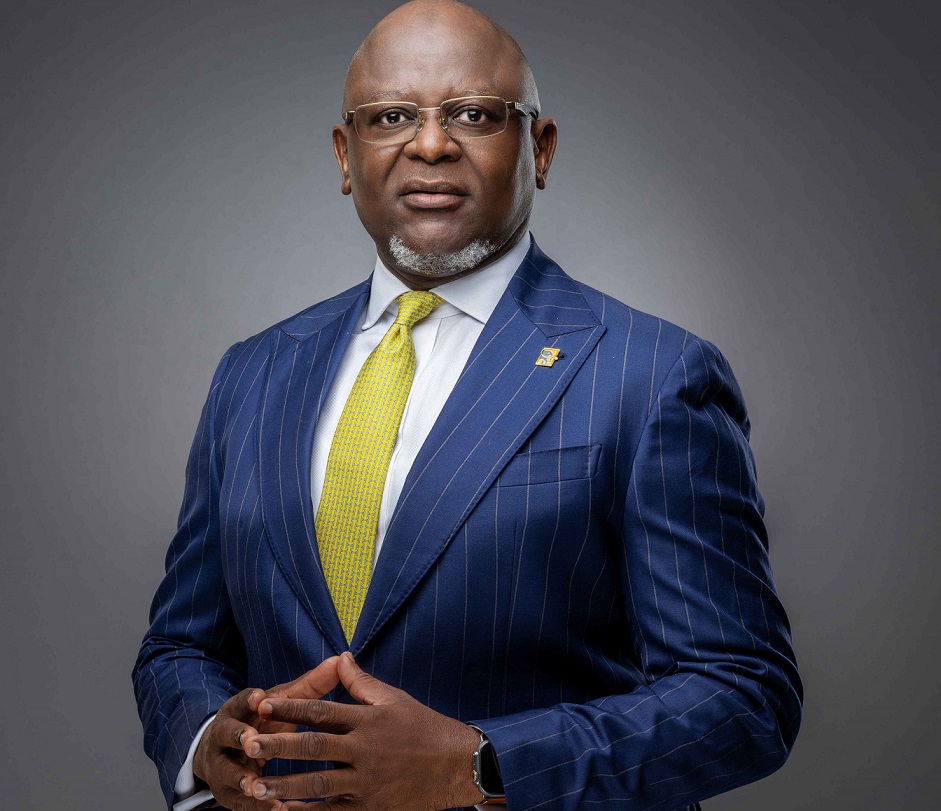



By Adedapo Adesanya
The Central Bank of Nigeria (CBN) is considering the recapitalisation and restructuring of Development Finance Institutions (DFIs) to address the significant financing gap facing micro, small, and medium-sized enterprises (MSMEs).
The Deputy Governor of the apex bank in charge of Economic Policy, Mr Muhammad Abdullahi, disclosed this during a panel session at the launch of the Nigeria Development Update by the World Bank in Abuja on Tuesday.
He explained that a recent review by the apex bank found that existing DFIs were too small to meet the credit needs of businesses.
DFIs are specialised, government-backed financial entities designed to promote economic growth by funding critical sectors like agriculture, infrastructure, and SMEs. Key institutions include the Bank of Industry (BOI), Development Bank of Nigeria (DBN), Nigeria Export Import Bank (NEXIM Bank), Bank of Agriculture (BOA), National Credit Guarantee Company Limited, and Nigerian Consumer Credit Corporation, among others.
“We conducted a review last year of the development finance space. Across all the DFIs in Nigeria, the total asset base is slightly above N8 trillion, whereas what is required in development finance for MSMEs is over N130 trillion,” he said.
He said that simply injecting capital would not solve the problem.
“The only way to address this is not only through public sector capital injections into these institutions, but also by making them bankable and investable,” he said.
Abdullahi said the CBN and the Ministry of Finance are reviewing DFI structures to improve their efficiency and risk appetite.
“We are reviewing the entire sector to ensure that we can correct the incentives, improve risk appetite, and also strengthen capital levels,” the deputy governor added.
He also said the reforms aim to introduce stronger market-based principles.
“We are looking at the structure to see how more market fundamentals can be incorporated, because the way it has been done in the past has not delivered the desired results,” Mr Abdullahi said.
On the persistent financing challenge for MSMEs, he said lending to the real sector has always been one of the structural challenges “Nigeria’s economy faces in terms of ensuring that credit reaches businesses that require it”.
Business Post reports that the CBN recently concluded the recapitalisation of the Nigerian banking sector, while the insurance sector is ongoing.

By Modupe Gbadeyanka
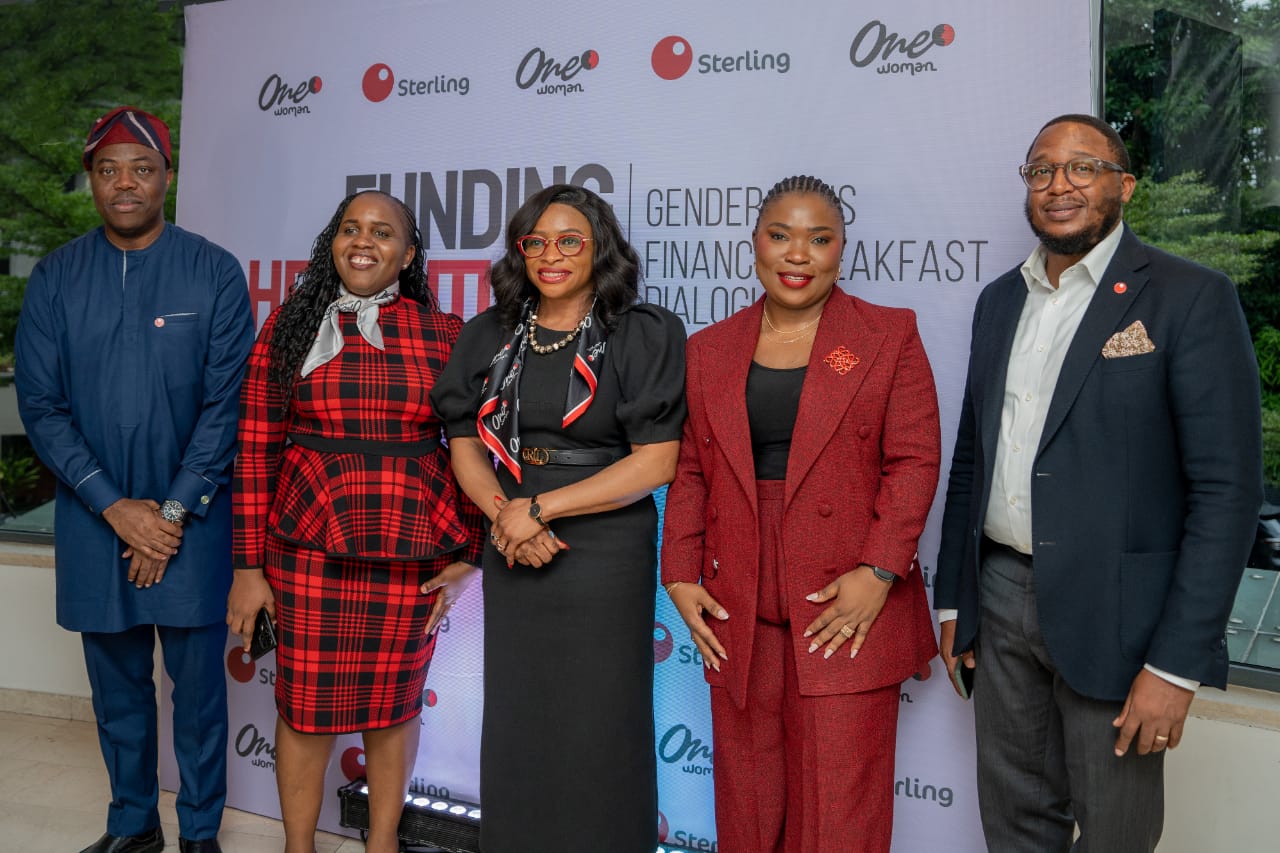
The women-focused initiative by Sterling Bank, OneWoman, is already yielding positive results, especially in promoting financial inclusion and empowering female-led enterprises in Nigeria.
Business Post reports that the programme was created to support women through three key pillars of capital, capacity, and community.
In 2025, according to the Head of the OneWoman Initiative, Ms Ezinne Nwokafor, the initiative gave out N43.9 billion loans to 2,450 female entrepreneurs, trained 6,000 of them, served about 380,000 women across three sectors of career women, women in business and freshers, and their vision 2030 is to give out N500 billion loans to one million women across their three sectors.
She noted that a significant majority of Nigerian women remain excluded from formal credit, with only a small percentage able to access structured financing. Despite improvements in financial inclusion, women continue to face systemic barriers that limit their ability to secure funding.
Ms Nwokafor pointed out that women account for a substantial share of micro, small, and medium enterprises and contribute meaningfully to the economy, yet face a financing gap estimated at $42 billion annually, according to the International Finance Corporation.
She also referenced data showing that more than half of women-led businesses identify access to finance as a major constraint, while rejection rates for loan applications remain significantly higher for women than for men.
According to her, these challenges are often linked to structural issues such as gaps in asset ownership, social norms, and limited access to financial data and visibility.
“Sterling’s OneWoman initiative is positioned to bridge this gap by combining financial solutions, mentorship, capacity building, and community support for women across different stages of their journey,” she said at the Funding Her Future Breakfast Dialogue in Lagos.
The session brought together voices from across sectors for a focused and necessary conversation on how to unlock more inclusive and effective financing pathways for women-led businesses in Nigeria.
On his part, the chief executive of Sterling Bank, Mr Abubakar Suleiman, said, “Women-led businesses need the right support systems, the right networks, and the right ecosystem to grow with confidence and scale with resilience.”
By Modupe Gbadeyanka
Alpha Morgan Bank has reaffirmed its commitment to supporting institutions that drive intellectual growth and national development.
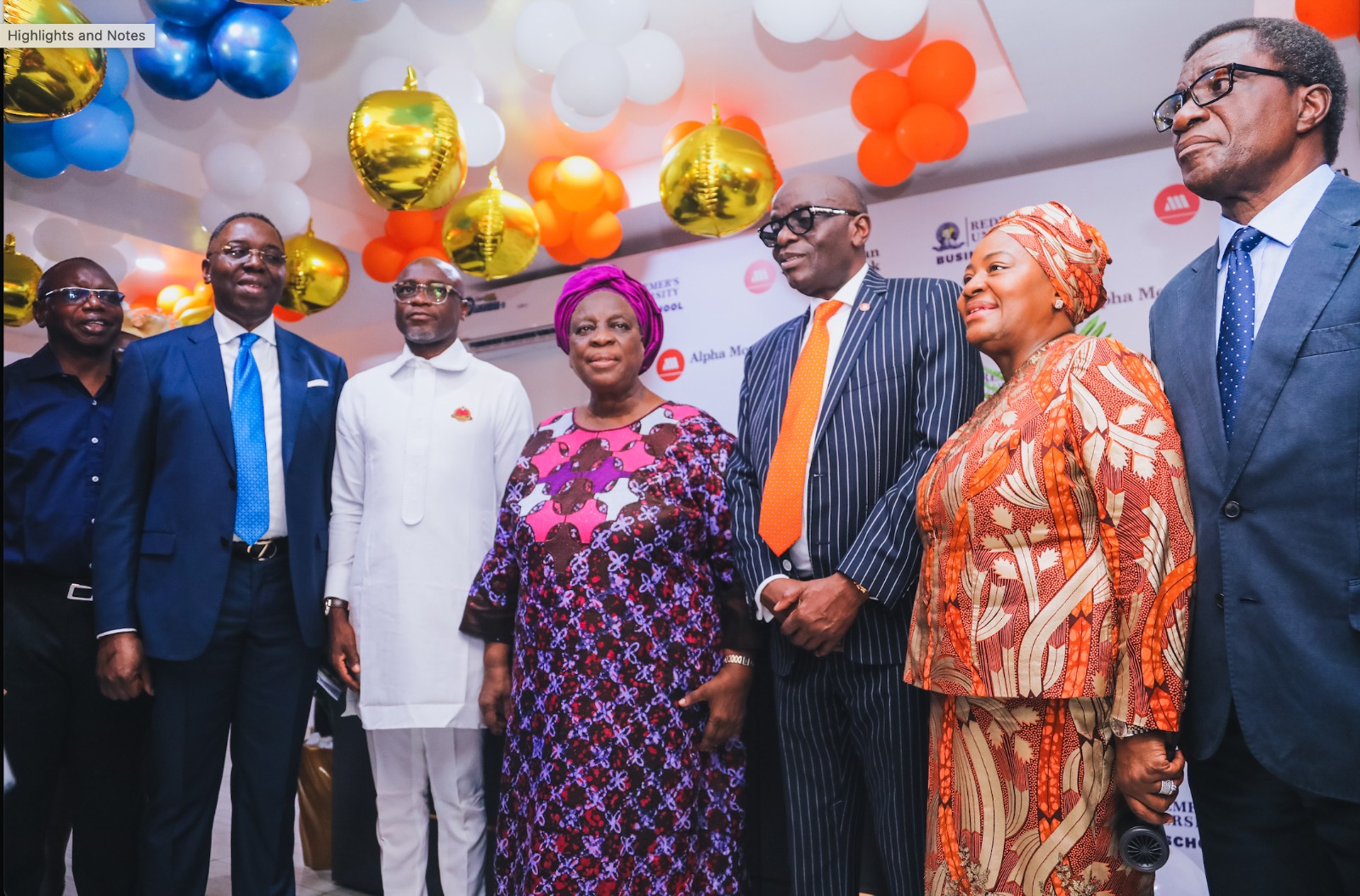
The lender gave this reassurance at the commissioning of the Redeemer’s University Business School by Pastor (Mrs) Folu Adeboye, the wife of the General Overseer of the Redeemed Christian Church of God (RCCG), Pastor Enoch Adeboye.
Speaking at the event, the Managing Director of Alpha Morgan Bank, Mr Ade Buraimo, said the company was proud to be associated with the school, noting its commitment to education and institutional development.
As part of its broader focus on knowledge sharing and thought leadership, Alpha Morgan Bank will host its Economic Review Webinar in May 2026, bringing together experts to share insights on key economic trends and opportunities.
The commissioning of the business school was witnessed by distinguished guests, including the Pro-Chancellor and Chairman of the Governing Council of Redeemers University, Professor Oluwatoyin Ogundipe; the Vice Chancellor, Professor Shadrach Olufemi Akindele; Mrs Bola Obasanjo; and other notable dignitaries.
-
 Feature/OPED6 years ago
Davos was Different this year
-
Travel/Tourism10 years ago
Lagos Seals Western Lodge Hotel In Ikorodu
-

 Showbiz3 years ago
Estranged Lover Releases Videos of Empress Njamah Bathing
-
 Banking8 years ago
Sort Codes of GTBank Branches in Nigeria
-

 Economy3 years ago
Subsidy Removal: CNG at N130 Per Litre Cheaper Than Petrol—IPMAN
-

 Banking3 years ago
Sort Codes of UBA Branches in Nigeria
-

 Banking3 years ago
First Bank Announces Planned Downtime
-

 Sports3 years ago
Highest Paid Nigerian Footballer – How Much Do Nigerian Footballers Earn