Banking
Titan Trust Bank: 2 Years of Service with Power and Pride
By Opeyemi Dabiri
On October 4, 2021, one of the fastest-growing financial service providers in Nigeria, Titan Trust Bank Limited, celebrated two years of its existence.
Established with a mission to take advantage of the identified gaps in the banking sector and address the unmet needs of the retail mass market, SMEs and corporates, Titan Trust Bank, has continued to provide seamless banking experience, accurate and relevant information to its customers.
The management team led by seasoned bankers, Mudassir Amray, the group managing director/CEO, and Adaeze Udensi, PhD, executive director, in the last two years, has been able to position the bank on an upward trajectory with many unprecedented innovations.
With management focused on innovation and a unique philosophy to create, preserve and satisfy its customers, Titan Trust Bank found itself in a fiercely competitive banking environment but it remained guided by passion, resilience, innovation and brand architecture that exuded quality service, performance and sheer excellence.
The lender has found its feet quickly on the floor of the Nigerian banking sector and recorded one of the highest increases in the number of customers. It remains committed to its customers and continues to search for new heights to attain in the Nigerian banking sector and that is why the bank is considered the fastest growing bank in Nigeria.
The Titan Trust Bank story is increasingly becoming a case study in corporate governance, leadership, vision and excellence.
Amid the bank’s audacity to dare and succeed, industry watchers have continued to marvel at the amazing rise of the lender since its inception and ask: how are they doing it? The answers may not be far from the fact that at the inception of the bank’s operations in October 2019, the management team drew up a holistic and integrated approach to business modernization, which has formed the foundation for the bank’s superior customer-centric experience.
The bank has continued to deliver exceptional banking services by making financial services easy and accessible to its teeming customers.
In its determination to take financial services to every household in order to drive effective inclusion and participation in the recovery and growth of Nigeria’s economy, Titan Trust Bank has invested substantially in technology and developed fully integrated service models that enable its customers to enjoy banking services through a wide range of channels.. The bank believes in innovation, creativity and the use of technology to enhance the lives of its customers while it also strives to ensure that its products and services are meeting the changing needs of its customers.
Recently, the lender launched and deployed the latest version of Oracle’s FCCM module, powering our AML/CFT infrastructure, used in over 120+ sites by top global banks. It has also invested in top-notch infrastructure for AML/KYC, as well as the Oracle Financial Services Analytical Application (OFSAA) to ensure rigorous analysis and measurement of its risk-performance objectives.
The bank’s digital platforms which include: the Titan Mobile Application, Titan Internet Banking platform and the Titan *922# Unstructured Supplementary Service Data (USSD) solution, are seamless, fast, reliable and easy to use. Aside from the regular features, its state-of-the-art mobile banking application – the TITAN mobile app has been upgraded with new features such as the generation of referral codes whilst opening accounts, transaction status information, receipt generation for previous transactions, as well as being able to carry out traditional mobile banking services.
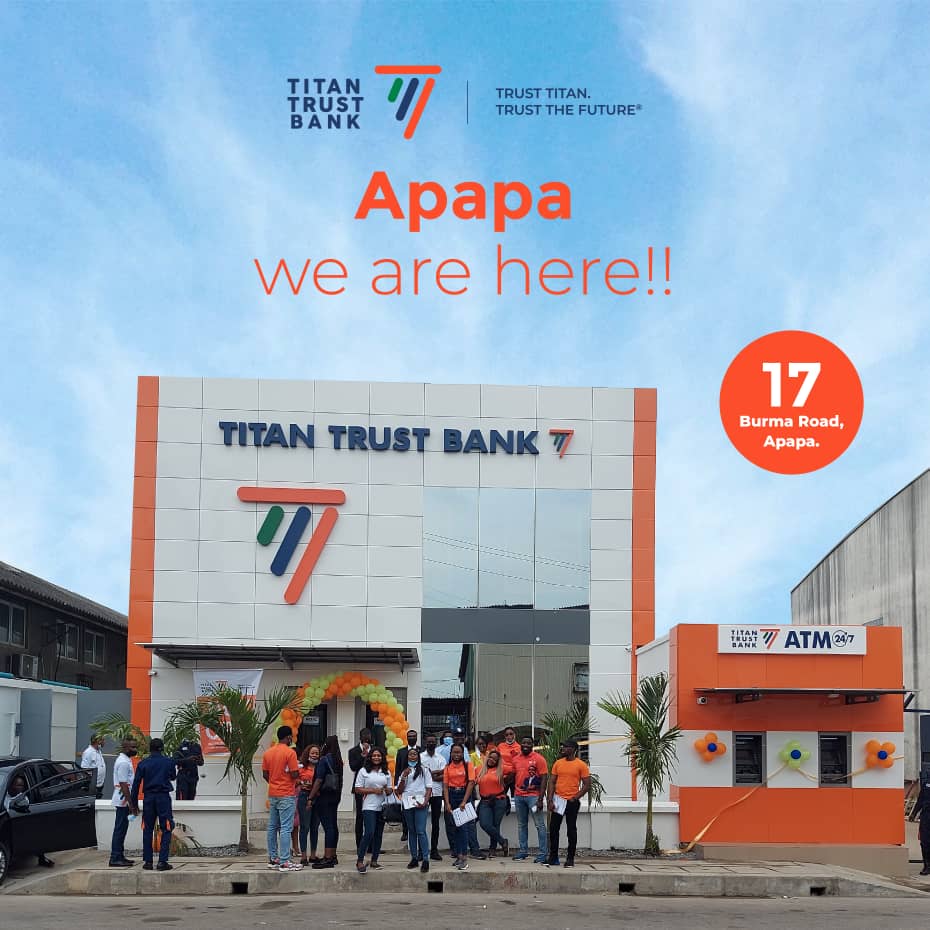
In furtherance of its efforts to offer customers an endearing experience by extending its reach and offer seamless banking services across the country, the bank has also opened two more branches in strategic locations in Lagos with a skilled and professional relationship team dedicated to satisfying the banking needs of the people.
The two state-of-the-art branches located at 53, Allen Avenue, Ikeja, Lagos and 17, Burma Road, Apapa, Lagos, according to the bank, are in line with its quest to provide financial service to micro, small and medium scale enterprises within Lagos State. The new branches provide a full suite of banking products and services for retail and corporate banking clients.
In his comment at the launch of one of the new branches, Mr Amray, the bank’s CEO, noted that the launch represents a translation into the concrete reality of “our determination to live by our mission and keeping to our service promise to provide simple, reliable, and quick banking solutions to all our customers.”
The federal government through the Central Bank of Nigeria (CBN) also announced the appointment of the lender as one of the designated banks for the collection of the Nigeria export Supervision Scheme (NESS) levy, a feat industry watchers applauded as a strategic move. NESS levy is a statutory payment to the federal government, which is charged at 0.50 per cent of the export value. The apex bank collects the fees through designated banks on behalf of FG.
As part of its initiative to continuously support entrepreneurs in the country by providing financial and advisory services for the growth of their businesses, Titan Trust Bank in collaboration with the International Finance Corporation (IFC), launched an online platform to empower business owners with the knowledge to manage and grow their businesses amid the COVID-19 pandemic.
At the first edition of the programme held on the 18th of February 2020, participants gave positive testimonials on how relevant and rewarding they found the training.
During the training, participants numbering over 200 were taken through series of webinars by business and digital experts on how to use social media and online tools to transform businesses from the traditional space to an online digital marketplace, how to set up an online business, identifying the best ways to make product offerings available online and finding target market.
On its staff welfare, the bank has placed a premium on improving workplace culture towards making its employees happy and productive. In the past two years, the bank has launched several internal initiatives to enhance staff welfare to keep staff engaged together with an open-door approach to have every voice heard.
The bank understands that employees are the engine room required in making any organization work and if they are not treated right it is to the disadvantage of all. It believes that when its employees are treated right, they will always be in their best shape to keep delivering a superior customer experience.
Undoubtedly, the bank’s achievements in the last two years have not gone unnoticed even on the international stage.
The lender recently bagged two awards as the ‘Best New Commercial Banking Brand’ and ‘Fastest Growing Digital Banking Brand in Nigeria for the Year 2021’ at the 2021 annual United Kingdom-based Global Brands Magazine Awards. The bank clinched the coveted influential awards in less than two years of its commercial operations.
The bank also emerged ‘Best Trade Finance Provider in Nigeria for the year 2020’ by Global Finance Magazine World’s Best Trade Finance Providers Awards. The lender clinched the coveted influential international award previously won by only the first-tier banks in Nigeria in just 15 months of its commercial operations.
Going by the speed with which the bank is moving towards the top, one expects that in the next year it will become one of the most talked-about financial institutions in terms of delivery and impact on its customers.
Opeyemi Dabiri, a financial analyst, writes from Lagos, Nigeria.
Banking
Union Bank Seeks Stronger Collaboration to Confront Climate Change
By Modupe Gbadeyanka
The need for stronger collaboration to address climate change, advance conservation and equip young people to lead a more sustainable future has been emphasised by Union Bank.
At a symposium organised to commemorate 2026 World Environment Day in partnership with the Nigerian Conservation Foundation (NCF) at the Lekki Conservation Centre in Lagos, the financial institution urged businesses to match their commitments with action and pointed to the decisive role of finance in shaping a greener economy.
“As a bank that has been part of Nigeria’s story for over a century, Union Bank recognises that sustainable development and environmental responsibility must go hand in hand,” the company’s Chief Brand and Marketing Officer, Mrs Olufunmilola Aluko, stated.
“We believe businesses have a role to play not only in what they say, but also in what they do. Banks play an important role because they help determine where capital flows. The choices financial institutions make about what to fund and what to encourage help shape the kind of economy we build. This is a responsibility we take seriously at Union Bank, and it is one of the reasons gatherings like these matter to us,” she added.
In his keynote address, the Director General of NCF, Mr Joseph Daniel Onoja, framed conservation as a matter of human survival, noting that “nature has placed all the models that we need to be able to live well in it.”
“When we talk about nature conservation or environmental conservation, we’re saying human conservation because nature, Mother Earth, will always take care of herself.
“If we don’t take care of it, it will take care of itself by getting rid of us. Now, it is in our best interest to take care of the earth and learn from her, because she has provided everything we need to do so,” he further submitted.
A panel session featuring secondary school students from within and beyond Lagos brought an intergenerational dimension to the day. The students urged businesses and individuals to prioritise climate-conscious investments and cleaner energy sources, and exhibited innovations that turned waste into interior décor and clean energy.
Their work offered a vivid illustration of Sustainable Development Goal 12 on responsible consumption and production, and of the creativity a younger generation brings to the climate conversation.
This year’s World Environment Day theme, Inspired by Nature. For Climate. For Our Future, and the event, reflected a growing global consensus, captured in Sustainable Development Goal 13 on climate action and Sustainable Development Goal 17 on partnerships, that no single institution can meet the climate challenge alone.
Banking
BOA Unveils Roadmap to Boost Agricultural Financing, Food Security
By Adedapo Adesanya
The Bank of Agriculture (BOA) has unveiled a strategic roadmap aimed at modernising its operations, expanding grassroots financial inclusion and accelerating agricultural transformation in line with the Federal Government’s food security agenda.
The chief executive of the bank, Mr Ayodeji Sotinrin, disclosed this in a statement issued on Friday that the institution is implementing operational upgrades and forging strategic partnerships to improve the delivery of agricultural intervention programmes and empower smallholder farmers across the country.
According to the statement, the BOA is strengthening its agricultural delivery architecture by expanding collaborations with state-level delivery platforms, licensed input suppliers and international development partners.
A key component of the strategy is a recently signed Memorandum of Understanding with the United Nations Development Programme (UNDP), aligning the bank’s revitalisation agenda with the UN agency’s Integrated Smart States Programme.
The bank said the partnership would help transform Nigeria’s agricultural sector into an investment-ready system capable of attracting blended and climate finance while supporting the One Million Hectare Tree Crop Initiative, described as a presidential priority expected to boost commercial agriculture, job creation and export diversification.
“Our vision for the Bank of Agriculture is to deploy capital in an intelligent, smart, and highly efficient way to reposition the institution as a catalyst for food security and rural prosperity. We are bringing everyone into the financial net, especially the youthful population of farmers in our hinterlands, to create a new, resilient food system for Nigeria,” Mr Sotinrin said.
The bank also disclosed that it had overhauled its verification framework to eliminate fraudulent beneficiaries and ensure interventions reached genuine farmers.
According to the statement, the new credit profiling process incorporates Bank Verification Number checks, Know Your Customer protocols and GPS farm mapping to strengthen transparency and accountability in loan disbursement.
Commenting on the initiative, the National President of the All Farmers Association of Nigeria, Muhammad Magaji, endorsed the verification measures while urging quicker loan disbursement.
“The All Farmers Association of Nigeria recognises the critical role the Bank of Agriculture plays in shielding our farmers from exorbitant commercial interest rates. While we continuously advocate for faster disbursement cycles to match planting seasons, we stand with the BOA on the need for strict verification.
“It is the only way to ensure that these interventions reach the genuine smallholder farmers who actually till the soil, rather than ‘political farmers.’ We remain committed to working closely with the BOA management to fine-tune this delivery framework,” he added.
The BOA further said it is modernising its nationwide operations by deploying digital farmer systems, agency banking models and solar-powered infrastructure across its 110 branches to improve service delivery in rural communities.
It added that recent ICT infrastructure support from the UNDP would strengthen its digital transformation efforts and enable the bank to provide financial and extension services directly to farmers.
The bank said it would continue engaging commodity associations, verified grassroots cooperatives and other agricultural stakeholders through town hall meetings and working groups to identify genuine beneficiaries and support the implementation of the National Agri-food System Investment Plan.
Banking
PalmPay Calls for Trust, Responsible AI to Drive Payment Ecosystem Innovation
By Adedapo Adesanya
Stakeholders, including industry leaders, regulators, and payment experts, have called for stronger infrastructure, responsible artificial intelligence (AI) adoption, and deeper cross-sector collaboration to unlock the next phase of growth in Nigeria’s digital payments ecosystem.
They made the call during the 2026 Digital Pay Expo held in Lagos on June 17 and 18, 2026. This year’s event focused heavily on the transformative role of AI, cybersecurity, cross-border transactions, and deepening financial inclusion across Africa.
Speaking at the event, Dr Rekiya Yusuf, Director of the Payment System Supervision Department at the Central Bank of Nigeria (CBN), represented by Mr Chika Ugwueze, Deputy Director, stated that Nigeria’s payment ecosystem is rapidly evolving beyond digital adoption into deeper digital transformation.
According to Dr Yusuf, artificial intelligence is emerging as a critical driver of this shift, particularly in real-time fraud detection and expanding access to underserved populations.
“The goal is to make financial transactions seamless. AI is now driving innovation, helping in real-time fraud detection and helping to expand access,” she said.
She noted, however, that important gaps remain, particularly around infrastructure and inclusion. Building a resilient digital market system in the AI era requires reliable connectivity, robust infrastructure, intentional talent development, and sustained capacity building.
Echoing the regulator’s call for robust ecosystem support, Mr Chika Nwosu, Managing Director of PalmPay Nigeria, said trust, access, and practical financial support remain critical to helping small businesses participate more meaningfully in the formal economy.
He noted that while micro, small, and medium enterprises (SMEs) contribute an impressive 40 per cent to Nigeria’s Gross Domestic Product (GDP), limited access to credit and reliable payment infrastructure continues to slow their ability to grow and scale.
To drive true innovation, Nwosu argued that financial inclusion must move beyond simply opening accounts and enabling basic transactions; it requires building a foundation of trust and tangible economic empowerment.
“SMEs contribute 40 per cent of the country’s GDP. For us at PalmPay, we don’t just provide payment solutions to them, we also support them with financial tools they need to expand and create jobs,” he said.
Mr Nwosu further emphasised the importance of digital literacy, noting that a stronger understanding of digital tools and AI-enabled systems will be essential to building long-term trust and participation across the ecosystem.
The discussions at Digital Pay Expo 2026 reflected a growing consensus across the industry: the future of African digital payments will depend on getting the fundamentals right. That means stronger infrastructure, responsible use of AI, better cybersecurity, and closer collaboration between regulators, fintechs, and other ecosystem players.
For PalmPay, the event reinforced the importance of building a payments ecosystem that is more resilient, more secure, and better equipped to support inclusion and growth at scale.
Founded in 2019, PalmPay has expanded its operations across emerging markets, providing digital financial services ranging from payments and savings to credit and merchant solutions, while supporting financial inclusion through smartphone financing and access to digital banking services.
-
Feature/OPED6 years agoDavos was Different this year
-
Travel/Tourism10 years ago
Lagos Seals Western Lodge Hotel In Ikorodu
-
Showbiz3 years agoEstranged Lover Releases Videos of Empress Njamah Bathing
-
Banking8 years agoSort Codes of GTBank Branches in Nigeria
-
Economy3 years agoSubsidy Removal: CNG at N130 Per Litre Cheaper Than Petrol—IPMAN
-
Banking3 years agoSort Codes of UBA Branches in Nigeria
-
Banking3 years agoFirst Bank Announces Planned Downtime
-
Sports3 years agoHighest Paid Nigerian Footballer – How Much Do Nigerian Footballers Earn