Banking
UBA, NiDCOM to Unlock Diaspora Capital for Nigeria’s Growth
By Modupe Gbadeyanka
A partnership aimed to unlock diaspora capital for Nigeria’s growth has been deepened by the United Bank for Africa (UBA) Plc and the Nigerians in Diaspora Commission (NiDCOM).
The chief executive of UBA, Mr Oliver Alawuba, underscored the diaspora’s critical role as a powerful economic force and a generation of builders shaping new narratives for the continent.
He also reiterated the financial institution’s readiness to leverage its global network and innovative financial solutions to support diaspora engagement, urging Nigerians abroad to tap into opportunities within Africa’s economic landscape.
“You are not limited here; you have opportunities on the continent, and we want you to make good use of them. That is where banking, and we at UBA, become the connecting point that you need to access the opportunities back home.
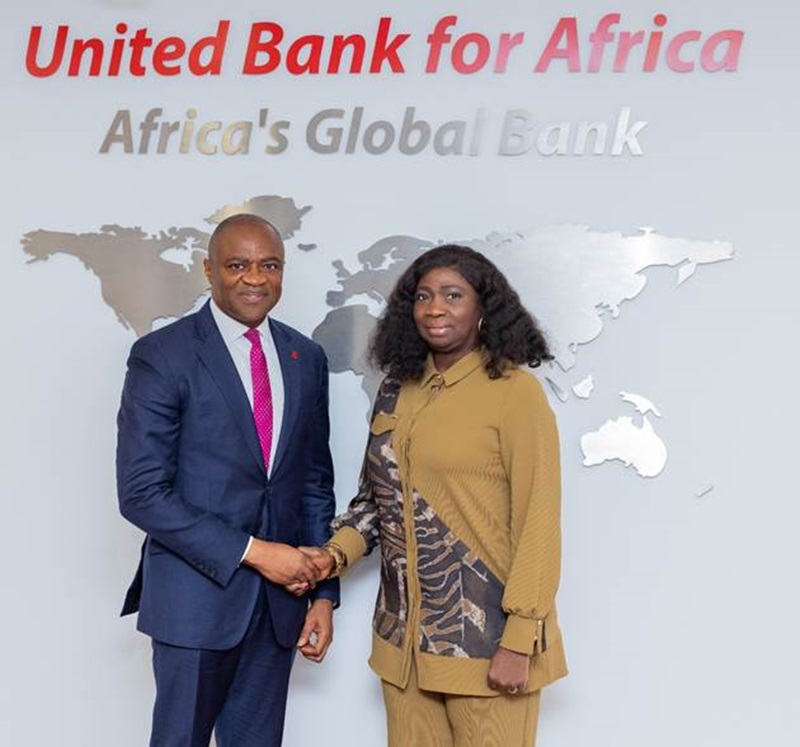
“Whether you like it or not, the returns are high in Africa, and we are here to help you navigate that space,” the UBA chief said on Monday when he hosted key representatives of NiDCOM led by its chairman, Mrs Abike Dabiri, at the bank’s office in the United Kingdom.
UBA recently launched a Diaspora Banking platform to provide a seamless, integrated platform for Africans in the diaspora to bank, invest, and manage their financial obligations back home, thus connecting global Africans with investment and wealth opportunities.
The lender introduced the platform, with leading ecosystem partners representing a major step in redefining diaspora banking beyond remittances toward structured wealth creation and long-term investment.
“With UBA, you have a financial partner that is with you, that understands what you are going through, and that can support you to make sure you realise your aspirations, both here and in the country,” Mr Alawuba noted.
In her remarks, Mrs Dabiri-Erewa praised UBA for being a trusted financial partner over the years, especially with the recent launch of its diaspora platform.
“Many of you here are the real game-changers. “For years, it has been wonderful engaging Nigerians all over the world. When I started, it felt like we only heard the bad stories, not the good ones. What we have tried to do internationally is to tell and celebrate the good stories. We have Nigerians doing well all over the world, and they are in this room. We must continue to celebrate you,” she stated.
While remarking that the meeting demonstrates a significant step in aligning public and private sector efforts to deepen diaspora inclusion and accelerate Nigeria’s development agenda, she pledged closer collaboration in driving policies and initiatives that encourage Nigerians abroad to actively participate in the country’s economic growth.
Banking
Merger: ProvidusUnity Bank Targets Financial Inclusion, Economic Growth
By Adedapo Adesanya
Nigeria’s newly merged lender, ProvidusUnity Bank, says it hopes to accelerate financial inclusion, strengthen lending capacity, and support Nigeria’s economic growth.
The new bank, made up of Providus Bank and Unity Bank, is set to commence operations as a single unified institution following the successful completion of their business combination and the conclusion of all required regulatory, shareholder, and judicial processes.
A statement from the bank on Sunday stated that the newly formed entity represents a consolidated banking institution positioned to strengthen capitalisation, expand national coverage, deepen financial inclusion, and support Nigeria’s long-term economic ambitions.
The merger brings together Providus Bank’s innovation-driven, customer-centric service model and digital capabilities with Unity Bank’s extensive geographic reach and established market presence, creating a broader platform for retail, SME, and corporate banking services across the country.
The development aligns with ongoing reforms in Nigeria’s financial sector aimed at strengthening institutional resilience, safeguarding depositor confidence, improving competitiveness, and building banks capable of supporting economic transformation.
The bank expressed appreciation to the Central Bank of Nigeria (CBN) for its role in facilitating the transaction and for its commitment to strengthening the banking system. It also acknowledged the support of shareholders, customers, employees, and other stakeholders.
ProvidusUnity Bank said the merger is expected to enhance Nigeria’s financial sector capacity to mobilise investment, support enterprise development, expand access to credit, and contribute to the country’s aspiration of building a trillion-dollar economy.
Earlier this month, the Supreme Court ordered the transfer of all assets, liabilities and undertakings, including real properties, of Unity Bank to Providus Bank in accordance with the approved Scheme of Merger. The merger between the two lenders was challenged by customers and shareholders of the affected banks, Mr Suleiman Abubakar and Mr Mohammed Goni Modu.
The apex court held that the appeal lacked merit and accordingly dismissed it in its entirety, while imposing costs of N10 million in favour of each respondent. As part of the merger arrangements, the apex court approved a consideration of N3.18 per share or 18 Providus Bank shares of 50 kobo each for every 17 Unity Bank shares held by shareholders.
For customers, the new bank said the integration will deliver expanded access, improved service delivery, stronger technology infrastructure, broader banking channels, and a wider national footprint designed to improve consistency and efficiency of services.
It added that customers should expect continuity in service in the immediate term, with gradual access to enhanced products and broader capabilities over time.
For employees, the bank said the transaction represents continuity, opportunity and stability, adding that it remains committed to retaining talent, preserving institutional knowledge and supporting career growth within the new organisation.
Banking
Union Bank Seeks Stronger Collaboration to Confront Climate Change
By Modupe Gbadeyanka
The need for stronger collaboration to address climate change, advance conservation and equip young people to lead a more sustainable future has been emphasised by Union Bank.
At a symposium organised to commemorate 2026 World Environment Day in partnership with the Nigerian Conservation Foundation (NCF) at the Lekki Conservation Centre in Lagos, the financial institution urged businesses to match their commitments with action and pointed to the decisive role of finance in shaping a greener economy.
“As a bank that has been part of Nigeria’s story for over a century, Union Bank recognises that sustainable development and environmental responsibility must go hand in hand,” the company’s Chief Brand and Marketing Officer, Mrs Olufunmilola Aluko, stated.
“We believe businesses have a role to play not only in what they say, but also in what they do. Banks play an important role because they help determine where capital flows. The choices financial institutions make about what to fund and what to encourage help shape the kind of economy we build. This is a responsibility we take seriously at Union Bank, and it is one of the reasons gatherings like these matter to us,” she added.
In his keynote address, the Director General of NCF, Mr Joseph Daniel Onoja, framed conservation as a matter of human survival, noting that “nature has placed all the models that we need to be able to live well in it.”
“When we talk about nature conservation or environmental conservation, we’re saying human conservation because nature, Mother Earth, will always take care of herself.
“If we don’t take care of it, it will take care of itself by getting rid of us. Now, it is in our best interest to take care of the earth and learn from her, because she has provided everything we need to do so,” he further submitted.
A panel session featuring secondary school students from within and beyond Lagos brought an intergenerational dimension to the day. The students urged businesses and individuals to prioritise climate-conscious investments and cleaner energy sources, and exhibited innovations that turned waste into interior décor and clean energy.
Their work offered a vivid illustration of Sustainable Development Goal 12 on responsible consumption and production, and of the creativity a younger generation brings to the climate conversation.
This year’s World Environment Day theme, Inspired by Nature. For Climate. For Our Future, and the event, reflected a growing global consensus, captured in Sustainable Development Goal 13 on climate action and Sustainable Development Goal 17 on partnerships, that no single institution can meet the climate challenge alone.
Banking
BOA Unveils Roadmap to Boost Agricultural Financing, Food Security
By Adedapo Adesanya
The Bank of Agriculture (BOA) has unveiled a strategic roadmap aimed at modernising its operations, expanding grassroots financial inclusion and accelerating agricultural transformation in line with the Federal Government’s food security agenda.
The chief executive of the bank, Mr Ayodeji Sotinrin, disclosed this in a statement issued on Friday that the institution is implementing operational upgrades and forging strategic partnerships to improve the delivery of agricultural intervention programmes and empower smallholder farmers across the country.
According to the statement, the BOA is strengthening its agricultural delivery architecture by expanding collaborations with state-level delivery platforms, licensed input suppliers and international development partners.
A key component of the strategy is a recently signed Memorandum of Understanding with the United Nations Development Programme (UNDP), aligning the bank’s revitalisation agenda with the UN agency’s Integrated Smart States Programme.
The bank said the partnership would help transform Nigeria’s agricultural sector into an investment-ready system capable of attracting blended and climate finance while supporting the One Million Hectare Tree Crop Initiative, described as a presidential priority expected to boost commercial agriculture, job creation and export diversification.
“Our vision for the Bank of Agriculture is to deploy capital in an intelligent, smart, and highly efficient way to reposition the institution as a catalyst for food security and rural prosperity. We are bringing everyone into the financial net, especially the youthful population of farmers in our hinterlands, to create a new, resilient food system for Nigeria,” Mr Sotinrin said.
The bank also disclosed that it had overhauled its verification framework to eliminate fraudulent beneficiaries and ensure interventions reached genuine farmers.
According to the statement, the new credit profiling process incorporates Bank Verification Number checks, Know Your Customer protocols and GPS farm mapping to strengthen transparency and accountability in loan disbursement.
Commenting on the initiative, the National President of the All Farmers Association of Nigeria, Muhammad Magaji, endorsed the verification measures while urging quicker loan disbursement.
“The All Farmers Association of Nigeria recognises the critical role the Bank of Agriculture plays in shielding our farmers from exorbitant commercial interest rates. While we continuously advocate for faster disbursement cycles to match planting seasons, we stand with the BOA on the need for strict verification.
“It is the only way to ensure that these interventions reach the genuine smallholder farmers who actually till the soil, rather than ‘political farmers.’ We remain committed to working closely with the BOA management to fine-tune this delivery framework,” he added.
The BOA further said it is modernising its nationwide operations by deploying digital farmer systems, agency banking models and solar-powered infrastructure across its 110 branches to improve service delivery in rural communities.
It added that recent ICT infrastructure support from the UNDP would strengthen its digital transformation efforts and enable the bank to provide financial and extension services directly to farmers.
The bank said it would continue engaging commodity associations, verified grassroots cooperatives and other agricultural stakeholders through town hall meetings and working groups to identify genuine beneficiaries and support the implementation of the National Agri-food System Investment Plan.
-
Feature/OPED6 years agoDavos was Different this year
-
Travel/Tourism10 years ago
Lagos Seals Western Lodge Hotel In Ikorodu
-
Showbiz3 years agoEstranged Lover Releases Videos of Empress Njamah Bathing
-
Banking8 years agoSort Codes of GTBank Branches in Nigeria
-
Economy3 years agoSubsidy Removal: CNG at N130 Per Litre Cheaper Than Petrol—IPMAN
-
Banking3 years agoSort Codes of UBA Branches in Nigeria
-
Banking3 years agoFirst Bank Announces Planned Downtime
-
Sports3 years agoHighest Paid Nigerian Footballer – How Much Do Nigerian Footballers Earn