Connect with us

Banking

What Jim Ovia Said About Rumoured Zenith Bank, Union Bank Merger

Published

on

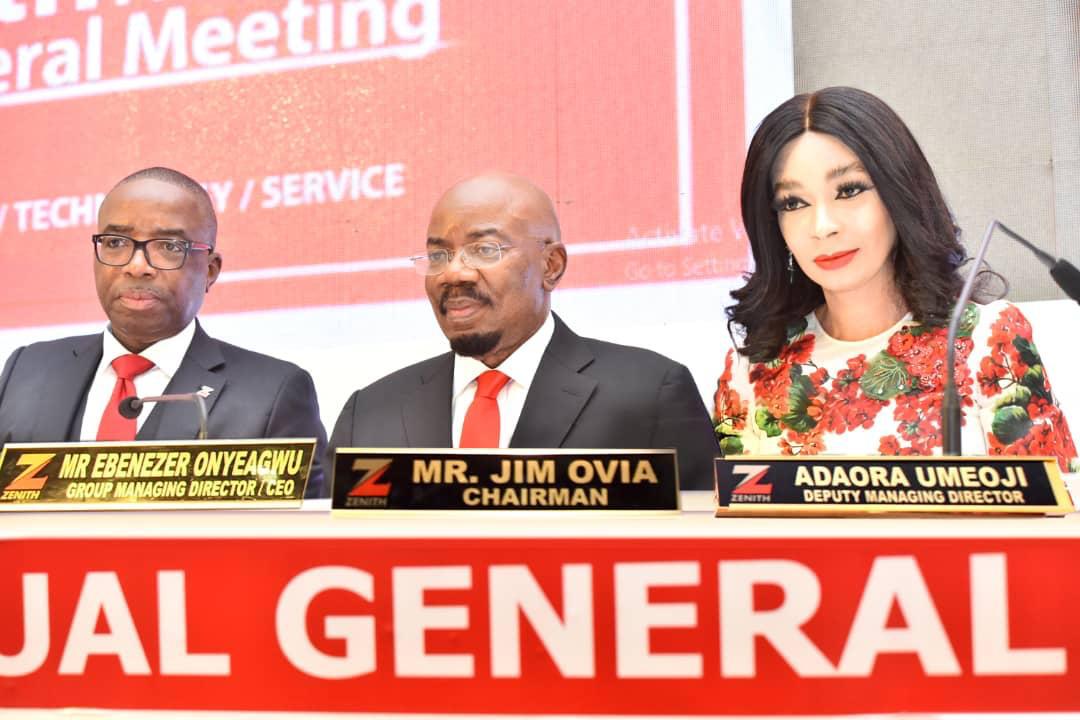
Jim Ovia Zenith Bank AGM

By Dipo Olowookere

On Monday, March 16, 2020, Zenith Bank Plc held its 29th Annual General Meeting (AGM) in Abuja, and it was an opportunity for shareholders of the bank to engage the top hierarchy of the company on some issues, including the financial statements and others.

Before the meeting, there were unconfirmed reports that Zenith Bank was planning to acquire Union Bank of Nigeria Plc and the shareholders used the occasion, the AGM, to ask Chairman of the bank, Mr Jim Ovia, if this was true.

However, this question was dodged by Mr Ovia as he said nothing about it, but went ahead to answer other questions asked by shareholders present at the meeting.

“Zenith Bank is committed to consistently deliver superior returns to our highly esteemed shareholders by ensuring that a good chunk of our profit is set aside for you.

“In a clear demonstration of this, we had declared and paid you an interim dividend of 30kobo per share in the course of the 2019 financial year.

“We hereby propose a final dividend of N2.50kobo per share. If approved, this will bring the total dividend for the year ended December 31, 2019, to N2.80kobo per share,” Mr Ovia said at the gathering.

During the AGM, shareholders of Zenith Bank unanimously approved the proposed final dividend of N2.50 per share, bringing the total dividend payment for the 2019 financial year to N2.80 per share with a total value of N87.9 billion.

Zenith Bank reaffirmed its leading position in the Nigerian banking industry posting an impressive pre-tax profit of N243 billion, representing a 5 percent increase over the N231.6 billion recorded in the corresponding period of 2018. Its post-tax profit stood at N208.8 billion over N193 billion, an increase of 8 percent, thus making Zenith Bank the first Nigerian bank to cross the N200 billion mark.

The bank’s result showed an increase in gross earnings from N662 billion to N630 billion, indicating dominance in market share, while its assets grew by 5 percent from the N5.9 trillion to N6.3 trillion, a growth driven by the 29 percent increase in non-interest income from N179.9 billion in 2018 to N231.1 billion in 2019.

The bank’s fees on electronic products continue to grow significantly with a 108 percent year-on-year from N20.4 billion in 2018 to N42.5 billion in 2019.

The drive for cheaper retail deposits coupled with the low-interest yield environment helped reduce the cost of funding from 3.1 percent to 3.0 percent.

However, this also affected net interest margin, which reduced from 8.9 percent to 8.2 percent in the current year due to re-pricing of interest-bearing assets.

Although returns on equity and assets held steady YoY at 23.8 percent and 3.4 percent respectively, the group still delivered an improved earnings per share (EPS) which grew 8 percent from N6.15 to N6.65 in the current year.

The group created new viable risk assets as gross loans grew by 22 percent from N2.016 trillion to N2.462 trillion. This was executed prudently at a low cost of risk of 1.1% and a significant reduction in the non-performing loan ratio from 4.98 percent to 4.30 percent.

Prudential ratios such as liquidity and capital adequacy ratios also remained above regulatory thresholds at 57.3 percent and 22.0 percent respectively.

Financial analysts noted this unprecedented feat by a Nigerian bank as remarkable, and an indication of strong financial leadership and resilience.

As a testament to this superlative performance, the bank emerged as the Most Valuable Banking Brand in Nigeria, for the third consecutive year, in the recently released Banker Magazine Top 500 Banking Brands 2020, the Best Bank in Nigeria 2020 in the Global Finance World’s Best Banks Awards 2020 and the Bank of the Decade (People’s Choice) at the Thisday Awards 2020.

In addition, the Bank was also voted as the Best Commercial Bank in Nigeria 2019 by the World Finance and the Best Digital Bank in Nigeria 2019 by Agusto & Co.


Dipo Olowookere is a journalist based in Nigeria that has passion for reporting business news stories. At his leisure time, he watches football and supports 3SC of Ibadan. Mr Olowookere can be reached via [email protected]

Click to comment

Leave a Reply

Your email address will not be published. Required fields are marked *

Banking

CBN, NCC Set up Committees to Protect Consumers Against Fraud

Published

on

CBN NCC

By Modupe Gbadeyanka

In a bid to ensure consumer safety across the telecommunications and financial services sectors, the Central Bank of Nigeria (CBN) and the Nigerian Communications Commission (NCC) have decided to work together.

On Monday, both organisations sealed a Memorandum of Understanding (MoU) for the establishment of joint committees for the protection of consumers against fraud in the sectors.

The two teams set up by the CBN and the NCC include the Joint Committee on Payment Systems and Consumer Protection, and the Joint Committee on Telecoms Identity Risk Management System (TIRMS) Portal.

Through the TIRMS portal, which aggregates data on churned (recycled) phone numbers, as well as numbers flagged within the financial services sector, it will now have enhanced visibility into the status of phone numbers, one of the most widely utilised resources in the sector, although regulated by the NCC.

With this, according to the chief executive of NCC, Mr Aminu Maida, financial institutions will be able to determine when a line is active, when it has been swapped, when it has been disconnected due to inactivity and reassigned to a new subscriber, and when it has been flagged for suspicious or fraudulent activity. “This ensures that our financial services industry is better equipped with timely and relevant information to effectively combat e-fraud, particularly those perpetuated using phone numbers, in the country,” he stated.

It was stated that the partnership between the two parties will reduce electronic fraud, which has become increasingly pervasive, with significant implications for the integrity of the digital economy.

In his remarks, the Governor of the CBN, Mr Yemi Cardoso, said the MoU will strengthen coordination on approvals, technical standards, and innovation trials, including sandbox testing that supports market-led solutions, while safeguarding stability.

“Going forward, the CBN remains fully committed to working with the NCC to deliver a safer, more resilient, and more inclusive digital financial system that supports national productivity, protects consumers, and strengthens trust in Nigeria’s digital economy,” the central bank chief said.

Continue Reading

Banking

Wema Bank Looks to Deepen Role as Catalyst for Growth, Market Presence

Published

on

wema-bank-logo

By Aduragbemi Omiyale

Mid-level Nigerian lender, Wema Bank Plc, has set its eyes on expanding its market presence and supporting the government in achieving its $1 trillion economy by 2030.

In a statement, the financial institution said it hopes to achieve these and others through its recently recapitalisation exercise, which saw its capital base rise to about N265 billion, well above the N200 billion-threshold set by the Central Bank of Nigeria (CBN) for its category of licence.

Wema Bank operates with a national licence, and based on the regulator’s requirement, the capital base must be at least N200 billion.

Before the March 31, 2026-deadline set be the CBN, banks were required to have at least N25 billion, but to meet up with the 2030 target of the federal government, this threshold was raised, with banks operating branches out the country asked to have at least N500 billion, while regional banks were told to have a minimum of N50 billion.

To comply with the new directive, Wema Bank embarked on a strategic capital raise through the stock market, successfully strengthening its shareholder base and securing the required capital through strong participation from existing investors.

Its N150 billion rights issue, which opened on April 14, 2025, and closed on May 21, 2025, marked a significant step in this journey. This was subsequently complemented by a N50 billion special placement later in the year, ensuring the bank not only met but exceeded the regulatory threshold well ahead of schedule.

“The successful completion of our recapitalisation exercise is a defining moment for Wema Bank. It is a strong validation of our strategy, our performance, and the enduring confidence our shareholders and stakeholders have in our vision.

“We have not only met the CBN’s requirements; we have exceeded them, reinforcing our position as a National Bank with the scale, strength, and stability to compete and lead,” the chief executive of Wema Bank, Mr Moruf Oseni, stated.

“Looking ahead, we remain focused on deepening our market presence, driving customer-centric innovation, and strengthening our role as a catalyst for growth across retail, SME, and corporate segments.

“This is not just about retaining our license; it is about building a bigger, stronger, and more impactful Wema Bank,” the bank executive further stated.

Continue Reading

Banking

Nigeria to Invest $75m in Flutterwave’s IPO Drive

Published

on

flutterwave IndusInd Bank India

By Adedapo Adesanya

President Bola Tinubu has given approval for the investment of $75 million in Flutterwave, as part of the payments company’s efforts to raise $250 million through an Initial Public Offering (IPO).

The investment is expected to be executed through the Ministry of Finance Incorporated (MoFI), according to reports on Monday.

Since its founding in 2016, Flutterwave has rapidly expanded and now has a presence in about 30 African countries. The company’s valuation is at $3 billion.

According to the reports, the fintech company approached the federal government last year to participate in the offer, which has been in motion since it was first touted as far back as 2022.

Flutterwave’s IPO has been delayed by its lack of sustained profitability, earlier governance and misconduct scandals, and unfavourable global market conditions.

It was gathered that MoFI engaged two of the Big Four global accounting and auditing firms to carry out a detailed review of the company’s financial statements and operations, in a move aimed at ensuring due diligence and strengthening investor confidence.

Citing sources, the newspaper said Flutterwave brought Nigerian government participation to secure sovereign backing and reinforce confidence in Nigeria’s growing technology sector.

According to the sources, the move was also intended to project Nigeria’s potential on the global stage, adding that the company is also using the IPO to widen ownership and allow more Nigerians to invest in its growth.

The paper also reported that the IPO would expand ownership, giving more Nigerians the opportunity to invest in one of Africa’s leading fintech companies.

Market interest in the offer is said to be strong, with existing investors indicating plans to increase their stakes, while new institutional players are also positioning to participate.

This development is coming after the Central Bank of Nigeria (CBN) granted Flutterwave a license to operate microfinance banking services in Nigeria. The license enables the company to hold funds and deposits directly, strengthening its financial infrastructure across its largest market and enabling more efficient financial services and settlement flows for consumers, businesses and enterprises.

Continue Reading

Trending