Connect with us

Brands/Products

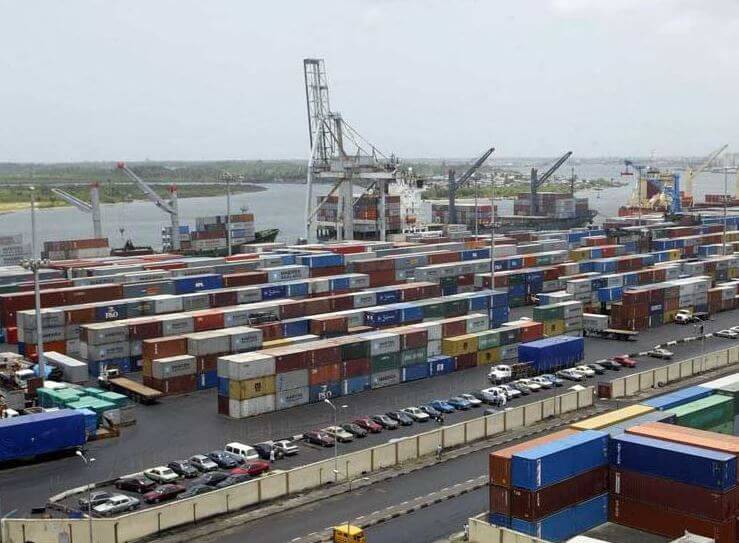
19,833 Vessels Berthed at Nigerian Ports from 2013 to 2016—NBS

Published

on

Vessels Berthed nigerian ports

By Modupe Gbadeyanka

A report released on Wednesday, February 8, 2017 by the National Bureau of Statistics (NBS) has revealed that a total of 19,833 vessels berthed at the various ports in the country between 2013 and 2016.

In the report titled ‘Shipping & Port Activities 2013-2016’ and obtained by Business Post, it was also disclosed that the ship traffic statistics at Nigerian ports showed 543,842,425 tonnages were registered within the period under review.

It was stated that the year 2014 recorded the highest number of vessels berthed as well as tonnages registered while the least were recorded in 2016.

Tin Can Island Port handled the most ships accounting for 33 percent of total number of ships that berthed in all ports and 32 percent of total tonnage registered in all ports.

It is closely followed by Apapa port which accounted for 28 percent of ships that berthed and 25 percent of total tonnage registered and Onne port which accounted for 15 percent of ships that berthed and 30 percent of total tonnage registered.

Also, cargo traffic statistics revealed a total of 312,185,808 cargo traffic was recorded at all Nigerian ports between 2013 and 2016.

Furthermore, 196,851,236 or 63 percent of the cargo traffic were inwards while 115, 334572 or 37 percent were outward.

It was also indicated in the report that Apapa port handled the most number of inward cargoes accounting for 39 percent of total inward cargoes and closely followed by Tin Can Island and Delta ports accounting for 31 percent and 11 percent respectively.

Similarly, Calabar port accounted for 4.29 percent to record the least and Onne ports handled the most number of outward cargoes accounting for 80 percent of total outward cargoes and closely followed by Delta and Apapa ports accounting for 10.63 percent and 3.52 percent respectively. Calabar port accounted for 0.05 percent to record the least.

The number of passenger traffic within the period under was put at 52,262 while the highest number of passenger traffic was recorded in 2013.

Business Post learnt that the number of vessels that berthed at the Apapa Port has been dropping gradually from 1,510 in 2013 to 1,097 in 2016 while the Gross Registered Tonnage at the Port Peaked at 37,041,879 in 2014 and dropped to 31,032,377 in 2016.

also, the number of vessels that berthed at the Tin Can Island Port increased from 1,615 in 2013 to 1,774 in 2015 and later dropped in 2016 to 1,414 while the Gross Registered Tonnage at the Port Peaked at 48,435,584 in 2015 and dropped to 40,674,982 in 2016.

In the report also, the number of vessels that berthed at the Delta Port dropped from 609 in 2013 to 433 in 2016 while the Gross Registered Tonnage at the Port also dropped from 8,687,160 in 2013 to 6,177,809 in 2016.

For the Rivers Port, the number of vessels that berthed dropped from 439 in 2013 to 287 in 2016 while the Gross Registered Tonnage at the Port also dropped from 6,761,057 in 2014 to 4,560,844 in 2016.

A look at the Onne port revealed that the number of vessels that berthed declined from 847 in 2014 to 605 in 2016 while the Gross Registered Tonnage at the Port also dropped from 43,916,846 in 2014 to 35,937,547 in 2016 and that of Calabar port recorded a fall from 373 in 2013 to 189 in 2016 while the Gross Registered Tonnage which peaked at 4,087,599 in 2015 dropped to 3,803,199 in 2016.

In summary, the number of vessels that berthed at all the Ports dropped from 5,369 in 2013 to 4,025 in 2016 while the Gross Registered Tonnage dropped from 146,820,488 in 2014 to 122,186,758 in 2016.

Business Post gathered that the total number of passenger traffic at the ports peaked at 12,418 in 2013 and dropped to 2,473 in 2015 and later increased to 12,861 in 2016.


 

Modupe Gbadeyanka is a fast-rising journalist with Business Post Nigeria. Her passion for journalism is amazing. She is willing to learn more with a view to becoming one of the best pen-pushers in Nigeria. Her role models are the duo of CNN's Richard Quest and Christiane Amanpour.

Click to comment

Leave a Reply

Your email address will not be published. Required fields are marked *

Brands/Products

Connect Nigeria Introduces Quote Request Platform

Published

on

Connect Nigeria Quote Request

By Modupe Gbadeyanka

To make finding the right service provider or reaching the right customer seamless, popular local information portal, Connect Nigeria, has introduced a Quote Request platform.

Connect Nigeria described the new system as “a digital solution designed to make connecting with service providers faster, easier, and more reliable.”

It said the Quote Request was built for consumers who need services quickly and want trusted options without the stress of searching endlessly; and service providers and businesses looking for real, high-intent customers without spending heavily on marketing.

“Whether you need a caterer for an event, a plumber for your home, or a designer for your brand, the platform is designed to connect you with the right people,” Connect Nigeria added.

“By connecting demand directly with supply, the platform creates a more structured and dependable marketplace,” it further stated.

At its core, the Quote Request simplifies the entire process of finding and offering services.

To use the service, users have to submit a request describing the service or product needed, which is then sent to verified vendors on the platform. Interested providers respond within 1–2 days, and users compare offers and choose what works best for their needs and budget.

“Instead of searching for vendors, the vendors come to you, with relevant, tailored responses,” Connect Nigeria explained.

The company expects this new platform to eliminate the stress of endless online searches, delayed or vague responses, and uncertainty about service quality.

As for businesses, it solves poor visibility, inconsistent customer flow, and lost opportunities due to slow response times.

Connect Nigeria Quote Request mobile app is now available on the Google Play Store and Apple App Store.

Continue Reading

Brands/Products

Mathesis Analytics to Scale AI-Powered Credit Infrastructure Across Nigeria

Published

on

Mathesis Analytics Winston Osuchukwu

By Aduragbemi Omiyale

An institutional investor, First Ally Capital, has strengthened a leading Nigerian financial technology company, Mathesis Analytics, to scale its proprietary credit decisioning infrastructure.

It made this possible by injecting fresh capital into the firm, which specialises in AI-powered credit decisioning infrastructure, an action that will directly support the growth and scaling of Mathesis’ core mission of providing the intelligence and infrastructure needed to bridge the credit gap for millions of unscored or underscored individuals across Nigeria.

With this investment, Mathesis will enable financial institutions to confidently assess and extend credit to borrowers who lack a formal credit history by leveraging an expanded pool of alternative behavioural and transactional data.

To date, Mathesis’ systems have supported more than 8 million loans for over 2 million unique borrowers in Nigeria, and the company is actively deploying its infrastructure to establish a growing pan-African footprint.

With the investment from First Ally Capital, Mathesis is well positioned to transform how the credit ecosystem operates, driving financial inclusion in partnership with lenders across the continent.

A significant barrier to credit access in Nigeria, which prides itself on being Africa’s largest economy, is data fragmentation. Borrowers frequently build positive financial behaviours across multiple digital platforms by repaying microfinance loans, saving through fintech wallets, or servicing Buy Now, Pay Later (BNPL) facilities.

However, under traditional credit infrastructure, these achievements remain invisible to new lenders.

Mathesis addresses this challenge through the concept of Personal Equity—the quantified expression of an individual’s financial behaviour aggregated across every institution with which they have transacted.

By translating these disparate signals into a precise, portable measure of creditworthiness, Mathesis creates a comprehensive credit identity that reflects the full breadth of a person’s financial life.

“True financial inclusion cannot be achieved in a vacuum; it requires structural collaboration in which lenders and fintech companies work as partners within the ecosystem.

“This investment from First Ally Capital validates our approach to reshaping credit infrastructure. By quantifying Personal Equity, we empower lenders to safely look beyond the constraints of formal credit histories and recognise a borrower’s true creditworthiness. This capital enables us to accelerate our pan-African expansion while maintaining the robust, institutional-grade infrastructure our partners rely on,” the chief executive of Mathesis Analytics, Winston Osuchukwu, stated.

On his part, the chief executive of First Ally Capital, Mr Ebenezer Olufowose, said, “At First Ally Capital, we pride ourselves on being a one-stop destination for financial solutions, offering a diverse portfolio of services ranging from investment banking and asset management to trusteeship, inclusive banking, and real estate.

“Our investment in Mathesis Analytics reflects our strong belief in the company’s vision and our commitment to supporting forward-thinking enterprises that deliver excellence.”

Continue Reading

Brands/Products

MultiChoice Now Full Subsidiary of Canal+—CEO

Published

on

CANAL+ MultiChoice

By Aduragbemi Omiyale

The chief executive of Canal+ Africa, Mr David Mignot, has disclosed that MultiChoice is now fully integrated into the media group.

Mr Mignot disclosed this via a statement issued on Thursday, noting that this development marks a new phase in the evolution of one of Africa’s leading pay television operators.

He noted that the integration positions MultiChoice within a global media organisation with an extensive international footprint.

“MultiChoice is now a full subsidiary of a truly international media group operating in 70 countries. The group was founded in France, is listed in London and Johannesburg, and has a strong African presence with operations in more than 45 countries,” Mr Mignot said.

The statement underscores the scale of the combined business, highlighting Canal+’s global reach alongside its significant investments across Africa.

The completion of the transaction is expected to strengthen MultiChoice’s position in the African media and entertainment market by giving it access to the broader resources, expertise and international capabilities of the Canal+ Group, while reinforcing the group’s commitment to the continent.

MultiChoice operates across sub-Saharan Africa through platforms including DStv and GOtv, serving millions of subscribers with entertainment, sports and news content.

Continue Reading