
Brands/Products
Advertising Agencies to Elect New Executives at 51st Congress in Ogun


By Aduragbemi Omiyale
Stakeholders in the advertising industry, including practitioners, agencies, advertisers and others, are in Abeokuta, the Ogun State capital, for the 51st Annual General Meeting (AGM)/Congress of the Association of Advertising Agencies of Nigeria (AAAN).
The event started on Thursday and will end on Saturday, July 2024, with the induction of new members, dissolution of the executive committee, and election of new executives to lead the group for the next two years.
The election will take place during a morning business session to be followed later in the day with a Gala/Award Night designed to recognise deserving industry figures.
Yesterday, the Governor of Ogun State, Mr Dapo Abiodun, flagged off the programme, while the president of AAAN, Mr Steve Babaeko, led the executive committee team on a courtesy visit to the Alake of Egbaland, Oba Adedotun Gbadebo Aremu 111; and the Osile of Oke-Ona, Oba Adedapo Tejuosho.
Earlier today, the organisation hosted a panel of discussion involving experts from different economic sectors.
The chairman of the Events Planning Committee, Mr Doyin Adewumi, noted that the association has a tradition of using multi-disciplinary and multi-industry expertise to improve advertising practice, the reason it has, again, invited experts from other fields to the event.
“The AAAN is a body that is receptive to knowledge from other professions. This is why we have invited accomplished professionals from other fields to lend their knowledge to what we do. We believe that this approach will provide new thinking that advertising professionals can use,” he stated.
This session had the Director General of the National Council for Arts and Culture, Mr Obi Asika; the founder of Zuri35 Media, Mr Femi Odugbemi; the founder of WHAT Media, Ms Chichi Nwoko; the Director of Google West Africa, Mr Olumide Balogun; and the Lagos State Commissioner for Innovation, Science and Technology, Mr Olatunbosun Alake.
Shedding light on what to expect from the AGM/Congress, Mr Babaeko said, “The 51st AGM/Congress presents advertising professionals the opportunity to assess the impact of what we do and how we can add more value, which informed this year’s theme, Breaking the Mold-Creativity and National Development.
“The impact of advertising on the country’s Gross Domestic Product (GDP) is considerable. The fact of it was recently reiterated by study carried out by PwC, which was commissioned by the Advertising Regulatory Council of Nigeria (ARCON) and funded by industry associations.
“The report of the study, presented to the public in Lagos last month, puts the value of the advertising industry at N605.2 billion.”











P+ Measurement Services, Nigeria’s leading independent media intelligence and PR measurement agency, will host the 31st edition of its flagship thought-leadership platform, EvaluatePR, on Friday, March 27, 2026, at 12:00 p.m. (WAT).
Themed PR After the Algorithm: Trust, Truth & Intelligence in 2026, this virtual session will convene professionals across public relations, communications, and media measurement to explore how algorithms, artificial intelligence, and digital ecosystems are reshaping reputation management, media influence, and audience trust.
With the increasing role of automation in communications, the event will challenge professionals to rethink how credibility is built and sustained in a fast-evolving digital landscape, while emphasising the need for transparency, ethical measurement, and strategic intelligence.
The session will feature a distinguished lineup of speakers representing diverse expertise across global communications, media intelligence, and analytics: Felicia Nugroho – Director, Analytics & Insights, Maverick Indonesia / Chair, Asia Pacific & International Board Director, AMEC; Cyrille Djami – Founder & Publisher, CommsOfAfrica; Strategic Communications, Editorial and Influence Consultant; Amrita Sidhu – Managing Director, Medianet / Director & Board Representative, AsiaNet / Board Member, AMEC; and Satira Osemudiamen Oreweme – Principal Consultant, Satira Media & Public Relations Limited.
Together, they will lead insightful discussions on how communicators can navigate the intersection of technology and trust, maintain authenticity in automated environments, and leverage data-driven intelligence to deliver meaningful communication outcomes.
Participation in the session is free, with access available via the official registration link: https://bit.ly/4stWjUh
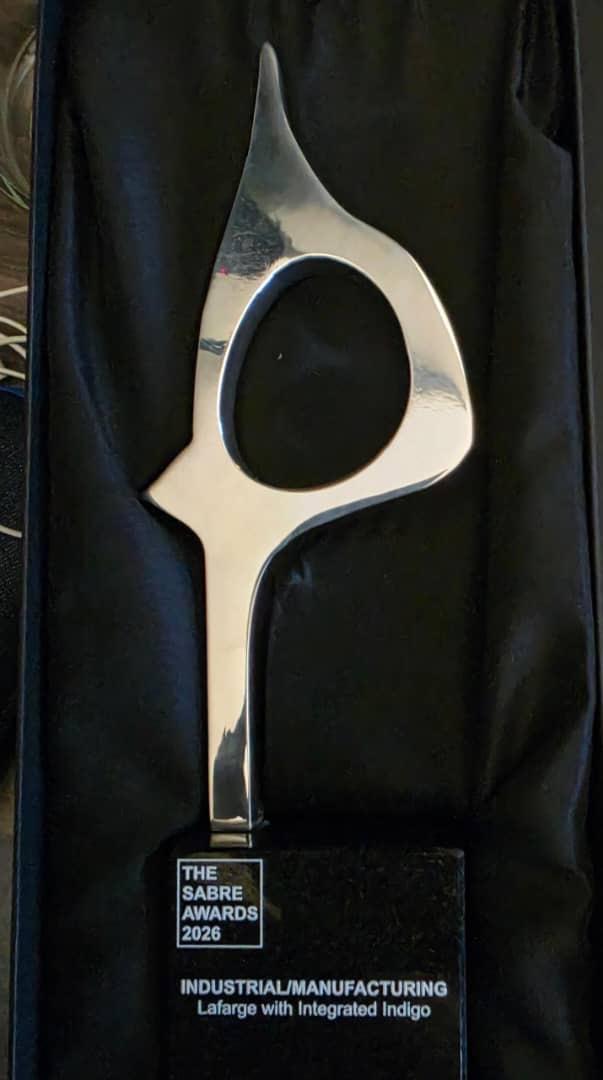
Integrated Indigo Limited, one of Nigeria’s leading full-service marketing communications consultancy firms, has once again proved its mettle as an agency to reckon with, not only in Nigeria but also across the continent, by winning another award at the 2026 Superior Achievement in Branding, Reputation & Engagement (SABRE) Awards recently held in South Africa.
Indigo won in the Industrial/Manufacturing category for its impactful ‘Women on Wheels’ campaign executed for Lafarge Africa Plc. The award-winning ‘Women on Wheels’ campaign was designed to challenge gender stereotypes and promote inclusivity within the industrial and manufacturing sector, while amplifying Lafarge Africa’s commitment to empowering women through innovative and purpose-driven initiatives.
Last year, the agency emerged as the winner for its effective communication strategy and execution on the Nigerian Breweries Plc Rights Issue.
Commenting on the win, the Managing Director/CEO, Integrated Indigo Limited, Bolaji Abimbola, explained that the success of the campaign was driven by a shared vision between the agency and Lafarge Africa Plc, noting that the win reflects the agency’s long-standing commitment to delivering impactful and purpose-driven campaigns that go beyond traditional communications.
Abimbola added that such recognitions serve as both validation and motivation for the agency to continue pushing boundaries, challenging norms, and delivering innovative solutions that create real value for clients and society at large.
“We are thrilled to receive this recognition for our ‘Women on Wheels’ campaign. This win is a testament to our consistency and dedication to breaking new ground by relentlessly pushing bold ideas, building impactful collaborations, and fostering strong partnerships. We are proud of the impact this campaign has created and grateful to our clients for trusting us to bring this vision to life,” he said.
Abimbola also commended the Integrated Indigo team for their creativity, passion, and resilience, noting that the award reflects the collective effort of a team committed to excellence and innovation.
“I would like to celebrate our incredible team for their commitment and drive. This achievement belongs to every individual who contributed to making this campaign a success. We remain focused on pushing boundaries, delivering value, and continuing to create meaningful impact for our clients and the communities we serve,” he added.
As it celebrates this milestone, Integrated Indigo reaffirms its commitment to delivering innovative communication solutions, pushing boundaries, and creating campaigns that generate lasting impact.
The 2026 Africa SABRE Awards shortlist includes more than 120 campaigns, selected from over 500 entries in this year’s competition, which recognises Superior Achievement in Branding, Reputation and Engagement. The campaigns were evaluated by a jury of industry leaders. The 2026 Africa SABRE Awards took place on March 17 in South Africa.

By Modupe Gbadeyanka
A leading cloud-based restaurant management platform operating in Nigeria, Orda Africa, has been acquired by the continent\s all-in-one financial ecosystem platform, Moniepoint Incorporated.
The acquisition of Orda comes as Africa’s food service industry experiences unprecedented growth, with the sector valued at $50 billion and Nigeria’s market alone projected to reach $19.31 billion by 2030, growing at 11.73 per cent annually.
With Orda’s restaurant-focused capabilities now part of the Moniepoint ecosystem, the platform is well-positioned to capture this opportunity.
Business Post gathered that Orda will now become part of the Moniebook platform, the all-in-one Point-of-Sale (POS) and business management platform of Moniepoint.
Since launching its business management tools product in 2025, Moniebook has rapidly become the go-to platform for thousands of African businesses seeking integrated financial and operational tools, seamlessly unifying payments and bookkeeping in one platform.
With Orda, restaurant owners can now gain access to this proven ecosystem that creates unprecedented opportunities to scale operations, optimise performance, and access credit, as well as the extensive reach of Moniepoint, which has powered growth for millions of African businesses.
“The food industry isn’t just about feeding people; it’s a major source of jobs and daily survival for many Africans. It highlights how vital the informal sector is, not just for the economy, but for everyday life across the continent,” the chief executive of Moniepoint, Mr Tosin Eniolorunda, said.
Data has shown us that Africa’s restaurant sector is one of the continent’s most dynamic economic engines, yet the majority of food businesses still operate with manual processes and fragmented tools.
“By bringing Orda into Moniepoint, we are giving restaurant owners what they deserve: one simple platform that handles everything from managing their kitchen to growing their business.
“Our goal remains to create financial happiness for Africans, giving them the tools to reach their full potential, and that’s exactly what we’ve built here,” he added.
Also commenting, the chief executive of Orda, Mr Guy Futi, said, “Orda has found the perfect home in Moniepoint. We have spent years building deep expertise in restaurant operations, but we have always known that to truly transform the industry, we needed to connect that expertise with comprehensive financial infrastructure.
“That’s exactly what this integration delivers. For our customers, we are assuring a smooth transition with no disruption to the platform and retained access to the support you are used to. What changes is your access to opportunities. Over the coming weeks, being part of Moniepoint means you’ll have more tools, more reach, and more ways to grow your business than ever before.”
Moniepoint was established in 2015 by Mr Eniolorunda and Mr Felix Ike. The firm has considerably expanded its offerings to include digital payments, business and personal banking, credit, cross-border payments, and business management tools, with a customer base exceeding 20 million active businesses and personal banking customers and processes over $250 billion in digital payment transaction value annually.
On its part, Orda was formed in 2020 to give Africa’s small and independent restaurants the tools they need to run more efficiently, providing a purpose-built software to businesses that had long operated without it.
Combining their respective strengths, Moniepoint and Orda are expected to deliver a purpose-built solution that empowers food businesses at every scale to manage orders, track inventory, pay suppliers, and access working capital, all in one seamless experience.









-
 Feature/OPED6 years ago
Davos was Different this year
-
Travel/Tourism10 years ago
Lagos Seals Western Lodge Hotel In Ikorodu
-

 Showbiz3 years ago
Estranged Lover Releases Videos of Empress Njamah Bathing
-
 Banking8 years ago
Sort Codes of GTBank Branches in Nigeria
-

 Economy3 years ago
Subsidy Removal: CNG at N130 Per Litre Cheaper Than Petrol—IPMAN
-

 Banking3 years ago
Sort Codes of UBA Branches in Nigeria
-

 Banking3 years ago
First Bank Announces Planned Downtime
-

 Sports3 years ago
Highest Paid Nigerian Footballer – How Much Do Nigerian Footballers Earn