Brands/Products
How Start-ups Can Leverage 360 Degrees Marketing Techniques to Increase Sales
By Emmanuel Otori
Sales are a determinant of whether a business would survive or not. The lifeblood of every business is embedded in the day-to-day activities that can generate consistent cash flow.
Some organizations get caught up in trying to do many things are at a time which makes their progression towards activities that contribute to their downline flawed and is visible in the finances of the organizations.
Organizations are not necessarily alarmed until there is a sharp drop in revenue; however, a sharp drop in revenue is only an indication of many other factors beyond what has been observed. This revenue drop is a symptom that some core activities are ailing such as staff retention, customer service, lack of repeat sales, poor product management, unclear definitions of the target market, lack of promotional.
If the sale is consistent, a business can survive the most difficult phases as cash flow is directly linked to the overall activities.
The most important question to ask then is “how can more sales be made”? Without asking this question, the business risks every other form of major distraction.
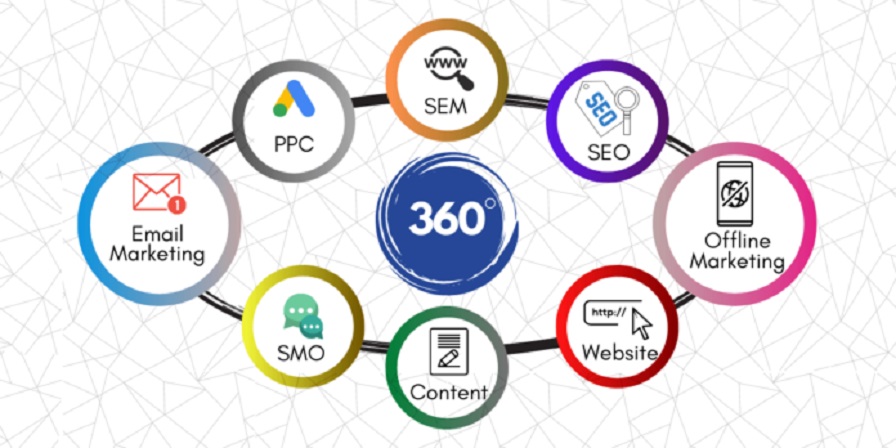
The 360 degrees Marketing Techniques
The 360 degrees marketing techniques are sometimes called Integrated Marketing Communications (IMC). These techniques are a mix of several activities that organizations are engaged in to increase awareness about a product or service.
The perception of visibility by a customer over a long period of time consistently makes a brand become a sort of inevitable to a customer whenever they need to make a purchasing decision as the brand is the first to come to mind due to the number of exposures they have had with the prospect and vice-versa.
Email Marketing
Email is one of the easiest and fastest ways to reach a large audience and when properly deployed has the potential to create a consistent stream of customers, as it takes the form of a closed user group through the reception of newsletters by the customers and overtime a relationship is built through readership as the audience are regularly updated about eh activities of the organization or products and services.
Email Marketing also helps to create some form of targets as there are metrics that could show who reads a particular newsletter and how many times. Observing the behaviour of the readers and the type of content they are reading could initiate a purchase decision by offering a product that compliments what they read.
Blogging
Blogging is similar to email marketing, but while email marketing is only sent to subscribers or users generated through a third party, blogging reaches out to all possible audiences that are online and serves as a tool to consistently inform customers about the product, services or activities of a business. Regular blogging should average up to 3-5 blog posts weekly to make conversions; this done over a period of 6 months is a guarantee for increased sales.
Granting Media Interviews
As much as the new media is emerging greatly, the traditional media still holds a sit in the preference of most audiences and the ability to use these tools such as television, radio and print media is key to reaching a lot of people. The conversations on these platforms create a direct connection with the listeners as it is visual and the ability to see the person being interviewed as they share industry-based experience makes them look to most audiences like thought leaders. This done over time would make such personality become a face and voice in their sector.
Search Engine Optimization (SEO)
Search Engine Optimization is arguably the first on the list of all techniques as it reduces the time, effort and energy to directly reach out to prospective customers. SEO guarantees that prospects can easily find an offer and make a purchase decision as it places a brand right where the audience is seeking answers. Sales are also made round the clock with no limitation of where the customer buys from.
Networking
Getting exposure as a Founder for your business is necessary to build a personal brand first, as this benefit extends to a business brand as trust can easily be built when people can interact with the owner of the business. A core part of business visibility is to ensure that a business owner continuously puts themselves out there as many times as possible, and this consistency over time is able to drastically build loyalty right from the onset and sales.
While there are many other techniques in addition to the ones mentioned, engaging in one or more of these activities has the potential to increase the revenue base of the business and reachability.
Emmanuel Otori has worked on the GEM Project of the World Bank, conducted training for entrepreneurs and professionals at the Abuja Enterprise Agency and has over 8 years of experience working with over 50 SMEs across Nigeria. He can be reached via https://www.linkedin.com/in/emmanuelotori/
Brands/Products
Investors Inject $9.2m into AI Dating App Ditto for Yacht Blind Dates
By Dipo Olowookere
About 9.2 million funding round has been secured by an AI-dating app, Ditto, for the expansion of its iMessage-based matchmaker, with the participation of Peak XV Partners, Gradient, Scribble Ventures, Alumni Ventures, and Llama Venture.
The iMessage-based matchmaker plans real dates for users, handling everything from the match to logistics, so students can focus on showing up and connecting in real-life. Users grow tired of endless swiping and stalled conversations.
College students swipe endlessly, juggle multiple chats, and still struggle to turn matches into actual dates. Ditto was created to remove that friction entirely.
The business was established by two Berkeley undergraduates, Mr Allen Wang and Mr Eric Liu, who saw friends spend hours on dating apps without forming meaningful connections.
The platform initially launched at UC San Diego and went viral across sorority group chats before quickly expanding to UC Berkeley, USC, UCLA, and UC Davis.
It operates entirely over iMessage, where users already communicate daily. Users tell Ditto their preference for a date, such as ‘a 6 ‘2 hot nerd that brings me flowers’ or ‘an ABG who mastered leetcode’. After sharing their preferences and availability, users receive a text with a complete date plan, including the time, place, and details of their match, all centred around the campus they are near.
After each date, Ditto collects feedback and incorporates these feedbacks into the user’s profile to improve future matches. The result is a system that feels personal, efficient, and low-pressure, while removing much of the anxiety and inefficiency associated with modern dating apps.
“Our goal was to build something that actually helps people go on dates, not stay stuck in an app. When you remove swiping and chatting, you remove a lot of the toxicity and anxiety that people associate with online dating.
“We plan the date, people show up, and real connections have a chance to form. About 20 per cent of our matches turned into actual dates,” Mr Wang stated.
With this funding, Ditto is kicking off 2026 by hosting 10 yacht parties across the US, starting in Los Angeles on Valentine’s Day.
Each yacht will host 100 college singles, matched into 50 couples. This will be the biggest yacht party in college history. Ditto is co-hosting these parties with the hottest school clubs and Greek life organisations in Los Angeles, New York, Boston, and more.
A Partner at Gradient, Vig Sachidananda, while commenting on the new funding package, said, “Ditto is leveraging AI in a creative way to build a novel online dating experience — one which resembles a true matchmaking service.
“We’ve seen a great early response from users to this approach, and we’re excited to continue to work with Ditto as they expand to college campuses across the US.”
Since launching, Ditto has grown to more than 42,000 users across four college campuses, with over 25 per cent of users coming through referrals.
Looking ahead, Ditto plans to expand beyond college campuses and eventually support other forms of connection, including professional networking and group social experiences. The long-term vision is to become a matchmaker for modern life, helping people turn intent into meaningful, real-world interactions, one plan at a time.
Brands/Products
Odekina Leaves UBA for AEDC to Head Corporate Communications Department
By Aduragbemi Omiyale
One of the foremost Public Relations practitioners in Nigeria, Mr Omede Odekina, has joined the Abuja Electric Distribution Company (AEDC).
He is now on the payroll of the energy firm as the Head of Brand Marketing and Corporate Communications Department after leaving the United Bank for Africa (UBA) Plc.
The Kogi State University graduate will use his experience as a media relations expert to sell the image of the electricity organization.
In an announcement via his LinkedIn page, Mr Odekina described his movement from the banking space to the energy industry as the “beginning of an exciting new chapter and a unique opportunity to help shape how one of Nigeria’s most critical service organisations engages with its customers and communities.”
He thanked UBA for providing him with the platform to grow his career, describing the lender as “truly one of the best places to work.”
According to him, “UBA was more than a workplace; it was a family. The culture, leadership, and people created an environment of excellence, trust, and continuous growth. I leave deeply appreciative of the journey, the friendships, and the values that will remain with me always.”
The Associate of the Nigerian Institute of Public Relations (NIPR) disclosed that in his new role, “my focus is firmly on positioning Abuja Electricity Distribution Plc as Nigeria’s number one electricity distribution company, one that delivers reliable service with professionalism, respect, transparency, and a strong sense of community partnership.”
“It is a responsibility I embrace with enthusiasm, purpose, and optimism for what lies ahead,” he said further.
Brands/Products
Reputation Economy: How Nigerian Brands Won and Lost Public Trust in 2025
Nigeria’s leading independent media intelligence consultancy, P+ Measurement Services, has released its 2025 Industry Media Reputation Report, revealing that corporate reputation has emerged as one of the most decisive assets for Nigerian companies, rivaling financial performance and market share in shaping public trust.
The report analysed and audited thousands of print and online news reports published in 2025 across the banking, insurance, telecommunications, and e-hailing sectors. In total, coverage of 29 commercial banks, 13 insurance companies, five e-hailing platforms, and four telecommunications operators was examined to determine how corporate actions translated into public perception.
According to the findings, rising operational costs, currency pressures, regulatory scrutiny, labour relations, and service reliability now directly influence how brands are judged in the media and by stakeholders.
“Reputation is no longer a soft outcome of publicity. It is a measurable business asset shaped by corporate behaviour, governance quality, customer experience, and crisis response,” said a Senior Analyst at P+ Measurement Services, Ms Tumininu Balogun.
She added, “For more than a decade, we have been at the forefront of media intelligence in Nigeria. Our commitment to the PR and communications industry is to ensure that reliable media data and actionable insight are always available, so professionals can move beyond intuition and make truly data-driven decisions.”
E-Hailing Industry: Driver Relations Reshaped Corporate Reputation
The e-hailing sector recorded one of the clearest shifts in reputation dynamics in 2025, driven largely by labour policies and platform economics.
inDrive Nigeria led the sector with 39% of positive reputation share, following extensive media coverage of its decision to reduce driver commission to 0.1% during peak hours in Abuja. Bolt Nigeria followed with 32%, supported by reports on its electric tricycle deployment in Lagos. LagRide recorded 17%, driven by coverage of its electric vehicle infrastructure partnership, while Uber Nigeria accounted for 11% and Rida 1%.
On the negative reputation scale, Bolt recorded the highest share at 40%, linked to driver protests following fare reduction policies. Uber accounted for 29%, inDrive 20%, LagRide 8%, and Rida 3%, largely associated with reports on strike threats, platform reliability concerns, and driver earnings disputes.
The report notes that how platforms treat drivers has become as influential to reputation as rider experience.
Banking Industry: Profitability Confronted by Governance Risk
Among commercial banks, Stanbic IBTC recorded the strongest positive reputation position at 26%, driven by recognition as KPMG’s top retail bank. Zenith Bank followed with 22%, supported by dividend payout coverage. Fidelity Bank (19%), UBA (17%), and FirstBank (16%) gained positive reputation visibility through education initiatives, digital service upgrades, and branch automation projects.
However, reputational exposure remained significant. GTCO recorded the highest negative reputation share at 28%, followed by FirstBank at 26%, FCMB at 18%, and both UBA and Ecobank at 14%, mainly due to media reports concerning legal disputes, fraud investigations, and customer-related controversies.
The report highlights that in the banking sector, strong earnings and digital innovation strengthen reputation, but governance failures can rapidly undermine it.
Insurance Industry: Financial Stability and Data Protection Define Trust
In the insurance sector, AXA Mansard led positive reputation share with 36%, followed by Leadway Assurance (29%), AIICO (16%), NEM Insurance (11%), and SanlamAllianz (8%).
AXA Mansard also accounted for the highest negative reputation exposure at 68%, driven by reports of a significant decline in pre-tax profit. AIICO recorded 18%, Leadway 12%, and NEM 2%, largely connected to regulatory matters and data protection concerns, including coverage of customer data breaches.
The findings indicate that insurers are now judged as much by financial resilience and cybersecurity posture as by product offerings.
Telecommunications Industry: Infrastructure Investment Meets Rising Public Expectations
MTN Nigeria led positive reputation share with 47%, driven by infrastructure expansion narratives and innovation campaigns. Glo followed with 28%, Airtel Nigeria with 16%, and T2 (formerly 9mobile) with 9%, largely supported by its rebranding coverage.
On the negative reputation side, MTN recorded 44%, T2 31%, Glo 13%, and Airtel 12%, influenced by reports on service quality challenges and the Nigeria Labour Congress boycott directive targeting telecommunications operators.
The sector’s results suggest that while capital investment enhances visibility, network reliability and customer experience increasingly determine long-term reputation.
Reputation Has Become a Strategic Business Asset
Across all four industries, the report finds a consistent pattern: reputation in 2025 closely followed corporate behaviour.
Brands that demonstrated transparency, operational fairness, financial discipline, digital reliability, and customer focus were more likely to build positive public trust. Companies facing labour unrest, legal disputes, regulatory sanctions, data breaches, or service disruptions saw these issues rapidly reflected in their reputation profile.
For brand owners, investors, regulators, and communication professionals, the implication is clear: reputation is no longer managed only through messaging, but through measurable actions that are permanently recorded in the media ecosystem and searchable online.
-
Feature/OPED6 years agoDavos was Different this year
-
Travel/Tourism9 years ago
Lagos Seals Western Lodge Hotel In Ikorodu
-
Showbiz3 years agoEstranged Lover Releases Videos of Empress Njamah Bathing
-
Banking8 years agoSort Codes of GTBank Branches in Nigeria
-
Economy3 years agoSubsidy Removal: CNG at N130 Per Litre Cheaper Than Petrol—IPMAN
-
Banking3 years agoSort Codes of UBA Branches in Nigeria
-
Banking3 years agoFirst Bank Announces Planned Downtime
-
Sports3 years agoHighest Paid Nigerian Footballer – How Much Do Nigerian Footballers Earn