Connect with us

Economy

5,527 MSMEs in Lagos Share N4.5b Funding Support

Published

on

By Modupe Gbadeyanka

Not less than N4.5 billion has been disbursed to 5,527 Medium Small Manufacturing Enterprises (MSMEs) by the Lagos Employment Trust Fund in the last one year.

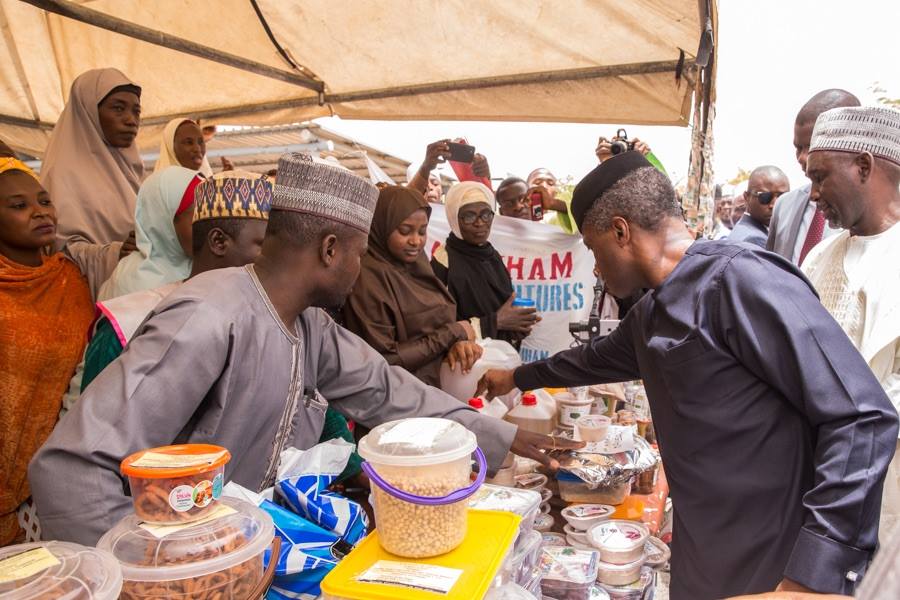
Speaking on Monday at the 2nd Micro, Small and Medium Enterprises (MSMEs) exclusive fair themed ‘Unleashing the Potentials of MSMEs for Economic Diversification,’ Governor Akinwunmi Ambode of Lagos State his administration will continue to do more for the sector.

The Governor, who spoke through the Secretary to the State Government, Mr Tunji Bello, noted that despite the contributions of the MSME sector to the Lagos economy, the sector’s competitiveness was weakened by limited access to credible, customized-business support and inability to penetrate local and expanded markets, emphasizing that there is a need to build strong public-private support systems that would enhance the capacity of the MSME sector for economic diversification.

“I charge you to take advantage of the structures our administration has put in place to support your businesses and together, let us build world class businesses which would positively impact on Lagos, Nigeria and the World,” the Governor disclosed.

Mr Ambode urged all exhibitors to take full advantage of the platform of the fair and e-commerce to launch their products to a global but competitive market.

At the inception of his administration in 2015, Governor Ambode set aside N25 billion to support the small scale sector.

Yesterday, the Governor revealed that the fund, in partnership with the UNDP and private sector employers, will also train 16,000 unemployed Lagosians in order to take up technical and vocational jobs, adding that, “The state government would launch innovation driven enterprise framework to support business start-ups in the fourth quarter of this year.”

He reiterated the commitment of the present administration to continually implement enterprise-friendly policies and develop the critical infrastructure that would enhance the productivity and competitiveness of all businesses in the state.

“We will continue to support the growth of MSMEs and make concerted efforts to develop enterprise cluster parks especially the Imota Light Industrial Park”, he said.

The Governor informed that the theme of this year, ‘Unleashing the Potentials of MSMEs for Economic Diversification,’ throws a challenge to all players, both public and private, to look inwards and develop the internal and external capacities of the local non-oil MSME for steady growth and global competitiveness.

He stated that the 4-Day fair would match-up the local small-scale industrial giants with business development support providers, investors from the private sector, public regulatory support agencies at the state and Federal government levels as well as foreign economic development institutions.

Speaking earlier, Commissioner for Commerce, Industry and Cooperatives, Prince Rotimi Oguleye, described Lagos as the largest hub of MSMEs and the economic nerve-centre of Nigeria, accounting for more than 3 million micro and 11,663 small and medium enterprises that are significantly boosting the nation’s Gross Domestic Product (GDP), generating employment, creating sustainable enterprises, and accelerating value-added industrialization.

Also speaking, Chairman, House Committee on Commerce, Industry and Cooperatives, Mr Oladele Adekanye, expressed appreciation to Governor Ambode-led administration for introducing the numerous innovative interventions aimed at enhancing the capacity of the small-business sector so that its members could actively contribute to national development and economic recovery.

The event also attracted the President of the Lagos Chamber of Commerce and Industries, Mrs Nike Akande; representative of the National President of the National Association of Chambers of Commerce, Industry, Mines and Agriculture (NACCIMA), Iyalode Alaba Lawson; and members of the Organised Private Sector.


Modupe Gbadeyanka is a fast-rising journalist with Business Post Nigeria. Her passion for journalism is amazing. She is willing to learn more with a view to becoming one of the best pen-pushers in Nigeria. Her role models are the duo of CNN's Richard Quest and Christiane Amanpour.

Economy

How Investor Confidence Is Reshaping Africa’s Digital Business Landscape

Published

on

Digital Business Landscape

Africa’s business environment is undergoing a quiet but significant transformation. Over the past few years, investor confidence in African-focused digital companies has grown steadily, driven by stronger business fundamentals, improved technology infrastructure, and a deeper understanding of local markets. What was once viewed as a high-risk frontier is increasingly seen as a long-term growth opportunity with scalable returns.

This shift is evident in the types of startups attracting capital today. Investors are backing platforms that combine technology, recurring revenue models, and cross-border appeal—signaling a new phase in how digital businesses are built and funded across the continent.

The Evolution of Venture Capital in Africa

Early venture capital activity in Africa was largely experimental. Funding rounds were modest, timelines were short, and expectations focused on proof of concept rather than long-term scale. Today, the narrative has changed. Investors are deploying larger checks and looking beyond survival metrics toward sustainable growth, operational efficiency, and regional expansion.

Digital-first companies are particularly attractive because they can scale without heavy physical infrastructure. With mobile penetration rising and digital payments becoming more common, African startups now have access to broader audiences than ever before. This scalability has become a key selling point for investors seeking exposure to emerging markets without excessive operational complexity.

Why Digital Platforms Are Drawing Increased Attention

One notable trend is growing investment interest in digital entertainment and online platforms. These businesses benefit from high engagement, repeat usage, and diverse monetization opportunities. Unlike traditional industries, digital platforms can adapt quickly to consumer behavior and expand into new markets with relatively low marginal cost.

Recent investment activity reflects this shift. A clear example is the funding momentum around winna casino, which highlights how investors are backing tech-enabled platforms positioned for global reach rather than local limitation.

The significance of such deals goes beyond the individual company. They point to a broader willingness by investors to support African-linked digital businesses operating at the intersection of technology, finance, and entertainment.

Technology as a Driver of Business Scalability

Technology is no longer just an enabler—it is the core value proposition. Businesses that leverage automation, cloud infrastructure, and data-driven decision-making are better positioned to scale efficiently. This is particularly relevant in Africa, where legacy systems can slow down traditional business models.

Digital platforms reduce friction by offering faster transactions, better user experiences, and real-time insights. From an investor’s perspective, these efficiencies translate into lower operating risk and higher growth potential. Companies that build with scalability in mind from day one are more likely to secure follow-on funding and strategic partnerships.

Africa’s Changing Perception Among Global Investors

Global investors are increasingly reassessing Africa’s role in their portfolios. Rather than viewing the continent solely through the lens of risk, many now see demographic advantage, underpenetrated markets, and long-term consumer growth.

A growing body of international business analysis supports this outlook. Forbes, for instance, has highlighted why global investors are paying closer attention to African tech and digital businesses as part of broader emerging market strategies:

This change in perception is critical. It influences not only the volume of capital flowing into Africa but also the quality—bringing in investors with longer horizons, stronger networks, and deeper operational expertise.

The Importance of Governance and Trust

Despite the optimism, capital is not deployed blindly. Investors remain highly selective, particularly when it comes to governance, compliance, and transparency. Digital businesses operating in regulated or semi-regulated spaces are expected to demonstrate strong internal controls and responsible growth strategies.

For African startups, this means that trust has become a competitive advantage. Companies that invest early in governance structures, risk management, and user protection are better positioned to attract serious institutional capital. In the long term, this focus strengthens the overall business ecosystem.

What This Means for African Entrepreneurs

For founders, the evolving investment climate presents both opportunity and responsibility. Access to capital can accelerate growth, but it also raises expectations around execution, reporting, and accountability. Investors now expect African startups to operate at global standards while maintaining local relevance.

This environment rewards entrepreneurs who think beyond short-term gains and focus on building resilient, scalable businesses. Those who can balance innovation with discipline are more likely to thrive in an increasingly competitive funding landscape.

Looking Ahead

Africa’s digital economy is entering a more mature phase. Venture capital is no longer just fueling ideas—it is shaping business models, governance practices, and long-term strategies. As investor confidence continues to grow, digital platforms that demonstrate scalability, trust, and clear value propositions will define the next chapter of Africa’s business story.

For business leaders, policymakers, and investors alike, one thing is clear: Africa’s digital transformation is not a future promise—it is already underway, and capital is following conviction.

Continue Reading

Economy

Dangote Refinery Seeks Naira-For-Crude Policy Expansion

Published

on

Naira-for-Crude

By Adedapo Adesanya

The Dangote Petroleum Refinery has called for the expansion of the federal government’s Naira-for-Crude policy, describing this initiative as a strong indication of support for domestic refining.

The newly appointed Managing Director of the oil facility, Mr David Bird, made this call during a press briefing at the refinery complex in Lagos, noting that the scheme has significantly contributed to stabilising the the local currency and should be expanded in Nigeria’s overall economic interest.

“I think it’s a great testimony to the level of government support that we get,” he said on Wednesday.

According to Mr Bird, between 30 and 40 per cent of the refinery’s current crude feedstock is sourced under the Naira-for-Crude arrangement, with ongoing monthly engagements between the refinery and the Nigerian National Petroleum Company (NNPC) Limited to determine suitable crude grades.

“Let’s say between 30 and 40 per cent of our current crude diet is on the crude-for-naira programme. We engage with NNPC monthly on the grades to buy because there is a lot of variability in the Nigerian crude grades.

“So, we have a preference, we have a wish list, and we continue to work with government support to ensure we get the right allocations,” he explained.

Mr Bird noted that while the refinery is optimised for Nigerian crude, supply volumes fluctuate.

He said approximately 30 per cent of crude supply is obtained through the Naira-for-Crude programme, another 30 per cent from Nigerian crudes purchased on the spot market, while the remaining 40 per cent comes from international grades, adding that even at that, the refinery would welcome an expansion of the policy.

“We would always like to enhance the crude-for-naira programme. Even at that level, five cargoes a month, for example, it has contributed to the stabilisation of the naira enormously,” Bird said, in response to a question.

Mr Bird added that the refinery has the capacity to absorb additional crude volumes if allocations are increased, noting that continued engagement with NNPC and the federal government is ongoing.

“We would have the potential to take further grades if and when, and we continue to engage with NNPC and the government on further increasing that,” he said, pointing to global geopolitical uncertainties as a reason Nigeria should prioritise domestic crude supply.

“It is in the country’s interest to supply domestically, because geopolitically it’s a very volatile situation. If Venezuelan crude comes back on the market, for example, it is in Nigeria’s interest to secure an offtaker through domestic refining,” he said.

The Naira-for-Crude policy, which began in October 2024, allows local refineries to purchase crude oil from NNPC in Naira instead of US Dollars. This approach reduces pressure on foreign exchange, lowers transaction costs, stabilises the local currency, and strengthens domestic refining capacity.

Continue Reading

Economy

Edun Signals Interest Rate Cuts if Inflation Keeps Cooling

Published

on

wale edun

By Adedapo Adesanya

The Minister of Finance and Coordinating Minister of the Economy, Mr Wale Edun, has said there may be cuts in the interest rate if Nigeria’s inflation keeps cooling.

Mr Edun revealed this during an interview on the sidelines of the Abu Dhabi Sustainability Week, as reported by Bloomberg.

According to Mr Edun, a sustained decline in inflation would create room for additional rate cuts, helping to reduce borrowing costs and easing the government’s debt servicing burden.

Although the Minister has no control over interest rate decisions – a primary responsibility of the Central Bank of Nigeria (CBN), he said lower inflation and borrowing costs would free up revenue currently spent on servicing debt and improve the fiscal balance.

Mr Edun, according to Bloomberg, commended the apex bank for what he described as “excellent” progress in curbing inflation, attributing recent improvements to aggressive monetary tightening implemented over the past two years.

The CBN had more than doubled its policy rate from 2022 levels in a bid to rein in inflationary pressures, before implementing a 50 basis-point cut in September that brought the monetary policy rate to 27 per cent.

The move followed a sharp moderation in inflation from its late-2024 peak. As at November 2025, headline inflation rate eased to 14.45 per cent down from 16.05 per cent recorded in October. On a year-on-year basis, the headline inflation rate was 20.15 percentage points lower than the 34.60 per cent recorded in November 2024.

The Finance Minister also revealed that the government’s borrowing strategy would remain flexible and market-driven, with decisions on domestic and external issuances guided by pricing, timing, investor appetite, and adherence to debt limits outlined in the medium-term expenditure framework.

Mr Edun also said the Bola Tinubu-led administration is intensifying efforts to boost revenue mobilisation and reduce reliance on borrowing, particularly through structural reforms and improved efficiency in revenue collection.

He noted that the government is rolling out directives requiring ministries, departments, and agencies (MDAs) to halt cash collections and migrate fully to automated payment platforms to improve transparency and reduce leakages.

According to him, the federal government is also counting on privatisation proceeds, divestments by the Nigerian National Petroleum Company (NNPC), and increased crude oil production to support budget funding.

Continue Reading

Trending