Economy
Lekki Deep Seaport to Commence Operations in Q1 2023
By Adedapo Adesanya
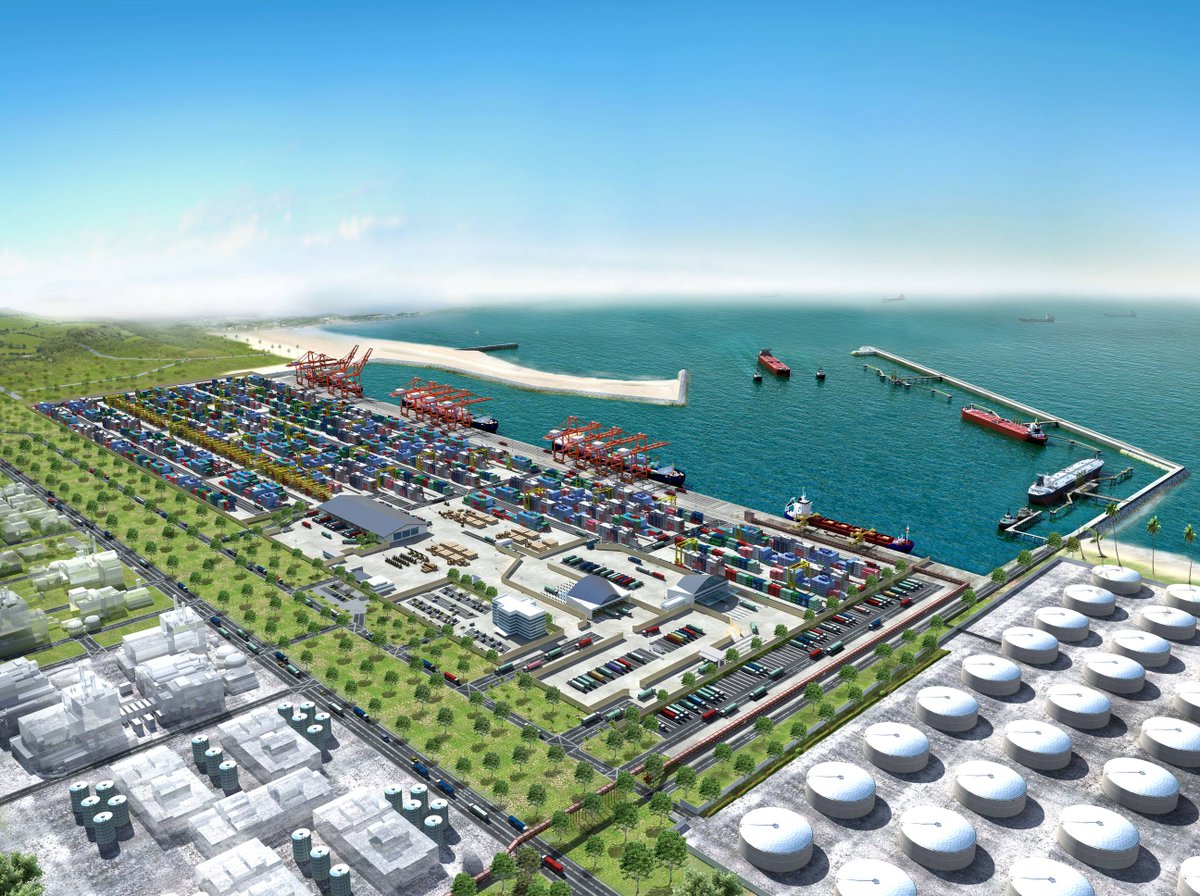
Commercial operations at the Lekki Deep Seaport at the Lagos Free Zone (LFZ) will commence in the first quarter of 2023, says Mr Dinesh Rathi, the company’s CEO.
It was also projected that more than 170,000 direct and indirect job opportunities would be created for residents of Lagos when the deep seaport is completed.
Mr Rathi, while speaking with the Governor of Lagos State, Mr Babajide Sanwo-Olu, on Friday, disclosed that Tolaram Group, a Singaporean company, initiated a $2 billion investment in the Lagos Free Zone, with $950 million committed to developing a manufacturing hub in the zone.
“When the deep seaport is completed, besides that the maritime project was expected to generate more than 170,000 direct and indirect job opportunities for Lagos residents, it would serve as an alternative in an effort to decongest the federal government-owned seaports in Apapa,” he told Mr Sanwo-Olu.
About the Lekki Deep Seaport
The Governor and members of the state’s cabinet embarked on a two-day working tour of the three free trade zones established in Ibeju Lekki area of Lagos.
The project commenced in 2017 under the immediate past administration of Mr Akinwunmi Ambode and it is being constructed by the China Habour Engineering firm.
It is occupying 90 hectares of the entire 830 hectares of land carved out for the Lagos Free Zone. The zone was created in 2012 to enhance the economic position of Lagos as a manufacturing and logistics hub in West Africa.
The first phase of the seaport project, which is being financed by a $629 million facility from China Development Bank (CDB), is at 48 per cent completion.
Governor speaks
After going through the project master plan, Mr Sanwo-Olu said his administration remains committed to delivering the project, stressing that the deep seaport and other investments happening on the corridor had the potential to increase the state’s Gross Domestic Product (GDP) in multiple folds.
He said: “Given the report I got and what I have seen here, I can say that Lagos Free Zone has made tremendous improvement. We have seen the level of partnership Tolaram Group is bringing in terms of international investment and local brands on this corridor.
“I commend all stakeholders that are with us on this journey we have found ourselves. With the level of work we have seen, I’m truly excited. It is more gratifying that we are taking up this assignment with all energies required and we all can see what we can achieve when we work together.
“Since we signed a loan agreement less than 18 months ago, we have demonstrated strong capability in bringing the project to reality. This is the first quarter of 2021 and we have seen the project in about 48 per cent completion. The investors have given us the commitment to the first quarter of the 2023 completion date. We will fulfil all our parts to make sure this date becomes reality.”
Mr Sanwo-Olu, who noted that he had been part of the conversation for the development of the free zones as a Commissioner for Commerce and Industry in 2006, said his administration has recorded significant progress in bringing the projects to reality.
The Governor said the priority accorded to the construction of complementary infrastructure projects along the corridor was a demonstration of his government’s fulfilment of its pledge to Lagos residents. He promised the state would work with the timeline to ensure all projects mapped out in the zones are deliver.
He further said the size of the deep seaport will allow 18,000 twenty-foot equivalent units (TEU) capacity vessels, which are four times bigger than the ones berthing at Apapa seaports, thereby scaling down the cost of container transportation from any part of the world.
Mr Sanwo-Olu said: “The interesting part is that our youths and young women will be the beneficiaries of this project. The project managers have engaged a large number of our citizens in the construction parts of the work; all personnel are not expatriates. All the technical work and technology deployed have a local component to them.
“For us a government, this is the strongest point we have made with the project. I am fully convinced that the delivery of this project will transform the commercial architecture of West Africa and bring about quick turnaround time in the maritime sector.”
Project receives commendation
Chairman of Lagos Free Zone Development Company, Mr Biodun Dabiri, hailed the state government for its commitment towards changing the face of commerce in Africa, stressing that all statutory permits, licences and endorsement for the Lekki port project were already secured.
“There is a strong guarantee that the port will be delivered before time, going by the inflow of capital investment and technical services,” Mr Dabiri said.
The Governor and his entourage also visited Africa’s second-largest manufacturing plant of Kellogg Tolaram, manufacturer of cornflakes, which is built in Lagos Free Zone. The Governor toured the processing unit of the firm and inspected the production chain.
Economy
NASD OTC Exchange Opens Week Lower as Valuation Dips N1.27bn
By Adedapo Adesanya
The NASD Over-the-Counter (OTC) Securities Exchange recorded a marginal 0.05 per cent drop on Monday, June 8, depleting the market capitalisation by N1.27 billion to N2.606 trillion from N2.607 trillion, and cutting the Unlisted Security Index (NSI) by 2.12 points to 4,356.20 points from the previous 4,358.32 points.
The contraction witnessed during the session was triggered by a price loser, which overpowered that gains recorded by two securities on the trading platform.
Data indicated that MRS Oil Plc lost N6 at the close of business to settle at N165.00 per share compared with last Friday’s price of N171.00 per share.
Conversely, Lighthouse Financial Services Plc added 9 Kobo to sell at N1.03 per unit versus 94 Kobo per unit, and Central Securities Clearing System (CSCS) Plc appreciated by 8 Kobo to N78.48 per share from N78.40 per share.
The volume of securities traded by investors yesterday soared by 51.9 per cent to 213,188 units from 140,345 units, and the value of securities increased by 12.6 per cent to N20.2 million from N17.9 million, while the number of deals executed fell by 7.4 per cent to 25 deals from 27 deals.
Great Nigeria Insurance (GNI) Plc remained the most traded stock by value on a year-to-date basis, with 3.4 billion units sold for N8.4 billion, followed by Infrastructure Credit Guarantee (Infracredit) Plc with 2.3 billion units valued at N6.5 billion, and CSCS Plc with 64.8 million units exchanged for N4.4 billion.
GNI Plc also remained as the most traded stock by volume on a year-to-date basis, with 3.4 billion units worth N8.4 billion, trailed by Infracredit Plc with 2.3 billion units transacted for N6.5 billion, and Resourcery Plc with 1.1 billion units traded for N415.7 million.
Economy
Naira Loses Against Dollar Official, Black Markets
By Adedapo Adesanya
The Naira opened the new trading week on a negative note on Monday at the Nigerian Autonomous Foreign Exchange Market (NAFEX) and the black market.
At the parallel market, the Nigerian currency weakened against the US Dollar by N5 to sell for N1,380/$1 compared with the preceding session’s rate of N1,375/$1, and at the GTBank FX desk, it shed N1 to trade at N1,373/$1 versus N1,372/$1.
At the official market, it lost 63 Kobo or 0.05 per cent against the Dollar during the session to close at N1,362.84/$1, in contrast to last Friday’s value of N1,362.21/$1.
However, the Nigerian Naira gained N2.30 against the Pound Sterling at the spot market yesterday, quoting at N1,821.29/£1 compared with the previous rate of N1,823.59/£1, and improved against the Euro by 23 Kobo to settle at N1,574.35/€1 versus N1,574.58/€1.
Data from the Central Bank of Nigeria (CBN) showed that interbank forex turnover increased to $92.248 million across 90 deals, from $73.565 million last Friday.
On the policy front, participants believed that the application of the fourth edition of the Foreign Exchange Manual of the central bank, which introduces updated guidelines for foreign exchange transactions and tightening compliance requirements for authorised dealers and market participants, will enhance market flexibility and ease previous restrictions.
Meanwhile, the cryptocurrency market snapped from recent declines, jolted by Strategy’s purchase of 1,550 Bitcoin for approximately $101 million, increasing its total holdings to 845,256 BTC. The company raised $181 million through common stock sales, using the proceeds to fund the bitcoin purchase and increase its cash reserves to $1 billion, pushing the price of the coin higher by 3.2 per cent to $63,731.69.
Cardano (ADA) appreciated by 8.4 per cent to $0.1738, Ethereum (ETH) rose by 5.2 per cent to $1,711.54, Solana (SOL) expanded by 5.1 per cent to $67.82, and Ripple (XRP) improved by 4.9 per cent to $1.18.
Further, Dogecoin (DOGE) jumped by 4.3 per cent to $0.0873, Binance Coin (BNB) soared by 2.7 per cent to $609.50, and TRON (TRX) increased by 0.7 per cent to $0.3274, while the US Dollar Tether (USDT) and the US Dollar Coin (USDC) remained unchanged at $0.9997 and $0.9998, respectively.
Economy
Economist Tasks FG to Explore Alternative Funding Sources
By Aduragbemi Omiyale
The federal government has been advised to consider exploring other funding sources to finance its budget deficits.
Speaking with Punch recently, the chief executive of CSA Advisory, Mr Aliyu Ilias, said the current appetite for borrowing by the government cannot be sustained because it elevates debt-servicing costs.
The economist suggested the sale of some public assets and the involvement of the private sector in infrastructure financing for economic growth.
According to him, running to the debt markets to raise funds for the government is not the best route to take, as the reliance on borrowing always leads to higher debt-servicing obligations.
“The more you borrow, the more you are also incurring more debt services,” he said, tasking the government to also capitalise on increased oil revenues stemming from ongoing geopolitical tensions in the Middle East.
“The government can actually sell off some of their assets to raise more money. The government can also, if you look at the revenue we are getting from oil, it’s getting more, especially with this war. It’s another opportunity for us to actually not borrow again,” Mr Ilias submitted.
He also pointed to ongoing tax reforms as another avenue to improve government finances and narrow the fiscal gap.
“The government can also look at tax reform. The fact is that the government does not have money. The only chance for getting more money is to address the financial deficit,” he added.
-
Feature/OPED6 years agoDavos was Different this year
-
Travel/Tourism10 years ago
Lagos Seals Western Lodge Hotel In Ikorodu
-
Showbiz3 years agoEstranged Lover Releases Videos of Empress Njamah Bathing
-
Banking8 years agoSort Codes of GTBank Branches in Nigeria
-
Economy3 years agoSubsidy Removal: CNG at N130 Per Litre Cheaper Than Petrol—IPMAN
-
Banking3 years agoSort Codes of UBA Branches in Nigeria
-
Banking3 years agoFirst Bank Announces Planned Downtime
-
Sports3 years agoHighest Paid Nigerian Footballer – How Much Do Nigerian Footballers Earn