Connect with us

Economy

Adedeji Urges Nigeria to Add More Products to Export Basket

Published

on

nigeria Export Basket

By Adedapo Adesanya

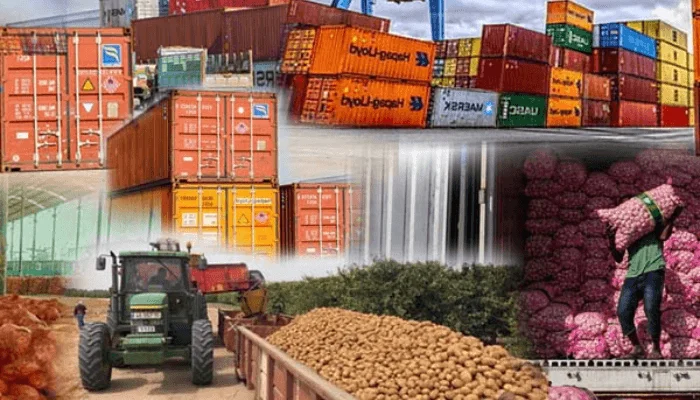
The chairman of the Nigeria Revenue Service (NRS), Mr Zacch Adedeji, has urged the country to broaden its export basket beyond raw materials by embracing ideas, innovation and the production of more value-added and complex products

Mr Adedeji said this during the maiden distinguished personality lecture of the Faculty of Administration, Obafemi Awolowo University (OAU), Ile-Ife, Osun State, on Thursday.

The NRS chairman, in the lecture entitled From Potential to Prosperity: Export-led Economy, revealed that Nigeria experienced stagnation in its export drive over three decades, from 1998 to 2023, and added only six new products to its export basket during that period.

He stressed the need to rethink growth through the lens of complexity by not just producing more of the same stuff, lamenting that Nigeria possesses a high-tech oil sector and a low-productivity informal sector, as well as lacking “the vibrant, labour-absorbing industrial base that serves as a bridge to higher complexity,” he said in a statement by his special adviser on Media, Dare Adekanmbi.

Mr Adedeji urged Nigeria to learn from the world by comparative studies of success and failure, such as Vietnam, Bangladesh, Indonesia, South Africa, and Brazil.

“We are not just looking at numbers in a vacuum; we are looking at the strategic choices made by nations like Vietnam, Indonesia, Bangladesh, Brazil, and South Africa over the same twenty-five-year period. While there are many ways to underperform, the path to success is remarkably consistent: it is defined by a clear strategy to build economic complexity.

“When we put these stories together, the divergence is clear. Vietnam used global trade to build a resilient, complex economy, while the others remained dependent on natural resources or a single low-tech niche.

“There are three big lessons here for us in Nigeria as we think about our roadmap. First, avoiding the resource curse is necessary, but it is not enough. You need a proactive strategy to build productive capabilities,” he stated, adding that for Nigeria, which is at an even earlier stage of development and even less diversified than these nations, the warning is stark.

“Relying solely on our natural endowments isn’t just a path to stagnation; it’s a path to regression. The global economy increasingly rewards knowledge and complexity, not just what you can dig out of the ground. If we want to move from potential to prosperity, we must stop being just a source of raw materials and start being a source of ideas, innovation, and complex products,” the taxman stated.

He added that President Bola Tinubu has already begun the difficult work of rebuilding the economy, building collective knowledge to innovate, produce, and build a resilient economy.


Adedapo Adesanya is a journalist, polymath, and connoisseur of everything art. When he is not writing, he has his nose buried in one of the many books or articles he has bookmarked or simply listening to good music with a bottle of beer or wine. He supports the greatest club in the world, Manchester United F.C.

Click to comment

Leave a Reply

Your email address will not be published. Required fields are marked *

Economy

Finance Ministry Orders NAICOM to Suspend Nigeria Re, NICON Recapitalisation Fees

Published

on

NAICOM

By Adedapo Adesanya

The Federal Ministry of Finance has directed the National Insurance Commission (NAICOM) to suspend enforcement of disputed recapitalisation fees and a directive requiring NICON Insurance Limited and the Nigeria Reinsurance Corporation to transfer their entire fresh capital into an escrow account with the Central Bank of Nigeria (CBN).

The ministry also demanded a detailed response and legal justification from NAICOM over assessments of N305 million against NICON and N375 million against Nigeria Re as part of the ongoing insurance industry recapitalisation exercise.

The directive was contained in a letter dated August 6, 2026, signed by the Permanent Secretary, Finance, Mr Raymond Omachi, on behalf of the Minister of Finance and Coordinating Minister of the Economy, Mr Taiwo Oyedele.

The letter followed a July 27 petition by NICON and Nigeria Re over the implementation of the Nigerian Insurance Industry Reform Act, 2025. The companies challenged NAICOM’s demand for a one per cent capital injection fee, alongside processing and verification charges under the commission’s Minimum Capital Requirement Guidelines.

They also disputed a directive requiring existing insurance companies to transfer their entire recapitalisation funds into a CBN escrow account, arguing that Section 16(3) of NIIRA 2025 provides for a statutory deposit of only 10 per cent.

According to the Finance Ministry, NICON and Nigeria Re had injected N20 billion and N30 billion respectively into Mudaraba Term Deposit accounts with Lotus Bank, exceeding their adjusted capital requirements of N16 billion and N28 billion.

The companies also deposited N2.5 billion and N3.5 billion respectively with the CBN as statutory deposits and paid initial fees of N80 million and N75 million.

The ministry said the companies therefore considered themselves compliant with the July 31, 2026 recapitalisation deadline.

“Pending the determination of the petition, the Commission should suspend the enforcement of the contested processing fees, 1 per cent capital injection fee demands, and full-capital escrow transfer directives against NICON Insurance Limited and Nigeria Reinsurance Corporation,” the letter stated.

The ministry consequently asked NAICOM to explain the basis and legal justification for the disputed charges and escrow requirement.

The intervention comes amid the Federal Government’s efforts to strengthen the capital base of insurance companies and reinsurers, improve their capacity to underwrite larger risks and enhance the sector’s contribution to economic development.

The dispute, however, has raised questions over the extent of NAICOM’s authority to impose additional fees and require existing insurers to place their entire recapitalisation funds in escrow.

The Finance Ministry’s letter did not disclose whether NAICOM had responded to the issues raised. It also referenced an alleged N500 million demand and an additional N180 million capitalisation charge in its subject, although the substantive section specifically put the disputed assessments at N305 million for NICON and N375 million for Nigeria Re.

For now, enforcement of the contested fees and full-capital escrow directive against the two state-owned insurers has been suspended pending NAICOM’s response and legal clarification.

Continue Reading

Economy

NASD Exchange Sheds 0.32% 11 Plc Leads Losers’ Chart

Published

on

NASD Exchange bullish

By Adedapo Adesanya

Four price decliners overpowered the two price gainers recorded at the NASD Over-the-Counter (OTC) Securities Exchange on Monday, August 10, weakening it by 0.32 per cent at the close of transactions.

The advancers were led by Food Concepts Plc, which chalked up 25 Kobo to sell at N2.75 per unit versus the previous price of N2.50 per unit, and Mass Telecoms Innovation Plc appreciated by 3 Kobo to 35 Kobo per share from 32 Kobo per share.

However, 11 Plc lost N24.75 to close at N222.75 per unit versus N247.50 per unit, FrieslandCampina Wamco Nigeria Plc declined by N3.09 to N145.00 per share from N148.09 per share, Industrial and General Insurance (IGI) Plc went down by 5 Kobo to 50 Kobo per unit from 55 Kobo per unit, and Geo-Fluids Plc slid by 1 Kobo to N2.27 per share from N2.28 per share.

As a result, the market capitalisation contracted by N8.94 billion to N2.798 trillion from the previous session’s N2.807 trillion, and the NASD Security Index (NSI) retreated by 14.9 points to 4,663.18 points from 4,678.08 points.

The trading data showed that the volume of securities exchanged by investors rose by 108.9 per cent to 1.1 million units from 535,7560 units, and the value of securities jumped by 69.5 per cent to N10.2 million from N6.0 million, while the number of deals executed receded by 2.8 per cent to 35 deals from 36 deals.

Great Nigeria Insurance (GNI) Plc closed the trading session as the most traded stock by value on a year-to-date basis, with 3.4 billion units exchanged for N8.4 billion, followed by Infrastructure Credit Guarantee (Infracredit) Plc with 2.3 billion units valued at N6.5 billion, and Central Securities Clearing System (CSCS) Plc with 77.0 million units transacted for N5.5 billion.

GNI Plc also ended the day as the most traded stock by volume on a year-to-date basis, with 3.4 billion units worth N8.4 billion, followed by Infracredit Plc with 2.3 billion units sold for N6.5 billion, and Resourcery Plc with 1.1 billion units traded for N415.7 million.

Continue Reading

Economy

Naira Gains N5.55, Sells N1,360/$1 at Official Market

Published

on

naira official market

By Adedapo Adesanya

The Naira opened the week on a positive note, appreciating against the US Dollar by N5.55 or 0.41 per cent in the Nigerian Autonomous Foreign Exchange Market (NAFEM) on Monday, August 10, to N1,360.14/$1 from N1,365.69/$1.

The domestic currency also improved its exchange rate against the Pound Sterling in the official market during the session by 67 Kobo to sell at N1,838.50/£1 compared with the preceding session’s N1,839.17/£1, and gained N4.64 against the Euro to quote at N1,571.09/€1, in contrast to last Friday’s N1,575.73/€1.

However, the Naira maintained stability against the Dollar in the black market and the GTBank forex counter on Monday at N1,400/$1 and N1,371/$1, respectively.

Data from the Central Bank of Nigeria (CBN) showed that interbank FX turnover fell by 46 per cent yesterday to $213.845 million from the $393.477 million recorded at the close of trading on Friday.

The decline came despite a sharp increase in the volume of foreign exchange transactions executed during the session, indicating weaker participation by high-ticket FX customers and other major market participants.

The lower turnover suggests reduced demand for FX among large-scale buyers, even as market makers continued to facilitate transactions through the NAFEM window, with the number of FX traded rising to 182 from 102.

In the cryptocurrency market, traders and investors took profit as broader markets’ focus shifted to rising bond yields, higher oil prices and upcoming US inflation data.

Cardano (ADA) depreciated by 5.2 per cent to $0.1873, Ethereum (ETH) slipped by 2.6 per cent to $1,873.43, Ripple (XRP) slumped by 2.3 per cent to $1.01, Bitcoin (BTC) fell by 1.8 per cent to $63,949.22, Solana (SOL) crashed by 1.3 per cent to $75.81, and Binance Coin (BNB) tumbled by 0.6 per cent to $599.49.

But TRON (TRX) gained 0.5 per cent to trade at $0.3314, and Dogecoin (DOGE) grew by 0.2 per cent to $0.0700, while the US Dollar Tether (USDT) and the US Dollar Coin (USDC) traded flat at $1.00 apiece.

Continue Reading