Connect with us

Economy

AfDB Okays $20m for Road Upgrade in Comoros

Published

on

By Modupe Gbadeyanka

The African Development Bank Group will help the Union of Comoros Government to diversify its economy with a $20.4-million road network rehabilitation project grant approved by the Board of Directors on Monday, January 23, 2017.

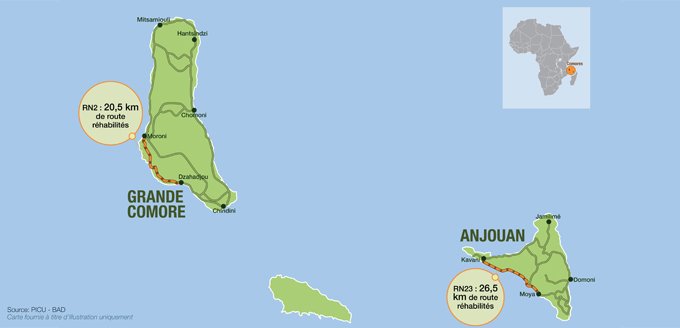
The project will be implemented in four years to 2020 in the islands of Grande Comore and Anjouan, which account for 94% of the country’s total population of almost 756,000 inhabitants.

The project will focus on improving the quality of key roads infrastructure on the National Road-2 and Road-23 to boost trade and spur economic growth. The road network rehabilitation will improve traffic flow and the movement of people as well as access to basic services and the living conditions of the population.

Economic activities in the Comoros are focused mainly in the agricultural and tertiary sectors. However, the poor quality of infrastructure, especially road infrastructure and related services has been identified as is one of the major constraints to economic diversification in the country.

According to the Bank, improvement and extension of the national road networks would help to develop the tourism and fisheries sectors which have been identified as potential growth poles for the national economy.

The project comprises rehabilitation of a 47-kilometre stretch; protection against sea erosion; support measures for women’s empowerment and institutional capacity building using procurement and institutional reform specialists.

It is in line with the Comoros’ development strategies, policies and plans, especially the national transport strategy for 2030 as well as the Bank’s Country Strategy Paper (CSP) 2016-2020.

The project will be funded with the African Development Fund (ADF) and European Union grants over four years at a total cost of $36.5 million.


Modupe Gbadeyanka is a fast-rising journalist with Business Post Nigeria. Her passion for journalism is amazing. She is willing to learn more with a view to becoming one of the best pen-pushers in Nigeria. Her role models are the duo of CNN's Richard Quest and Christiane Amanpour.

Click to comment

Leave a Reply

Your email address will not be published. Required fields are marked *

Economy

Sell-offs in Financial, Energy Equities Extend NGX Losing Streak to Eight Straight Sessions

Published

on

Financial Equities

By Dipo Olowookere

For the eighth straight session, the Nigerian Exchange (NGX) closed lower, losing 0.32 per cent at the close of business on Thursday as a result of continued sell-offs.

Yesterday, the financial and energy sectors came under selling pressure as investors’ appetite for domestic equities waned, with attention turning to the 2027 presidential campaigns, which kicked off on Wednesday.

The energy index shed 2.49 per cent, the insurance sector depreciated by 0.79 per cent, and the banking segment declined by 0.41 per cent. But the consumer goods space gained 0.10 per cent, while the industrial goods counter closed flat.

When the market closed for the day, the All-Share Index (ASI) contracted by 712.67 points to 240,037.80 points from 240,750.47 points, and the market capitalisation decreased by N439 billion to N154.978 trillion from N155.417 trillion.

International Energy Insurance slumped by 9.85 per cent to N4.30, Coronation Insurance dropped 9.84 per cent to trade at N2.20, Fortis Global slipped by 9.76 per cent to N1.85, AVA Capital crashed by 7.89 per cent to N7.00, and Zichis shrank by 7.36 per cent to N17.00.

On the other side, Haldane McCall rose by 9.38 per cent to N3.85, Trans-Nationwide Express jumped by 8.90 per cent to N3.06, McNichols appreciated by 8.33 per cent to N5.20, Cutix gained 2.56 per cent to close at N2.40, and Veritas Kapital expanded by 1.52 per cent to N1.34.

Business Post reports that Customs Street recorded 14 advancing stocks and 29 declining stocks, representing a negative market breadth index and weak investor sentiment.

A total of 2.9 billion shares worth N34.0 billion were transacted in 34,725 deals during the session versus the 1.2 billion shares valued at N37.8 billion traded in 34,546 deals at midweek. This showed that the trading value moderated by 10.05 per cent, while the trading volume and number of deals increased by 141.67 per cent and 0.59 per cent apiece.

Fortis Global Insurance was on top of the activity chart yesterday, with a turnover of 2.6 billion equities valued at N5.2 billion. Sterling Holdings exchanged 28.1 million shares worth N211.4 million, Trans-Nationwide Express transacted 21.7 million stocks for N66.2 million, UBA sold 17.9 million equities worth N803.7 million, and First Holdco traded 15.7 million shares valued at N2.0 billion.

Continue Reading

Economy

Oil Rallies to One-Month High as Trump Targets Iran Backers

Published

on

Brent crude oil price

By Adedapo Adesanya

Oil jumped more than 2 per cent on ‌Thursday to its highest level in nearly a month, after US President Donald Trump warned of retaliation against nations supporting Iran.

Brent crude futures gained $2.16 or ​2.4 per cent to trade at $93.78 a barrel, while the US West Texas Intermediate (WTI) crude futures for September ​rose by $2 or 2.3 per cent to $87.83 a barrel.

President Trump has threatened sweeping economic measures against Iran, warning countries that provide Iran with “any type of lifeline” that they could face severe consequences.

The American President described the planned campaign as “economic warfare and isolation on an unprecedented scale,” as the US seeks to intensify pressure on Tehran nearly six months into the conflict.

US Treasury Secretary Scott Bessent said the Trump-led administration would impose what he called the “toughest sanctions in history” on Iran and urged China and other countries to cooperate with the campaign.

Mr Bessent said he would hold a press conference on Monday to provide details of the measures, which he said would complement the US blockade of Iran.

Concerns about stricter sanctions enforcement against Iran added to anxiety about the risk to supply in the Middle East.

The economic offensive comes as the war, which began on February 28 after the US and Israel launched military strikes on Iran, has killed thousands of people and severely disrupted energy supplies.

Iran’s blockade of the Strait of Hormuz, a key route for global oil and gas shipments, and attacks on energy infrastructure across the Middle East have sharply reduced the flow of energy to international markets.

The latest US threats mark an escalation in the US’s economic pressure on Iran, with Trump also warning countries that continue to trade with or support Iran that they could face punitive measures. Iran has dismissed the campaign as “economic terrorism” and a continuation of failed US policies.

Shipping traffic through the Strait of Hormuz remains far below ​pre-war levels, according to the ​latest shipping data. Prior to ⁠the Iran war, shipments equal to about one-fifth of global consumption moved through the waterway.

This week, the United Arab Emirates suspended all financial and economic transactions with Iran until further notice, highlighting ​the fraught ties between the major Gulf Arab oil producer and Iran. The war has also ​impacted the supply ⁠of refined fuels and drawn down inventories, with less crude available to refiners.

Continue Reading

Economy

NECA Demands Accountability for N10.4tn Subsidy Funds Shared to States, LGs

Published

on

NECA Nigeria

By Adedapo Adesanya

The Nigeria Employers’ Consultative Association (NECA) has called on state and local governments to account for the N10.4 trillion they received from resources generated following the removal of the petrol subsidy.

The Director-General of NECA, Mr Adewale-Smatt Oyerinde, made the call on Channels Television’s Sunrise Daily on Thursday morning, a day after the Minister of Finance and Coordinating Minister of the Economy, Mr Taiwo Oyedele, disclosed details of the financial impact of the federal government’s economic reforms.

Mr Oyedele had said the removal of the petrol subsidy and reforms to the foreign exchange market mobilised N15.8 trillion for the Federation between June 2023 and December 2025.

According to the minister, the federal government received N5.4 trillion of the amount, while N10.4 trillion was distributed to state and local governments through the Federation Account.

Reacting to the disclosure, Mr Oyerinde said the states and local governments should now provide details of how the funds they received were utilised.

He particularly called on state commissioners for finance to disclose the amounts their respective governments received and how the funds were spent.

“Absolutely. I think it should trickle down. The commissioners of finance in states, you come out and also say, this is how much we’ve received; this is how much we have spent,” he said on the television programme.

Mr Oyerinde compared the expected disclosure by governments to the financial reporting obligations of private businesses, where companies present audited accounts and performance reports to shareholders.

“We believe strongly that as private businesses, at the end of the year you audit your accounts, you present your scorecard to your shareholders to gauge what we have done. The Minister of Finance has led the way now, and the states also should follow,” he said.

The NECA director-general urged state governments to provide a breakdown of the funds received, the challenges encountered and how the money was deployed.

“And so this is how much we have received. These are the constraints we face, and this is how we have expended this amount. I think we should move progressively towards transparency in government,” he said.

Mr Oyerinde commended the Federal Government for publicly disclosing details of its finances, describing the presentation by the finance minister as a step towards greater transparency in public administration.

He said the level of detail provided by Mr Oyedele would enable citizens and other stakeholders to better scrutinise government spending and assess the impact of the reforms.

The NECA boss also said greater disclosure by the sub-national governments would allow citizens to engage state and local governments more constructively on the use of public funds.

“I also put citizens, and I must say this, citizens are also in a good position now to engage constructively, engage the state governments constructively, and also engage local governments constructively, because that is where development should actually start,” Mr Oyerinde said.

Continue Reading