Connect with us

Economy

Agriculture Economic Empowerment Tool—Youths

Published

on

By Modupe Gbadeyanka

The agro-allied industrialization of the African continent cannot materialize without the involvement of the youths because they have the right drive and energy, participants at a Tuesday session of the 2016 African Economic Conference that focused on youth entrepreneurship in agriculture said.

“I say and I hope you join me to say that agribusiness is not the future. It is the now,” said Oyin Asaaju, a young Nigerian who is excited about agribusiness.

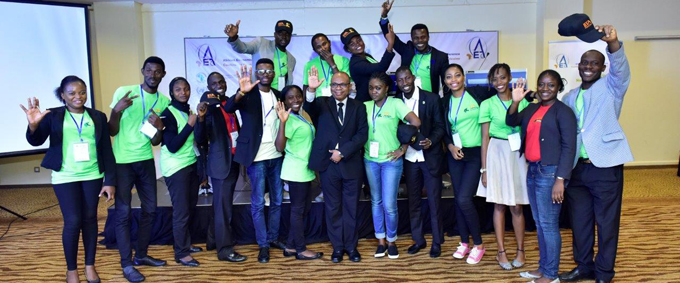
Indeed, participants in the International Institute for Tropical Agriculture (IITA) youth agripreneurs scheme have affirmed agriculture as an economic empowerment tool.

They exhibited some of their products, most of which were made from cassava, a staple crop, at the session to the delight of participants and visitors. They further voiced their views at two different debate sessions where they shared their views on “Agriculture: A sector of economic opportunities for African youths.”

“Agri-business is not the future. It is the now,” said Assaju, who explained how the IITA agriculture apprenticeship scheme, ENABLE (Empowering Novel Agri-Business-Led Employment) Youth, had changed her perception about agriculture, describing the sector as a viable earner.

Two years ago, Asaaju kept late nights serving drinks at a bar. Now her late nights are about thought-provoking assignments that must result in food solutions.

“I would like to thank the African Development Bank for the support. Like many other youths, when I graduated from the university, I couldn’t find an idle job, so I took on the job of a waitress. I was learning some skills. More than anything else, I wanted to engage in something more challenging. The job wasn’t giving me that. I learnt about the youth agripreneur programme when I had to serve food and drinks to a group of young people at a party at IITA. I have had the opportunity of joining the group. These young people happen to be the notable IITA youth agripreneurs that you see in the hall today, who today are my colleagues,” she said to the rousing applause from participants.

So far Assaju and her team have been trained in value addition, business development and soft skills. She is now able to convert farm produce into finished products, and has had the opportunity of representing the group at two international conferences, in South Africa and the United States.

“These have helped build my capacity professionally. In February this year, I was transferred with some colleagues to the IITA station in Onne, Rivers State. Rivers is an oil-producing state, but we have taken agri-business there – not to compete, but because we must go back to the basics. In a space of 10 months, we have been able to establish demonstration plots in cassava, rice and plantain. We are into the production of catfish and plantain suckers. So far we have been able to involve 40 rural youths in our activities,” she noted.

She said her team is currently unable to meet its market demands for cassava and catfish, which she considers a good platform for investment.

She declared: “We, the youths, have decided to lead this agri-business movement, not only to create job opportunities, but also to restore the strength of Nigeria as the giant of Africa and to have Africa be the bread basket of the world.”

Just like Assaju, other youths in the agri-business apprenticeship scheme – Mercy Wakawa and Zacchaeus Isuwa – were emphatic in their testimonies.

Youth engagement in agri-business through the IITA has shown that the generation does have a role to play in changing the face of farming in Africa, they said.

The annual African Economic Conference is organized by the African Development Bank (AfDB), the UN Economic Commission of Africa (ECA) and the United Nations Development Programme (UNDP).

ENABLE Youth is a programme for young African people (18-35 years old) wanting to start a business in the agricultural sector, borne out of the African Development Bank’s Dakar High Level Conference on Agricultural Transformation in Africa and with the support of the International Institute of Tropical Agriculture, which is headquartered in Abuja, Nigeria. The programme works to promote, enhance, and modernize agricultural entrepreneurship in Africa. In order to do this, the African Development Bank offers its support in capacity strengthening, promoting professionals working in agriculture, and financing projects of young people in the sector.

ENABLE Youth is working to help launch 300,000 agribusinesses and create 8 million jobs in some 30 African countries over the next five years. Above all, it is counting on young people to develop Africa’s agricultural future, an African agriculture that relies on innovation, technologies, and modernization of techniques and practices, as well as on the development of the value chain in the sector.


Modupe Gbadeyanka is a fast-rising journalist with Business Post Nigeria. Her passion for journalism is amazing. She is willing to learn more with a view to becoming one of the best pen-pushers in Nigeria. Her role models are the duo of CNN's Richard Quest and Christiane Amanpour.

Economy

Peter Obi Raises Eyebrows Over Tinubu’s $11.6bn Debt Servicing Plan

Published

on

peter obi

By Aduragbemi Omiyale

The presidential candidate of the Labour Party in the 2023 general elections, Mr Peter Obi, has expressed worry over plans by the administration of President Bola Tinubu to spend about $11.6 billion on debt servicing.

In a post on his social media platform on Monday, the opposition politician criticised this move, saying it is not good for the country.

He also said this action “should concern anyone interested in the country’s economic future and long-term development.”

The former Governor of Anambra State kicked against the penchant of the government to borrow from various sources without anything to show for it.

“There is nothing inherently wrong with borrowing when it is guided by prudence and directed toward productive investment, he noted, stressing that countries such as Japan, the United Kingdom, the United States, the United Arab Emirates, Singapore, and Indonesia are all heavily indebted, yet their borrowings are largely channelled into education, healthcare, infrastructure, and innovation – sectors that generate long-term economic returns and sustain repayment capacity.”

According to him, “despite high debt levels, their obligations remain more manageable because they are tied to measurable productivity.”

He said, “Nigeria’s situation, however, is markedly different. A huge proportion of past borrowing has been directed toward consumption, with limited visible or sustainable developmental outcomes to justify the scale of indebtedness.”

“It is also important to note that a huge portion of the debt currently being serviced was accumulated under the Tinubu administration itself, while borrowing has continued at a significant pace. The administration’s recent external borrowing alone includes about $6 billion (from First Abu Dhabi Bank in the UAE—$5 billion, and UK Export Finance via Citibank London—$1 billion), a further $1.25 billion under consideration from the World Bank, and an additional $516 million arranged through Deutsche Bank, bringing the latest known external loan commitments to roughly $7.8 billion. In addition, domestic borrowing through monthly bond issuances continues to add to the overall debt stock,” the businessman also stated.

“Against this backdrop, Nigeria’s 2026 budget shows that health is N2.46 trillion, education is N2.56 trillion, and poverty alleviation is N865 billion, giving a combined total of about N5.885 trillion for these three critical sectors.

“By comparison, debt servicing at about $11.6 billion (approximately N17–N18 trillion, depending on exchange rate assumptions) is almost three times higher than the total allocation to health, education, and social protection combined. This imbalance highlights a troubling fiscal reality in which debt obligations increasingly crowd out investment in human capital and poverty reduction.

“Moreover, even within the limited allocations to these sectors, funds may not be fully released, and a significant portion of what is eventually released could be misappropriated,” he further stated.

Mr Obi said, “The central issue is not borrowing itself, but whether borrowed funds are being converted into measurable productivity, inclusive growth, and improved living standards. Without this, debt servicing shifts from being a temporary fiscal obligation to a long-term structural burden that constrains development and deepens economic vulnerability.”

Continue Reading

Economy

Pathway Advisors Closes Fresh N16.76bn Oversubscribed Veritasi Homes CP

Published

on

Pathway Advisors Limited

By Adedapo Adesanya

Pathway Advisors Limited, an issuing house and financial advisory firm, has announced the successful completion of the Series 2 Commercial Paper issuance for Veritasi Homes & Properties Plc.

The Series 2 offer, issued under Veritasi Homes’ newly registered N20.00 billion Commercial Paper Programme, raised N16.76 billion, significantly above its initial N12.00 billion target on the back of strong institutional demand.

This issuance builds on the company’s track record in the Nigerian debt capital market and follows the recently concluded N10 billion 3-year 20 per cent  Series 1 Fixed Rate Bond Issuance, further reinforcing investor confidence in Veritasi Homes’ strong credit profile.

The 364-day tenor instrument attracted robust participation from a diverse pool of institutional investors, underscoring sustained confidence in the Company’s financial strength, operating model, and governance standards.

Commenting on the deal, the Founder/CEO of Pathway Advisors Limited, Mr Adekunle Alade (MBA, FCA, M.CIod), noted that the outcome further validates investor appetite for well-structured transactions in the Nigerian capital market.

“The strong oversubscription speaks to the market’s confidence in Veritasi Homes’ performance, governance, and repayment track record. We are pleased to continue supporting issuers with strong fundamentals in accessing efficient funding.’’

He further highlighted that Veritasi Homes’ consistent market activities since 2022, including successful issuances and full redemption of matured obligations, continue to strengthen its reputation among institutional investors.

“Pathway Advisors Limited remains committed to maintaining its leadership position within Nigeria’s capital markets through the origination and execution of transformative, value-driven, and commercially viable transactions by deploying innovative financial solutions and facilitating strategic capital formation across critical sectors.

“We are committed to supporting credible corporates in accessing efficient short-term and long-term financing solutions within the Nigerian capital market,” he said in a statement on Monday.

Speaking on the transaction, the Managing Director/CEO of Veritasi Homes & Properties Plc, Mr Nola Adetola, described the outcome as a strong endorsement of the company’s fundamentals.

“This result reflects the resilience of our business model, our growing market reputation, and the continued trust of the investment community. We are grateful to all institutional investors for their confidence in Veritasi Homes.”

He added that the proceeds from the issuance will be deployed to support the company’s working capital requirements, enhance liquidity, and complete the ongoing development activities across its real estate portfolio.

Mr Adetola also commended Pathway Advisors Limited for its advisory and arranging role in the successful execution of the transaction.

Continue Reading

Economy

SEC Okays Migration to T+1 Settlement Cycle for Capital Market Transactions

Published

on

Investments and Securities Act 2025

By Aduragbemi Omiyale

The Securities and Exchange Commission (SEC) has approved the transition to the T+1 settlement cycle for capital market transactions from June 1, 2026.

This is coming some months after Nigeria moved from the T+3 settlement cycle to the T+2 settlement cycle.

The T+ settlement cycle is the number of working days required to complete a capital market transaction, such as the trading of securities, shares, and others, from the first day the trade was executed by an investor.

In a notice on Monday, the SEC, which is the apex capital market regulator in Nigeria, said it was authorising the new system to “promote an efficient, fair, and transparent capital market.”

Under the new arrangement, equities and commodities traded by investors at the market would be cleared and settled by the Central Securities Clearing System (CSCS) within one day.

The agency noted that the migration to a T+1 settlement cycle forms part of its ongoing market modernisation initiatives aimed at enhancing market efficiency and strengthening risk management. reducing counterparty exposure, improving liquidity, and aligning the Nigerian capital market with international standards and global best practices.

“Accordingly, all eligible trades executed in the Nigerian capital market shall settle one business day after the trade date (T+1),” a part of the statement noted.

It was stressed that “Friday, May 29, 2026, shall be the final trading day under the existing T+2 settlement cycle. Trades executed on Friday, May 29, 2026, and Monday, June 1, 2026, shall both settle on Tuesday, June 2, 2026. All trades executed from Monday, June 1, 2026, onward shall be subject to the T+1 settlement cycle.”

SEC tasked all capital market operators, securities exchanges, clearing and settlement infrastructure providers, custodians, registrars, issuers, and other relevant stakeholders to take all necessary measures to ensure full operational readiness and compliance with the new settlement framework.

“Market participants are expected to review and align their systems, processes, controls, and operational workflows ahead of the implementation date,” it further stated, promising to continue to engage stakeholders and monitor the implementation process to ensure an orderly and seamless transition.

The regulator said it remains committed to strengthening market integrity, enhancing investor confidence, and fostering the development of a modern. resilient and globally competitive Nigerian capital market.

Continue Reading

Trending