Economy
Anxiety as Naira Nears N1000/$1 at Parallel Market
By Adedapo Adesanya
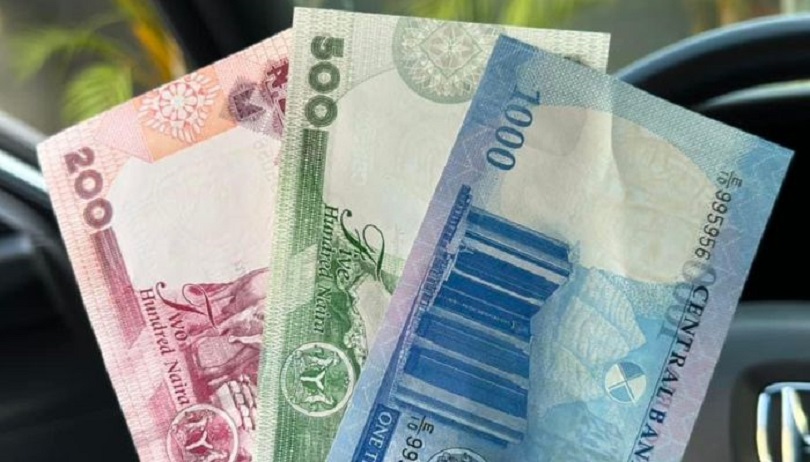
All is not well with the Naira in the parallel market and the peer-to-peer (P2P) segments of the foreign exchange (FX) market in Nigeria, with its exchange rate against the Dollar nearing N1000.
At the black market on Thursday, the Nigerian Naira depreciated against the US Dollar by N25 to sell at N995/$1 compared with the preceding session’s value of N970/$1.
It was a similar story with the local currency in the P2P wing of the forex market as it lost N22 against the greenback yesterday to quote at N992/$1, in contrast to Wednesday’s exchange rate of N970/$1.
Business Post reports that the two markets took advantage of the uncertainty in the leadership status of the Central Bank of Nigeria (CBN).
On Thursday, the apex bank postponed the interest rate setting meeting scheduled for September 25-26, and it was speculated that there is a vacuum in the CBN leadership as the acting Governor, Mr Folashodun Shonubi, and four deputy governors have allegedly resigned.
The nominated candidate to fill the post, a former Citigroup executive, Mr Olayemi Cardoso, is yet to be confirmed by the Senate, which resumes from recess next Tuesday.
But in the Investors and Exporters (I&E) window, the Naira appreciated against the American currency during the session by 4.2 per cent or N32.71 to close at N738.00/$1 versus the midweek session’s N770.71/$1.
The strengthening of the domestic currency in the official was supported by the supply of FX into the space, with the value of transactions rising by 236.7 per cent or $152.32 million to $216.68 million from the $64.36 million achieved a day earlier.
Also in the spot market, the Naira appreciated against the Euro yesterday by N36.85 to close at N787.31/€1 compared with the previous day’s N824.16/€1 and closed flat against the Pound Sterling at N953.55/£1.
In the cryptocurrency market, momentum dropped following the US Federal Open Market Committee (FOMC) meeting, with investors watching the clock. It had been anticipated that a rate pause would spur optimism among investors, but that was not the case.
Bitcoin (BTC) dropped 1.6 per cent to close at $26,640.48, Ethereum (ETH) went down by 1.9 per cent to $1,592.22, Dogecoin (DOGE) shed 2.03 per cent to sell at $0.0616, Cardano (ADA) slid by 1.9 per cent to trade at $0.2457, Solana (SOL) depreciated by 1.8 per cent to $19.64, Binance Coin (BNB) slumped by 1.5 per cent to $211.17, and Ripple (XRP) recorded a 0.8 per cent loss to quote at $0.5121.
Conversely, Litecoin (LTC) gained 0.3 per cent to trade at $64.71, and the US Dollar Tether (USDT) and Binance USD (BUSD) traded flat at $1.00 each.
Economy
NRS, JRB Issue Guidelines for Taxation of Virtual Assets
By Adedapo Adesanya
The Nigeria Revenue Service (NRS) and the Joint Revenue Board (JRB) have issued new guidelines clarifying the taxation of virtual assets in Nigeria.
The guidelines provide an administrative framework for the taxation of virtual assets and specify the tax obligations of individuals and businesses operating in the sector.
According to a public notice issued by the two agencies, the framework covers registration, reporting and record-keeping requirements, valuation principles and the tax treatment of virtual asset transactions.
It applies to taxpayers, Virtual Asset Service Providers (VASPs), peer-to-peer (P2P) marketplace operators, tax practitioners and other persons engaged in virtual asset-related activities.
The NRS and JRB said the guidelines were developed in line with the provisions of the Nigeria Tax Act 2025 and the Nigeria Tax Administration Act 2025.
The two bodies said the release was aimed at providing clarity, certainty and consistency in the administration of Nigeria’s tax laws as the country’s virtual asset ecosystem continues to evolve.
The agencies added that the framework would promote voluntary compliance, enhance transparency and support the development of a fair and efficient tax system for digital asset transactions.
They urged all affected taxpayers and stakeholders to familiarise themselves with the guidelines and ensure compliance with the applicable tax obligations.
The guidelines are available on the official websites of the two agencies.
Economy
Nigerian Manufacturers Still Grapple With Multiple Taxes Despite Reforms—MAN
By Adedapo Adesanya
Manufacturers are yet to benefit from relief on the burden of multiple taxes and levies despite the enactment of the Nigeria Tax Act 2025, according to the Manufacturers Association of Nigeria (MAN).
The association, in its Manufacturers CEO Confidence Index (MCCI) report for the second quarter of 2026, said manufacturers continued to face multiple tax collectors and regulatory agencies during the period.
Director-General of MAN, Mr Segun Ajayi-Kadir, said the new tax law, which was expected to reduce the burden of multiple taxation, had yet to deliver the intended benefits.
“Manufacturers complained that they were still met with multiple tax collectors and regulators in Q2 2026. It follows that the implementation of the Nigeria Tax Act 2025 is yet to achieve its objective of relieving manufacturers of the burden of taxes and levies,” he said.
According to the report, Nigeria’s business environment remains largely unsupportive of manufacturing growth, with local sourcing of raw materials emerging as the only indicator that recorded noticeable improvement.
MAN, however, warned that the gains in local sourcing could be undermined by worsening insecurity in parts of the country.
The association attributed the improvement largely to persistent foreign exchange constraints, which have forced many manufacturers to source inputs locally.
Despite this, it said excessive regulation and multiple taxation continue to weigh heavily on manufacturers.
The report showed that manufacturers recorded a modest increase in sales volume during the second quarter, but rising production, distribution and logistics costs continued to erode profitability.
It added that capacity utilisation, production levels, investment and employment remained broadly unchanged during the review period.
MAN further observed that although recent foreign exchange reforms had helped stabilise the naira, inadequate foreign currency supply remained a major constraint to manufacturing operations.
Other key challenges identified in the report include poor infrastructure, high production costs, raw material shortages and unfavourable trade policies.
The association said the findings underscore the continued pressure on manufacturers despite recent fiscal and foreign exchange reforms, stressing the need for more effective implementation of policies aimed at improving the operating environment for the real sector.
Economy
FG Spends N3.14trn Servicing Domestic Debt in Q1 2026
By Adedapo Adesanya
The federal government spent N3.14 trillion on servicing its domestic debt in the first quarter (Q1) of 2026, according to the Debt Management Office (DMO).
The figure, contained in the DMO’s latest domestic debt service report for Q1 2026, comprised N2.97 trillion in interest payments and N169.68 billion in principal repayments.
According to the report, the government spent N741.82 billion on domestic debt service in January before the figure rose to N967.67 billion in February.
Debt service increased further to N1.43 trillion in March, bringing total spending for the quarter to N3.14 trillion.
The March figure represented a 47.7 per cent increase from the N967.67 billion recorded in February and was 92.7 per cent higher than the N741.82 billion spent in January.
The debt office said interest payments accounted for approximately 94.6 per cent of the total domestic debt service during the quarter.
Treasury bills accounted for the largest share of interest payments at N1 trillion, while interest payments on Federal Government bonds stood at N1.96 trillion.
The government also paid N4.24 billion in interest on FGN savings bonds during the period.
The debt management body said the principal component of the debt service comprised N169.68 billion in repayments on local-denominated promissory notes.
Overall, domestic debt service rose significantly throughout the quarter, with March alone accounting for nearly half of the N3.14 trillion spent between January and March.