Economy
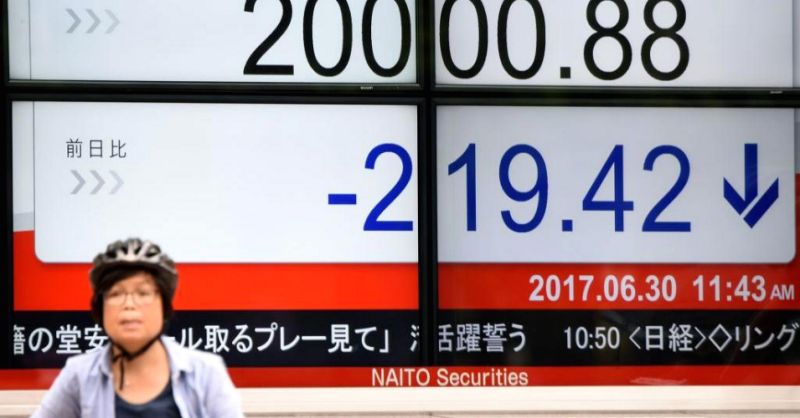
Asian Equities Finish Higher Amid Cautious Trading
By Investors Hub
Asian stocks struggled for direction before finishing mostly higher in cautious trading on Wednesday as investors awaited cues from high-stakes talks between the U.S. and Canada as well as China?s official factory PMI due on Friday.
Canada’s Foreign Minister Chrystia Freeland has arrived in Washington to resume talks about the future of the three-nation North American Free Trade Agreement after the U.S. and Mexico agreed to a new trade deal on Monday.
Chinese stocks closed lower after the country?s state planner warned of increased economic risks in the second half of the year and said greater efforts are needed to hit key development goals.
The benchmark Shanghai Composite Index dropped 8.69 points or 0.3 percent to 2,769.29, while Hong Kong’s Hang Seng Index inched up 64.82 points or 0.2 percent to 28,416.44.
Japanese stocks extended gains for the seventh straight session as technology stocks followed their U.S. peers higher. The Nikkei 225 Index rose 34.75 points or 0.2 percent to 22,848.22, and the broader Topix index closed 0.5 percent higher at 1,739.60.
Tokyo Electron, Sumco Corp. and Advantest Corp. rallied 1-2 percent. Automakers turned in a mixed performance amid the threat of U.S. auto tariffs after the new U.S.-Mexico trade deal proposed levying punitive tariffs of up to 25 percent on imports of Mexican-made cars, sport utility vehicles and auto parts above certain volumes.
Australian shares finished notably higher as easing global trade tensions helped lift financial and material stocks. The benchmark S&P/ASX 200 Index climbed 47.50 points or 0.8 percent to 6,352.20, while the broader All Ordinaries Index ended up 43.40 points or 0.7 percent at 6,457.
The big four banks offering high dividend yields climbed 2-3 percent, and insurers QBE Insurance and Suncorp Group advanced 1.5 percent and 1.8 percent, respectively.
Miners also posted broad-based gains, helped by a rise in commodity prices. BHP Billiton rose 1.3 percent to extend gains for a fifth straight session, while South32 rallied 2 percent.
Building materials firm Boral jumped 10 percent after reporting a nearly 50 percent surge in full-year profits.
Meanwhile, Virgin Australia lost 4 percent after it reported a full-year loss that widened from last year on impairments and write-offs.
Economy
PalmPay Hits $1bn Valuation, Eyes Hong Kong IPO
By Adedapo Adesanya
Africa-focused fintech company PalmPay has joined the ranks of unicorn startups after attaining a valuation of more than $1 billion, as the digital payment platform prepares for a potential initial public offering (IPO) in Hong Kong.
According to a report by Bloomberg on Tuesday, citing people familiar with the matter, the Hong Kong-headquartered company is in advanced discussions to raise about $200 million in a new funding round that would cement its unicorn status and support its next phase of expansion.
The planned fundraising comes as PalmPay accelerates its growth strategy across Africa and Asia, while positioning itself for a public listing that could become one of the most significant fintech IPOs involving an Africa-focused company in recent years.
PalmPay’s move follows a period of rapid growth in Nigeria, where it has become one of the country’s largest digital financial services providers. Alongside OPay and Moniepoint, the company forms the trio that dominates Nigeria’s retail digital payments and agency banking market, a segment driven by millions of point-of-sale (POS) transactions processed daily.
With PalmPay’s latest valuation milestone, all three leading Nigerian fintechs have now achieved unicorn status. While OPay has previously disclosed plans to pursue a listing in the United States, Moniepoint has remained focused on expanding its banking and business services without publicly indicating IPO ambitions.
Founded in 2019 after securing a Mobile Money Operator (MMO) licence from the Central Bank of Nigeria (CBN), PalmPay has built one of the country’s fastest-growing fintech ecosystems. The company says it now serves more than 35 million registered users and over 600,000 merchants, supported by an extensive network of more than 500,000 mobile money agents nationwide.
The platform offers a broad suite of financial services, including peer-to-peer transfers, bill payments, airtime purchases, savings, credit products, merchant payment solutions and agency banking services. PalmPay says it processes as many as 15 million transactions daily, reflecting the increasing adoption of digital payments across Nigeria.
Beyond its home market, the fintech has expanded into Tanzania, Ghana, and Bangladesh, underscoring its ambition to become a leading emerging-market digital bank. Industry analysts view the expansion as part of a broader strategy to diversify revenue streams while replicating its Nigerian success in other underbanked markets.
PalmPay has attracted backing from prominent global investors, including Taiwanese semiconductor manufacturer MediaTek and smartphone maker Transsion Holdings, whose Tecno, Infinix and itel brands command significant market share across Africa. Their support has helped PalmPay leverage smartphone penetration to drive financial inclusion through mobile-first banking services.
As part of efforts to strengthen its leadership ahead of its next growth phase, PalmPay recently appointed Mr Samuel Oluyemi as Chief Operating Officer (COO) for its Nigerian business. Mr Oluyemi joined the company after more than two decades at the Nigeria Inter-Bank Settlement System (NIBSS), where he played key roles in developing the country’s digital payments infrastructure.
If completed, the fundraising and eventual Hong Kong listing would further underscore growing international investor confidence in African fintech companies despite a more cautious global venture capital environment. The proceeds are expected to support PalmPay’s geographical expansion, deepen its product offerings, invest in technology infrastructure and strengthen its competitive position in Africa’s rapidly evolving digital financial services industry.
Economy
CSCS, FrieslandCampina Lead OTC Exchange’s 2.08% Leap
By Adedapo Adesanya
Market bellwethers, Central Securities Clearing System (CSCS) Plc and FrieslandCampina Wamco Nigeria Plc, lifted the NASD Over-the-Counter (OTC) Securities Exchange by 2.08 per cent on Monday, August 3.
CSCS Plc, the Nigerian securities depository company, gained N10.00 to close at N112.00 per share compared with the previous session’s N102.00 per share, and FrieslandCampina Wamco Nigeria Plc advanced by N4.71 to quote at N152.64 per unit versus last Friday’s N147.93 per unit.
As a result, the NASD Security Index (NSI) added 92.14 points to finish at 4,523.85 points compared with the preceding session’s 4,431.71 points, and the market capitalisation appreciated by N55.31 billion to N2.715 trillion from N2.659 trillion.
Business Post reports that the price of MRS Oil Plc crashed during the trading day by N12.00 to N120.00 per share from N132.00 per share, and UBN Property Plc dipped by 3 Kobo to N1.90 per unit from N1.93 per unit.
Trading data showed that the volume of securities exchanged rose by 113.1 per cent to 1.5 million units from 690,990 units, and the number of deals climbed by 19.2 per cent to 31 deals from 26 deals, while the value of securities slid by 13.1 per cent to N65.2 million from N75.0 million.
Great Nigeria Insurance (GNI) Plc remained the most traded stock by value on a year-to-date basis, with 3.4 billion units valued at N8.4 billion, followed by Infrastructure Credit Guarantee (Infracredit) Plc with 2.3 billion units sold for N6.5 billion, and CSCS Plc with 76.8 million units traded for N5.5 billion.
GNI Plc also closed the session as the most traded stock by volume on a year-to-date basis, with 3.4 billion units worth N8.4 billion, followed by Infracredit Plc with 2.3 billion units exchanged for N6.5 billion, and Resourcery Plc with 1.1 billion units transacted for N415.7 million.
Economy
Nigeria Introduces 1.5% Stamp Duty on Bitcoin, Crypto Transactions
By Adedapo Adesanya
The Nigeria Revenue Service (NRS) has introduced a 1.5 per cent stamp duty on eligible virtual asset transactions, with the tax deducted directly from the cryptocurrency purchased before it is credited to the buyer’s wallet.
According to the new guidelines issued on Monday, anyone buying Bitcoin (BTC), USDT or other cryptocurrencies in Nigeria will receive fewer digital assets due to the deduction.
This requires registered crypto exchanges and other Virtual Asset Service Providers (VASPs) to withhold the levy in the digital asset being traded and remit it to the government, marking Nigeria’s most comprehensive move yet to bring cryptocurrency transactions into the country’s tax net.
Unlike traditional taxes deducted from a customer’s bank account, the 1.5 per cent charge will be taken from the cryptocurrency itself, meaning buyers will receive less Bitcoin, USDT or other tokens than they paid for.
The tax body stated that “income tax deducted at source and stamp duty shall be remitted to the service in the originating token of the transaction.”
Besides the new stamp duty, the guidelines also clarify how income tax, Value Added Tax (VAT) and other tax obligations will apply to virtual asset activities such as trading, staking, mining and other crypto-related transactions.
To illustrate the new rule, the tax authority said a buyer who pays N1 million for one Bitcoin will receive only 0.985 BTC after 0.015 BTC is deducted as stamp duty and remitted to the government. When that Bitcoin is later sold, the next buyer will also have 1.5 per cent deducted from the cryptocurrency credited to their wallet.
The NRS said the guidelines are intended to provide clarity for taxpayers, crypto exchanges, peer-to-peer (P2P) marketplace operators, financial institutions, tax consultants and all participants in Nigeria’s virtual asset ecosystem.
According to the guidelines, the 1.5 per cent duty applies to eligible virtual asset transactions facilitated through registered exchanges and other recognised intermediaries. Where a cryptocurrency is used to complete a transaction that already attracts stamp duty under the law, the applicable duty on the underlying instrument will also be payable.
For crypto users, the implication is higher transaction costs, as eligible purchases will attract the 1.5 per cent stamp duty, while VAT on exchange service fees and income tax on taxable gains may also apply, depending on the nature of the transaction.