Economy
Asian Equities Finish Mixed on Thursday
By Investors Hub
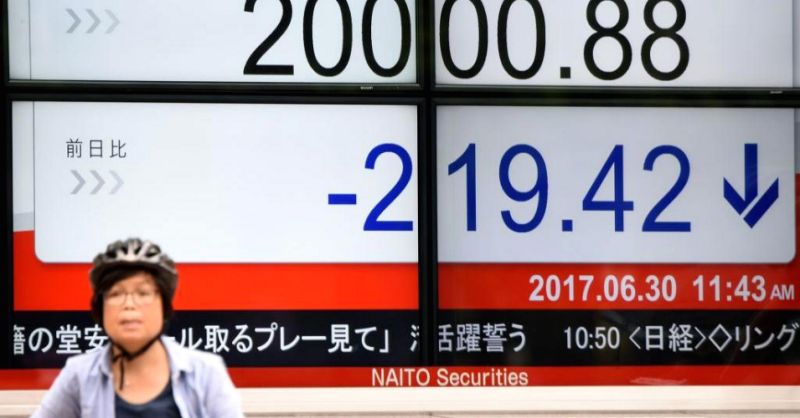
Asian stocks ended mixed on Thursday as caution set in after recent string of gains on optimism that the U.S. and China are closer to a trade deal that would put an end to their ongoing trade war. Brexit developments and the upcoming U.S. jobs report also remained on investors’ radar.
Chinese shares ended at more than a one-year high as investors looked ahead to a meeting between U.S. President Donald Trump and Chinese Vice Premier Liu He in Washington later today.
The benchmark Shanghai Composite Index advanced 30.28 points or 0.9 percent to 3,246.57 amid reports that Beijing will cut government-related fees and service charges to reduce costs for companies and individuals beginning July 1. However, Hong Kong’s Hang Seng Index dipped 50.07 points or 0.2 percent to 29,936.32.
Japanese shares fluctuated before finishing marginally higher, led by carmakers and cyclical shares. The Nikkei 225 Index crept up 11.74 points or 0.1 percent to 21,724.95 points, its highest closing level since March 5. The broader Topix closed 0.1 percent lower at 1,620.05, giving up earlier gains.
Honda Motor rose 0.9 percent and Toyota Motor gained 0.7 percent as tariff worries eased. Chipmakers also gained ground, with Advantest rising 2.1 percent and Sumco adding 1.7 percent after the Philadelphia Semiconductor index surged up more than 2 percent to a record high on Wednesday.
Nomura Holdings fell 1.5 percent on a Nikkei report that the brokerage plans to shut down about 20 percent of its 156 retail branches in Japan.
Meanwhile, Australian markets fell sharply to snap a seven-day winning streak, with miners and banks pacing the decliners.
The benchmark S&P/ASX 200 Index dropped 52.20 points or 0.8 percent to 6,232.80, while the broader All Ordinaries Index ended down 48.30 points or 0.8 percent at 6,320.40.
Woodside Petroleum, Santos, Origin Energy and Oil Search fell 1-2 percent as oil prices declined after U.S. government data showed a surprise build in crude inventories. Oilfield services firm WorleyParsons tumbled 3 percent.
Miners BHP, Rio Tinto and Fortescue Metals Group declined between 0.7 percent and 1.2 percent. Gold miner Newcrest lost 2.5 percent after gold prices edged lower overnight.
The big four banks ended down between 0.2 percent and 0.7 percent. GrainCorp rallied 2.2 percent after the bulk grain handler unveiled plans to spin off its malting business.
IOOF Holdings shed 1.5 percent after the beleaguered wealth manager announced the permanent departure of managing director Christopher Kelaher.
Economy
Odu’a Investment Eyes N1trn Asset Base by 2030, Posts N23.58bn Pre-Tax Profit
By Adedapo Adesanya
Odu’a Investment Company Limited has unveiled an ambitious plan to grow its asset base to N1 trillion by 2030, following a record financial performance that saw the conglomerate post a N23.58 billion Profit Before Tax (PBT) for the 2025 financial year.
The target was announced at the company’s 44th Annual General Meeting (AGM), held on Friday at the newly redeveloped Premier Hotel in Ibadan, where shareholders, representatives of the six South-West states and other stakeholders also witnessed the conclusion of the four-year tenure of the chairman, Mr Bimbo Ashiru.
Presenting the 2025 financial results, Mr Ashiru said the group had been strategically repositioned despite a challenging macroeconomic environment, laying a solid foundation for its long-term growth ambitions.
According to the results, operating revenue increased by 78 per cent to N20.22 billion from N11.34 billion recorded in 2024, while profit before tax surged by 410 per cent to N23.58 billion from N4.62 billion in the previous year.
The impressive earnings were largely driven by N18.81 billion in fair value gains on investment properties and strong gains from the bullish performance of the Nigerian Exchange (NGX), where it trades its stock.
Mr Ashiru described the year as one of significant strategic milestones that have permanently repositioned the investment group.
Among the highlights was the completion of the extensive redevelopment of the historic Premier Hotel, Ibadan, which was commissioned on the eve of the AGM and is expected to commence full operations in the fourth quarter of 2026.
The organisation also marked the 60th anniversary of Cocoa House in July 2025, reinforcing its commitment to preserving iconic assets while unlocking greater commercial value.
In another milestone, Agusto & Co. upgraded Odu’a Investment’s credit rating from A+ to Aa- with a stable outlook, reflecting the company’s improved financial discipline and treasury management.
Speaking at the AGM, the Managing Director, Mr Abdulrahman Yinusa, disclosed that the company has commenced the process of obtaining its first international credit rating from a leading global rating agency, adding that the move would enhance access to international debt capital markets and attract foreign direct investment as part of the group’s long-term growth strategy.
The company also presented its first fully consolidated financial statements, providing shareholders with a comprehensive view of the financial position of the holding company and all its subsidiaries.
The AGM also marked a leadership transition as Mr Ashiru completed his four-year tenure as Group Chairman.
In his valedictory address, he reflected on the transformation achieved between 2022 and 2026, noting that Odu’a Investment had evolved from being “asset rich, cash poor” into a strategy-driven organisation that is both asset and cash-rich.
He thanked the governors of the six South-West states, members of the Board, past and present Group Managing Directors, subsidiary boards and management, and staff for their support throughout his tenure.
Although stepping down as chairman, Mr Ashiru will remain on the board as a director until 2028, providing continuity as the group pursues its vision of building a N1 trillion asset portfolio by 2030.
Economy
Nigeria Accesses $1.5bn from UAE Lender’s $5bn Swap Deal
By Adedapo Adesanya
Nigeria has received the first tranche of its $5 billion derivatives financing arrangement with the First Abu Dhabi Bank (FAB), the United Arab Emirates’ largest lender.
According to a Bloomberg report published on Friday, the federal government drew about $1.5 billion over the past two weeks through a Total Return Swap (TRS) transaction with the lender.
The report stated that Nigeria will provide naira-denominated securities valued at 133.3 per cent of the loan amount as collateral for the transaction, while international financial institutions continue to express concerns about the risks associated with such derivative-based financing structures.
The financing is expected to support the government’s debt management strategy by replacing more expensive borrowings while helping finance the country’s fiscal deficit.
The first tranche is priced at 395 basis points above the Secured Overnight Financing Rate (SOFR), rising to SOFR plus 400 basis points thereafter.
The transaction further expands Nigeria’s financial relationship with First Abu Dhabi Bank, which had earlier provided about $1.2 billion to support the construction of a section of the ongoing Lagos-Calabar Coastal Highway.
The swap deal has come with much scrutiny from critics and international organisations. Recall that the International Monetary Fund (IMF), after a consultation visit, warned Nigeria against the deal, noting that such transactions are often opaque and complex.
“Our view is that the transactions in these types of structures carry risks. Usually they are opaque, so the terms are not always very transparent when we reviewed these instruments across countries,” according to the IMF’s mission chief in Nigeria, Mr Christian Ebeke.
Mr Ebeke said Nigeria could instead issue eurobonds to finance its deficits or other means to raise funding, including on concessional terms.
The Senate in April gave its approval to the agreement put forward by President Bola Tinubu, who said his administration intends to use proceeds from the total return swap to refinance expensive debt and pay for infrastructure.
Economy
Nigeria Needs More Taxpayers, Not Higher Taxes—Oyedele
By Adedapo Adesanya
The Minister of Finance and Coordinating Minister of the Economy, Mr Taiwo Oyedele, yesterday clarified that the federal government is not increasing taxes but making efforts to raise the tax net.
Mr Oyedele made this remark on Thursday while receiving a delegation from the Chartered Institute of Taxation of Nigeria (CITN) at his office in Abuja.
He hailed the institute for introducing a National Tax Awareness Day and for supporting the current tax reforms of the federal government.
The minister charged the institute to double its effort in public enlightenment, stressing that many Nigerians still view taxation as a means for the government to take money from citizens.
He reiterated that the priority of the government is not to increase tax rates but to broaden the tax base by ensuring that all eligible taxpayers meet their obligations.
“We are still not getting enough revenue from taxes.
“It is not about increasing taxes but making sure that those who are supposed to pay taxes. We want to promote fairness in tax administration,” he said.
Nigeria is challenged by the inability to generate adequate revenue from taxation despite ongoing reforms, stressing that a significant number of eligible taxpayers have yet to fulfil their civic obligations.
He said the challenge facing the country was not necessarily about raising tax rates but ensuring that individuals and businesses that ought to pay taxes do so in a fair and transparent system.
The minister also commended the institute for supporting the federal government’s tax reform agenda and promoting public understanding of taxation, but urged it to intensify its advocacy efforts, noting that many Nigerians still harbour misconceptions about taxation.
According to him, many citizens continue to view taxation merely as a tool for the government to take money from the people rather than as a critical instrument for national development.
“We are still not getting enough revenue from taxes. It is not about increasing taxes, but making sure that those who are supposed to pay taxes. We want to promote fairness in tax administration,” he added.
Mr Oyedele stressed that if Nigeria succeeds in building an efficient and equitable tax system, the impact on infrastructure, public services and economic development would be transformative, challenging the institute to introduce annual awards for the country’s most tax-compliant individuals and organisations as a means of encouraging voluntary compliance and recognising responsible taxpayers.
-
Feature/OPED6 years agoDavos was Different this year
-
Travel/Tourism10 years ago
Lagos Seals Western Lodge Hotel In Ikorodu
-
Showbiz3 years agoEstranged Lover Releases Videos of Empress Njamah Bathing
-
Banking8 years agoSort Codes of GTBank Branches in Nigeria
-
Economy3 years agoSubsidy Removal: CNG at N130 Per Litre Cheaper Than Petrol—IPMAN
-
Banking3 years agoSort Codes of UBA Branches in Nigeria
-
Banking3 years agoFirst Bank Announces Planned Downtime
-
Sports3 years agoHighest Paid Nigerian Footballer – How Much Do Nigerian Footballers Earn