Economy
Asian Equities Give up Early Gains to Close Mostly Lower
By Investors Hub
Asian markets ended mostly lower on Thursday, with investors digesting a slew of economic reports from the region and reacting to an interest rate hike in the U.S.
Although most of the markets in the region started off on a slightly positive note, many of these gave up early gains. In China, the central bank’s decision to increase rates on open market operations weighed on sentiment.
The Australian market failed to hold early gains and ended flat, although a few front line stocks managed to register handsome gains.
The benchmark S&P/ASX 200 Index declined 10.50 points or 0.2 percent to 6011.30, snapping a five-session winning streak.
Shares of mining companies Independence Group and Resolute Mining Limited gained nearly 6.5% each. West Areas, Whitehaven Coal and Syrah Resources gained 4.75 – 5.4 percent.
Myer Holdings plunged 9.6 percent following a profit warning by the company. Metcash, RTL Food, Credit Corp and Qantas declined 2.8 – 3.3 percent.
In economic news, the unemployment rate in Australia came in at a seasonally adjusted 5.4 percent in November, the Australian Bureau of Statistics said. That was in line with expectations and unchanged from the October reading.
The Australian economy added 61,600 jobs last month, shattering expectations for a gain of 19,000 jobs following the addition of 7,800 jobs in the previous month.
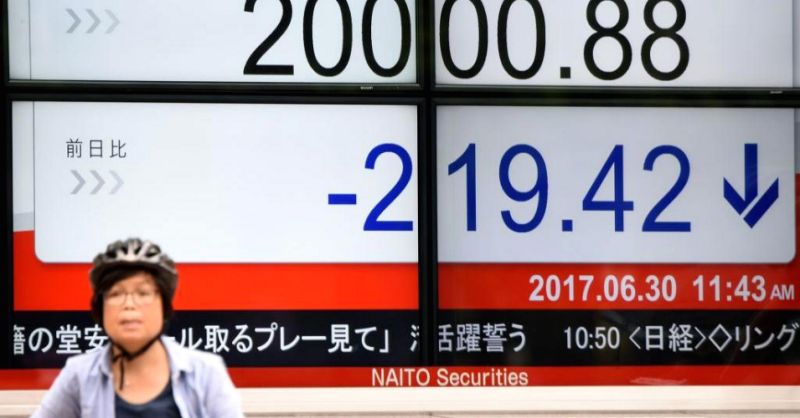
Save for a few minutes at the start of the session, the Japanese were in negative territory, despite reasonably encouraging economic data. The benchmark Nikkei 225 Index ended down 63.62 points or 0.3 percent at 22,694.45.
Rakuten declined nearly 5 percent. Konica Minolta, Yahoo Japan, Furukawa Electric, Chiyoda Corp, Daikin Industries, TDK Corp, Casio Computer, Concordia Financial Group, Nikon Corp, Credit Saison, Resona Holdings, Softbank Group, Mizuho Financial Group and Matsui Securities ended lower by 1 to 3 percent.
Data released by IHS Markit showed manufacturing activity in Japan to have expanded at the fastest pace in nearly four years in December. The Nikkei flash Manufacturing Purchasing Managers’ Index climbed to 54.2 in December from 53.6 in November.
On the price front, input price inflation eased in December, while output price inflation accelerated to a 41-month high, data showed.
According to a report from the Ministry of Economy, Trade and Industry, Japanese industrial production rebounded as initially estimated in October, rising a seasonally adjusted 0.5 percent month-over-month. In September, production had declined 1.0 percent.
In China, the Shanghai Composite Index declined 9.46 points or 0.3 percent to 3,293.58. Hong Kong’s Hang Seng Index declined 55.72 points or 0.2 percent to settle at 29,166.38.
The Chinese central bank unexpectedly lifted its rates on open market operations following the Federal Reserve’s decision to tighten its policy rates. The People’s Bank of China raised its 7-day and 28-day reverse repo rates by 5 basis points to 2.50 percent and 2.80 percent, respectively. The bank raised the rate on its Medium-term Lending Facility by 5 basis points to 3.25 percent.
Data released by the National Bureau of Statistics showed industrial production in China to have grown 6.1 percent year-on-year in November, slower than the 6.2 percent increase recorded a month earlier.
Meanwhile, retail sales grew at a faster pace on domestic consumption, improving to 10.2 percent, up 0.2 percent from the previous month.
Economy
MTN Nigeria Ignites Yuletide Spirit With VibeTide Campaign
By Modupe Gbadeyanka
A festive campaign designed to blend culture, lifestyle, music, generosity, and digital engagement into one connected celebration that brings millions of Nigerians together across cities and communities has been launched by MTN Nigeria.
Known as VibeTide, this initiative will continue throughout the festive months with a rich mix of activities designed to meet Nigerians wherever they gather.
The campaign came alive this morning with Y’ello Santa, a multi-city activation that lit up Lagos, Abuja, Port Harcourt, Kano, Ibadan, and Enugu with surprises, gifts, entertainment, and heartwarming interactions.
Thousands of Nigerians were celebrated and rewarded as MTN teams visited high traffic locations to create spontaneous festive moments. The turnout and excitement across the cities reflected the early momentum that the season typically brings.
To support the influx of returnees and tourists arriving for the holidays, MTN would introduce integrated bundles designed with the I Just Got Back (IJGB) community in mind.
Many travellers rely on mobile data the moment they land, using it to navigate busy cities, book rides, find events, make cashless payments, and stay connected to family and friends.
These affordable and reliable options ensure that visitors can settle in quickly and enjoy the festive experience without connectivity barriers. The bundles would be available through the yellotide portal, regular channels and the MyMTN app.
The dedicated portal for the initiative serves as the digital gateway for the entire campaign. It provides customers with access to exclusive event tickets, curated experiences, giveaways, and up to date information on all VibeTide activities, giving Nigerians an easy and personal way to stay plugged into the celebration.
YelloTide will run across November and December and extend into early 2026. It combines on ground activations, digital engagement, talent showcases, and community focused surprises that reinforce MTN’s commitment to celebrating Nigerians and powering shared experiences. Whether in bustling cities or in hometowns with family, MTN is placing itself at the heart of the celebrations, giving Nigerians more to enjoy and more to remember this festive season.
The Chief Marketing Officer of MTN Nigeria, Ms Onyinye Ikenna Emeka, said VibeTide was created to elevate the energy and emotion of the season, noting that it celebrates the joy Nigerians naturally bring to this time of year.
Economy
NACCIMA Backs N20bn Bond Replacement of Container Deposit System
By Adedapo Adesanya
Nigerian Association of Chambers of Commerce, Industry, Mines and Agriculture (NACCIMA) has welcomed the introduction of a N20 billion collective insurance bond backed by a consortium of insurers to replace the long-standing container deposit system in Nigeria’s maritime trade.
The container deposit system allows shipping companies to charge importers of clearing agents a refundable fee (container deposit) whenever they take delivery of a container from the port for the purpose of unpacking and returning it after use. It serves as a guarantee that the importer will return the container to the shipping line in good condition within a stipulated, agreed period.
The new scheme, designed to protect international traders and freight-forwarders, marks a major shift toward an insurance-driven framework for container and cargo risk management, with agreed standard premiums now set for container indemnity, cargo-in-transit, and public liability coverages.
Speaking at an engagement with insurance stakeholders on Wednesday in Lagos, NACCIMA’s President, Mr Jani Ibrahim, represented by the group’s Director General, Mr Sola Obadimu, emphasised the critical role of insurance in enabling business operations from maritime and oil & gas to agriculture and exports.
The two-day event, which dedicated the first day to maritime stakeholders, held at NACCIMA’s secretariat, spotlighted how Section 203 of the newly assented Nigerian Insurance Industry Reform Act (NIIRA) 2025 outlaws the traditional container-deposit fee and ushers in an insurance-based mechanism for both laden and empty shipping containers.
The reform signals “a new era” in container-risk management, NACCIMA said.
To drive implementation, NACCIMA proposed setting up an Implementation Committee representing private-sector trade groups (including manufacturers, SMEs, employers), regulators and all maritime stakeholders.
According to the association, on-boarding is slated to begin January 2026.
“The private sector will take the lead in implementing the Container Insurance Law in the maritime sector, towards the complete elimination of the deposit fee, as stipulated in law,” Mr Obadimu said.
Business-owners were urged to support the shift to an insurance-model, with NACCIMA detailing its partnership with consulting firm FRM Communications Limited to digitise container profiling, map stakeholders and integrate into national trade-facilitation systems.
Economy
Nigeria to Commence T+2 Settlement Cycle November 28
By Adedapo Adesanya
The Securities and Exchange Commission (SEC) has announced that Nigeria’s capital market will officially transition to a T+2 settlement cycle for equities transactions from Friday, November 28, 2025.
The reform, aimed at aligning Nigeria with global best practices, is expected to enhance market efficiency, improve liquidity, and strengthen investor confidence ahead of the traditional year-end rally.
With the T+2 transition, Nigeria is taking a significant step toward a more efficient, competitive, and investor-friendly capital market as it braces for becoming an ambitious $1 trillion economy.
In a statement issued on Thursday, the SEC said the migration from the current T+3 (trade date plus three days) cycle had reached full implementation following months of preparation and rigorous stakeholder testing.
“The migration is expected to significantly enhance the Nigerian capital market by allowing investors quicker access to funds, improving overall liquidity, and reducing counterparty risk exposure,” the Commission noted.
The Central Securities Clearing System (CSCS) Plc, which serves as the market’s central counterparty, was praised for ensuring operational and technical readiness.
“Extensive testing with market participants has been successfully conducted without any reported issues,” the SEC said, adding that the initiative represents a “landmark change” in Nigeria’s market infrastructure.
Under the new settlement framework, all trades executed on Friday, November 28, 2025, will settle on Tuesday, December 2, 2025, while earlier transactions will continue under the existing T+3 system.
The SEC also reaffirmed its commitment to building a modern, transparent, and globally competitive market that continues to attract domestic and international investors.
-
Feature/OPED6 years agoDavos was Different this year
-
Travel/Tourism9 years ago
Lagos Seals Western Lodge Hotel In Ikorodu
-
Showbiz3 years agoEstranged Lover Releases Videos of Empress Njamah Bathing
-
Banking7 years agoSort Codes of GTBank Branches in Nigeria
-
Economy2 years agoSubsidy Removal: CNG at N130 Per Litre Cheaper Than Petrol—IPMAN
-
Banking3 years agoFirst Bank Announces Planned Downtime
-
Sports3 years agoHighest Paid Nigerian Footballer – How Much Do Nigerian Footballers Earn
-
Banking3 years agoSort Codes of UBA Branches in Nigeria