Connect with us

Economy

Asian Shares Rise as Investors Peruse Economic Data

Published

on

By Investors Hub

Asian stocks rose on Wednesday as investors digested a slew of economic data, corporate earnings results and weaker than expected Chinese manufacturing data.

China’s Shanghai Composite Index rallied 34.73 points or 1.4 percent to close at 2,602.78, a day after the country’s securities regulator promised measures to improve market liquidity, encourage share buybacks and mergers and acquisitions. Hong Kong’s Hang Seng Index jumped 394.16 points or 1.6 percent to 24,979.69.

Traders ignored the latest PMI numbers confirming a broad-based decline in Chinese economic activity.

China’s official manufacturing PMI fell to 50.2 in October, the lowest since July of 2016 and down from 50.8 in September, in a sign of further loss of momentum in the world’s second-largest economy.

The services PMI dropped from 54.9 to 53.9, marking the weakest pace of expansion since August of 2017.

On the heels of the disappointing data, the People’s Bank of China weakened the yuan fix to the lowest in more than a decade.

Japanese shares hit a one-week high and the yen edged lower against the dollar after the Bank of Japan left interest rates steady, cut its inflation forecasts and signaled it was a long way off from exiting its massive stimulus program.

Investors shrugged off weak data showing that industrial production in the country fell 1.1 percent in September from the previous month compared to expectations for a decline of 0.3 percent.

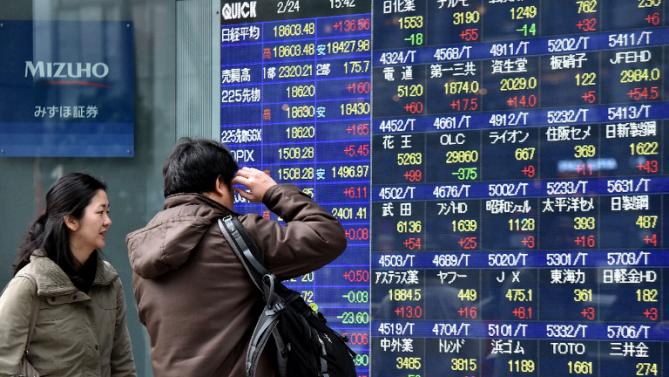
The Nikkei 225 Index surged up 463.17 points or 2.2 percent to 21,920.46, while the broader Topix Index closed 2.2 percent higher at 1,646.12.

Chip-related stocks followed their U.S. peers higher, with Tokyo Electron rallying 3.6 percent and TDK Corp spiking 6.1 percent. Advantest shares soared 13 percent. Sony jumped 4.7 percent and Honda Motor surged up 6.5 percent after raising their annual profit forecasts.

Australian markets ended modestly higher, led by banking and energy stocks. The benchmark S&P/ASX 200 Index rose 25.20 points or 0.4 percent to 5830.30 but ended the month down over 6 percent, marking its worst monthly fall since August of 2015. The broader All Ordinaries Index also closed up 0.4 percent at 5,913.30.

The Australian dollar fell slightly after a government report showed inflation rose 0.4 percent sequentially in the third quarter of 2018, below market expectations for a 0.5 percent increase.

ANZ rose over 1 percent after reporting a 5 percent drop in full-year cash profit, hit by remediation costs in the aftermath of the royal commission.

Commonwealth Bank advanced 1.6 percent after it agreed to sell its Colonial First State asset management business to Japanese bank Mitsubishi UFJ Trust and Banking Corp for A$4.13 billion.

QBE Insurance rallied 2.4 percent after it announced a streamlining of its operations.

Oil stocks also closed broadly higher as oil prices rose for the first time in three sessions. Woodside Petroleum climbed 2.3 percent, Origin Energy added 1.7 percent and Oil Search gained 0.8 percent.

Meanwhile, mining heavyweights BHP Billiton and Rio Tinto ended marginally lower. Gold miners Evolution and Newcrest also slumped after gold prices settled at a more than one-week low overnight.


Modupe Gbadeyanka is a fast-rising journalist with Business Post Nigeria. Her passion for journalism is amazing. She is willing to learn more with a view to becoming one of the best pen-pushers in Nigeria. Her role models are the duo of CNN's Richard Quest and Christiane Amanpour.

Click to comment

Leave a Reply

Your email address will not be published. Required fields are marked *

Economy

H1 2026: Presco Offers N10 Interim Dividend, Pledges Long-Term Value Creation

Published

on

presco logo

By Aduragbemi Omiyale

The board of Presco Plc has proposed the payment of an interim dividend of N10 per share to shareholders of the organisation for the first six months of this year.

This information was conveyed in the unaudited financial statements of the company released to the Nigerian Exchange (NGX) Limited.

In the results for the half-year ended June 30, 2026, the fully integrated agro-industrial firm said the cash reward reinforces its commitment to delivering consistent shareholder returns.

It further assured that looking ahead, it remains focused on disciplined capital allocation, operational efficiency and long-term value creation while navigating evolving market conditions.

A look at the key financial highlights of the results showed that revenue was relatively stable at about N199.0 billion in the first half of 2026 and the same period of 2025 amid a high-cost operating environment and softer crude palm oil prices.

However, the pre-tax profit rose by 9.3 per cent to N122.2 billion from N119.9 billion as result of a 31.9 per cent reduction in financing costs.

Further, the Edo State-based company posted an EBITDA of N123.1 billion, which yielded a margin of 61.9 per cent, as the organisation strengthened its balance sheet, reducing total liabilities by 42.5 per cent to N277.8 billion, while equity grew 13.8 per cent to N503.6 billion, with a current ratio of 345.6 per cent, which underscores robust liquidity.

“Our H1 2026 performance underscores the strength of our operational model in a challenging environment. The 9.3 per cent growth in profit before tax, driven largely by a 31.9 per cent reduction in financing costs, reflects our deliberate focus on cost optimisation and balance sheet discipline.

“With equity up 13.8 per cent and liabilities down by 42.5 per cent, we have further fortified our financial foundation.

“The proposed interim dividend of N10 per share signals our confidence in the business’s trajectory and our commitment to rewarding shareholders,” the chief executive of Presco, Mr Reji George, stated.

Continue Reading

Economy

Dangote Refinery Reduces ex-Depot Price of Petrol to N1,165/Litre

Published

on

Dangote refinery petrol

By Aduragbemi Omiyale

The ex-depot prices of the two major petroleum products in the country, Premium Motor Spirit (PMS), commonly known as petrol, and Automotive Gas Oil (Diesel), have been slashed by Dangote Petroleum Refinery.

The company, in a statement on Wednesday, disclosed that while petrol is now N1,165 per litre, diesel is now N1,570 per litre.

The energy firm said it slashed the prices to reaffirm its commitment to providing affordable, high-quality petroleum products to the Nigerian market.

The latest cut in the price of PMS represents N50, as it was previously sold to marketers at N1,215 per litre, while diesel witnessed an N80 reduction, as it was formerly being sold at N1,650 per litre.

Dangote Refinery stated that the downward price review reflects its ongoing efforts to enhance energy affordability, improve access to refined petroleum products, and support economic activities across Nigeria, saying it remains committed to ensuring stable supply while leveraging operational efficiencies to deliver value to consumers, businesses, and stakeholders.

As Africa’s largest refinery, Dangote Petroleum Refinery continues to play a pivotal role in strengthening Nigeria’s energy security, reducing reliance on imports, and supporting the nation’s economic development through the supply of world-class petroleum products.

The company reaffirmed its dedication to contributing to the growth of the Nigerian economy and passing on the benefits of improved operational efficiencies to consumers whenever market conditions permit.

Continue Reading

Economy

Dangote Refinery Targets $5bn in Landmark IPO Due in October

Published

on

Dangote Refinery Crude Supply to Local Refineries

By Adedapo Adesanya

Dangote Petroleum Refinery is preparing to raise about $5 billion through an initial public offering (IPO) expected to conclude in October, in what could become the largest stock market listing in Africa’s history.

The company has already submitted an initial application to the Securities and Exchange Commission (SEC), with approval expected in the coming weeks. Once authorised, the refinery is expected to release its prospectus in September ahead of the public offer.

The primary listing will be on the Nigerian Exchange (NGX) Limited, although investors across Africa are expected to participate through structured investment instruments rather than a dual listing.

The proceeds will be used to expand the capacity of the 700,000-barrels-per-day refinery in Lagos and possibly support plans to replicate the project in Kenya as Dangote seeks to deepen Africa’s energy independence.

The proposed IPO comes after the refinery benefited from increased demand for refined products during the recent Iran conflict, supplying jet fuel across Africa and into Western Europe as global shortages disrupted markets.

As per Reuters, stock exchanges in South Africa, Kenya, Egypt, Ghana and Rwanda have held discussions with advisers to the transaction as interest in the offering continues to build across the continent.

Kenya alone could account for as much as $500 million of the targeted capital raise, driven largely by demand from institutional investors, including pension funds, the publication reported.

While the company is targeting a $5 billion raise, the final amount will depend on the outcome of the SEC’s review. If achieved, the offering would represent more than four per cent of the Nigerian Exchange’s current market capitalisation.

The IPO follows a $2.5 billion private placement completed last month, in which a six per cent stake in the refinery was sold, implying a valuation of about $40 billion.

That valuation, however, would place the refinery well above several listed global refining companies. Turkey’s Tupras, which operates a similar combined refining capacity across four facilities, has a market value of roughly $12 billion, while US-listed HF Sinclair, with a comparable processing capacity, is valued at around $16 billion.

Although the NGX generally requires companies on its main board to maintain a minimum free float of 20 per cent, there have been exceptions. Dangote Cement, for instance, currently has a free float of just over 12 per cent.

The publication also reported that investors outside Nigeria are likely to gain exposure through instruments such as global depositary receipts or exchange-traded products linked to the Nigerian-listed shares, rather than through a cross-listing on other African exchanges.

The founder of the 700,000-barrels-per-day capacity plant, Mr Aliko Dangote, said in April that the refinery aims to increase production capacity to 1.4 million barrels per day.

Mr Dangote is also pursuing plans to build another refinery in Lamu along Kenya’s coast in partnership with other East African governments, although it remains unclear whether part of the IPO proceeds will be allocated to that project valued at an estimated $17 billion.

Continue Reading