

Economy
Before You Fall Into Recharge Card Business Scam, Read This


By Dipo Olowookere
I have read several times about some Nigerians lamenting being scammed by fraudsters who claim they can go into recharge business by selling in bulk with as low as N10,000.
Each time I read or hear about victims crying about being scammed, I say to myself that they fell for it because they were ignorant and failed to do at least a bit of research before parting away with their hard-earned money.
The purpose of this article is to educate you on some basics of the recharge card business so that no one can fool you next time about it.
It is important I state that recharge card business is capital intensive, especially if you want to make huge profit.
First, none of the GSM network provider sells recharge cards in bulk directly to individuals or small scale sellers. They sell their recharge card pins directly to dealers, who have registered with them and must have millions of Naira to invest into the business.
In some cases, if not most, banks stand in as guarantor for these dealers because dealers are given targets to meet each month. Some networks, like MTN, give their dealers N1 billion turnover per month.
Now, when dealers buy these recharge card pins, which are then printed in cards and papers, they sell to those called the sub-dealers. Dealers also sell the recharge card pins to sub-dealers as Virtual Top Up (VTU).
In some cases, some of these sub-dealers buy recharge cards worth N10-50 million daily from dealers to resell to those who hawk the cards to retailers (those who sell the product under umbrellas by the roadsides, shops and others).
Recharge Card Prices
The prices of recharge cards are influenced by demand and supply. When there is a huge demand for a network’s recharge card, the price goes up because it is scarce in the market. However, when there is less demand for it, the price drops.
In most cases, the prices of recharge cards go up at the beginning of the month and drops at the end of the month. This is because at the end of the month, most dealers are after meeting their targets and would sell at a lower rate in order to get the commission network providers give to dealers who meet their targets.
But MTN, which is the market leader, has somehow stabilised its price at the market unlike in the past.
From my investigation, MTN sells its N100 recharge card to dealers at N96 and it expects them to sell to sub-dealers and retailers at N96.50k. It came up with this policy so as to stop the sale of its cards above the face value like it happened in the past where the N100 voucher was sold for N110.
For Airtel, the price ranges from N94.50k to N95.50k, depending on who is selling it and the volume being purchased.
For Etisalat, the price ranges from N94 to N95, while Glo goes for N90 to N92.
In recharge card business, the prices of other card denominations are calculated using the price of the N100 cards.
If anyone approaches you to say he can get you recharge cards of any network at rates about N3-5 below the above prices, you should raise a red flag.
Also, if anyone says you can start printing recharge cards as low as N10,000, you should raise an eyebrow because no network sells their recharge card pins to sub-dealers or retailers, but dealers alone, who are like partners in the business with them. In fact, the network providers call their dealers Trade Partners.
If you require further information or clarification, please feel free to use the comment box.




By Adedapo Adesanya
Three bellwether stocks lifted the NASD Over-the-Counter (OTC) Securities Exchange by 0.62 per cent on Friday, December 12 with the NASD Unlisted Security Index (NSI) jumping by 22.20 points to 3,600.43 points from 3,578.23 points.
In the same vein, the market capitalisation of the trading platform increased by N13.28 billion to close at N2.154 trillion from the previous day’s N2.140 trillion.
During the session, Central Securities Clearing System (CSCS) Plc went up by N2.53 to close at N39.71 per share compared with the previous day’s N37.18 per share, Geo-Fluids Plc added 35 Kobo to its price to finish at N5.00 per unit versus Thursday’s closing price of N4.65 per unit, and FrieslandCampina Wamco Nigeria Plc appreciated by 23 Kobo appreciation to sell at N60.23 per share versus N60.00 per share.
It was observed that yesterday, the price of Golden Capital Plc went down by N1.05 to N9.45 per unit from N10.50 per unit, and UBN Propertiy Plc declined by 21 Kobo to N2.01 per share from the N2.22 per share it was traded a day earlier.
There was a significant improvement in the level of activity for the day, as the volume of transactions increased by 6.2 per cent to 37.4 million units from the previous day’s 35.2 million units, the value of trades went up by 265.1 per cent to N4.9 billion from N1.4 billion, and the number of deals soared by 13.80 per cent to 33 deals from 29 deals.
Infrastructure Credit Guarantee Company (InfraCredit) Plc ended the last trading day of this week as the most active stock by value on a year-to-date basis with 5.8 billion units valued at N16.4 billion, the second spot was taken by Okitipupa Plc with 178.9 million units traded for N9.5 billion, and third space was occupied by a new comer in MRS Oil Plc with 36.1 million units worth N4.9 billion.
InfraCredit Plc also finished the session as the most active stock by volume on a year-to-date basis with 5.8 billion units transacted for N16.4 billion, followed by Industrial and General Insurance (IGI) Plc with 1.2 billion units valued at N420.3 million, and Impresit Bakolori Plc with 537.0 million units sold for N524.9 million.
By Dipo Olowookere
The bullish run on the Nigerian Exchange (NGX) Limited continued on Friday with a further 1.00 per cent growth buoyed by gains recorded by Guinness Nigeria, Champion Breweries, and others.
Data showed that the consumer goods space expanded by 1.53 per cent during the last trading session of the week, as the insurance counter grew by 0.51 per cent, and the industrial goods sector marginally gained 0.01 per cent.
However, the banking index depreciated by 0.54 per cent due to a pocket of profit-taking, and the energy industry shrank by 0.09 per cent, while the commodity sector closed flat.
Guinness Nigeria gained 10.00 per cent to trade at N217.80, Morison Industries rose by 9.84 per cent to N4.69, Champion Breweries jumped by 9.69 per cent to N14.15, Austin Laz grew by 9.66 per cent to N2.27, and C&I Leasing appreciated by 9.62 per cent to N5.70.
Conversely, eTranzact lost 10.00 per cent to finish at N12.60, Chellarams slumped by 9.00 per cent to N13.20, Eunisell depleted by 9.89 per cent to N75.15, Africa Prudential moderated by 9.77 per cent to N12.00, and DAAR Communications decreased by 9.18 per cent to 89 Kobo.
The busiest stock on Friday was Access Holdings with 107.6 million units sold for N2.2 billion, Consolidated Hallmark traded 59.9 million units worth N245.8 million, Zenith Bank transacted 48.2 million units valued at N3.1 billion, Transcorp Power transacted 42.8 million units for N13.1 billion, and Champion Breweries exchanged 36.4 million units valued at N510.2 million.
At the close of business, a total of 602.8 million units worth N30.7 billion exchanged hands in 20,550 deals yesterday, in contrast to the 529.7 million units valued at N12.3 billion traded in 18,159 deals on Thursday, representing a surge in the trading volume, value, and number of deals by 13.80 per cent, 149.59 per cent, and 13.17 per cent apiece.
Business Post reports that the All-Share Index (ASI) soared during the session by 1,485.89 points to 149,436.48 points from 147,950.59 points and the market capitalisation moved up by N945 billion to N95.264 trillion from N94.319 trillion.
By Adedapo Adesanya
An intervention of the Central Bank of Nigeria (CBN) in the foreign exchange (FX) market eased the pressure on the Naira on Friday.
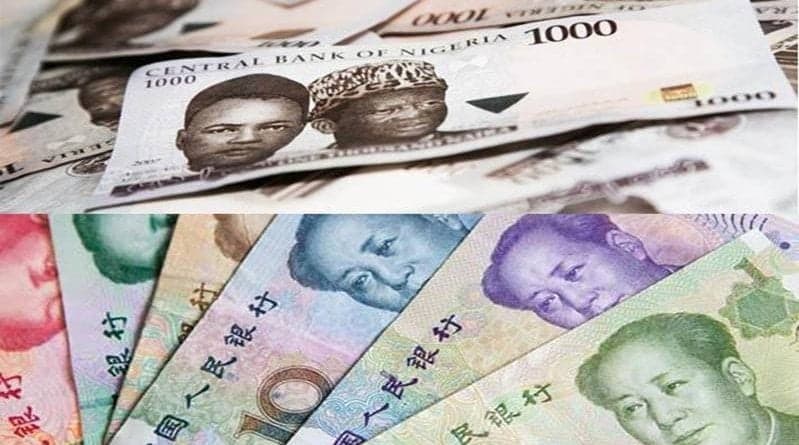
The apex bank sold forex to banks and other authorised dealers in the official window to defend the domestic currency, helping to calm the FX demand pressure, with the Nigerian currency appreciating against the US Dollar in the Nigerian Autonomous Foreign Exchange Market (NAFEM) by 0.11 per cent or N1.57 to sell at N1,454.50/$1 compared with Thursday’s closing price of N1,456.07/$1.
Also, the domestic currency improved its value against the Pound Sterling in the official market yesterday by N3.95 to close at N1,946.15/£1 versus the previous day’s N1,950.11/£1 but lost 10 Kobo on the Euro to quote at N1,706.46/€1 compared with the N1,706.36/€1 it was exchanged a day earlier.
At the black market segment, the Nigerian Naira maintained stability against the Dollar during the session at N1,470/$1 and also traded flat at N1,463/$1 at the GTBank forex counter.
Despite the sigh of relief, demand pressures outweighed the robust supply from the CBN and inflow from offshore players looking to participate at the OMO bills auction.
Gross FX reserves increased for the twenty fifth consecutive week, growing by a strong $396.84 million week-on-week to $45.44 billion.
As for the cryptocurrency market, it was down on Friday as pressure remained after Federal Reserve chair Jerome Powell’s speech on Wednesday, which hinted at a possible rate cut pause in January. As a result, markets now expect only two rate cuts in 2026 instead of three.
However, Chicago Federal Reserve President Austan Goolsbee, who was against a December rate cut, said he expects more in 2026 than the current median projection.
Ethereum (ETH) slumped by 5.1 per cent to $3,090.61, Solana (SOL) declined by 4.5 per cent to $132.79, Cardano (ADA) depreciated by 3.8 per cent to $0.4103, and Dogecoin (DOGE) dropped 2.5 per cent to trade at $0.1373.
In addition, Bitcoin (BTC) lost 2.4 per cent to sell at $90,342.74, Litecoin (LTC) tumbled by 1.9 per cent to $81.86, Binance Coin (BNB) fell by 0.6 per cent to $886.93, and Ripple (XRP) slipped by 0.5 per cent to $2.02, while the US Dollar Tether (USDT) and the US Dollar Coin (USDC) traded flat at $1.00 each.









-
 Feature/OPED6 years ago
Davos was Different this year
-
Travel/Tourism9 years ago
Lagos Seals Western Lodge Hotel In Ikorodu
-

 Showbiz3 years ago
Estranged Lover Releases Videos of Empress Njamah Bathing
-
 Banking7 years ago
Sort Codes of GTBank Branches in Nigeria
-

 Economy3 years ago
Subsidy Removal: CNG at N130 Per Litre Cheaper Than Petrol—IPMAN
-

 Banking3 years ago
First Bank Announces Planned Downtime
-

 Banking3 years ago
Sort Codes of UBA Branches in Nigeria
-

 Sports3 years ago
Highest Paid Nigerian Footballer – How Much Do Nigerian Footballers Earn