Connect with us

Economy

Belarus Offers to Support Nigeria’s Agricultural Mechanization Drive

Published

on

Agricultural Mechanization Drive

By Aduragbemi Omiyale

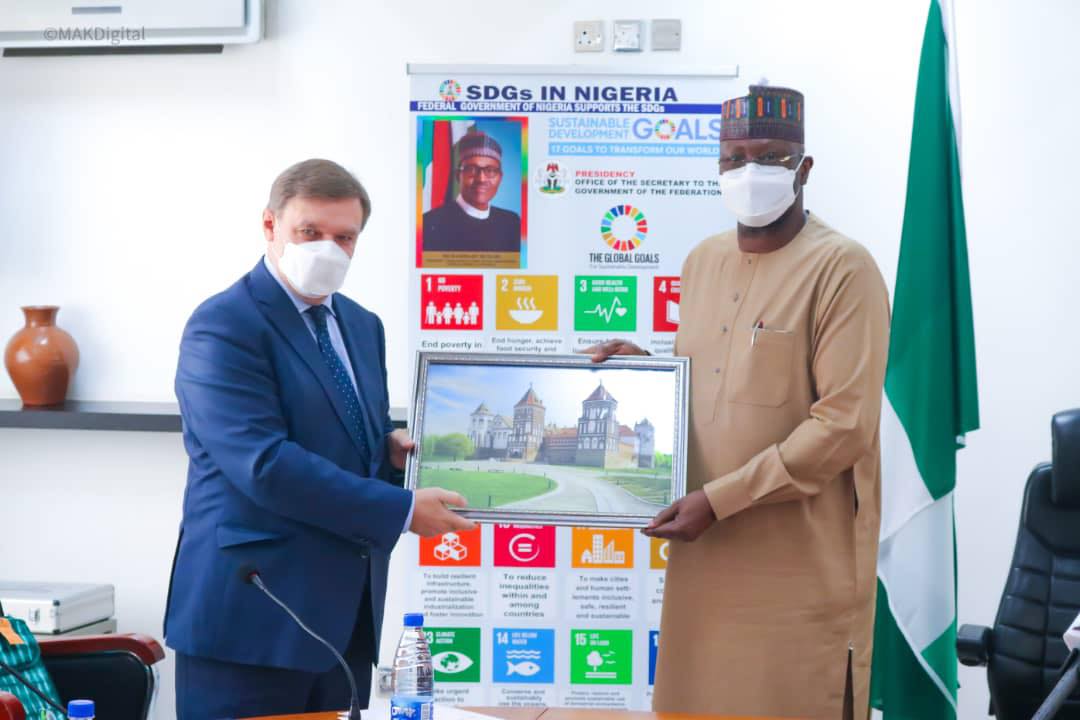
The government of Belarus has offered to support the agricultural mechanization drive of Nigeria, promising to produce tractors that will fit the nation’s specifications.

This request was made by the Ambassador of Belarus to Nigeria, Mr Vyacheslav Bril, during a visit to the Secretary to the Government of the Federation (SGF), Mr Boss Mustapha.

The envoy said his country has a track record in agricultural mechanization, producing 60,000 tractors annually with different modifications, assuring that the federal government of the desire of the landlocked country in Eastern Europe to partner with Nigeria in the area of agriculture, manufacturing, solid minerals, oil and gas, defence and security.

According to him, Belarus is ready to partner with Nigeria to provide the required expertise for sustainable development, noting that through its military-technical cooperation, Nigeria will receive the support of his government in securing modernized ammunitions.

He also assured the federal government that with their gains in the oil and gas industry, they would provide the necessary maintenance and upgrading of refineries to operate optimally.

Responding, Mr Mustapha thanked the diplomat for the visit, affirming Nigeria’s commitment to strengthening its bilateral ties with the Republic of Belarus in order to diversify its economy.

The SGF noted that Nigeria’s long-existing ties with Belarus in the area of trading have not improved and requested the Ambassador to explore means of improving trade relations so as to boost its volume of trade.

“To assure you that slowly but steadily, we will continue to build on this very strong relationship that we believe will be mutually beneficial to Nigeria as a trading partner with Belarus.

“We hope to see improvements in the same as the volume of trade between the two countries have not really increased in the dimension that we want to see over the last couple of years, but we believe that the way you’ve set to engage.

“I can see that since you presented your letters of credence, I think I can see that you’ve begun to engage ministers in cabinet, and you’ve been able to get some visits to Belarus from those ministers. that is the way to go,” Mr Mustapha said.

He commended the government of Belarus on the quality of their products which have received acceptability among Nigerians and promised to seek their support in turning the fortunes of​ the country’s agricultural drive.

The SGF informed the Ambassador of the federal government’s diversification drive and seeks partnership with the Belarusian government on Information and Communication Technology (ICT) as a way forward.

“I believe there are certain areas from which we can begin to partner. in the last two quarters, our digital economy and ICT have contributed immensely to our GDP, which is a clear indication that in as much as we are an oil-dependent country, but we can strongly drive the diversification drive in our economy particularly in the service sector.

“ICT stands out as an area we can partner as a nation. I hope you We have an opportunity with the Minister of Communications and Digital Economy (Mr Isa Pantami) so that you can discuss at length on how we can work together in a particular industry to see how, how you can help institutionalize our developmental efforts in that particular area,” he said.

Mr Mustapha also affirmed that the federal government would like the Belarusian government to partner with the Federal Ministry of Industry, Trade and Investment, Federal Ministry of Youth and Sports Development among others to build institutions that would impact and transfer knowledge on entrepreneurship to our teeming youths.


Aduragbemi Omiyale is a journalist with Business Post Nigeria, who has passion for news writing. In her leisure time, she loves to read.

Click to comment

Leave a Reply

Your email address will not be published. Required fields are marked *

Economy

FG Targets Low-Carbon Growth in Blue Economy

Published

on

marine economy

By Adedapo Adesanya

The federal government has reaffirmed its commitment to climate-responsive and sustainable practices as core pillars for developing Nigeria’s marine and blue economy.

This is contained in a press statement on Tuesday by Mrs Anastasia Ogbonna, Director, Information and Public Relations, Federal Ministry of Marine and Blue Economy.

According to the statement, the Permanent Secretary, Federal Ministry of Marine and Blue Economy (FMMBE), Mrs Fatima Mahmood, made this known while receiving a delegation from Invest International, a Dutch state-owned development finance institution under the Netherlands Ministry of Finance, led by Ms Fenna Zoe Howkamp.

Mrs Mahmood disclosed that the Ministry was actively mainstreaming climate considerations into its policies and programmes, with a sharp focus on reducing carbon footprints, conserving marine ecosystems, and promoting environmentally responsible resource utilisation.

She noted that global attention is increasingly shifting to the sustainable exploration of marine resources, including emerging areas such as marine mining.

According to her, Nigeria is aligning with international best practices to ensure such activities proceed without adverse environmental impact, while safeguarding critical ecosystems such as coral reefs.

She further identified the fisheries subsector as a priority, stressing its critical role in boosting food and nutrition security and creating jobs. While acknowledging Nigeria’s vast marine and freshwater resources, she pointed to significant opportunities for investment and growth within the subsector.

The Permanent Secretary reiterated the Ministry’s openness to strategic partnerships, particularly in port services and marine infrastructure, to unlock the long-term investment required for sustainable development.

She assured the delegation of Nigeria’s readiness to collaborate with international partners to drive innovation, investment, and sustainability in the blue economy.

In her remarks, the Head of Public Finance for Invest International (Southern Africa Region, including Nigeria), Ms Fenna Howkamp, reaffirmed the Netherlands’ commitment to deepening collaboration with the Ministry.

She highlighted the organisation’s expertise in marine and water management and presented specific project proposals, including a coastal protection initiative with an accompanying feasibility study, and nature-based solutions for drainage and water supply systems.

Ms Howkamp underscored the shared interest in developing resilient public infrastructure within the blue economy and expressed readiness to align proposed initiatives with the Ministry’s priority areas.

She also outlined Invest International’s financing options, which include up to 35% funding support for public infrastructure projects valued between €100 million and €150 million.

According to her, such financing could be structured through co-financing arrangements with institutions like the World Bank and the European Investment Bank, or through direct lending to the Ministry.

She called for sustained engagement to formalise feasibility studies and identify partners to advance coastal protection and other blue economy initiatives that promote sustainable, nature-based solutions for Nigeria’s coastal communities.

Continue Reading

Economy

IMF Downgrades Nigeria’s 2026 Growth Forecast to 4.1%

Published

on

Rethink Relationship With IMF Nigeria

By Adedapo Adesanya

The International Monetary Fund (IMF) has downgraded Nigeria’s 2026 growth forecast to 4.1 per cent due to the ripple effect of the Middle East war.

The revision was announced at the IMF and World Bank Spring Meetings in Washington, D.C., where officials warned that war-related energy and supply shocks are undercutting recovery across the region.

IMF Chief Economist, Mr Pierre-Olivier Gourinchas, said the downgrade reflects broader pressures facing energy-importing countries.

“On Sub-Saharan Africa, we are seeing some downgrade of growth, and we are seeing some uptick in inflation in a number of countries in the region,” Mr Gourinchas noted.

“The impact is very much along the lines of what we see more broadly — for a lot of the countries, especially the ones that are energy importers,” he added.

He added that the global lender is “following with a number of countries what their needs may be in the current environment” and coordinating with the International Energy Agency and the World Bank on energy market disruptions.

Speaking further, the Chief of the IMF Research Department’s World Economic Studies Division, Ms Denz Igan, said the 0.3 percentage point cut reflects competing pressures.

“War-related higher fuel and fertiliser prices and higher shipping costs are going to weigh on non-oil activity in Nigeria,” Ms Igan said. “There’s some offset coming from higher oil prices, but the net balance is weaker growth in 2026, with some recovery built in for 2027.”

The IMF also projects that median inflation in Sub-Saharan Africa will rise from 3.4 per cent in 2025 to 5 per cent in 2026, driven by high oil and fertiliser prices, potential fuel shortages, and rising costs.

For Nigeria, she said, a tight monetary policy will be “crucial to achieve the inflation target of the central bank.”

The IMF noted that bilateral aid to Sub-Saharan Africa has fallen by 16 per cent to 20 per cent in 2025, removing a key buffer just as commodity and shipping costs spike.

It said assuming that the ongoing conflict remains limited in duration and scope, global growth is projected to slow to 3.1 per cent in 2026 and 3.2 per cent in 2027.

Global headline inflation is projected to rise modestly in 2026 before resuming its decline in 2027. Slowdown in growth and an increase in inflation are expected to be particularly pronounced in emerging market and developing economies.

The Bretton Woods institution said global inflation is expected to tick up in 2026 and resume its decline in 2027. Pressures are concentrated in emerging markets and developing economies, especially commodity importers with preexisting vulnerabilities. Risks are decisively on the downside.

Continue Reading

Economy

El-Rufai Gets Bail in Ongoing ICPC Corruption Proceedings

Published

on

icpc el rufai

By Adedapo Adesanya

Former Kaduna Governor Nasir Ahmad El-Rufai has been granted bail in the ongoing corruption case filed by the Independent Corrupt Practices and Other Related Offences Commission (ICPC).

However, Mr El-Rufai will remain in ICPC custody until he fulfils all the bail conditions set by the court.

The development was confirmed by his son, Mr Bello El-Rufai, shortly after the ruling.

This comes amid separate proceedings at the Kaduna State High Court, where the ICPC recently amended its charges against the former governor. Mr El-Rufai has pleaded not guilty to the allegations.

The chieftain of the opposition African Democratic Congress (ADC) was arraigned by the ICPC over charges related to alleged corruption and abuse of office during his tenure in the North-Western state from 2015 to 2023. Allegations ranging from abuse of office and fraud to intent to commit fraud and conferring undue advantage were levied against the politician.

The commission disclosed that both charges were instituted on March 18, 2026, as part of its ongoing efforts to enforce accountability and combat corruption.

The scrutiny of Mr El-Rufai by the ICPC follows the report of the Kaduna State House of Assembly’s ad hoc committee constituted in 2024 to investigate finances, loans and contracts awarded between 2015 and 2023 under his eight-year administration of the state.

Presenting the committee’s report during plenary last year, the committee chairman, Mr Henry Zacharia, alleged that most of the loans obtained by the El-Rufai administration within the eight years were not utilised for the purposes for which they were secured.

While receiving the report, the Speaker of the House, Mr Yusuf Dahiru Leman, alleged that about N423 billion was siphoned under the El-Rufai administration, leaving Kaduna State with heavy financial liabilities and a rising debt profile.

The committee recommended the investigation and prosecution of the former governor and several members of his cabinet over alleged abuse of office, award of contracts without due process, diversion of public funds, money laundering and reckless borrowing.

The Assembly subsequently endorsed a petition to the EFCC and the ICPC, urging them to take up the matter.

The embattled former FCT Minister is equally embroiled in a case with the federal government over alleged unlawful interception of the phone communications of the National Security Adviser, Mr Nuhu Ribadu.

Continue Reading

Trending